

-
The Wall of Oblivion: A Calling to the Children of God
A Treatise on the Confusion Satan Has Loosed Upon the Human Race, and the Silence That Has Made Us Complicit
Introduction: The Strange Double Standard of Obedience
There is a strange and revealing double standard buried deep in the conscience of the modern world, and once you see it, you cannot unsee it. Consider this: when a man obeys the laws of the road, when he stops at the red light, signals before he turns, and yields to the pedestrian in the crosswalk, we call him a good citizen. We praise him. We hold him up as the very model of decency and responsibility. No one accuses him of being hateful for refusing to run a stop sign. No one calls him a bigot for buckling his seatbelt. We understand instinctively that the laws of the road exist to protect us, to keep order, to prevent chaos and death on the highways, and so we obey them without complaint and even with a measure of pride.
But the moment a person announces that he intends to obey the laws of God, something snaps in the collective mind of society. Suddenly obedience is no longer a virtue. Suddenly the very same impulse that made the law-abiding driver admirable makes the law-abiding believer despicable. To say that you obey God, that you take His commandments seriously, that you actually intend to live every word written in the Bible, is to invite accusations of hatred, of misogyny, of racism, of sexism, of every ugly thing the human tongue can manufacture. The world will call the Book itself hateful before it will admit that the problem lies in its own unwillingness to read and obey that Book.
This is the contradiction I want to expose at the very outset of this essay, because it is the doorway through which all the other confusions enter. We honor obedience to man's law and we revile obedience to God's law. We will gladly bend our entire lives around the regulations of the state, the demands of our employers, the expectations of our peers, and the fashions of the hour, but we will not bend a single inch for the One who made us. And we have the audacity to call ourselves His children while we do it.
The Bewitching of the Whole Earth
What I have witnessed, traveling and speaking and trying to reach souls, is not ordinary disagreement. It is something that can only be described as a kind of mass enchantment, a paranormal phenomenon with the devil's fingerprints all over it. No matter where I go, no matter when I go, every time I try to speak to someone about the truth of God, I am met with the identical look, the identical recoil, the identical opinion. It is as though one spirit has descended upon the entire human race and given every person the very same instinct: to flinch away from God the moment His name is spoken in earnest.
I cannot remember a time, not in recent memory, when I could speak about God in public and have the conversation reciprocated like any other ordinary topic. Today, to speak openly about God in a public place is treated as something almost obscene, as though you had decided to undress in front of everyone and declare yourself a nudist. The discomfort, the embarrassment, the desire of everyone present to be anywhere else, is exactly the same. That should tell us something. When the mere mention of the Creator produces in people the same horror as public indecency, we are not dealing with reasoned skepticism. We are dealing with a spell.
And everyone seems to hate God in unison. That unison is the tell. Genuine human opinion is messy, varied, and unpredictable. People disagree about everything under the sun. But on this one subject, the truth of God, the human race has achieved a suspicious uniformity. The same scowl, the same dismissiveness, the same rehearsed line about how it is "their truth" and you have "yours." When you see that kind of unnatural agreement spread across every nation, every background, every personality type, you are looking at something that did not arise on its own. You are looking at the work of an enemy who has bewitched the whole earth.
Assessing the Situation Honestly
Let us begin to assess this entire situation with clear eyes, because clarity is the first casualty of the spell that has fallen over us. Here is the chain of reasoning, laid out plainly:
We are not hearing from God. That is the starting fact, and almost everyone, if they are honest, will admit it. The heavens feel silent. Prayers go up and nothing seems to come down. People cry out in their suffering and the answer does not arrive.
But why are we not hearing from God? We are not hearing from Him because we will not obey Him. And we will not obey Him because we have enthroned a single phrase above His entire law: "my body, my choice." That phrase, harmless as it sounds, is in truth a declaration of independence from the Creator. It says: I will do what I want with what He gave me, and He has no say in the matter. It is the very serpent's promise repeated in modern language.
So we commit, day after day, the kinds of crimes for which the Bible shows there is very limited mercy. And then, when the consequences of those crimes finally materialize, when the disease comes, when the marriage shatters, when the body that we insisted was ours alone is suddenly seized by forces we cannot command, we have the breathtaking audacity to look up and say, "There is no God."
But notice when that phrase actually escapes our lips. It only comes out when our most inner being is fully, painfully aware that the reason we are not hearing from God is our own inability to change out of our sins and into holiness. The denial of God is never the calm conclusion of a philosopher. It is the panicked cry of a guilty conscience that knows the truth and cannot bear it.
The War Between the Inner and the Outer Being
There is a part of us, the deepest part, that always knows there is a God. This knowledge is not earned and it cannot be erased. It was placed there. But there is another part of us, the outermost being, the part that loves the world and craves its pleasures, and this outer being is the one responsible for angering God after the inner being has already acknowledged Him.
Here is how the tragedy unfolds inside a single human soul. The inner being, in a quiet moment, admits: yes, He is real, and yes, I ought to obey. But the outer being, which is always going to want to sin, will not allow the change into holiness to take place. It vetoes the verdict of the conscience. It overrules what the heart already knows. And so the person walks through life with a divided self, an inner being that believes and an outer being that rebels, and the rebellion of the outer being is what keeps the whole person locked out of the presence of God.
This is why so many can say, almost in the same breath, "I believe in God" and "I will not do what He says." They are not lying about the first statement. The inner being truly does believe. But they are governed by the second, because the outer being has the controls, and the outer being will always vote for the flesh. Until that war is settled, until the inner being's knowledge is allowed to conquer the outer being's appetite, there can be no relationship with the Lord at all.
The Recoil That Exposes Everything
Now I want to speak directly to the great revealing test, the one that, more than any argument, exposes the true condition of a person's soul. It is the recoil.
No matter where I go or when I go, every time I try talking to someone about the truth of God, they all give me the same look, the same opinion, the same everything. And this universal reaction, this collective decision of the whole world to feel exactly this way about God and the truth of God, really does expose the entire religious aspect of our existence. Because here is the question that the recoil forces upon us: how can you walk around calling yourself a child of God, and yet when I try to talk to you about God and the biblical truth, you recoil? That recoil should tell you something. It should tell you everything about your relationship with God.
Ask yourself this honestly. If there are people who call themselves the children of God, exactly as you do, but you will not believe what they believe, then which one of you is right about the whole thing? You cannot both be correct. You cannot have all the supposed children of God believing contradictory things and still all arrive at the same heaven. One of you has the truth and one of you has a counterfeit, and the recoil is the symptom that helps us tell them apart. The one who has the truth does not flinch from the Book. The one who flinches from the Book is announcing, whether he means to or not, exactly where he stands with the Lord.
I am calling the whole world not to ignore this fact. If you are truly a child of God, then why are you not even able to listen, let alone believe, what I am telling you? The fact that you only recoil at what I am saying says a great deal about where you stand with the Lord. You cannot have all the children of God believing different things and still go to the same heaven. It is not possible. It is a logical impossibility before it is even a spiritual one.
Believing Lies About a Friend
Let me put this in terms that anyone can understand, because the spiritual principle is identical to a principle we all already know in our everyday lives. You cannot believe nonsense about one of your friends and still expect your relationship with that person to be as good as the relationships that person has with people who refuse to believe the nonsense.
Think about it carefully. If you choose to believe lies about a friend, then you will treat that friend in a manner that complements the lies you have chosen to believe. You will be cold where you should be warm. You will be suspicious where you should be trusting. You will withhold yourself, guard yourself, and quietly wound that friend over and over, all because you believed a story about them that was never true. You will hurt your friend very badly, and the worst part is that you will feel justified the entire time, because in your own mind you are only responding to what you believe to be real.
Just look at the image of the person I am describing. Picture the kind of human being who hears a rumor and immediately treats a faithful friend as an enemy. Sad, is it not? You have to be a truly sad and worthless human being to believe lies without checking the information out first. These are the kinds of people who enjoy gossip, who love to cause trouble, who would rather repeat a juicy lie than verify a sober truth. And that, I am sorry to say, pretty much describes the entire human race today when it comes to the way they handle the character of God.
This is exactly how we approach the word of God. This is exactly how we approach a relationship with God. We live by, and believe, things about our God that, had we believed them about a human friend, would have gotten us labeled narcissistic and abandoned forever. The treatment we casually hand out to the Almighty is the kind of treatment that, applied to an ordinary person, would land that person in therapy. We say and do things about God that we would never dream of saying or doing to one another, because at least with one another there are consequences, and with God we have convinced ourselves there are none.
Making Up the Rules As We Go
No one ever stops to think about what they actually believe when it comes to God. People simply choose to believe anything they wish, and then they expect God to honor their invention. They will disobey every law in the Bible and then expect God to accept all of their made-up, evil, narcissistic notions about who He is and what He wants. These days God is pretty much whatever people say He is, with no contradictions allowed, no correction permitted, no appeal to the actual text tolerated.
People spew lies about God with total impunity. They make statements completely divorced from the biblical text, comments that go directly against God's revealed nature and against the limits of His mercy, and they suffer no social penalty whatsoever. In fact they are applauded for it. The man who invents a soft, permissive, indulgent god who asks nothing and forgives everything regardless of repentance is celebrated as enlightened and loving. The woman who insists that God actually meant what He wrote is treated as a fanatic.
This is like sitting down to a board game and making up your own rules as you go along, changing them whenever you are about to lose, declaring new exceptions whenever the existing rules would cost you something. It might be amusing in a board game, but life is not a board game. Life is very serious. Life is the most serious thing there is, because the stakes are eternal. And yet this is exactly how people choose to treat it, as though it were a total joke, as though they could rewrite the rules of their own salvation and the Author of those rules would simply nod along.
The People Who Recoil and Still Call Themselves Saved
Now I come to the heart of this essay, to the people I most want to describe, because their condition is the great riddle of our age. These are the people who are living and believing lies about God, who recoil at the truth the instant it is spoken, and who nevertheless continue to call themselves the children of God with absolutely no evidence of the same.
Look at their lives and you will find no fruit of obedience anywhere. You will find them perpetually physically ill, sick with one thing after another, and yet never once connecting the sickness to the lifestyle, never once changing the beliefs or the behavior that produced it. You will find them carefully, almost instinctively, avoiding the only book in the world that condemns the way they live. They will read self-help books, horoscopes, novels, the endless scroll of opinion online, anything and everything, but the one Book that would actually diagnose their condition they leave shut on the shelf, because some part of them knows what it would say.
And here is the most upside-down part of the whole arrangement, the inversion that proves the spell is real. These people who recoil at the word of God genuinely believe that they are saved, and they believe that the people who actually obey the word of God are the ones going to hell. There is this sick, settled understanding among the children of the world that they do not have to believe in the word of God to go to heaven, but that the people who do believe in the word of God, and who order their entire lives around it, are the ones headed for destruction. The obedient are pitied. The disobedient feel secure.
I see it in my own family. My siblings believe that their Christmas trees, and everything else God never permitted, somehow make them saved. And I, who follow every law in the Bible to the best of my ability, am regarded by them as the one who is lost. They feel that they need to save me. Imagine that. The ones decorating the golden tree feel burdened to rescue the one who refuses to bow to it. This is the new mentality of the world today. This is precisely the confusion the Bible warned us about, and it is only one of many confusions that satan unleashes, and unleashes with terrible success.
The Pigsty of Confusion
Picture a pigsty. Picture the pigs lying in it, content, well-fed, utterly at ease, wallowing in filth that they have long since stopped noticing because it is the only environment they have ever known. The filth does not trouble them. They do not look up and wonder whether there is cleaner ground somewhere. They are at home in the muck.
That is the image I am forced to use to describe the confusion that satan has the entire human race wallowing in. It is not a confusion that torments people, at least not on the surface. It is a comfortable confusion, a confusion people have learned to enjoy, a confusion that feels like freedom. The whole world lies down in it together and calls it peace.
And the genius of this particular filth is that it disguises itself as cleanliness. The person who is the most thoroughly confused, the most completely deceived about God, is often the most certain that he sees clearly. He is sure he is enlightened. He is sure the believer is the deluded one. The pig in the sty looks at the creature standing on clean ground and feels sorry for it, because the clean ground looks so bare, so lonely, so lacking in the warm familiar muck that the pig has learned to love.
This is why the confusion is so durable. People will not climb out of it, because they do not believe they are in it. They have been persuaded that the sty is the world and the world is the sty, that there is nowhere else and nothing else, and that anyone who claims otherwise is either lying or mad. So they settle deeper into the filth, and they grow indignant at the one who points out the smell.
The Wall That Hides Them From the Truth
How is it that human beings can stand so near to such terrible danger and feel nothing? How can people who are surrounded by collapse, by disease, by the visible disintegration of every human institution, look upon the truth of God without the slightest tremor of fear? The answer is that they have built a wall.
It is an incredibly strong, incredibly thick brick wall, and it stands between every person and the truth of God, preventing them from truly feeling the terror and the danger of what is coming if we do not obey. We built this wall ourselves, but we built it out of an unlikely material. We built it out of the silence of God.
Here is how the wall was constructed, brick by brick. God, in His patience, does not punish us the instant we sin. The lightning does not fall. The ground does not open. We sin on Monday and we are still alive and comfortable on Tuesday, and we sin again, and still nothing happens. At the same time, our prayers go unanswered, because He does not hear the prayers of the unrighteous, and so we conclude from the silence that no one is listening at all. His refusal to punish us in the moment, combined with His refusal to answer the prayers of the disobedient, has been misread by the whole human race as evidence that He is either absent or indifferent. And out of that misreading we have built our wall.
It is a wall of absolute oblivion, and people hide behind it whenever the truth of God approaches and becomes a threat. The moment a conversation turns serious, the moment someone like me begins to press the claims of the Book, they retreat behind the wall, where they do not have to take responsibility for their unholy actions. From behind that wall they call out the magic words that excuse everything: "It is my life and so it is my choice." The wall lets them ignore the glaring contradiction between claiming to be saved, claiming to be heaven-bound, while despising the actual words written in the Bible.
It is precisely this contradiction that people love to ignore, and they expect everyone around them to respect their ignoring of it. They want to hold two opposite things at once, to keep their seat in heaven and their sin on earth, and they want no one to point out that the two cannot be held together. The wall makes this possible. The wall is the most popular structure on earth.
Why No One Wants the Mystery Solved
There is a question that ought to haunt every thinking person: why are there so many religions on earth? If there is one God, one truth, one heaven, why does humanity fracture into a thousand competing faiths, each certain of itself, each contradicting the others? You would think that a question of such enormous importance, a question on which our eternal destiny depends, would be the single most urgently pursued question in all of human life.
But it is not. And the reason it is not is the most damning thing of all. No one wants the mystery of why there are so many religions on earth to be solved, because people are subconsciously, fully aware that finding out the truth means conforming to that truth. To discover the one true faith is to incur the obligation to live it. And since living it would cost them the sins they love, they would rather the question remain forever open, forever debated, forever unresolved.
So everyone secretly loves all this religious nonsense. The endless variety of contradictory beliefs is not a frustration to the worldly soul; it is a comfort. It keeps them oblivious. It keeps them confused. It gives them permanent cover, because as long as no one can say for certain which path is right, no one can be blamed for choosing the wrong one. The very confusion that the Bible commands us to flee, the confusion God explicitly tells us to make sure we are not trapped in, is the confusion that the world clutches to its chest like a security blanket, precisely because confusion is the perfect excuse for disobedience.
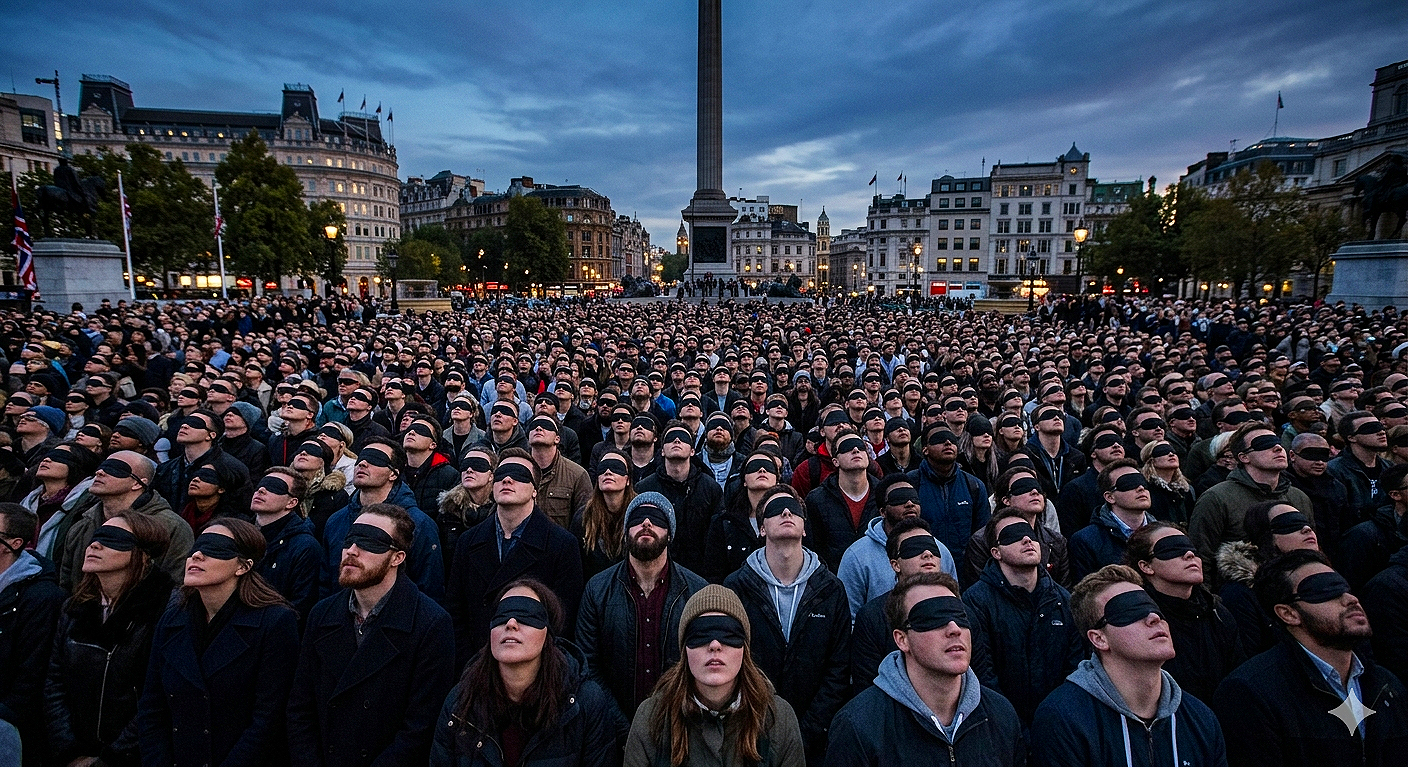
It always strikes me with a strange intensity, an almost electric awareness of how real all of this is, whenever I consider that everyone who refuses to accept the truth is living in this blindfolded oblivion for one reason and one reason only: so that they do not have to obey the Bible. Every elaborate argument, every appeal to tolerance, every shrug about different paths up the same mountain, traces back to that single root. They do not refuse the truth because they have examined it and found it wanting. They refuse it because they have sensed what it would demand, and they have decided the demand is too high.
The Sin of Silence
Now I must turn the mirror upon those of us who claim to be the true children of God, because we are not innocent in this catastrophe. There is a sin we have been committing, quietly, continually, and it is the sin of silence.
We who have had the scales removed from our eyes face a terrible difficulty, and I will not pretend otherwise. We do not want to be social pariahs. We do not want to be the strange ones, the unwelcome ones, the people whose presence makes every room go cold. We are human, and the desire to belong is woven deeply into us. But at the very same time, we are not permitted to keep our silence about sin whenever we see it. We are caught between two pressures, the pressure of the world that wants us to shut up, and the pressure of the Lord who commands us to speak.
The world has a saying that it applies to terrorism and crime: "When you see something, say something." Everyone understands and approves of this principle in that context. If you see a suspicious package, you report it. If you see a child in danger, you intervene. To stay silent in those situations would be a kind of complicity, and everyone knows it. But because the world does not recognize the law of the Bible as the law of man, no one understands the importance of saying something when you see someone living in sin. The same principle that everyone applauds in every other arena, they reject the instant it is applied to the spiritual life. They cannot grasp that a soul living in sin is in greater danger than a person standing next to an unattended bag, because the danger to the soul is eternal.
This silence that the children of God have been exercising is itself unholy. We are not allowed to keep our silence like this. We comfort ourselves that we are only being polite, only being respectful, only keeping the peace, but in truth we are afraid, afraid of becoming outcasts in our own societies, and we have dressed up our cowardice as courtesy. And so both groups have been sinning at the same time, in different ways. The children of the world have been sinning through their disobedience, and the children of God have been sinning through their silence. The disobedient and the silent are both guilty, just of different offenses.
And here is the hard truth that I cannot soften: keeping your silence is the same as committing the sin yourself. When you watch a brother or sister walking off a cliff and you say nothing, because you are afraid of how it will look, you have not kept your hands clean. You have joined them in their fall. Your silence is your participation. The blood is on you as surely as it is on them.
Why It Is Now Urgent to Speak Up About Sin
I want to explain why this is no longer a matter we can put off, why the obligation to speak has become urgent in a way it perhaps was not in calmer times. We are living in a time when everything around us is falling apart, and it is falling apart for one reason: our God is no longer on our side. We have removed Him. We have built the wall, embraced the confusion, and driven Him out, and the consequences are now arriving on schedule.
The diseases are only going to get worse and worse as sin gets more and more prevalent. This is not pessimism; it is observation joined to principle. Sickness in the body follows sin in the soul the way effect follows cause, and as the sin multiplies, so will the affliction. And it is not going to end where we imagine it will end. Sin is not going to find its own brakes, its own natural stopping point, simply because we have decided that everyone is finally free to live however they please. That is the great delusion, that we can open every gate and the flood will somehow politely stop at a level we find acceptable.
It will not. The very same force of destruction that told us it was acceptable to remarry after divorce is the same force of destruction that is now coming to dismantle every remaining aspect of human decency and human organization. People imagine that the corruption has a ceiling, that there is some line so obvious that even the devil would not cross it. They are wrong, and the error is dangerous.
The Trickle-Down of One Sin to the Next
Do you think homosexuality is where the devil draws his line in the sand for himself? How naive that hope is. No. Satan is not going to stop there, and he is not going to stop anywhere, until everything we call human organization lies in ruins. Each sin that is permitted does not satisfy the appetite; it enlarges it. Each barrier that falls does not protect the next barrier; it exposes it. This is the trickle-down logic of evil: allow one sin, and the next sin follows, and the one after that, with no true adult supervision left anywhere to halt the slide.
Watch how it has already happened in the matter of our children, which to me is the darkest evidence of all. I have never seen so many female teachers getting down with their young students, having sex with them, grooming them, abusing the very trust that is supposed to be most sacred. Twenty years ago there was perhaps one such case, maybe two, and when they happened they were enormous scandals, famous precisely because they were so rare and so shocking. Today it is so normal that judges do not even bother handing down long sentences anymore. Some of these offenders walk away with probation. Probation, for a crime against a child.
This did not used to happen when I was young in the 1990s. This is something that has been unleashed upon our children in just the last twenty years, and it has been unleashed because the adults cannot get it together, or, more honestly, will not get it together. We removed the restraints, one by one, congratulating ourselves on our broad-mindedness, and now the predators move freely through the gap we opened, and we are surprised. We should not be surprised. We were warned that one allowance leads to the next, and we did not listen.
It is only going to get worse for humanity now that we have allowed this much sin, and especially given the kind of sin we have allowed and legalized. These are sins for which the Bible shows us God has very little mercy. We did not merely loosen the rules around minor matters; we trampled directly on the offenses He treats most severely, and we did it openly, proudly, with parades and applause. And still it does not seem to bother anyone, because everyone on earth has that incredibly strong brick wall standing between them and the truth of God, the wall that prevents them from truly feeling the terror and danger of what is to come if we do not obey.
The Price of Sin Written on the Body
For years I used to watch the videos online, the ones where people document their journeys through incurable disease, and I would weep for them. I would feel such sorrow, such helplessness, even though I already understood the root of why they were suffering, which is sin. But something shifted in me after I tried, again and again, to speak to people about their sins, to explain to them gently why they were actually sick, and was met every single time with angry disbelief and immovable stubbornness, with no chance whatsoever of any change. After enough of that, I came to a realization that has stayed with me ever since.
The real trouble is not that we cannot find the cure for cancer. The real trouble is that no one wants to hear our Creator telling us why we are all sick. We have framed the entire problem backwards. We treat sickness as a puzzle of chemistry and biology that simply has not yet been solved, when in truth it is a message of judgment that we refuse to read. I now watch those same videos understanding that what I am actually seeing is the price of sin made visible in the flesh.
These suffering people cannot explain to you why they are sick. Even though they believe, somewhere inside, that there is a powerful God who has control over every disease on earth, control enough that they grow angry at Him for allowing it, not one of them has ever actually asked Him the real question. Not one has knelt down and said, "What is it that we are doing that is causing You to allow all these fatal, incurable diseases?" If they did ask, and if they were willing to hear, they would discover an angry God whose only remaining means of communication with the human race has become these very diseases, because we have refused Him every other means. The one form of communication He actually wants is absolute obedience to His Word, and that is the one form we will not give Him. So He speaks in the only language we have left Him.
Cells That Obey Their Instruction
Let me show you something that I find almost unbearably clear, something that turned my understanding of the human body into an act of worship. Your bodily cells contain an instruction, a set of commands written into what we call DNA, and your cells obey that instruction faithfully, ceaselessly, without complaint. That obedience is the only reason you are alive at this moment. Every breath, every heartbeat, every healing wound is the fruit of trillions of tiny obediences happening inside you right now.
But consider what happens when a cell stops obeying its instruction. When a single cell breaks from its commanded pattern and begins to do what it wants, multiplying without restraint, refusing the limits written into it, we have a name for the result. We call it cancer. Cancer is, at its very root, a cell in a state of disobedience. A cell that has decided, in the only way a cell can decide, that it is its own body and its own choice.
Now draw the line all the way out. If a single cell disobeying its instruction produces something as devastating as cancer in the body, what do you imagine happens when an entire human being disobeys his instruction? We marvel at the catastrophe when our cells rebel, and we pour billions into reversing it, but we cannot see that we ourselves are doing to God exactly what the cancer cell does to us. We want our cells to obey their instruction so that we may continue to enjoy the bodies God designed, and at the very same moment we have absolutely no intention of obeying our own instruction, the law God wrote for us. The hypocrisy is total. We demand from our cells the precise obedience that we refuse to give our Creator.
If our cells obeyed their instruction as badly as we obey ours, there would be no human race left on this earth. That is not an exaggeration. Our continued existence depends entirely on a faithfulness at the cellular level that we will not imitate at the level of the soul. Every plague, every virus, every cancer is, in a sense, a small preview of what total disobedience produces, a glimpse of the end that waits when rebellion is allowed to run without limit.
The Folly of Playing God
There is a whole industry built upon refusing to hear the Creator's voice, and we call it science. I want to be careful and precise here, because the issue is not knowledge itself; the issue is the posture of the heart behind the knowledge. What I have come to see is that so much of what passes for science today is simply a vast effort by God-denying minds to take His place, to figure out on their own what He would gladly have told them, if only they would obey Him and listen.
Picture it. The silence from above, the silence that we ourselves created by our disobedience, is the very reason the world is filled with science labs. Because people do not know how to hear the voice of their Creator, they decided He must not exist, and having decided He does not exist, they concluded that they would have to work everything out alone. Completely void of biblical knowledge, they never realized that all they had to do was open the Book, conform their lives to its commands, and let God speak. Instead they study things on a scale so minute that the effort is almost useless, trying to force the cells of the body to obey their instruction while the people themselves have no intention of obeying their own.
There is a bitter irony in it. We agree that what God made is wonderful, so wonderful that we want our cells to keep obeying their instruction forever so that we may go on enjoying His creation. We will fight tooth and nail to make a rebellious cell fall back into line. But it never occurs to us that we too were given a book of rules, that perhaps all these diseases are in some measure our own fault, that we are reaping the effect of a cause we set in motion. We accept cause and effect in every other domain of life, yet we cannot accept that our suffering might be the effect of our own sin, and you would be shouted down for even suggesting it. To unleash every cure now, while the human race goes on sinning, would be irresponsible, because a cure without repentance is not the end of suffering. It is merely a second chance. And how can a second chance mean anything to a man who has no intention of giving up the thing that is killing him?
The Stolen Blueprint
I want to offer a picture that finally made sense to me of why even the holy suffer, why people who genuinely try to obey still fall ill, because this is one of the hardest objections anyone can raise, and it deserves an honest answer. Imagine that I created something powerful and wonderful, something you wanted so badly that you finally succeeded in stealing it from me. And imagine that, even after the theft, I remained your friend and kept on being a blessing to you. But here is the catch: when the thing you stole begins to break down, it is no longer in my possession for me to repair. You have taken it into your own hands. For me to fix it now, you would have to invite me back in, and you would have to do exactly what I tell you.
That is precisely the situation of the human race. In the Garden, we stole the blueprint of the human design. We grasped at the knowledge that was meant to stay in God's keeping, and the serpent's promise was, in a horrible sense, fulfilled. We took the design into our own possession. And so now, when the human body breaks down, we cannot simply hand it back to the Maker for repair as we once could, because we are no longer in the Garden, no longer under that direct and constant care. What God did instead was leave us a book of instructions, a manual explaining how to maintain the design we seized, and when we refuse to follow those instructions, the design we stole breaks down, because the One who built it is no longer the one in charge of it. We are.
This is why a person can obey God in the matters of conduct and still fall ill, if at the same time they bow to idols, if they keep the man-made holidays, if they decorate the tree and feast at the appointed festivals that God never sanctioned. Obedience cannot be partial. You may refuse to justify sin in your behavior and still be undone by the idolatry of the calendar, because the body and the relationship with God, though they are now two separate things since the Garden, still affect one another profoundly. The blueprint is in our hands, and the instructions are in the Book, and we cannot pick and choose which pages of the manual we will honor and expect the machine to keep running.
James 2:10 and the Impossibility of Being Half-Saved
This brings me to one of the most important truths in all of Scripture, and one of the most ignored. In James 2:10 it is written: "For whosoever shall keep the whole law, and yet offend in one point, he is guilty of all." Sit with the weight of that. It does not say that the one who offends in one point has done well in the others and will be graded on a curve. It says he is guilty of all. One breach makes him a lawbreaker entirely.
To me, a human being who justifies disobeying any part of the Bible while carefully obeying other parts is either a chameleon or a creature of diminished sense. You cannot be only half saved. You are either completely saved or completely condemned. When a fireman runs into a burning building to rescue you, he does not save half of you and leave the other half to burn. He saves all of you, or he does not save you at all. When God made you, He did not make you half alive. And He has not promised you half of heaven.
Yet half-salvation is the most fashionable doctrine of our day. People assemble a private religion out of the parts of the Bible that cost them nothing and quietly discard the parts that would require sacrifice. They will be kind, perhaps, because kindness is pleasant and costs little, and they will tell themselves that kindness alone will carry them through the gates. This is the new religion of inappropriate kindness, the belief that as long as you are nice to everyone you will go to heaven, no matter what condition your soul or your obedience is in. But God did not give us a single law and call it kindness. He gave us a whole law, and James tells us that to break it in one point is to break it in all.
The Lie That God Does Not Care About the Outer Appearance
One of the most stubborn lies of all is the claim that God does not care about your outer appearance, that He looks only on the heart and is utterly indifferent to what you do with the body He gave you. People love this lie because it frees them from the most visible and the most easily corrected forms of obedience. But it is a lie, and a tragic one, and I want to dismantle it.
If God created your outer appearance, why on earth would you assume He does not care about what He created? Consider the most ordinary human example. If you came upon a filthy, neglected child, ragged and unwashed, looking as though no one had ever cared what became of him, while his parents stood nearby clean and well put together, what would you conclude? You would conclude that the parents had failed in their most basic duty, and you would be right to. We all understand, instinctively, that it is the parent's responsibility to look after the child's every need, including how the child appears to the world.
So when God tells you what to wear and what not to wear, He is doing exactly what a good parent does. He is your Maker, your Father, the One responsible for your every need, and He is exercising that responsibility down to the details of your appearance. To suggest that the God who designed your outer self would then turn away in indifference from that same outer self is not only sad, it does not even make sense. I would be heartbroken if my God were not looking out for my outer state. The lie that He does not is meant to sound liberating, but it is actually the disinheritance of a child who has been told his Father does not care how he looks. No loving parent is indifferent to that, and neither is He.
Modesty That Never Changes, Fashion That Always Does
God told us to dress modestly, not fashionably, and the distinction is everything. According to common definition, apparel means the whole category of fashion, the dresses and pants and tops and accessories, all of it organized around the changing tides of style. And fashion, by its very nature, never stops shifting. What is appropriate this season would have scandalized people a few years ago, and what would land you in jail one year is paraded down the street the next. Fashion has no fixed point. It is a current that carries you wherever the culture happens to be flowing.
Modesty is the opposite. Modesty does not change. It is anchored, steady, the same in every generation, just like our Creator who is forever faithful to His promises. This is why God commanded modesty and not fashion. He did not tie our obedience to a moving target, because a moving target cannot be obeyed; it can only be chased. He gave us something permanent to stand on. And the permanence of modesty is itself a reflection of His own unchanging character. When we abandon modesty for fashion, we are not merely changing our clothes; we are trading the eternal for the temporary, the faithful for the fickle.
This is why the adorning of the body with gold and apparel, the painting of the face, the perpetual rearranging of oneself to match the season's demands, is not a small matter. It is a declaration of allegiance. It announces that we have chosen the world's ever-shifting standard over God's settled one. And every excuse we make to keep it, the forgotten head covering, the bracelet slipped on as a joke, the arms left bare because we were preoccupied, exposes how lightly we hold the One we claim to serve. We women know perfectly well how to be diligent about our appearance when we are dressing for a man's approval. The makeup that smudges is fixed in an instant; we fly to the mirror. But for God, somehow, we cannot summon the same energy. We do not find Him important enough to look for Him the way He has asked to be looked for, though we will spend hours assembling ourselves for someone whose opinion will not follow us past the grave.
The Lesson God Meant Us to Take From Jezebel
When God describes a person the way He describes Jezebel, He is not telling a bedtime story for our entertainment. He means for us to take the example to heart. Notice the detail He chose to record, the detail He preserved across the centuries: she was painted. Notice, too, the exact word. God did not say she was wearing makeup. He said she painted herself. He chose the word painting, and the choice was deliberate.
What He meant to communicate, by selecting that word and attaching it to a figure of such judgment, is that any and all painting of the face is displeasing to Him. He was not naming a particular cosmetic or a particular fashion of a particular era. He was naming the act itself, the painting, and He preserved it as a permanent warning. This is the kind of careful reading the Book requires and almost never receives. People skim past Jezebel as a villain in a tale, never asking why God bothered to mention the paint, never realizing that the mention was the lesson.
And here is something that struck me as I considered it not only as a believer but almost as a scientist would. If we are made in His image, and if He is displeased with the painting of our faces, then it stands to reason that our very cells would not benefit from it either. By forbidding us to paint ourselves with any paint, He was, among other things, protecting the body He designed. We all know how toxic paint is, no matter how gentle the label claims it to be. God knew it long before any laboratory measured it. So the command that the world dismisses as petty vanity-policing is in fact an act of protection from a Father who understood the chemistry of His own creation better than we ever will. I once caught a fragment of a documentary in which researchers were discussing new findings that the application of cosmetics could activate cancerous cells in the body. I never had the chance to follow the research further, but hearing it gave me that cold feeling in the knees, the feeling you get when you see the lights flashing behind you, because it was simply the confirmation of what the Book had said all along.
Taking the Word Out of Context
People are masters at taking little pieces of the Bible and bending them to fit their narrative, lifting the Word completely out of its setting to license the very thing it forbids. The favorite verse for this maneuver is the one about God looking on the heart. People wield it like a permission slip: God only looks inside the heart, they say, so the outside does not matter.
But that is not what the verse means, and to use it that way is to make the whole Bible contradict itself. When the Lord told the prophet not to judge by the outward appearance in the selection of king David, He was correcting the prophet's instinct to choose by height and impressive stature. He was pointing to David's pure heart, the place where God Himself dwelt, as the source of David's true strength. He was not issuing a universal decree that appearance is irrelevant and that you may therefore adorn and paint and dress however the flesh desires. To read it that way is to take a statement made for one purpose, in one moment, about one decision, and drag it into a completely different context to win an argument it was never part of.
It reminds me of a scheme I once heard about, where a marketing company would call businesses, ask strange questions, and record the calls, then splice the recordings, inserting different questions, until it sounded as though the person had agreed to a binding year-long contract they never consented to. Infuriating, is it not? But that is exactly what people do with the Bible. They record a fragment, cut it loose from its true context, and replay it to make God appear to have said something He never said. And then they hold their forged contract up as proof, expecting everyone to honor a consent that was never given.
The fuller truth is that God called the human heart wicked. The very reason He told us to concern ourselves with the heart is that He wanted to expose how corrupt the heart of the whole human race truly is. And right beneath the verse people love to quote, there is more, instruction about what we are to do with our bodies in order to begin the work on those wicked hearts. If we drape ourselves in gold and apparel, our hearts only grow more wicked. The command about the heart was never a license to neglect the body; it was the doorway into a discipline that includes the body, because what we do with the outer self shapes the condition of the inner self.
The Idols of the Calendar
I must now speak plainly about the idols, because this is where even the people who try hardest to obey still stumble, and it is the very thing that keeps the holy among us suffering alongside the rest. The most blasphemous habit of our age is the habit of adding to the Bible the very thing God told us never to add. We invent observances He never authorized, attach His name to them, and then act on them as though He had commanded them Himself.
Consider the invention of a human birthday for God. The Bible never makes a fuss about the birth of Jesus as an annual festival, never instructs us to mark it, never hints that we should decorate and feast and exchange gifts in its name. And yet the whole world burns incense, so to speak, to this human creation. People decorate, they feast, they spend the last of their money on electricity to light up the decorations, and each of these observances comes complete with its own feast menu and its own mascots, often many mascots. A friend of mine who lived in open sin once said to me, "I'd think God would be happy we're celebrating His birthday." But consider what actually happens. People get drunk for this day. And the gifts? They do not give those gifts to God; they give them to one another, and even then most people both give and get, keeping a careful ledger of exchange. To give gifts to each other on what you claim to be the Savior's birthday, while He receives nothing but the disobedience of the whole performance, is despicable in His eyes. And the economy swells on the strength of it, taking a great boost from the season, which tells you whose interests are really being served.
Do you genuinely believe that celebrating a birthday you yourself invented will make up for all the crimes you commit against the Lord throughout the year? You did not merely invent this observance; you take an entire day out of your year to keep it. You write songs for it. You set out food for it, an ungodly multitude of turkeys and feasts for one occasion or another, and then you sit down and eat the very food you pretended to offer. This is the pattern of the calendar, one invented festival after another, each draining the heart's devotion away from the actual commands of God and pouring it into a celebration He never asked for. The Book warns us against adding to the Word, and warns that to those who add, God will add misery. There is an awful lot of adding going on across the whole earth, and the misery is arriving on schedule.
What grieves me most about these idols is how they reach for our children. We are no longer bringing our children to our Creator. We are dressing them up in the colors of the idol, standing them in front of the golden tree, and teaching them to sing songs they do not understand. The thing that should be teaching them the fear of the Lord is teaching them instead to delight in what He forbids, and we call it innocence. There is nothing innocent about training a child to love an idol.
The Cross Around the Neck
There is a companion to the idolatry of the calendar, and it is the idolatry of the ornament that pretends to be devotion. People find obedience to the Word too difficult, and you can read that difficulty in their faces and their clothing, so they reach for a substitute. They hang a great cross around the neck, imagining that the symbol will make up for the substance, that the jewelry of faith will excuse the absence of faith's obedience.
But the Bible has already named this exact maneuver. "They love me with their lips, but their hearts are far from me." The cross worn as decoration, while every law is broken beneath it, is the lips loving God while the heart has wandered off entirely. It is the appearance of nearness covering the reality of distance. And the more elaborate the ornament, the larger the cross, the more designer the clothing draped around it, the more it tends to signal not devotion but its opposite: a person dressed in every disobedience, hoping that one conspicuous symbol will distract God and man from all the rest.
I confess I am fascinated, in a sorrowful way, by the truly confident ones, the ones who believe themselves so highly educated and refined, the high heels, the designer bag, the designer clothes, every detail of the outfit a quiet rebellion against the Word, and I think to myself: ruthless, disobedient, entirely unwilling to listen. It is not that such people lack intelligence. It is that intelligence, untethered from obedience, becomes only a more sophisticated instrument of self-justification. They can construct a defense of anything. What they cannot do is bow.
The Bible Is Not Up for Debate
I have stood like a deer caught in headlights while a friend debated and debated the Bible, a Book she had never read, every one of my beliefs met with reflexive argument. Had I been telling her about any other book, she would have accepted everything as simply a different point of view, an interesting perspective, nothing to fight about. But something about the Book of Life ruffles everyone's feathers. It is the strangest paranormal phenomenon I know, this thing that happens when you try to feed the Word of God to an ungodly soul. It is as though there is a dark force standing between the lost soul and the Word of truth, guarding its property ruthlessly, allowing no entry.
And I have come to a firm conclusion about the impulse to debate. To me, a person who wishes to debate the Bible before living the truth in it is not operating in his full mental capacity. To be so clueless as to live in any form of biblical disobedience is, by itself, enough for me to consider someone mentally deficient. But to then proceed to debate what one knows almost nothing of, having never lived a page of it, is to be a human being shamelessly void of all common sense.
Here is what no one seems to grasp: the Bible is not up for debate. It is the Book of truth, which is exactly why people living a lie have no standing to debate it. The truth is a straight line. If you want to truly understand it, you must live it in order to believe it. You cannot get to know a person merely by hearing about them endlessly from a distance; you have to live with them to know them as you wish to be known. It is the same with the Word. The one who has lived it knows it from the inside, and the one who only argues about it from the outside knows nothing, however loudly he argues. And it is always the loud ones, I have noticed, who are wrong, because it most often takes the greatest volume to carry the weakest truth.
Only the Prayers of the Righteous
There is a hard saying in Scripture that the modern believer would very much like to forget, and it is this: God hears the prayers of the righteous. People recite it as a comfort without ever stopping to consider its terrible implication for the one who is not righteous. If God hears the prayers of the righteous, then it follows, plainly and inescapably, that He does not hear the prayers of the unrighteous. He does not hear them, and what is more, He does not know them.
Follow the logic where it leads, even though it wounds. Suppose you fall ill with an incurable disease, and you pray and pray for God to heal you, and He never does, and you die. What would make you think He will simply usher you into heaven, when the very silence you experienced in your sickness was the evidence of your standing before Him? Here are the painful facts laid side by side: God hears the prayers of the righteous, and your prayers were not answered. The conclusion writes itself. If your prayer went unheard, then by the Bible's own measure you were not counted among the righteous.
And who are the righteous? The righteous are those who obey every law in the Bible, to the best of their ability, without debate. That phrase, to the best of your ability, is where so many hide, so let me press on it. You are not obeying to the best of your ability if you are wearing makeup and jewelry, because those things are not difficult to remove. They come off in seconds. If a woman insists that she is the godliest person she knows, that she is obeying to the very limit of her ability, while her face is painted and her ears hang with ornaments, then I am forced to assume her arms are not working, because she seems to find it impossibly hard to lift them to her face and wipe the paint away, or to reach up and take off the dangling earrings, or to loosen the choker at her throat. The excuse collapses the moment you examine it. The things we claim we cannot manage to obey are precisely the things that would take us thirty seconds to obey, if we wanted to.
The False Prophets Who Comfort the Guilty
It is hard for me to keep watching the parade of television false prophets who lie and deceive innocent souls for the sake of money. They promise salvation, and the people hand over their money in exchange for that promise, and the transaction runs smoothly because, deep down, every human being who knows what the Bible says but does otherwise would love nothing more than to have someone perpetually soothe the guilty conscience into a false assurance. The market for comfort is bottomless, because the supply of guilt is endless.
But understand this clearly: no human being can relieve you of your own responsibility to obey every law in the Bible. Not a preacher, not a priest, not a televised personality with a soft voice and an outstretched hand. What would make you believe that God would assign certain commands to some women and excuse other women from those same commands, and then welcome both groups into the identical heaven? The notion is absurd on its face. There is one law, given to all, and the only thing the false prophet sells you is permission to ignore it, which is not his to sell and not yours to buy. The prosperity preacher grows rich on the very confusion he is paid to maintain, and the people who fund him are funding their own deception.
The Peace That Rests on the Obedient
I want to testify to something I have seen with my own eyes, because it is not all darkness, and the contrast itself is part of the argument. There were seasons in my life when I was fortunate enough to be among people who followed every law in the Bible, who never made excuses about what the Book said, who simply obeyed. And when you come near such people, you can feel the peace of God resting upon them. It is unmistakable, and it is wonderful, and once you have felt it you can never quite forget it.
That peace became a kind of landmark for me, a reference point, because I spend so much of my time among people who do not know God and do not wish to, and their lives are unmistakable too, full of turmoil, churning with anxiety, never still. The peace of God is simply not present around them; only the restlessness is. So the memory of those obedient ones, the calm that hung about them like an atmosphere, remains my happy place, the proof in human form that the path of obedience leads somewhere the world cannot follow.
And yet, I must be honest, because honesty is the whole purpose of this essay. Those same holy people, the ones who refused to justify any sin in their conduct, still suffered incurable diseases like everyone else. Why? Because while they would not justify sin, they all bowed to the idols of the calendar. They celebrated the invented birthday, the harvest feast, the spring festival, and every other observance the church has justified over the centuries. Their obedience in conduct was real, but it was not complete, because the idolatry of the holidays remained, and the law cannot be kept in part. This is the stolen blueprint again, breaking down in the very people who tried hardest, because the manual was honored on most pages and violated on a few. It is the most sobering proof I know that there is no such thing as being almost obedient.
The New Religion of Inappropriate Kindness
I keep returning to the new religion of our day, because it is the soft trap that catches even sincere people, and it deserves to be named again and exposed fully. Today, inappropriate kindness has become the standard of salvation in the popular mind. People believe that as long as they are kind to everyone, they will go to heaven, and they hold this belief while entirely disregarding the horrible physical and spiritual condition they are in. They are wallowing in unholy filth, but as long as they are pleasant to one another, they are confident heaven awaits, because they have decided that God must not care what you look like or how you live, only whether you were nice.
This misguided understanding is tragic. It takes one genuine virtue, kindness, and inflates it into a complete substitute for the whole law, which is exactly the kind of distortion the enemy specializes in. He does not always tempt us with obvious evil; sometimes he tempts us with a single good thing magnified out of all proportion, until it crowds out everything else God asked of us. A person can be kind and still be in open rebellion, kind and still painted, adorned, remarried in adultery, kind and still bowing to every idol on the calendar. Kindness does not cancel disobedience. It cannot. And the saddest part is how reasonable the lie sounds, how generous, how warm, which is precisely why it has become the religion of the age.
My Body, My Choice, Until the Body Is Taken
The motto of the age is "my body, my choice," and it is recited as though it were self-evidently true, a final and unanswerable statement. I can do anything I want with my body, people say. If I want to give myself to someone, I can. If I want to mark my body permanently, I can. It is mine, the reasoning goes, and so the choice is mine alone, and no God and no Book has any say in the matter.
But watch what happens to that motto when the disease arrives. Watch the videos of people fighting cancer, and observe carefully, because the lesson is written on their bodies in a language no one can deny. That same control over the body, the control they insisted was total and inviolable, is simply gone. It has been handed over to the cancer that is ending their lives. The hair they painted and permed and obsessed over falls out. The nails they were forever decorating turn brittle under chemotherapy. The organs that were the instruments of sin before marriage are fried by radiation into infertility and impotence. The very parts of the body that were displayed for the world are replaced by surgical scars.
So tell me, when you reach that point, how much control do you still feel you have over your body? Does the cancer also believe that it is your body and your choice? It does not. It takes what it wants. And this is the unbearable irony of the slogan: the body we claimed as our absolute possession turns out to be a possession we cannot hold onto for a single day past the moment God allows it to be taken. When you disobey God, He permits the cells of your body to disobey their instruction, and you lose complete control over the very body that was the instrument of your rebellion. The choice you boasted of evaporates precisely in the organ you most abused. There is a terrible justice in it, a justice that no court of man could ever have designed.
Was the sin worth it? That is the question every one of those videos silently asks. Was the temporary pleasure, the assertion of autonomy, the defiant declaration of ownership, worth the loss of everything, including the body itself? No one ever thinks to ask the question until the answer has already been forced upon them.
Confronting the One Who Refuses the Small Things
I have heard it said to me so many times, in so many tones of dismissal: "You really think that just changing your clothes and taking off your makeup is going to do anything for your relationship with God? He doesn't care about small stuff like that." And I have a simple answer, an answer that exposes the whole bluff.
If it is not a big deal, then change your clothes. If you truly believe that what you wear and how you look does not matter to God in the slightest, then it should cost you nothing to take it all off. Wipe the paint from your face. Take the earrings out of your ears. Put on a godly attire. If these things are as trivial as you claim, you will do it without hesitation, because trivial things are easy to surrender.
But you will not do it. And do you know why you will not? Because it is a big deal. That is the whole reason it appears in the Bible at all. Your refusal to make the change you call insignificant proves that you know, somewhere beneath the wall, that it is not insignificant at all. If it really did not matter, you would let it go in an instant to win the argument. The fact that you cling to it so fiercely, while insisting it means nothing, is the loudest confession of all. Your outer appearance is a big deal to God, and your unwillingness to alter it is a big deal to you, and the two facts confirm each other.
To reject the sin of vanity, when you call yourself His child, means simply this: not putting on apparel as fashion, not decorating yourself with gold, and not painting yourself like Jezebel. These are not heavy burdens. They are the lightest of all commands, requiring nothing but a willingness to let go of what was never yours to glorify in the first place. And it is exactly because they are so light that refusing them is so damning.
The Difficulty of Living as a True Child of God
I do not want to pretend that the path I am calling people toward is easy in the social sense, because it is not, and to deny the difficulty would be to insult everyone who has actually tried to walk it. The true children of God face a real and constant pressure, a pressure that pulls in two directions at once and gives no rest.
On one side, we do not want to be social pariahs. We are not seeking persecution for its own sake; no sane person enjoys being the strange one, the unwelcome one, the figure whose arrival makes a room tense. We feel the cost of standing apart as keenly as anyone, perhaps more keenly, because we feel it every single day in every ordinary interaction. On the other side, we are not allowed to keep our silence about sin whenever we see it. The command to speak does not pause out of consideration for our comfort. So we live perpetually stretched between the longing to belong and the obligation to testify, and there is no easy resolution, no clever way to satisfy both at once.
There is something in the true children of God that simply burns the eyes of the world. I do not fully understand the mechanism of it, only that it is real. When the world looks at people who dress only in clothing pertaining to their own gender, who refuse to paint their faces or hang jewels upon their bodies, who quietly decline the festivals and the fashions, it reacts as though it has been physically provoked. The world feels it must strike back, as if the mere existence of the obedient were an act of aggression against it. It is not that we have attacked anyone; it is that our obedience is itself an unbearable accusation, a silent sermon that the disobedient cannot tolerate. And so they lash out, sometimes literally. I have, in attempting to tell a woman why she should not wear the clothing of a man, been attacked by a swinging purse. The light does not need to say a word to offend the darkness. It only needs to shine.
The Woman Who Asked for Respect Instead of Truth
Let me tell you about a particular encounter, because it captures the whole tragedy in a single exchange. I had been following a number of cancer patients online, partly for research and partly because I cannot look away from the price of sin written so plainly on human lives. One of them, after months of suffering, received good news on one of her three-month scans; she had been cleared. And so I reached out to her, gently, because she and her family attended church and prayed to the Almighty, which is exactly why I thought she ought to know what she was doing wrong. I told her that if she did not marry the man she was living with, her cancer would return, because living together unmarried is a sin, like all the other sins committed so casually and so constantly without any regard.
And in one of her next videos, she responded, though not to me directly. She said, in effect: please be more respectful in the comments, everyone has their own faith and their own beliefs, so let us all just be respectful of one another. I wanted to write back and say, sweetheart, there is only one God, one truth, one heaven, and one Bible. We cannot all have different beliefs and all arrive at the same heaven. Which religion do you imagine heaven belongs to? But I recognized how futile it would be, how it would only push her to shut off her comments entirely, and so I held my tongue, which is its own kind of grief.
Think about what she actually asked for. She did not ask whether what I said was true. She did not weigh it, test it, search the Book to see if it was so. She asked only that everyone be respectful, that all beliefs be treated as equally valid, which is to say she asked that the question of truth be set aside permanently in favor of the comfort of mutual non-interference. This is the religion of tolerance in its purest form: the agreement that no one will ever tell anyone that they are wrong, even when they are walking toward death, because telling the truth has been reclassified as disrespect. And so a woman who had just been spared, who had been given the second chance I spoke of earlier, used that chance to defend the very arrangement that had endangered her, and to silence the one voice trying to warn her.
Why They Ask God Why But Refuse the Answer
Here is one of the strangest behaviors of the modern soul, and once you notice it you will see it everywhere. People will ask God why. Why are You allowing all these diseases? Why the hurricanes? Why the earthquakes? They will raise the question loudly, even angrily, demanding an account from the heavens for the suffering of the world. But they do not actually want to hear the answer. They want the question to function as an accusation, not as an inquiry.
Because the answer is available. The answer has been available the entire time, sitting on the shelf in the one Book they will not open. The answer is that we have turned against the only book of instruction that was meant to keep everyone healthy, and that disobedience in the Holy Bible is the cause of these diseases, and that throughout Scripture, disease was used as a punishment for one thing or another. The answer is right there, plain and repeated. But to receive it would require accepting responsibility, and so people ask the question as a weapon and then flee from the reply. They want a God they can blame, not a God they must obey. They will interrogate Him about the consequences while refusing to discuss the cause, which is like a man demanding to know why his house is flooding while refusing to acknowledge that he left every faucet running.
Trying to Tell ET About Jesus
I have had experiences in this country that I can only describe as surreal, and I share them not for amusement but because they reveal how far the human race has drifted. I once tried to tell a man about Jesus, a man who had never even heard the name. I am not exaggerating when I say that it felt like trying to explain Jesus to ET, to a creature from another world entirely, so total was the absence of any frame of reference. The unsettling strangeness of that moment, the sense of speaking across an unbridgeable gulf, gained me a whole new respect for the men who do this difficult work of saving souls, because I have never felt more out of place in my life.
I had always assumed, naively, that people consulted the Bible for every confusion they encountered, that it was the natural reference point for any question of right and wrong. Only by living among people did I discover that most of them have never opened it at all. And this explains so much. It explains why people are so fearless of the Lord, doing the most reckless things even in the face of death. I used to think they were fearless, but I came to understand that they were not fearless at all; they were simply uninformed. The man told he is dying who spends his last wish on three hundred women, the woman who abandons her husband and children upon her diagnosis to chase one final fling, the couple who rush to formalize a forbidden union before death parts them, none of these people are defying a God they know. They are stumbling in the dark, unaware that there is an angry God waiting to judge them, because they never read the warning. Their boldness is not courage. It is ignorance wearing the mask of courage.
The Fear That Is Worse Than Any Horror Film
I used to enjoy horror films. There was something fascinating about each different kind of fear, the way it would hit you differently every time. The Exorcist was a favorite of mine; I could not sleep for two weeks after seeing it. But I outgrew the films, not because the fascination died, but because I found something better to do than wait out the heebie-jeebies.
And then I discovered a fear far worse than anything a film ever gave me. Every time I see someone die who I know did not truly know God, or who rejected Him while alive, the fear I feel is so much more horrifying than any movie, because it is real. The terror that person must feel at the very moment of understanding the circumstances he has fallen into, the dawning comprehension of where he now stands, is a darkness I cannot escape when I think of it. We have all imagined the dread of a prisoner standing before a judge who can sentence him to death. But imagine standing before a Judge who will send you to your death, and there is no better place waiting on the other side, only the lake of fire, where you remain for all eternity. Imagine those who were burned at the stake, the fire burning and never finishing its work, never consuming, only burning on and on like a candlewick that will not go out. That is the fear I feel for the soul that died outside the Lord, and it makes every horror film I ever watched look like a child's amusement.
This is why I say that to know about heaven, to possess the instructions written for us, is a privilege beyond reckoning, and that to sneer at those instructions is demonic. How can a person say he believes in good and evil, yet deny that God and the devil exist, and therefore want nothing to do with the Bible? If he truly believed in the Bible, he would be reading that Book day and night to make certain he was on the right path. The casual indifference of the unbeliever toward his own eternity is, to me, the most frightening thing of all, more frightening than any monster ever put on a screen.
Time Is Passing While You Sleep in Oblivion
I want to speak now to the person still hiding behind the wall, still wrapped in the comfortable blindfold, still lying down in the warm familiar filth. While you live in this unholy oblivion, time is not standing still to accommodate you. Time is passing, and passing, and passing, and with every hour we are drawing closer and closer to our day of judgment. The oblivion feels permanent from the inside, as though you could remain in it forever, but you cannot. The clock does not pause because you have chosen not to look at it.
We are each given only a certain amount of time on this earth, and that time has a purpose. We are here to build our souls through our actions, to prove to our Creator, by our obedience to the Bible, that we are worthy of the Kingdom of Heaven. That is the one assignment, the single reason we draw breath. We are not here for plastic surgery. We are not here for human happiness as the world defines it. We are not here for some selfish purpose of our own invention. We are here to build a soul, and we had better have that soul completed by the time we take our last breath, because there is no continuing the work afterward. The deadline is the final exhalation, and not one of us knows when it will arrive.
This is what makes the oblivion so deadly. It does not merely waste time; it consumes the only window we will ever have to do the one thing that matters eternally. Every day spent behind the wall is a day subtracted from the soul-building we were sent here to do, and that day will not be returned. The man who sleeps through his only chance does not get a second night. And so the very comfort of the blindfold is the trap, because it persuades you that there is no urgency, while urgency is the truest fact about your situation.
What Is Coming If We Do Not Turn
I will not soften the warning, because softening it would be a kind of lie, and lies are the very thing this essay was written to oppose. We are living in a time when everything around us is falling apart, and it is falling apart because our God is no longer on our side. We removed Him, and now the protection that came with His presence is being withdrawn, institution by institution, body by body, soul by soul.
The diseases are going to get worse. As sin becomes more prevalent, the affliction that follows sin will become more prevalent too, because the one tracks the other as surely as a shadow tracks the thing that casts it. And the dissolution will not stop at the body. The same force of destruction that persuaded us it was acceptable to remarry after divorce is the same force now dismantling every remaining boundary of human decency and organization. People imagine there is a floor beneath which the corruption cannot sink, a final line the enemy will respect. There is no such floor. Satan will not stop until everything we call human organization lies in ruins, until the protections around children, around marriage, around the body, around the family, around the very categories of male and female, have all been torn down and trampled.
We have already seen the preview. We have watched the abuse of children move from rare and scandalous to common and barely punished, in the space of a single generation. We have watched the offenders walk free where once they would have been buried under the weight of justice. And anyone who imagines this is the end of the descent has not understood the nature of what we are dealing with. One sin allowed clears the path for the next. One barrier removed exposes the barrier behind it. The legalization of one offense becomes the precedent for the legalization of the next, and on it goes, with no true adult supervision left to call a halt, because the adults themselves cannot, or will not, get it together.
These are not the small sins, either. The sins we have allowed and celebrated and written into law are, many of them, the very sins for which the Bible shows God has the least mercy. We did not stumble into minor errors; we marched proudly into the offenses He treats most gravely, and we did it with parades and applause and demands that everyone affirm us in it. And still the wall keeps everyone from feeling the danger, the thick brick wall of oblivion built from God's patient silence, the wall behind which the whole human race hides from the truth that will one day judge it.
The Calling
So let this essay be exactly what its subject demands: a calling. A calling for people to come out of their unholy oblivion and stop living in lies and confusion. I am calling the whole world not to ignore the facts assembled here, not to retreat behind the wall the moment the truth approaches, but to do the one thing the spell of the age makes hardest: to listen, and then to obey.
To the one who recoils, I say: examine the recoil itself. Ask yourself why the mere mention of the Word produces in you a reaction you would never have toward any other book. That recoil is not a sign of your strength or your enlightenment. It is a symptom, and it is telling you something true about where you stand with the Lord, if only you will hear it.
To the one who calls himself a child of God while breaking every law in the Bible, I say: there is no such thing as half-salvation. James 2:10 stands, and it will not bend to your convenience. You are guilty of all if you offend in one, and the only remedy is not a larger cross around your neck or a more generous festival on your calendar, but the complete and unconditional surrender of your whole life to the whole Word.
To the one who is sick and asking God why, I say: ask Him the real question, and then be willing to bear the real answer. The diseases are a message, the last language He has left because we silenced every other one. Stop demanding to know why the consequences came, and start examining the cause that summoned them.
To my fellow children of God who have kept silent out of fear, I say: our silence is not innocence. It is its own sin, the sin of watching a brother walk toward the cliff and saying nothing because we feared how it would look. When you see something, say something. The principle the world applauds in every other arena is binding upon us in the one arena that matters most. To keep silent is to share in the offense, and we are not permitted to keep silent any longer.
The Two Faithful Things
In the end, two things in all of creation are perfectly faithful, and they stand as twin witnesses against the unfaithfulness of the human race. The first is the body, where trillions of cells obey their instruction without ceasing, holding us in life by a faithfulness we will not imitate. The second is the Word, modesty that never changes, truth that runs in a straight line, a Maker forever faithful to His promises. Between these two faithful things stands man, who demands faithfulness from his cells and offers none to his God, who wants the rewards of obedience while practicing the science of sin, who insists upon his body and his choice right up until the cancer proves that neither was ever truly his.
The remedy is not complicated, only costly. Stop making excuses and obey the Book, and you will discover the most amazing relationship on earth, the peace of God resting upon you the way it rested on those obedient ones whose memory I cannot shake. Or go on pretending to know the Lord while living in complete disobedience, and remain miserable and confused, because the misery and the confusion are not random; they are the direct fruit of the disobedience itself. Those are the two paths, and there is no third. You are either completely saved or completely condemned, exactly as the fireman saves all of you or none of you, exactly as God made you wholly alive and never half.
The board game is not a game. The rules are not ours to rewrite. Life is the most serious thing there is, because the stakes are eternal, and the time to build the soul is running out with every breath. Come out from behind the wall. Take off the blindfold. Climb out of the sty. The truth is a straight line, and it is still standing exactly where it has always stood, waiting not to be debated but to be lived. Hear it while there is still time to obey it, for the only privilege greater than knowing the truth is the privilege of conforming your whole life to it before you take your last breath.
-
SWEET OBLIVION 2
God, Science, and the Human Body — One Author, Two Books, One Obedience
*
I. The Disconnect That Was Never There
There is a rumor going around the human race, and it has been going around so long that people have stopped treating it like a rumor and started treating it like weather. The rumor is this: that God belongs in one room, science belongs in another room, and human health belongs in a third room, and that the doors between those rooms are locked, and that anyone who tries to open them is either a fool, a fanatic, or a man who does not understand how any of the three rooms actually work.
I want to say at the very start of this essay what I intend to spend the next twenty thousand words proving: the rooms were never separate. There was never a wall. There was never a disconnect. There was only a story about a disconnect, and the human race believed the story because believing the story was easier than obeying the Book.
That is the whole thesis. Everything after this is elaboration.
I did not arrive at that sentence quickly, and I did not arrive at it comfortably. I arrived at it the way most people arrive at anything true — by being unable to make the lie work anymore. I studied. I read the Word and I read the science, and I kept waiting for the contradiction everybody promised me was coming. Everyone told me it was coming. The believers told me the science would try to steal my faith. The scientists told me the faith would embarrass my intellect. Both sides had already agreed on the one thing that isn't true: that these are two competing accounts of the same world, and that a person has to choose.
And I sat there, holding both, waiting for the collision — and it never came. What came instead was the most extraordinary feeling I have ever had in my life. I felt connected. I felt like a person who had been reading two halves of the same letter, in two different rooms, on two different days, and had finally laid them side by side on one table and seen that the handwriting matched.
I want to describe that feeling accurately, because it is the reason I am writing at all. It was not the feeling of winning an argument. It was the feeling of a dislocated shoulder going back into its socket. It was relief. It was the specific relief of realizing that the universe is not a schizophrenic place — that the God who made the stars is not a different God than the one who made the mitochondria; that the same mind that arranged the orbits arranged the immune system; that the Author of the moral law and the Author of the physical law never once had a meeting where they disagreed. I felt one with everything He made, and I have never been able to feel that way again in the presence of the contradictions. You cannot feel one with a creation you believe is at war with its own Creator. Nobody can. That war is why people feel homeless in their own bodies.
Here is the part that should stop everybody cold. Almost everyone who says "I don't believe in stuff like that" has already conceded the entire argument and does not know it. Because most of them will still tell you, if you press them gently, that they believe something made all this. They will say "energy," or "the universe," or "something bigger than us," or on their honest days they will say God outright and then change the subject fast. Fine. Start there. If you already believe that God made the entire universe, including our bodies, then there must be a way in which all of it is connected. He is not going to author a moral law in a book and then build a body that operates on a completely unrelated set of principles. No engineer does that. No author does that. No parent does that. You do not write your child a letter of instruction in English and then wire the child's brain to only understand Mandarin.
There is a connection. There has to be. And the connection is not mystical, not vague, and not hard to name. It has exactly two settings.
Obedience and disobedience.
That is the interface. That is the socket where the moral world plugs into the physical one. God, the great Scientist, built us, and He left us a book of instruction, and He also wrote instruction into us — into our genes, into our cells, into the rhythms of sleep and hunger and rest and mating and conscience. The written instruction and the biological instruction were never adversaries. They were the same instruction delivered on two different media, the way an architect gives you both the blueprint and the building.
And here is what nobody wants to consider: when you live in violation of the instruction, the cell answers. Not always immediately. Not always visibly. Not in a way that any laboratory has yet designed an instrument to measure, because no laboratory is going to fund the design of that instrument. But the body keeps a ledger. Every honest physician on earth already half-believes this and has a professional vocabulary for saying it without saying it: stress, lifestyle, risk factors, comorbidities, "psychosomatic," "chronic inflammation of unknown origin," "idiopathic," which is the most beautifully honest word in all of medicine because it means precisely we do not know why this is happening to you.
Idiopathic. Cause unknown. Say that word out loud a few times and consider how much of modern human suffering files under it.
Now, I already know the objection, because it is the only objection anybody ever raises, and it is raised loudly enough to end most conversations before they begin. The objection is: so you're saying sick people did something to deserve it. And I want to handle that here, at the front, honestly, because I am not writing this to stand over a hospital bed and accuse the person in it.
No. What I am saying is bigger and colder and much harder to escape than that. I am not talking about a private transaction where God tallies your individual sins and mails you a corresponding tumor. I am talking about a species that was given a manual for its own operation and decided, collectively, generation after generation, in its laws and its households and its entertainment and eventually in its houses of worship, to run the machine against the manual — and is now standing in the wreckage asking why the machine keeps breaking. The baby in the oncology ward did not do that. The baby is living in a world that did that. Adam and Eve committed one transgression and the entire race inherited the exile; that is exactly how consequence works in the world we actually live in, and every honest person knows it, because every honest person has seen a child suffer for what a parent did. We do not consider that unjust when we see it in a family. We only consider it unjust when we see it in a species.
So the question is not what did that person do. The question is the one the human race has never once bothered to ask, and it is the question this entire essay is built around:
What are we doing that is causing this?
I want you to notice how strange it is that we never ask it. We ask God for the cure. We beg God for the cure. We hold prayer vigils for the cure, we run marathons for the cure, we put ribbons on our cars for the cure. We get angry at God when the cure does not come, which means — and this is the part I cannot get over — we are angry at a God we simultaneously claim not to believe has anything to do with it. People will tell you disease is purely biological and random, and then curse Heaven for it in the same breath. Nobody curses gravity. Nobody shakes a fist at thermodynamics. You only rage at a Person. Our rage is a confession.
But in all that raging and begging and ribbon-wearing, when has the human race ever knelt down as a race and said: Father, what is it that we are doing? What in our conduct is producing this? Show us the line we crossed. When has a nation done that? When has a congress done that? When has a medical association opened its annual conference with that question?
Never. Not once. We will fund a hundred billion dollars of research into the mechanism and not one dollar into the cause, because the mechanism is a puzzle and the cause is a mirror.
That is the disconnect. It is not intellectual. It is not evidentiary. It is volitional. It is a disconnect we maintain on purpose, at enormous cost, with great sophistication, because the alternative is responsibility — and responsibility is the one thing the modern human being will spend any amount of money, effort, education, and suffering to avoid.
Let me put the three pieces on the table plainly, because I have never once seen anyone deny any of the three individually, and I have never once seen anyone allow them to sit in the same room together:
One. Biblical believers open the Bible in order to know what to do and how to live. That is the stated function of the Book. It is instruction.
Two. Every cell in your body opens the DNA in order to know what to do and how to function. That is the stated function of the genome. It is instruction.
Three. Both are enormous. The genome is a text of billions of characters. The Bible is a text of hundreds of thousands of words, sixty-six books, thousands of years of covenant. In both cases there is a great deal in there to read, and in both cases the reading is not optional — the cell that stops reading dies, and the man who stops reading dies more slowly and with more paperwork.
Nobody disputes any of those three statements. Every geneticist alive affirms number two. Every believer affirms number one. Number three is arithmetic. And yet the moment you set them beside each other and say these are the same pattern, from the same Author, describing the same reality — suddenly you are unscientific to one crowd and unspiritual to the other, and both crowds will be more comfortable if you go away.
I am not going to go away.
This essay is going to walk the whole length of it. I am going to ask how the explanation of God's own creation ended up being narrated to the entire world by people who deny that there is a God, and what that does to the accuracy of the narration. I am going to lay the Book of Scripture beside the book written in the cell and show you that they are structured the same way — instruction, reading, transcription, obedience, consequence — because they came from the same mind. I am going to trace the ledger of history: what the human race permitted, decade by decade, and what happened to human health in the same decades. I am going to define idolatry the way it is actually defined, which is not the way modern preachers define it. I am going to talk about how narrow the gate is and why almost nobody believes it anymore. I am going to talk about what has happened inside the church itself. I am going to talk about what it costs a person to see this and be disbelieved — the Cassandra curse, the secondary trauma, the compassion fatigue that comes from watching people you love walk cheerfully into ruin. And I am going to end where the whole thing started: with the question nobody asks.
If you came here for a comfortable essay, this is not one. If you came for an essay that splits the difference and assures everyone that all sides have a point, this is not one of those either. I have spent my life on this and I have come out the other side with one conviction, and I am going to state it as many times as it takes:
There is no disconnect between God, science, and human health. There is only disobedience, and the very expensive machinery we have built to avoid admitting it.
II. Who Was Given the Microphone
Every problem I am describing traces back to a single decision the human race made without ever holding a vote on it. We handed the explanation of God's entire creation to a class of people whose founding premise is that there is no God, and then we acted surprised when God went missing from the explanation.
Think about how insane that is as a procedure. Not as theology — as procedure. If you want to know how a machine works, you go to the person who built it, or failing that, to someone who has at least conceded that a builder exists. You do not hand the machine to a committee that begins every meeting by declaring the builder imaginary and then ask them to tell you what the machine is for. They can tell you what it is made of. They can tell you how fast the parts move. They can tell you, with genuinely astonishing precision, the mass of the components and the sequence of the operations. What they structurally cannot tell you is purpose, because purpose requires an author, and they have ruled the author out before the first observation is taken.
And purpose is the entire question when it comes to a human being.
I have used a comparison to explain this, and I have never found a better one, so I am going to use it here and then defend it. Letting people who deny God explain God's creation is like listening to a man describe what period cramps feel like. He will speak with confidence. He may even speak at length. He has observed the phenomenon repeatedly and at close range; he has data; he has been present for many occurrences. And what will his description contain? It will contain the horrible attitude his wife or his girlfriend had for one entire week. That is his data set. That is genuinely all he has access to. He will describe the external effects on him and call it a description of the thing itself, and he will not even know he has done it, and if you correct him he will explain to you, patiently, that he has been observing this for years.
That is the situation exactly. The people describing creation to us are describing the effects of a thing they have never been inside of. They are cataloguing the mood, not the mechanism. And they are doing it with total confidence, because a person's confidence is never limited by what they don't know — confidence is limited only by what they know they don't know, and this is the one thing that entire discipline has trained itself not to know.
I want to be careful and fair here, because I am not writing this to sneer at intelligent people, and I am not one of the believers who thinks that studying the material world is impiety. Quite the opposite. Someone who studies the human body properly is reading God's handwriting all day long, and I have profound respect for the work itself. The problem is not the microscope. The problem is who was allowed to narrate what appears under it.
Here is the mechanism of the corruption, and it is so simple it will annoy you.
A methodology quite reasonably decided, centuries ago, that it would only deal with what it could measure. That is a legitimate rule for a laboratory. It is a fence, not a philosophy. But somewhere along the way the fence got promoted. "We do not measure God in this building" quietly became "God is not in the data," which quietly became "there is no data for God," which finally became "there is no God" — a claim that the original rule never had any authority to make and could never test. And that final claim, which is a religious claim, dressed in the coat of the method, went out into the schools and the journals and the television programs and the popular books and became the official voice of reality.
That is how a fence became a faith, and how the whole world came to believe it was hearing a report when it was actually hearing a creed.
And so we get the situation we have now, where the average person believes that "science says there is no God" — when science, properly understood, is a procedure for asking questions about matter and has never in its life said anything about anything. Men say things. The procedure says nothing. But the men who say things get to stand in front of the procedure while they say them, and the authority of the procedure transfers to the man, and the entire world hears "science has determined" when what actually happened is "a man with a strong opinion stood next to some equipment."
Then comes the second half of the disaster, and the believers are guilty for this half. We let them have it. We conceded the whole territory. Somewhere in the last two centuries the true children of God got told that the study of the physical world belonged to the other side, and instead of laughing at that suggestion, we agreed to it. We started teaching our children to be suspicious of the very creation we say our Father made. We produced generations of believers who could quote the Book beautifully and could not tell you the first thing about the body the Book was written for. Meanwhile the other side produced generations who could tell you everything about the body and nothing about what it is for.
Both sides ended up half-blind. And a half-blind man is far more dangerous than a blind one, because he has enough vision to be confident and not enough to be right.
So the war got personal and stupid, and it has stayed personal and stupid ever since. Church people learned to say "I don't need all that science, I've got faith," as if faith were an alternative to knowledge instead of the foundation of it. Science people learned to say "I don't need all that Bible, I've got evidence," as if evidence interpreted itself. And a young person growing up in the middle of that is handed a genuinely false choice: your mind or your soul, pick one. Millions have picked. Most of them picked the mind, because the mind gets you a job, and the choice was never a fair one to put in front of a child.
There is a third party who benefits from every bit of this, and I do not think we should be shy about naming him. Division is not a natural byproduct here. Division is the product. If a genuinely evil intelligence wanted to make sure that the human race never discovered why it is suffering, it could not design a more efficient system than the one we have: put the instruction manual in one building, put the machine in another building, staff each building with people who despise the other building, and make sure that any person who walks between them is discredited by both.
That is what happens, by the way. I know it firsthand, and so does everyone else who has tried it. Walk into the science conversation with the Book and you are a superstitious embarrassment. Walk into the church conversation with the biology and you are a compromiser flirting with worldliness. There is no room built for the person who says these are the same subject. That room does not exist, so people like me have to build it out of scrap, alone, and then get accused of being alone.
Now let me answer the question a fair-minded reader is asking right now: if the people doing the research have the facts wrong at the foundation, why does the medicine work at all?
It is a good question and it has a clean answer. The measurements are usually right. The measurements were never the problem. A man who denies the existence of the architect can still measure the building accurately. He can tell you the load-bearing walls, the wiring, the plumbing, the exact tensile strength of the beams. All of that is real knowledge and I thank God for it, because it sets bones and stops hemorrhages and pulls children back from the edge.
But ask him what the building is for, and he has nothing. Ask him why there is a chapel in it, and he will tell you the chapel is a vestigial architectural accident that survived because it once helped the building stay standing. Ask him why the building keeps developing cracks in the same places century after century, and he will study the cracks — brilliantly, exhaustively, at fantastic expense — and never once consider reading the builder's instructions about what the building must never be used for.
That is where we are. We have a civilization of magnificent crack-studiers. We have people who can sequence the entire text of the human genome and cannot read a word of it in the sense that matters — the sense of what is this for, and what is it forbidden to do, and what happens when it does it anyway.
And here is the sentence they say, the one that broke something in me when I first understood what it meant. "We now have more questions than answers."
They say it charmingly. They say it as a kind of humble-brag, a way of communicating how vast and exciting the frontier is. And when you are a student, it is exciting — it sounds like there is a whole undiscovered country out there and you will get to explore it.
Then you finish the training and you understand what that sentence actually means, and it is not charming at all. It means: this is all there is. There is no back room. There is no advanced version of this knowledge that they give you at the higher levels. What you have just learned is the whole thing, and the whole thing has a hole in the middle of it, and the hole is the shape of a Person.
I was not comforted by that. I was angry. I had spent years being told that this was the body of knowledge that had replaced God, and I got to the end of it and found a very small, very honest, very frightened little pile of facts with an enormous cathedral built over it out of press releases. The pile of facts deserves respect. The cathedral is a lie. And the world is in the cathedral, kneeling.
So no, this is not a disconnect between religion and science. It is a disconnect between the truth and the people we appointed to explain it. The Author of the human body has been publishing continuously for thousands of years and has never once been out of print — and we handed the job of summarizing His work to reviewers who begin by announcing He does not exist.
Of course the summary is wrong. It was always going to be wrong. It was wrong the moment we decided who would write it.
III. Two Books, One Author
I want to slow down now and lay the two books side by side, carefully, the way you would lay two pages of handwriting on a table to see whether the same hand wrote both. This is the center of everything I believe, and it deserves to be argued rather than asserted.
The claim is this: God wrote two books of instruction for the human being. One He put in our hands. One He put in our cells. They are the same kind of document, they work the same way, they are read the same way, they are obeyed or disobeyed the same way, and they have the same consequences for disobedience — because they were written by the same Author for the same creature.
Start with what the written Book is, functionally. Strip away for one moment everything sentimental about it and look at it as an object with a job. It is a text. It is enormous. It is not organized as a list of feelings; it is organized as covenant, history, law, warning, promise, and consequence. It tells a creature what it is, where it came from, what it is for, what it must do, what it must never do, and precisely what will happen if it does the forbidden thing anyway. It anticipates that the creature will need to consult it repeatedly across an entire lifetime, and it is written to be re-read, meditated on, memorized, and applied to circumstances the reader has not yet encountered.
That is not a poem. That is a manual for the operation of a device by the device itself.
Now look at the other book. What is the genome, functionally? It is a text. It is enormous — three billion characters, written in an alphabet of four letters, packed into a space you cannot see without magnification, present in essentially every cell you have. It is not organized as a list of feelings; it is organized as coding regions, regulatory regions, promoters, repressors, switches, timing sequences, and error-correction. It tells the cell what it is, what it is for, what proteins to build, when to build them, when to stop, when to divide, when to repair, and — this is the part people forget — when to die. It anticipates that the cell will need to consult it continuously for the entire life of the organism, and it is written to be re-read constantly, because a cell that stops reading is a cell that is already dead.
So: two texts. Both vast. Both instructional. Both requiring continuous, lifelong reading. Both authored before the reader existed. Both containing explicit prohibitions. Both attaching consequence to violation.
I have been told this is a metaphor. It is not a metaphor. A metaphor is when you say a thing is like another thing for the purpose of illumination. I am saying something stronger and much less comfortable: these are two editions of the same instruction, issued to two levels of the same creature, by one Author, and the correspondence is not poetic — it is structural.
Consider how deep the correspondence runs.
The reading is not optional in either case. A cell does not get to decide that it has read enough DNA and will now proceed on instinct. It reads or it fails. There is no third option. Likewise, the Book was never given as reference material for emergencies. "Meditate on it day and night" is not devotional decoration; it is an operating specification. The parallel is exact, and it is the first place the modern believer has quietly stopped obeying — we have made the Book a thing consulted at crisis, the way a man consults the manual only after the smoke starts.
Both texts are read by machinery that did not write them and cannot amend them. The cell has an apparatus — enzymes, ribosomes, an elaborate reading and transcribing system — that opens the text, reads it, and produces something real in the world from it. Note carefully: the machinery does not get a vote on the content. It does not read a sequence and decide it disagrees. It does not skip a passage because the passage is inconvenient or culturally outdated. It reads what is written and produces what is written, and the fidelity of that reading is the difference between health and catastrophe.
Set that beside how the modern person reads Scripture and you will see the whole crisis of our age in one image. We have become reading machinery that edits. We open the text, scan for the passages we find agreeable, transcribe those enthusiastically, and silently omit the rest. We have invented a thousand respectable-sounding procedures for the omission — cultural context, genre, evolving understanding, the spirit rather than the letter — and every one of them performs the same operation: do not transcribe that part.
Now, in genetics, there is a name for a reading apparatus that skips or alters passages. It is not called maturity. It is not called nuance. It is called mutation, and the results of it fill hospitals. When a cell misreads its instruction — when it deletes a section, or reads past a stop signal, or transcribes a sequence it was supposed to leave silent — the outcome is not a more sophisticated cell. The outcome is disease. Very often the specific outcome is a cell that will not stop dividing, that ignores every instruction to die, and that spreads through the body building copies of its own error until the body is destroyed.
I want you to sit with that image for a moment, because it is not decoration. A cell that decides the instruction does not apply to it, keeps reproducing anyway, and refuses to die, is the precise biological definition of a cancer. And it is also the precise moral description of what a human being becomes when he decides the Book does not apply to him. He does not become free. He becomes a thing that grows without limit, consumes its surroundings, ignores every signal to stop, and cannot be reasoned with — and he will reproduce that pattern into his children and his friends and his culture until the whole body is sick with it.
That is not a poetic flourish. That is the same pattern at two scales, and the reason it is the same pattern is that the same Author wrote both instructions and attached the same logic to their violation.
Consider the correspondences further, because they keep holding.
Both texts contain far more than any reader will use at once, and the "unused" portions are not junk. For a long stretch, the confident consensus was that the overwhelming majority of the human genome was junk — evolutionary debris, meaningless filler accumulated over eons. That was stated with total authority. It was in the textbooks. And then better instruments arrived and it turned out that vast tracts of the so-called junk are regulatory: they control when and how much and in what tissue the rest gets read. The "meaningless" parts were the governing parts. The parts that looked like filler were the parts that decided everything.
Now tell me you have not heard exactly the same confident dismissal aimed at exactly the same proportion of Scripture. That is just ancient dietary rules. That is just ceremonial. That is just cultural. That is filler. That is the junk portion of the Book, safe to ignore, and the sophisticated reader knows to skip it. Every generation of religious sophisticates has drawn that circle, and every generation has drawn it a little larger, until in our own time the circle contains nearly the whole Book except a few verses about love, which are then read in a way that would have astonished the men who wrote them.
I do not know how many more times the human race needs to be humiliated by calling something junk before it develops the humility to consider that the Author included what He included on purpose. The regulatory portions of the genome do not announce themselves as important. Neither do the passages we have decided are optional. In both books, the parts we deleted were the parts that governed the rest.
Both texts operate on a stunning economy of consequence. In the genome, a single character out of three billion — one letter, in one position — is enough to produce sickle cell disease, or cystic fibrosis, or a fatal disorder that kills an infant. One letter. Not a chapter. Not a systemic corruption. One letter, in the wrong place, and the whole organism carries the consequence for its entire life and passes it to its children.
Now recall what the Book says about the man who keeps the whole law and offends in one point: he is guilty of all. People read that verse and find it excessive. They think it is rhetorical exaggeration meant to induce humility. It is not rhetoric. It is a description of how instructional systems actually work, and every geneticist on earth confirms it daily without knowing what he is confirming. One error in three billion characters is sufficient to define an entire life. The Author was not being dramatic. He was telling us the operating tolerance of the system He built, and He told it to us twice — once in the Book, once in the blood.
And that is exactly what happened in the Garden. People stumble over the severity of it. One act. One piece of fruit. One instruction, clearly stated, with the consequence disclosed in advance. And the result was expulsion, mortality, and the condition of the entire species thereafter.
Modern people find that story disproportionate. Modern geneticists find it Tuesday. They will tell you without blinking that a single substitution can end a bloodline. They will tell you that one error in a germ cell can visit iniquity on every generation that follows — that is not my phrasing, that is functionally what heritable mutation is. The Book said God visits the iniquity of the fathers upon the children unto the third and fourth generation, and the human race called that primitive and cruel, and then spent the twentieth century discovering heritable disease and called that science.
It is the same statement. One of them was published several thousand years earlier.
Here is the last and most important correspondence, and it is the one that reframes the entire argument about severity.
In both books, the consequence is not a punishment appended to the violation. The consequence IS the violation, played forward in time.
When a cell misreads its instruction and becomes malignant, God does not observe the misreading and then decide to send a separate penalty. The misreading is the disease, unfolding. There is no gap between transgression and consequence for a judge to occupy; the consequence is the transgression continuing to exist.
That is the thing people cannot get through their heads about disobedience. They imagine an angry Deity in the sky with a ledger, waiting for infractions so He can fire off an affliction. That picture makes God arbitrary and makes obedience feel like appeasement. But the true picture is far more terrifying and far more coherent: He built a universe in which the instruction and the outcome are the same substance. He told us what the machine does when you run it against the manual. He then built the machine that way, and told us in advance, in writing, twice.
Which means when we run it wrong, we are not being ambushed by a temperamental God. We are being answered by a consistent one.
So when I say there is no disconnect between God, science, and human health, understand precisely what I am claiming. I am not claiming that faith and science can politely coexist in separate lanes. That truce is a lie and it is the very lie that produced our situation. I am claiming something total: that they are one subject, examined at different resolutions. The theologian and the molecular biologist are reading the same Author's instructions to the same creature about the same conduct with the same consequences — and they have been forbidden, by professional custom on one side and by pious suspicion on the other, from ever comparing notes.
They should compare notes. The correspondence is right there, and it is not subtle, and once you have seen it you cannot go back to seeing two books.
IV. The Energy of Disobedience
Now I have to describe the mechanism, and I am going to do it in ordinary language, because the moment you dress this in technical vocabulary people stop feeling it, and this must be felt to be understood.
When a human being disobeys the instruction of God, the cells react with the same energy — the energy of disobedience.
I have said that sentence to people and watched them decide, in real time, that I am unscientific. So let me show you that they already believe it, in a shabbier form, and have simply never followed it to the end.
Every physician on earth will tell you that stress causes disease. That is not fringe. That is on the wall of the waiting room. Chronic stress elevates cortisol; sustained cortisol suppresses immune function; suppressed immune function permits infection, permits inflammation, and permits abnormal cells to survive that a healthy system would have destroyed. Chronic stress raises blood pressure, damages vessel walls, disrupts sleep, dysregulates blood sugar, and alters the way genes are expressed. Nobody argues about this. It is taught everywhere.
Now ask the obvious question that nobody asks. What is stress?
It is not a substance. You cannot fill a syringe with it. It is not a virus, a bacterium, or a toxin. Stress is the body's physical response to a state of the soul. It is fear, or dread, or grief, or rage, or shame, or the sensation of a life that is out of alignment with something. It is immaterial in origin and material in effect. Which means the entire medical establishment already concedes, every single day, that the condition of a person's inner life is physically written into their tissue. They concede the bridge exists. They just refuse to look at what is standing on the other side of it.
Because if a state of the soul can inflame an artery, then the question is no longer whether the moral life touches the body. The question is only which states of the soul do it, and how much, and what produces them.
And here I will say the thing they will not say. The most reliable producer of that state, in every human being who has ever lived, is guilt. Not the therapeutic imitation of guilt that we have been taught to dissolve. Real guilt — the accurate internal report of a creature that has done what it was instructed not to do.
We have spent a century teaching people that guilt is a malfunction. That it is a residue of repressive upbringing, a symptom to be treated, a distortion to be reframed. And we have gotten very good at silencing it. We can medicate it, rationalize it, socialize it, legislate it into approval, and surround a person with enough affirmation that the signal cannot be heard over the applause.
But consider what we have actually done. Guilt is not a disease. Guilt is a diagnostic. It is the check-engine light of the human soul. It is instrumentation installed by the Manufacturer to report a specific condition: you are operating outside the specification of the instruction.
And what has the modern world done with that instrument? We have not repaired the engine. We have gotten extremely sophisticated at disabling the light. Therapy that exists to make you comfortable with what you refuse to stop doing. Philosophies that redefine the fault as an identity. Laws that convert a prohibition into a right so that the transgression becomes legally unspeakable. Churches — and I will get to the churches — that stopped naming the fault so nobody would leave.
The light goes out. The engine keeps failing. And then everyone stands around the smoking machine, baffled, funding research into smoke.
Because here is what people refuse to grasp: turning off the warning light does not repair the fault. It only removes your ability to know about it. And a fault you cannot perceive does not stop operating; it operates in the dark, continuously, on the tissue.
So follow the sequence honestly.
A person violates the instruction. The instrument reports it. The person, living in a civilization that has industrialized the silencing of that instrument, suppresses the report. But suppression is not resolution — the body was never fooled. The conflict continues at a level beneath awareness, and it continues permanently, because it is never resolved by the one act that would resolve it, which is repentance. Sustained internal conflict is sustained stress. Sustained stress is measurable endocrine disruption, measurable immune suppression, measurable inflammation, measurable alteration of gene expression, disrupted sleep, disordered appetite, and a nervous system held indefinitely in a state it was designed to occupy only in emergencies.
And at the end of that chain of entirely uncontroversial, textbook physiology, a person gets sick — and everyone involved calls it idiopathic.
Cause unknown. The cause is not unknown. The cause has been published for thousands of years and is available in almost every language on earth. What is unknown is nothing; what is refused is everything.
Now widen it, because the individual case is the smallest version of this and not the important one.
Consider what disobedience actually consists of in practice, not in the abstract. It is not primarily a metaphysical event. It is a behavioral one, and behavior has a body attached. The instruction commands rest — one day in seven, a hard stop, non-negotiable — and we abolished it, and now we have an epidemic of exhaustion, burnout, and stress-related illness so vast that we have had to invent an entire industry to manage it. The instruction commands a specific and exclusive structure for sexual union, and we dismantled it, and we have epidemic sexually transmitted disease, fatherless children with measurably elevated rates of nearly every bad outcome medicine tracks, and a generation reporting loneliness at levels that clinicians now describe as a mortality risk comparable to heavy smoking. The instruction commands honesty, and we built entire economies on deception, and we have anxiety and paranoia and a collapse of trust so complete that people no longer believe anything they are told by anyone. The instruction commands us not to covet, and we constructed an advertising apparatus whose explicit function is to manufacture covetousness in every human being every waking hour — and then we hold conferences about why everyone is depressed.
Every single one of those is a physical outcome with a moral cause. Not one of them is mysterious. Not one of them requires new research. Every one of them was disclosed in advance, in writing, with the consequence stated.
This is what I mean by the energy of disobedience. It is not a mystical vapor. It is the total physical cost, in a body, of running that body against its own instruction — and it accumulates. It accumulates in a person across a lifetime. It accumulates in a family across generations. It accumulates in a nation across centuries. And the accumulation is what we are living in now.
Someone will object: many wicked people are perfectly healthy and many righteous people suffer terribly. Yes. That objection is true and I will not insult anyone by pretending otherwise. Job was righteous. The Book is not a vending machine and never claimed to be. What I am describing is not a private tally where each individual receives precisely his own account. I am describing the aggregate condition of a species and the trajectory of its health. A single smoker living to ninety-five does not refute the connection between smoking and cancer, and everybody understands that instantly when the subject is tobacco. The moment the subject is sin, that same statistical reasoning is suddenly declared cruel.
But the trajectory is the argument, and the trajectory is not subtle. Ask what the human race has permitted, decade by decade, and then ask what has happened to the health of the human race in those same decades — and refuse to let anyone change the subject.
That is the ledger, and it is the next thing I want to open.
And one more thing before I do, because it is the heaviest thing in this section.
If a disease is the physical expression of a violated instruction, then a disease is also a communication. That is the part that will offend most, and it is the part I am most certain of.
We have never permitted God any other channel. He gave us the Book and we stopped reading it. He gave us prophets and we killed them, and where we did not kill them we simply declined to listen, which is more efficient. He gave us conscience and we medicated it. He gave us the church and we filled it with the world. Every line of communication He opened, we cut — deliberately, one at a time, over centuries.
What is left? What means of speaking to a creature remains, when that creature has destroyed every channel except the one it cannot ignore?
The body. The one message a human being is physically incapable of walking away from. And so the human race, having refused every word, receives the only message it has left itself able to receive, and calls the message a mystery, and demands a cure for it, and gets angry at Heaven when the cure does not come.
We were not ambushed. We were answered.
V. The Ledger: What We Permitted and What We Caught
There is a study nobody will ever fund, and I want to describe it precisely, because describing it is the closest I will ever get to seeing it done.
The study is this. Take the record of what the human race has permitted — decade by decade, statute by statute, in its laws, its customs, its households, and its entertainments — and lay it directly against the record of human sickness in those same decades. Then look at the shape of the two lines.
That study will never be conducted. Not because the data is unavailable — the data is superb, better than any generation has ever had. Both halves are meticulously documented. Legal history is documented. Public health statistics are documented to the decimal. Nobody would have to gather anything; it is all sitting there in public archives.
It will not be conducted because of what it would find, and because of what the finding would require of the people who found it. You cannot publish a paper whose conclusion is "we must repent." There is no journal for that. There is no grant. There is no career. A researcher who produced that finding would not be refuted — he would be unemployed, which is more effective and requires no argument.
So the study will not be done. But the pattern does not require a grant to be visible. It only requires a person willing to look at two columns at once, and I am going to look at them here.
The pattern is: the more sin we permitted, the sicker we got.
Not "the more sin existed." Sin has always existed; there was never a golden age of human purity, and I am not one of those people who pines for a decade. The variable is not the existence of the sin. The variable is the permission. What changed across the last century and a half is not that human beings began doing forbidden things — they always did. What changed is that the forbidden things were removed from the category of forbidden, first in law, then in custom, then in the household, and finally in the church itself. And what tracks with human sickness is not the sinning. It is the licensing of it.
I want to be honest about the shape of this argument before I make it, because I am not interested in a cheap version. Someone will say: life expectancy rose over the same period, therefore the human race got healthier, therefore your pattern is backwards. That objection deserves a real answer, and here it is.
Life expectancy rose for reasons that are almost entirely about acute causes, and those reasons are genuine mercies. Clean water. Sewers. Refrigeration. Antibiotics. Surgical technique. Obstetric care that stopped killing mothers by the thousand. Vaccination against plagues that used to empty villages. Infant mortality collapsing. All of that is real, and all of it is God's mercy operating through human hands, and only a fool would sneer at it. When you stop children from dying at five, the average lifespan of a population leaps, and it should.
But that is a story about the beginning of life, not the condition of it. And the moment you look past acute survival to the actual state of the living human being, the second line appears, and it goes the other way.
Because here is what the same century did. It conquered the diseases that came at us — the ones caused by microbes and contaminated water and untreated wounds — and it presided over an explosion of the diseases that come from us. Every category of illness that is generated by how a human being lives has risen, and in many cases risen catastrophically, in exactly the period when we congratulated ourselves most loudly on our health.
Obesity and metabolic disease, historically rare, now so common in the developed world that we have had to redraw the medical charts. Type 2 diabetes, once called adult-onset because children did not get it, now routinely diagnosed in children — we had to change the name of the disease because our conduct outran the terminology. Autoimmune conditions, in which the body's own reading apparatus turns against its own tissue, rising across the industrialized world for reasons that remain — the word again — idiopathic. Allergy and asthma in children, rising. Cancers in populations under fifty, rising, and the researchers say plainly that they do not know why. Depression and anxiety, rising through the floor and the ceiling at once, in the wealthiest, safest, best-fed, most entertained, most medicated populations in the entire history of the species. Suicide, rising in exactly those populations. Addiction — to substances, to screens, to pornography, to gambling engineered by behavioral scientists to be unquittable — everywhere. Infertility, rising. Sleep disorder, near-universal. Loneliness now measured by clinicians as a mortality risk on the order of heavy smoking, in the most connected civilization ever built.
Set those two lines beside each other and say plainly what they show. We got extraordinarily good at preventing death from the outside and extraordinarily sick from the inside. We solved the diseases that were done to us and multiplied the diseases we do to ourselves. And the century in which the second line climbed is precisely the century in which we systematically dismantled every prohibition the instruction had placed on human conduct.
Now walk the ledger honestly, item by item.
Rest. The instruction commanded one day in seven. Not a suggestion. A hard stop, written into the creation account itself, embedded in the law with a severity that modern people find bizarre. The industrial age abolished it in practice; the commercial age abolished it in law; the digital age abolished the very possibility of it by putting the workplace in the pocket of every human being on earth. And what do we have? A civilization of the chronically exhausted. Sleep deprivation is now so normal that we treat it as a personality trait. Burnout is a clinical category. And chronic sleep deprivation is one of the most thoroughly documented immune suppressants, metabolic disruptors, and cognitive degraders in the entire medical literature. We removed a commanded rhythm from the operation of the human machine and the machine is failing exactly where the removed rhythm used to sit.
Sexual conduct. The instruction is unambiguous and comprehensive here, and it is the single area where the modern world has most completely reversed the sign — taking what the Book prohibits and converting it not merely into something permitted but into something celebrated, protected, and mandatory to affirm. And the physical record is not in dispute by anyone: epidemic sexually transmitted infection, some strains now resistant to the drugs that used to treat them; a cervical cancer with a known infectious cause and a known behavioral transmission; the near-total collapse of the intact household in large populations, and with it every metric that follows fatherlessness — incarceration, addiction, poverty, mental illness, early death. Every one of those is a health outcome. Every one has a moral cause. We do not present them together, because presenting them together would name the cause.
Truth. The instruction forbids the lie. We built commerce, politics, and media on managed deception, and the fruit is a population that cannot believe anything it is told by anyone. That is not merely a social condition; it is a physiological one. A human being living in permanent low-grade suspicion of his environment is a human being with a nervous system stuck in threat response, and threat response was designed for minutes, not decades. Anxiety is what a species looks like when nobody can trust the report.
Covetousness. The instruction forbids it in the Ten themselves, which tells you how seriously it is regarded, because it is the only one of the ten that prohibits a state of the heart rather than an act. And we did something no previous civilization was capable of: we built a global apparatus of extraordinary technical sophistication whose entire economic function is the manufacture of covetousness in every human being, several thousand times a day, from childhood. That is not an accident of the market. It is the deliberate industrialization of a thing God explicitly forbade — and we call it an industry and we teach it in universities. Then we hold symposia asking why adolescent girls hate their bodies and why nobody is content with anything.
Bloodshed. The instruction forbids the shedding of innocent blood in the strongest terms available in the language, and the Book states that the land itself is defiled by it. I will simply note that this is the century in which the deliberate ending of unborn human life was industrialized and legally normalized on a scale of hundreds of millions worldwide, and that the same century produced a fertility collapse across the developed world so severe that governments now treat it as an existential emergency and cannot reverse it with any incentive they have tried. I am not going to draw a mechanistic line between those two facts. I am going to put them in the same paragraph and let the reader sit with the fact that no one else ever does.
Now, someone will say: correlation is not causation. And that is true, and it is the single most useful sentence ever devised for the avoidance of an unwelcome conclusion. It is used with total rigor when the conclusion is inconvenient and forgotten entirely when it is not. Nobody said "correlation is not causation" about smoking and lung cancer once the pattern was undeniable — and note that we never did establish, for decades, the precise mechanism by which a cigarette produces a tumor. We acted on the pattern. We changed law, custom, advertising, and public conscience on the strength of a pattern, because the pattern was overwhelming and the stakes were lives.
The pattern I am describing is at least as strong and the stakes are considerably higher. The difference is not evidentiary. The difference is that the remedy for smoking was to quit smoking, and the remedy for this is to obey God — and one of those remedies is available for purchase and the other one costs you your autonomy.
That is the whole reason the study will never be done. Not the data. The remedy.
And I want to close this section on the piece of the ledger that is the strangest and the most damning, because it is the piece that removes every remaining excuse.
The sickest populations on earth are the richest ones.
Not the poorest. The richest. The nations with the most physicians per capita, the most advanced imaging, the most pharmaceuticals, the most research funding, the cleanest water, the most abundant food, the most leisure, the most safety — those are the nations with the highest rates of depression, anxiety, self-harm, addiction, obesity, metabolic disease, and loneliness. We spend more on health than any civilization in history by orders of magnitude and we are, by our own instruments, miserable and deteriorating.
If sickness were fundamentally a resource problem, that could not happen. Money would buy health, and it does buy some — but past a certain point it stops, and then it reverses, and the wealthiest societies on earth start generating diseases that poverty never produced.
Which means the variable is not money. It is not access. It is not technology. The variable is conduct — and the wealthy societies are precisely the ones that purchased, with their wealth, the freedom to do whatever they wanted, and then did it.
They bought the permission. The permission is what made them sick.
VI. Playing God
There is a phrase that gets used carelessly, and I want to use it carefully, because it names exactly what has happened and people say it without hearing it.
Playing God.
The human race is not depending on the Scientist who made us. It is depending on people playing the Scientist who made us. And there is a world of difference between a physician and an impersonator, between a man who studies the Author's work and a man who has taken up the Author's chair.
Let me be precise about where the line falls, because I do not want to be misread as opposing medicine. I am not. A surgeon who repairs a torn body is doing a righteous work and reading God's handwriting while he does it. A woman who nurses the dying is doing something the Book explicitly commends. Setting a bone, delivering a baby, stopping a hemorrhage, cleaning a wound — that is stewardship, and it honors the One who built the body.
The line is crossed the moment the practitioner stops repairing what the Author made and starts overruling what the Author said.
And that line has been crossed so many times in the last hundred years that it is no longer even visible as a line. We now live entirely on the far side of it.
Here is the character of the impersonation. God is the Author of life, of the body, of the boundary between the sexes, of the structure of the family, of the beginning and the end of a human life. Every one of those has now been taken over as an engineering problem to be solved by people who deny the Author exists.
The beginning of life — once a thing received, now a thing manufactured, screened, selected, stored, and discarded. Embryos graded and ranked. The unwanted ones disposed of as material. The end of life — once a thing surrendered to God, now in many places a scheduled medical procedure, with paperwork, expanding steadily from the terminally ill to the chronically ill to the mentally ill to the merely tired of living, exactly as the people who warned about it said it would. The body itself — once a given, now treated as raw material to be revised on demand, including in children, with surgical and chemical interventions performed on healthy tissue in service of a claim that the Author got the assignment wrong.
That last one deserves a full stop, because it is the purest form of the thing. The claim underneath it is that the Author made an error in the manufacture of a human being and that the error is correctable by the creature. That is not medicine. Medicine restores a body to its design. That is editing the design — and it is being carried out by an establishment which simultaneously insists there was no designer. Both cannot be true. If there is no design, there is no error to correct; a body cannot be wrong if there is no specification it is failing to meet. The entire enterprise smuggles in the Author in order to accuse Him, and nobody is permitted to notice.
And now the genome itself is on the table. We can edit it. We are editing it. The tools are cheap enough that they are within reach of institutions with no oversight worth the name, and the first heritable edits to human beings have already been made — meaning changes written into the germ line, into children, into every descendant those children will ever have, forever, by a decision made in a room by people who will be dead before the full consequences arrive.
I want to say what that is in plain language, without hysteria. That is editing the instruction manual. That is a reading apparatus deciding it will now amend the text it was built to obey. And I have already described, in the section on the two books, exactly what a reading apparatus that amends its own instruction is called. It is not called progress. It is called a mutation, and the outcome of it is disease.
Consider the arrogance required, and I mean the technical arrogance, not the spiritual kind. This is a text of three billion characters. This is a text in which, until very recently, the confident consensus held that the overwhelming majority was junk — and that consensus was completely wrong, and it was overturned within a single professional lifetime by better instruments. The men who declared it junk were not stupid. They were the leading minds of their generation, and they were as certain as men can be, and they were wrong about the majority of the human genome.
And those same institutions, having been that wrong that recently, now propose to edit it heritably. They are cutting into a document whose function they demonstrably did not understand a moment ago, and writing changes that cannot be recalled, into people who cannot consent, forever.
Ask a doctor whether he would perform surgery on an organ whose purpose the profession had catastrophically misjudged within his own career, and he would call you insane. Ask him about germline editing and he will call it the frontier.
That is playing God. Not because the ambition is large — the ambition is small. It is playing God because it is taking the Author's pen without the Author's knowledge of what the sentence is for.
And here is the fruit of the impersonation, the thing that should make everybody stop.
The impersonation does not work.
Look at what it has actually delivered against what it promised. It promised the elimination of disease and delivered the management of it. That distinction is everything, and almost nobody examines it. Look honestly at what the chronic disease industry actually consists of: not cures, but maintenance. A daily pill for blood pressure, forever. A daily pill for cholesterol, forever. Insulin, forever. An antidepressant, forever, for a condition whose chemical explanation has itself now been substantially retracted. An economy of hundreds of billions of dollars built not on the restoration of health but on the indefinite management of decline in patients who will take a substance every day until they die of the thing anyway.
That is not healing. That is a subscription. And it is not a conspiracy — it is something worse and more ordinary. It is what you inevitably get when you attack effects and refuse to name causes. If you will not say the word "cause," maintenance is the only product you are capable of manufacturing.
And notice the sentence they use to describe their own position, the one I mentioned earlier and cannot stop hearing: "we now have more questions than answers."
Hear it fresh. That is the summary statement, offered proudly, of the enterprise that displaced God as the explanation of human life. Not "we are nearly there." Not "the remaining gaps are technical." More questions than answers — from the discipline that told a civilization to stop consulting its Maker because it had this handled.
I remember what it did to me when I understood it. I was not charmed. I was angry, and I still am, and I think the anger is correct. Because I had been told my whole life that this was the mature replacement for faith, that this was where the real answers lived, that the Book was for people who had not yet been educated. And I went and got the education, and I arrived at the end of it and found that the frontier is not a shining city. The frontier is a very small clearing with a very large fog around it, and the fog is called idiopathic, and the men in the clearing have agreed among themselves never to consider that the fog might contain a Person.
Meanwhile — and this is the part that is simply beyond my capacity to be calm about — the actual Author is not hiding. He is not withholding. He published. He published in a book that has been the most widely distributed text on the planet for centuries, translated into nearly every language a human being speaks, available for free in every hotel room in half the world, and He published a second time in the tissue of every reader. The information the human race is spending trillions to search for is sitting on the nightstand.
We are not lost. We are refusing to read.
And a civilization that refuses to read the instruction, and then hires people to guess at it, and then elevates the guessers above the Author, and then edits the instruction to match the guesses — that civilization is not going to be argued out of its sickness. It is going to be answered by it, continuously, until it stops.
VII. Idolatry, Defined Correctly
I have to stop the argument here and correct a definition, because the definition has been vandalized, and the vandalism is one of the most successful operations ever run against the true children of God.
Ask almost any churchgoer today what idolatry is, and you will hear some version of this: an idol is anything you love more than God. Your job can be an idol. Your marriage can be an idol. Your children. Your phone. Your body. Your ambition. It is said gently, from pulpits, in study groups, in bestselling books, and everybody nods, and everybody goes home slightly convicted about their work-life balance.
That definition is false, and it was not an accident.
Look at what it accomplishes. It takes a commandment that God attached to specific, identifiable, physical acts — acts a person can be seen doing, or seen refusing to do — and converts it into a vague interior condition that no one can ever be held to and no one can ever be caught at. Under the true definition, idolatry is something you either did or did not do on a particular day. Under the counterfeit, idolatry is a mood. And a mood can be repented of in a general way every Sunday, forever, while changing nothing.
That is the entire function of the counterfeit. It moved idolatry from the calendar to the heart, where it cannot be inspected. And once it was safely interior, every believer could confess to having "idols" in the abstract — my career, my phone, my hobbies — while continuing, without a flicker of conscience, to do the very thing the commandment actually prohibits.
So let me state it correctly, plainly, without softening.
Idolatry is the intentional celebration of an unbiblical deity — the purposeful dedication of a certain day or days, a certain food or foods, a certain tradition or traditions, to an unbiblical celebration.
It is not something you love more than God. It is not your job. It is not your spouse. It is not your ambition or your attachment or your distraction. Idolatry is an act of deliberate dedication. It is the setting apart of time, of food, of practice, in honor of something that God did not command and did not name.
And it has two great emblems, and they are the same object in two ages.
The golden calf. And the golden Christmas tree.
The people at the foot of the mountain did not stop believing in God. That is the detail everyone races past, and it is the entire point of the story. They had just seen the sea open. They were standing at the foot of a mountain that was on fire with His presence. They were not atheists — they were believers who wanted a celebration of their own design. They gave their gold. They fashioned an object. They set aside a day. They held a feast, and they were sincere, and they even called it a feast to the LORD.
And it was still idolatry, and it cost thousands of them their lives that day.
Understand what that means, because it demolishes every defense that will be raised against this section. The calf was not a rejection of God in the minds of the people who made it. It was an enhancement. It was worship with better production values. It was heartfelt. It was communal. It was joyful. Children were there. And God did not accept one second of it, and He did not accept the sincerity as a substitute for the obedience, and He did not grade the intention.
He judged the act.
Now bring it forward, and I am aware of exactly how this will land, and I am going to say it anyway, because a man who softens this has no business writing anything else in this essay.
Where in the Book did God command the true children of God to observe the twenty-fifth of December? Where did He name that date? Where did He command the tree, the gold on the tree, the yule log, the mistletoe, the wreath, the exchange of gifts on that morning? Where did He institute any of it? Where did He so much as mention it?
Nowhere. Not one word of it is in the Book. Every part of it — the date, the tree, the greenery, the lights, the feast, the timing at the winter solstice — comes from somewhere else, from the observances of peoples who were not worshipping the God of the Book, and every historian of the subject, including the devout ones, says so openly. This is not a controversial historical claim. It is available in any encyclopedia. The church absorbed a pre-existing celebration and renamed it.
And here is the exact match to the calf: the people who keep it are not atheists. They are believers. They are sincere. They will tell you, and they will mean it, that they are honoring the Lord. They give their gold. They erect the object. They dedicate the day. They hold the feast. Children are there. It is joyful.
Every single element of the calf is present, and the only thing that has changed is that we are the ones doing it, and so we have decided it does not count.
The defense is always the same and it is always instant: but my heart is right, and I'm doing it for Jesus. Aaron's heart was in it too. He built it, he announced the feast, and he used the LORD's name over it. And when Moses came down, God did not say "well, the intention was good." The intention was never the issue. The dedication of the day was the issue.
And this is exactly where the counterfeit definition earns its keep. Because a believer who has been taught that idolatry means "loving your job too much" can dedicate a day God never named, to a celebration God never commanded, with an object God never authorized, and never once suspect he has come anywhere near the commandment. The false definition was manufactured to make the true one unreachable. That is what it is for. It is a lock installed on the outside of the door.
And it does not stop at one day. Every other holiday people celebrate falls under the same measure — every dedicated day, every mandatory food, every inherited tradition set apart for an occasion God did not institute. The eggs and the rabbits at the spring festival, whose origins are just as documented and just as pre-Christian. The costumes and the ritual on the night that is openly, by its own name and its own iconography, a celebration of the dead. The national days, the sentimental days, the invented days. In each case, ask the only question that matters, and it is a factual question with a findable answer:
Did God command this day, this food, this practice — or did men?
If men did, then it is a dedication of time and substance to something outside the instruction, and the fact that everyone you know does it changes nothing at all. The whole camp did the calf. It was unanimous. Unanimity has never once been a defense.
Now let me connect this back to the argument of the essay, because someone is wondering what a holiday has to do with human health, and the connection is direct.
Idolatry is the master disobedience. It is first in the commandments because everything else follows from it. And here is the mechanism, which is not mystical at all: idolatry is the act by which a human being asserts the right to determine his own dedications. It is the moment the creature says, I will decide what is holy, I will decide which day is set apart, I will decide which practices honor the Author. That is the same claim as the Garden — the claim to determine good and evil for oneself — and it is the same claim underneath every other transgression in this essay. It is the identical claim the man in the laboratory is making when he decides he will edit the germ line. The calf and the gene editor are the same act at different scales: the creature seizing the authority to define what is honored and what is permitted.
That is why it is first. It is not first because God is petty about statues. It is first because every other disobedience requires it as a precondition. You cannot break the rest until you have first established that you are the one who decides.
And a race that has established, universally and joyfully and in the name of the Lord Himself, that it decides which days are holy — is a race that has already granted itself permission for everything else in the ledger.
So when I say the human race is sick from disobedience, I am not starting the count at the obvious sins. I am starting it here, at the thing nobody counts at all: at the dedicated day, the decorated object, the inherited feast, kept sincerely by people who love God and have never once asked Him whether He asked for it.
Nobody asks. That is the whole condition of the human race in a sentence. Nobody asks Him.
VIII. The Hardest Thing in the World
I want to say something now that is going to be received as extremism, and it is the plainest reading of the Book there is.
Getting into heaven is the hardest thing in the world to do.
That sentence is not mine. I did not invent it and I take no credit for its severity. It is the consistent, repeated, unmistakable testimony of the Book from the front to the back, and the fact that it now sounds fanatical to most people who call themselves believers is the most alarming fact about our generation.
Look at what is actually written. A narrow gate and a hard way, and few there be that find it. Not many. Not most. Not "everyone who tries." Few. Set beside it the wide gate and the broad way, which is where the crowd goes and which leads to destruction. Not many people are lost by being sincere and slightly mistaken; many are lost on a broad, comfortable, well-populated road, and the Book says so in the plainest words available.
Then there are the ones who arrive expecting entry and are refused. Not the atheists. Not the openly wicked. People holding a religious résumé — we prophesied in Your name, we cast out demons in Your name, we did many wonderful works in Your name — and the answer is I never knew you. Read that and try to maintain the modern assumption that a general sense of belonging is sufficient. Those people had ministries. They had results. They were, by any measure our churches use today, wildly successful believers.
And He did not know them.
Then there is the strait gate, and the striving to enter in, and the many who will seek to enter and shall not be able. Seek. They looked for it and did not get in. That is in the Book, in the Lord's own words, and it is read aloud in churches every year by people who then go home entirely untroubled by it.
I want to take up the verse the user of every comfortable theology has to dismantle first, because it is the one that most exposes what has happened to us.
It is easier for a camel to go through the eye of a needle than for a rich man to enter the kingdom of God.
The modern handling of that verse is a masterpiece of evasion, and there are two standard maneuvers. The first is the gate story — the claim that there was a small gate in Jerusalem called the Needle's Eye through which a camel could squeeze if it knelt and was unloaded. That is a charming image and there is no historical evidence for such a gate; it appears many centuries after the fact, and its entire function is to convert an impossibility into a difficulty. The second maneuver is spiritualization: He didn't mean actually rich, He meant people who trust in riches — which conveniently exempts every rich person who feels he does not trust in them, which is all of them.
But look at what the disciples did when He said it. They were astonished. They said, who then can be saved? That is not the reaction of men who heard a manageable qualification. That is the reaction of men who heard something impossible. And the Lord did not correct them. He did not say relax, I meant a gate. He said: with men this is impossible.
That is the actual teaching. Impossible. With men.
Now I want to say something about the rich that will be misunderstood if I do not say it carefully, because I have thought about this a great deal and it does not go the way most sermons on this verse go.
I know a great many wealthy people. And here is the truth I have observed and will not pretend away: many of them are kinder, gentler, more generous, and more decent than the ordinary people I know. That is my honest observation and I state it deliberately. The wealthy people I know are frequently less bitter, less envious, less vicious in their speech, more given to charity, more courteous, more restrained. If entry into the kingdom depended on being nice, most of them would walk in ahead of nearly everyone.
And that is precisely what makes the verse so dangerous to ignore.
Because read it that way and the meaning inverts and comes back at you like a blade. If the Lord singles out the rich as the hardest case — and the rich are frequently the kindest — then kindness is not the qualification. Decency is not the qualification. Generosity is not the qualification. Being a good person is not the qualification. If it were, the verse would make no sense at all, because on those measures the rich often score highest.
So what is it about wealth that makes entry impossible?
It is this, and it is the same disease that runs through this entire essay: wealth is the ability to purchase permission. Wealth means never being brought to the end of yourself. Money answers most problems, and so the rich man is rarely forced to the place where he must obey rather than solve. Wealth insulates a person from consequence, and consequence is the mechanism by which God gets the attention of a creature that has stopped reading. The poor man is confronted daily with his own insufficiency. The rich man can always buy his way past the confrontation — a better doctor, a better lawyer, a better arrangement, a better distraction — and so the one lesson he most needs is the one lesson he can most reliably avoid.
And that is exactly what the verse says next: with men it is impossible, but with God all things are possible. The door is not sealed. But it does not open by decency and it does not open by charity and it does not open by feeling spiritual. It opens by surrender, and surrender is the one purchase wealth cannot make.
Now widen it, because almost nobody reading this is rich in the way that verse means and everybody reading this is rich in the way that matters. If wealth is the capacity to insulate yourself from consequence and to purchase permission, then the ordinary citizen of a developed nation today is wealthier than the man in that story could have dreamed. We have insulated ourselves from hunger, from cold, from silence, from boredom, from physical labor, from most disease, from death itself until it becomes unavoidable — and above all from conscience, which we can medicate, entertain, or legislate into approval. We have purchased permission for everything. We are all the rich man now. The verse is not about a small group of people with yachts. It is about us, and it says the odds are impossible.
And then there is the verse that finishes the argument, and it is the one I most wish people would sit with:
Whoever keeps the whole law and yet offends in one point is guilty of all.
People read that and immediately look for the escape hatch, because on its face it seems monstrously unfair. It is not unfair. It is a description of how instructional systems actually work, and I have already shown you the second witness: one character out of three billion is enough to write a fatal disease into a human being and every one of his descendants. The Author was not being harsh. He was telling us the tolerance of the system He built, and He wrote it into our cells so we could check His work.
And the Garden is the demonstration. Adam and Eve did everything else right. There is no list of their prior offenses. They had one prohibition, and the consequence was disclosed in advance, and they crossed it once — and the entire human race, every person who has ever lived, inherited the exile. That is one indiscretion. Not a career of wickedness. One.
So the question I want to leave standing at the end of this section is the one I would climb a mountain to shout, and I mean it exactly as it sounds:
If Adam and Eve were put out of the Garden for one transgression — how much do you imagine God will take from you?
We have built an entire popular theology on the assumption that the answer is an unlimited amount, indefinitely, without repentance. That everyone goes to heaven. That God is too loving to exclude anyone. That the gate is wide and the road is easy and the crowd streaming down it is going somewhere good.
The Book says the opposite in every place it addresses the question. Not once. Not ambiguously. Everywhere.
And that is why I say what I say about the odds. Judging by this generation's actual posture toward the Book — not its stated beliefs, its posture, the daily conduct of people who will tell you they are saved — a person has better odds of being struck by a spacecraft than of walking through that gate on the strength of what most people are currently relying on.
I am not saying it to frighten anyone for sport. I am saying it because it is what is written, and because almost nobody will say it anymore, and because the people who most need to hear it are sitting in churches every week being told the exact opposite by men who are afraid of them.
IX. The World Found Its Way Into the Church
Up to this point I have been describing a division between two camps — the people who deny God explaining creation on one side, the true children of God on the other. That framing has been useful, and now I have to complicate it, because the honest version of this essay cannot end with the believers on the clean side of the line.
The division did not stay outside. The world found its way into the church, and the church did not resist it. The church redecorated around it.
This is the part that grieves me most, because it is the part I have watched personally, in people I grew up with, in buildings I have sat in. I can tell you exactly what it feels like to make a biblical suggestion to a person you have known your whole life — someone raised in the same pews, holding the same book, using the same vocabulary — and to receive back a response that is not merely disagreement but something colder. Something with an atheistic quality to it. Not "I disagree with your interpretation." Something more like why would you bring that up. A flicker of embarrassment that the Book was mentioned at all, as though you had said something socially unfit.
That flicker is the whole story. You have just discovered a person who has the religious identity and does not have the belief, and who has never noticed the difference, because nothing in their environment has ever required them to notice.
Here is the doctrine that has quietly replaced the faith, and almost nobody has stated it out loud because stating it out loud would kill it:
Attendance is sufficient. Obedience is optional.
That is the operating creed of enormous portions of what calls itself the church. You go. You are part of the community. You give something. You have your children dedicated, your marriages performed, your dead buried. And in between, you live however you want, in whatever arrangement you want, by whatever standard the surrounding culture is currently using, and no one will ever mention the discrepancy — not from the pulpit, not from the pew, not from your friends, and eventually not from your own conscience, because a conscience that is never seconded by anybody eventually gives up.
The people I grew up with do not believe you must obey the Book. They believe you must attend. And they will say the word "saved" with total confidence while holding a life that contains nothing whatsoever that would distinguish them from a person who has never heard the name of the Lord.
How did that happen? It happened in a specific way, and I want to trace it, because it was not an accident and it was not sudden.
First, the church stopped naming particular sins and began speaking only of sin in general. Sin as a concept is safe. Everyone will nod at "we are all sinners" because it costs nothing and accuses no one in the room. Sin in the particular — this act, this arrangement, this dedication, this practice, in this pew, this week — that costs attendance. So the particulars were retired, and what was left was a warm, comfortable fog of general unworthiness that requires nothing and changes nothing.
Second, the church adopted the counterfeit definition of idolatry — the one I dismantled in the last section — and with that single move it made the first commandment unenforceable. Once idolatry means "loving your job too much," the actual dedicated days and actual dedicated objects are permanently safe from examination. Nobody can be convicted of a mood.
Third, the church accepted the culture's timeline. It waited to see what society would approve, then followed at a respectful distance — never leading, never resisting for long, always eventually arriving where the world already was and then discovering, remarkably, that Scripture had meant that all along. The pattern is so consistent you can predict it: a practice is condemned, then debated, then tolerated, then affirmed, then celebrated, then made a test of one's compassion — and the church's position moves through each of those stages roughly a decade behind the culture, every time. That is not the church leading a civilization. That is the church being led by it, and calling the delay "discernment."
Fourth, the church became a business, and businesses do not offend their customers. The moment a congregation's survival depends on the number of people who attend, the sermon becomes a product, and the market for the sermon has preferences, and the preferences do not include being told that the gate is narrow and few find it. So the message got adjusted — not by conspiracy, but by the same market pressure that adjusts everything. Preach the narrow gate and the building empties. Preach affirmation and the building fills. Do that for two generations and you get what we have.
And the fifth thing, and this is the one that produces the atheistic feeling I described: the church stopped believing in hell in any operative sense.
Nobody announced it. The doctrine is still technically on the books in most places. But it has been quietly moved to the same category as a legal disclaimer nobody reads. If a congregation genuinely believed that most people are on a broad road to destruction, its behavior would be unrecognizable — the urgency would be total, the preaching would be unbearable, nobody would be arguing about the color of the carpet. You can read a congregation's actual belief off its behavior far more reliably than off its statement of faith, and the behavior of the modern church says, unmistakably: we do not believe anyone is actually in danger.
Which brings me to the men who still do it properly, and I want to change register here, because I have been hard on the church and I am about to be the opposite.
Preaching the Word faithfully is, without any doubt, the most difficult job in the world.
I did not always think so. When I was younger I watched men preach and I had a different view of it — I thought it looked, if anything, fairly comfortable. You speak once a week to people who already agree with you. How hard could it be?
Then I studied, and I learned what the material actually is, and I understood what those men are actually attempting, and my opinion did not merely change — it reversed into something like awe.
Consider the assignment. You must stand in front of people you love, who pay your salary, whose children you baptized, whose parents you buried — and tell them the truth about their conduct. You must tell people who consider themselves good that good is not the standard. You must tell a room full of comfortable, decent, insured, well-fed people that the gate is narrow and few find it, and that many who expect to enter will not. You must say it clearly enough to be understood and often enough to matter, knowing that every time you say it plainly some of them will leave and go to the building down the road where it is never said. And you must do this every week, for decades, to a population that has been trained by everything else in its life to regard your entire subject as optional.
And you must do it while the culture treats you as a curiosity, a bigot, or a fraud — while every film and program of the last fifty years has taught the audience that a man in your position is either a hypocrite or a fool, so that you begin every conversation already convicted.
And then there is the part that is nearly unbearable, which I know a small piece of and which those men know in full. You must tell a person the truth and then watch them not receive it. Not argue — receive. Watch it land on nothing. Watch the eyes go polite. Watch them file it under "things he has to say." And then go home and prepare to do it again in six days.
I once tried to tell a man about the Lord who had genuinely never heard the name in any meaningful sense. And I want to describe what that felt like, because it changed my estimate of that job forever. There was no shared foundation to build on. Not a scrap. No sense of sin, no sense of judgment, no sense that a human life is accountable to anything, no framework in which any of my words could even be stored. I was not being argued with. I was being failed to be received, the way a radio fails to receive a frequency it was never built for. I have rarely felt so out of place in my life.
And there are men who walk into that, on purpose, every single day, and keep doing it for forty years without a single visible result, on the strength of nothing but the Book's own promise that the Word does not return void.
That is the hardest job in the world. And there are still men doing it properly, and the fact that they are rare and unpopular and frequently poor is not evidence against them — it is precisely what the Book said their situation would be.
So the division I described at the beginning of this essay is worse than I first stated it. It is not a wall between the church and the world with the truth safe on one side. The wall came down long ago and the traffic went one direction. The world walked into the church, sat down, made itself comfortable, and began setting the agenda — and the disconnect between God, science, and human health is now maintained just as diligently inside those buildings as outside them, by people who own Bibles and do not obey them and have never once been told that this is a problem.
X. The Cassandra Burden
I have to write about what this does to a person, because otherwise this essay is only an argument, and it is not only an argument. It is a report from inside a specific condition, and that condition has a name, and I want to name all three of its parts precisely, because precision is the only relief available.
The Cassandra Complex. Cassandra was given true sight and cursed so that no one would ever believe her. That is the exact shape of it. Not the pain of not knowing — the pain of knowing and being disbelieved. She saw the disaster coming and she was correct, and being correct did nothing, and she had to stand there and watch the people she loved walk into ruin she had described to them in advance, in detail, out loud, to their faces. The curse was not the sight. The sight would have been a gift if anyone had listened. The curse was the combination. And there is a cruelty in it that people who have not lived it do not grasp: it is not that she was ignored, it is that being ignored made the knowledge worthless, and worthless knowledge that is also true is the heaviest thing a person can carry, because you cannot put it down and you cannot use it.
Vicarious trauma. This is the residue that accumulates from continually witnessing destruction that is not happening to you. It is well documented in people whose work exposes them to catastrophe repeatedly — the ones who take the calls, work the wards, handle the cases. The damage is real and it is cumulative and it does not require you to be the one directly harmed. Watching is sufficient. Watching, over years, does something to a person.
Compassion fatigue. And this is the end state, and it is the one nobody prepares you for, because it does not feel like grief. It feels like hardening, and it arrives wearing the face of something shameful. You expect that a person who cares this much will keep feeling it forever. But there is a limit. There is a finite reservoir. And when you have wept over the same preventable ruin enough times — when you have explained the cause to enough people who responded with anger, or a change of subject, or that flicker of embarrassment — the weeping stops. Not because you stopped caring. Because the machinery that produces the weeping is worn out.
I used to watch people suffering and weep for them. Genuinely. I understood why it was happening and I wept anyway, because understanding does not cancel pity. And then I tried to say something. That is the turn. That is where the change happens — not in the watching, in the speaking. I tried to explain what I understood to people who were suffering, and what came back was not curiosity and not even reasoned disagreement. It was anger. Stubbornness. A flat refusal that had no argument in it at all, just a wall.
And after enough of that, I could no longer watch the same suffering the same way. Now when I see it, what I see is a price — and I am aware that this makes me sound cold, and I am aware that a certain kind of reader will stop here and file me under cruel. But I would ask that reader to consider something first: what exactly is supposed to happen to a person who has told the truth many times and been refused every time? Are they supposed to feel it identically on the thousandth occasion as on the first? Nobody is built that way. The hardening is not the sin. The hardening is the wound, and it is the specific occupational injury of everyone who has ever seen something true early.
And then there is the part that is the sharpest, the part that turns the grief into something with an edge on it. The same people who will not hear you will then expect you to join them.
That is the detail that breaks the patience of anyone who has lived it. It would be one thing to be dismissed and left alone. That would be a sorrow you could carry quietly. But it does not stop at dismissal. The person who refuses to hear a word about the instruction will then, without any sense of contradiction, expect you to participate in what they are doing. Attend the celebration. Approve the arrangement. Keep the day. Say the expected sentence. Be a good sport. And if you decline — not preach, merely decline — you have committed the one unforgivable offense of the age, which is not disagreement but abstention. They can tolerate being told they are wrong. They cannot tolerate you not joining, because your abstention is a standing statement that a choice existed, and the entire architecture of modern permission depends on nobody remembering that a choice existed.
So you are asked to be silent about the truth and to publicly ratify the error, and to do both cheerfully, and the refusal of the second is punished more severely than the assertion of the first.
Now here is what I have had to learn, and it is not a resolution, but it is the closest thing to one I have found.
There are no words I can say that will make people listen to me.
I mean that as a technical statement, not as self-pity. I have looked for those words. I have believed, at various times, that the problem was my delivery — that if I found the right phrasing, the right entry point, the right tone, the door would open. That belief is where most of my effort went for a long time, and it was a misdiagnosis. The failure is not in the transmission. It is in the reception. They are not failing to understand me. They understand me perfectly well. They are declining, and there is no rhetoric that defeats a decision of the will, because the will is precisely the thing rhetoric cannot reach.
I said earlier that people would rather do anything at all than obey — no matter how much more difficult the alternative is. That is the key to the whole thing, and it is the observation I would most want a reader to carry away. People are not avoiding obedience because obedience is hard. Look at what they will do instead. They will endure a chronic illness for thirty years. They will spend fortunes on treatments and regimens. They will submit to punishing disciplines of diet, exercise, and self-improvement. They will sit in therapy for a decade. They will take a medication every day of their lives that manages a symptom of something they refuse to stop doing. They will tolerate a level of ongoing misery that would be considered torture if imposed on them by another person.
None of that is easier than obedience. All of it is chosen over obedience.
Which proves that difficulty is not the obstacle. The obstacle is that every one of those alternatives leaves the person in charge. Each one is a purchase — something you buy, something you do, something you manage. Obedience is the only one that requires surrender, and surrender is the single thing the modern human being will not do at any price, and will pay any other price to avoid.
And now the honest part, the part I will not pretend my way out of.
It is hopeless.
I have written it. I mean it in a specific and limited sense and I want to be exact, because there is a version of that word that is despair and a version that is diagnosis, and I mean the second.
I do not believe the human race, as a race, is going to turn. Not by argument. Not by evidence. Not by any essay, including this one. The pattern of Scripture on this point is unbroken from the first page to the last: the truth is spoken, the truth is refused, and the consequence arrives — and the consequence is what finally speaks, because it is the only voice left that cannot be walked away from. The prophets did not fail because they were unpersuasive. They were told at the outset that they would not be received, and they were sent anyway.
That last clause is the whole thing. They were told they would fail, and they were sent anyway.
Which reframes the assignment completely, and this is the only genuine relief I have found in twenty years of carrying this. If the assignment were persuade them, then every unsuccessful conversation is a personal failure and the accumulated weight of those failures will eventually crush anyone. But that was never the assignment given to Cassandra's biblical counterparts. The assignment was say it. Speak it accurately, speak it whether or not it lands, and leave the reception to the One who made the ears.
That does not remove the grief. I want to be honest that it does not. It only removes the false guilt on top of the grief — the belief that the refusal of others is a verdict on you. It is not. Their refusal is a verdict on them, delivered by them, in full possession of the facts.
And I would rather carry the burden of seeing than wear the blindfold. That is the last thing I will say in this section, and it is not consolation, it is preference. The people around me are comfortable and blind and I am uncomfortable and I can see, and I would not trade. Not because sight is pleasant — it is not, it is mostly grief — but because the comfort on offer is purchased with a lie, and once you have seen what it costs, the price is visible on everyone who has paid it, and you can never unsee that either.
XI. The Study Nobody Will Fund
I said earlier that there is a study nobody will ever conduct, and I want to spend a section designing it properly. Not because I expect it to be done — I have already said I do not — but because designing it makes visible, in a way nothing else does, that the obstacle is not the science. The obstacle is the conclusion.
If it were a methodological problem, that would be an honest reason. It is not. This is a study that could be run with existing public data by a competent graduate student in a year, and I want to show that plainly.
The hypothesis. Human sickness rises in proportion to the institutional permission of biblically prohibited conduct, on a lag of one to two generations.
That is a testable hypothesis. It is falsifiable — the single criterion that is supposed to make something scientific. It makes predictions that could fail. If you permitted a prohibited practice and health outcomes in the affected domain improved over the following forty years, the hypothesis is damaged. If they degraded, it is supported. That is a real test.
The independent variable. Institutional permission — not private behavior, which is unmeasurable, but public licensing, which is exquisitely documented. Legal changes. Regulatory changes. Shifts in professional codes. Shifts in what is depicted approvingly in mass entertainment, which is measurable by content analysis and has been measured for decades. Every one of these is dated to the year. This is one of the best-documented variables in all of social science.
The dependent variable. Public health outcomes, by category, by year, by population. Also superbly documented, to the decimal, in national registries going back over a century in the developed world.
The method. Lay them against each other and look for lagged correlation. Nothing exotic. Nothing that requires a new instrument or a new technique. This is the most routine analysis in epidemiology, performed thousands of times a year on subjects nobody finds threatening.
The specific tests. Take the domain of sexual conduct. Date the legal and cultural changes precisely — they are precisely datable. Then plot, over the following four decades: sexually transmitted infection rates, cervical cancer incidence, household dissolution, fatherlessness, and every outcome that correlates with fatherlessness. Take the domain of rest. Date the abolition of the commanded weekly stop, jurisdiction by jurisdiction, which happened at different times in different places and therefore provides natural control groups. Then plot sleep duration, stress-related illness, and burnout in each. Take the domain of covetousness. Date the growth of the advertising apparatus and the arrival of the algorithmic feed, then plot adolescent depression, anxiety, self-harm, and eating disorders. Take intoxication. Take the deliberate ending of unborn life. Take honesty in public institutions, which is measured continuously by trust surveys, against anxiety and paranoia in the same populations.
And then run the controls that a serious researcher would demand, because I am not interested in a study that cheats. Control for diagnostic drift — some rise is because we now diagnose what we once ignored, and that must be subtracted honestly. Control for age structure, since older populations are sicker populations. Control for the acute-disease revolution, which genuinely extended life for reasons unrelated to conduct. Control for wealth, and here the control cuts in favor of the hypothesis rather than against it, because wealth ought to predict health and past a certain threshold it stops and reverses. Use natural experiments — jurisdictions that made the same change at different times, populations that never made it at all, communities that maintained the prohibitions in the middle of societies that abandoned them. Those communities exist. They are studied for other purposes. Nobody has ever run this particular comparison on them, and the reason nobody has run it is not that the data is missing.
That is a real study. It has a hypothesis, a design, controls, and a falsification condition. Any honest reader can see it is a legitimate piece of work.
And it will never be conducted, and I want to explain exactly why, because the reasons are not scientific and it matters that they are named.
The first reason is the conclusion. If it came out the way I believe it would, no journal could publish it and no institution could survive publishing it, because the finding does not terminate in a recommendation for further research. It terminates in repentance, and there is no professional apparatus on earth that can process that word. Science can recommend a drug, a policy, a program, a budget. It has no procedure for recommending that a civilization stop doing what it has decided it has a right to do.
The second reason is that the researcher would be destroyed. Not refuted — destroyed, which is cheaper and requires no counter-evidence. His funding ends. His appointment ends. His name becomes a warning to junior colleagues. And notice: none of that engages the data. The data is never the problem. The data would sit there, entirely undisturbed, while the man who assembled it was removed from the building.
And the young researchers watching will draw the correct professional conclusion, which is that certain questions have a career attached to them and the career is short. That is how a field gets policed without anyone ever having to formally forbid anything. You do not need censorship when you have incentives.
The third reason is the deepest, and it is the one this whole essay has been circling. Every human being who would have to approve, fund, conduct, review, or publish that study is himself living in violation of the instruction it would examine. This is not a study where the researcher stands outside the sample. There is no outside. The reviewer evaluating the sexual-conduct data has his own arrangement. The editor deciding on the rest data has his own exhausted, sabbath-less life. The board member weighing the covetousness findings works in an economy built on it. You are asking a room full of defendants to rule on the evidence — and they will not rule against themselves, and, more importantly, they will not experience their refusal as corruption. They will experience it as rigor. They will find methodological objections. They will find them sincerely. The mind is an extraordinary instrument for generating principled reasons to avoid a conclusion that would cost you your life as you have arranged it.
So the study will not be done, and I have made my peace with that, and here is what I want to say to the person who is quietly relieved by that fact.
The study not being run does not make the pattern stop operating.
That is the part that gets lost. People behave as though a thing that has not been formally published is a thing that is not happening. But the human race did not begin dying of tobacco when the paper was published. It had been dying of it the entire time. The paper did not create the pattern. The paper only ended our deniability about the pattern — and even then, the pattern kept killing people for decades afterward, because knowing and stopping are two entirely different acts and the second one is much rarer.
So we are in the phase before the paper. That is all. We are in the phase where the pattern is fully operational, fully lethal, and formally undocumented — and the people it is killing are entitled to say, with total technical accuracy, there is no evidence for that.
There is no evidence for it because no one will go and look. Those are not the same sentence, and the entire modern world depends on our continuing to confuse them.
And I will say one more thing, and it is the thing that makes this section less bleak than it sounds. We do not actually need the study. I would like it. I would like it very much. It would give me something to hand people, and I would use it every day of my life.
But the finding is already published. It has been published for thousands of years, in a Book that states the prohibitions, states the consequences, states them in advance, and has been distributed more widely than any document in human history. The human race is not waiting on data. It is waiting on a version of the data that does not require anything of it — and that version is never going to arrive, because the Author has never once issued a finding that leaves the reader unchanged.
XII. The Question Nobody Asks
Everything in this essay narrows to one point, and I have been walking toward it since the first page. It is a question — not an argument, a question — and the fact that the human race has never asked it is, to me, the single most extraordinary fact about our species.
Here is the situation, stated as neutrally as I can manage.
There are diseases we cannot cure. We have poured more intelligence, more money, more institutional force, and more human hours into that problem than into any other project in the history of the world, and there remain conditions that arrive without explanation, resist every intervention, and kill.
Now: the overwhelming majority of the human race believes in God. Not a fringe — the majority, across every continent, including enormous numbers of people who would be embarrassed to say so at work. And a very large fraction of those people believe specifically that God is sovereign — that nothing occurs outside His permission, including disease.
Those people pray about disease constantly. They pray for healing. They pray for the researchers. They hold vigils. They anoint the sick. They fast. And when the healing does not come, a great many of them get angry at God — furiously, articulately angry, angry enough to leave the faith over it. Entire libraries of argument exist about how a good God can permit a child's cancer.
So here is what we have: a race that believes God exists, believes He controls disease, begs Him for the cure, and rages at Him when it does not come.
And in all of that, when has anyone asked Him what we are doing that is causing it?
I do not mean an individual asking about his own affliction, though that is rare enough. I mean the question asked the way the situation demands it be asked — corporately, by a people, on behalf of a race. Father, what is it in our conduct that is producing this? Show us the line we crossed. Tell us what to stop.
Name the last time a nation did that. Name the last time a medical association opened a conference with it. Name the last time a legislature convened over it. Name the last time a major denomination called its people to it, not as a general devotional exercise but as a specific inquiry with a specific expectation of a specific answer.
It does not happen. It has not happened in living memory.
And I want to insist on how bizarre that is, because familiarity has anesthetized us to it. We ask God for the outcome and never for the cause. We treat Him as a dispensary and never as a physician. Imagine a man who goes to a doctor every week for years, demands medication every visit, becomes enraged when the medication does not work — and has never once, in all those years, allowed the doctor to tell him what is wrong with him. That man would be considered deranged. That man is the human race, and his behavior is so universal that it passes entirely without comment.
Why? The answer is the same answer as every other section of this essay, and by now the reader knows it.
Because we do not want the answer. We are not confused. We are not lacking a channel. We have every channel — prayer is not restricted, the Book is not out of print, the instruction is not encrypted. We are declining to ask a question whose answer we already suspect, because the answer would arrive with an obligation attached, and the obligation is the one thing we have organized our entire civilization to avoid.
We would rather have an unsolved mystery than a solved problem that costs us something. An unsolved mystery is comfortable. It permits infinite research, infinite funding, infinite sympathy, and infinite delay. A solved problem demands that you stop.
So the human race has chosen the mystery. Deliberately. At enormous cost. And it will keep choosing it, and it will keep funding the search for an answer it will not receive, because the answer is not found. The answer is given — and it is given to those who ask, and nobody is asking.
Now I want to close this section by taking the question seriously in the other direction, because there is a thing I believe that I have not yet said outright.
If disease is a communication, then withholding the cure is a mercy.
That will sound monstrous on first reading, and I ask for one paragraph before it is dismissed.
Consider what would happen if every incurable disease on earth were cured tomorrow morning. Every cancer, every degenerative condition, every syndrome. Consider it honestly, knowing this species as we know it. Would there be repentance? Would there be a single moment of national self-examination? Or would there be a celebration of human achievement, a wave of triumph about what we accomplished, an unprecedented acceleration of every behavior in the ledger — because the last remaining consequence had just been removed?
You know the answer. Everyone knows the answer. We would take the cure and run straight back to the conduct, faster, because the last brake had been released.
A cure handed to an unrepentant race is not a mercy. It is the removal of the last thing still speaking to it. It is giving a reconciliation to a man who has no intention of leaving his mistress and is not sorry — the reconciliation does not heal that marriage, it confirms him in the betrayal and removes the final pressure that might have brought him home.
That is why the cures do not come. Not because God is cruel and not because He is absent and not because the researchers are insufficiently clever. Because the cure is not the thing we need, and He is not in the habit of giving a creature the thing that would finish it.
And the terrible corollary, which I state because it is what I believe: a race that will not respond to the current level of communication will receive a louder one. That is the unbroken pattern of Scripture and it is not a threat, it is a mechanism — the voice that is not heeded speaks louder, and the last thing a merciful God does with a creature He is trying to reach is stop speaking to it entirely.
So the question stands, unasked, in the middle of the room, and it has stood there my entire life.
What are we doing that is causing this?
It is not a rhetorical question. It has an answer. The answer is available. It is written in two books by one Author, and the reason we do not have it is not that it is hidden.
It is that nobody has knelt down and asked.
XIII. The Reconnection
I want to end where I started, but on the other side of the argument, because the beginning of this essay was a feeling.
I said at the outset that when I finally accepted that these three things are one thing, I felt free, and I felt connected to the whole universe, and that I have never been able to feel that way again in the presence of the contradictions. That was not a devotional flourish. It is the most concrete experience of my life and I want to describe its mechanism, because I think it is available to anyone reading this and I think almost nobody knows it is on offer.
Here is what a person is carrying who holds the contradiction.
He believes, usually, that something made all this — he cannot look at a cell or a galaxy and truly believe it assembled itself, whatever he says at dinner parties. And he simultaneously believes that his body is a machine of no particular meaning, that his conduct is a matter of preference, that morality is a social arrangement subject to revision, and that the instruction he was raised on is an artifact of a less-informed age. He is holding both. Everyone in this civilization is holding both.
And holding both has a cost, and the cost is homelessness. A man who believes his body was designed but that its use is arbitrary is a man living inside a house he suspects has rules he refuses to look up. He is never at ease. He cannot be. There is a permanent low hum of unease in a creature who half-suspects there is an instruction and has decided not to read it — and that hum is precisely the "stress" our physicians measure, and it is precisely the "anxiety" that has become the defining condition of the wealthiest generation in history.
We are not anxious because life is hard. Life has always been hard. We are anxious because we are living in a designed thing while pretending it was not designed — and some part of every one of us knows better, and that part never stops reporting.
Now here is what happens when the contradiction resolves.
Everything becomes one subject. That is the whole experience, and it is enormous. The star and the cell and the commandment and the appetite and the marriage and the sabbath and the immune system are no longer separate departments filed in separate rooms with locked doors. They are one Author's work, examined at different magnifications. The physical law and the moral law stop being rivals and become what they always were, which is two descriptions of the same coherence.
And a person standing inside that is at home. Not because life has become easy — mine did not become easy, and I have described at length exactly how much it costs — but because he is finally living in a universe that makes sense, in a body whose instructions he can read, under an Author who has never once contradicted Himself. The hum stops. That is what I meant by feeling one with the universe. It was not mysticism. It was the cessation of a noise I had heard my entire life and had assumed was the sound of being alive.
That is what obedience actually is, and I want to correct the caricature before I finish, because the caricature is the reason people run from it.
Obedience is not appeasement. It is not a nervous creature performing rituals to keep an unstable Deity calm. Obedience is operating the machine according to the manual. It is what a cell does every second of its existence, without resentment, without negotiation, without any sense that it is being oppressed — and the result of that obedience is not a diminished cell. The result is a living one. A cell that "liberates" itself from its instruction is not free. It is a cancer, and it dies, and it kills its neighbors on the way out.
Freedom for a designed thing is alignment with its design. That is not a religious opinion; it is true of every engine, every instrument, every organ, and every organism in existence, and it is the one place we insist on making a special exception for ourselves.
So let me gather the argument one final time, in the plainest form I can.
There is no disconnect between God, science, and human health. There never was. There is one Creator who wrote one instruction and issued it in two editions — one to our hands, one to our cells. Both must be read continuously. Both are violated at the reader's peril. Both attach consequence to violation not as an appended punishment but as the violation itself, unfolding in time. The written instruction tells us what to do; the biological instruction shows us the same Author's logic at the scale of the molecule; and the health of a human being, a family, and a civilization is the running total of how each has treated what it was given.
The disconnect is manufactured. It is maintained by people who were handed the microphone despite denying the Author, and by believers who abandoned the field and let them have it. It is defended because the alternative is responsibility. And every institution we have — the laboratory, the legislature, the market, and now the church itself — is organized to keep it standing, because a great many people's entire lives depend on it never coming down.
And I will not pretend, at the end, that I expect it to come down. I have already said it is hopeless in the sense I meant: I do not believe the race turns. I believe it is answered.
But hopeless for the race is not the same as hopeless for the reader, and that is the distinction I want to leave standing.
Because whatever is true of the civilization, the instruction is still available to you. The Book is still in print. The gate is still narrow and still there. The question can still be asked, by one person, tonight, in a room, without a committee, without a grant, without permission from anybody: Father, what am I doing that is causing this?
That question has never once been asked sincerely and gone unanswered. Not once. The Book's entire promise on the subject is that the asking is what opens it.
And to whoever reads this and recognizes it — who has seen the same pattern and been disbelieved, who has watched people they love walk into ruin they described in advance, who has felt the specific loneliness of being the only one in the room not wearing the blindfold — I will say the only thing I have found that actually helps.
You were not given the sight in order to succeed. You were given it in order to see, and to say it accurately, and to keep saying it. Cassandra's curse was that she measured herself by whether they listened. The prophets were spared that, not because they were believed — they were not — but because they were told at the outset that they would not be, and were sent anyway. The assignment was never persuasion. The assignment was testimony.
So say it. Say it to the ones who will not hear it. Say it knowing they will not hear it. And when the hardening comes — and it will come, and it is not your sin, it is your wound — say it anyway, because the day may come when one of them is standing in a hospital corridor with everything they believed collapsed around them, and in that moment the only thing that will be left standing in their mind is the thing you said that they refused.
They will remember who told them. That is not nothing. In this generation, that may be everything.
And the truth does not require an audience to remain true. It is written in the Book, it is written in the cell, it is written in the ledger of what we permitted and what it cost us, and it will be written on this civilization's headstone in language a child could read:
We were told. We were told twice. And we would not stop.