


America is running out of water
-
When the Rain Stops
Three Vanished Civilizations, the Sins That Destroyed Them, and the Warning to America
www.ifyoucouldaskgodaquestion.com
*
Part One: The Pattern in the Dust
There is a particular kind of silence that hangs over the ruins of a great city. It is not the silence of a place that was never inhabited. It is the silence of a place that was once loud with markets and music, with children in the streets and priests at the altars, with water running through stone channels and grain being weighed on the scales—and then, one generation at a time, went quiet. The drains clogged. The scribes stopped writing. The last families packed what they could carry and walked away toward greener country, and the wind came in through the doorways and began its long work of burying everything.
This essay is about three such silences. The first fell over the cities of the Indus Valley around 1900 BCE. The second fell over the palaces of Minoan Crete around 1450 BCE. The third fell over the great stone metropolises of the Classic Maya around 900 CE. Three civilizations, on three different continents, separated from one another by thousands of miles and thousands of years. None of them knew the others existed. And yet, when we lay their stories side by side, a pattern emerges so clearly that it is difficult to look away from it.
Each of these civilizations was brilliant. Each built cities that astonish us still. Each developed writing, mathematics, engineering, art, and trade. Each rose to a height of comfort and sophistication that the surrounding peoples could not match. And each of them, at the height of that sophistication, gave itself over to the same cluster of practices: the worship of many gods and the veneration of carved images; the elevation of sexuality into a sacred and unrestrained public celebration; the blurring and dissolving of the distinction between male and female; and the offering up of children's bodies to the service of the culture's gods. Then each of them was broken—not primarily by the sword, but by the sky. The rains failed. The rivers moved or dried. The fields turned to dust. And the people who had once ruled the world around them were scattered, absorbed into other peoples, and their distinct culture was, for all practical purposes, erased from the earth.
The modern archaeologist looks at this and says: climate change. Megadrought. Shifting monsoons. Ecological overreach. And the archaeologist is not wrong about the mechanism. The evidence for the droughts is overwhelming. But the Bible has always insisted that there is a hand behind the mechanism. It does not treat rain as a mere accident of atmospheric pressure. It treats rain as something God gives, and something God withholds, and it tells us in the plainest possible language why He withholds it.
"Take heed to yourselves, that your heart be not deceived, and ye turn aside, and serve other gods, and worship them; And then the LORD's wrath be kindled against you, and he shut up the heaven, that there be no rain, and that the land yield not her fruit; and lest ye perish quickly from off the good land which the LORD giveth you." (Deuteronomy 11:16–17)
Read that passage again slowly, and then read the archaeological summary of what happened to the Indus Valley or to the Maya. The correspondence is not vague. It is nearly word for word. Turn aside to other gods. The heaven is shut up. There is no rain. The land does not yield. The people perish from off the land. This is not a coincidence that a believer has to strain to see. It is the stated policy of the God of the Bible toward nations that abandon Him, and it is exactly what the spades and the soil cores have uncovered.
Why This Matters Now
I would not have written this essay if it were only an exercise in ancient history. The reason it matters is that the things which preceded the destruction of these civilizations are the things we are doing now, in the United States of America, openly and with pride.
We have more gods than any ancient pantheon ever dreamed of. We bring our children before idols several times a year and call it tradition. We have taken sexuality out of the marriage bed and made it the organizing principle of public life, celebrated in parades and pumped through every screen. We have declared that the distinction between male and female is a fiction, a spectrum, a matter of personal announcement. We have grown men dressing as women and being applauded for it in front of children. And—most terrible of all—we have permitted the permanent surgical and chemical alteration of children's bodies before those children are old enough to buy a beer, sign a contract, or understand what they are giving up, and we have called this compassion.
The Maya bound the skulls of their infants between boards and hung beads before their eyes to cross them permanently, so that the children would resemble the gods. We look at that and shudder. And then we do something structurally identical, in the name of a different god, and congratulate ourselves on our enlightenment.
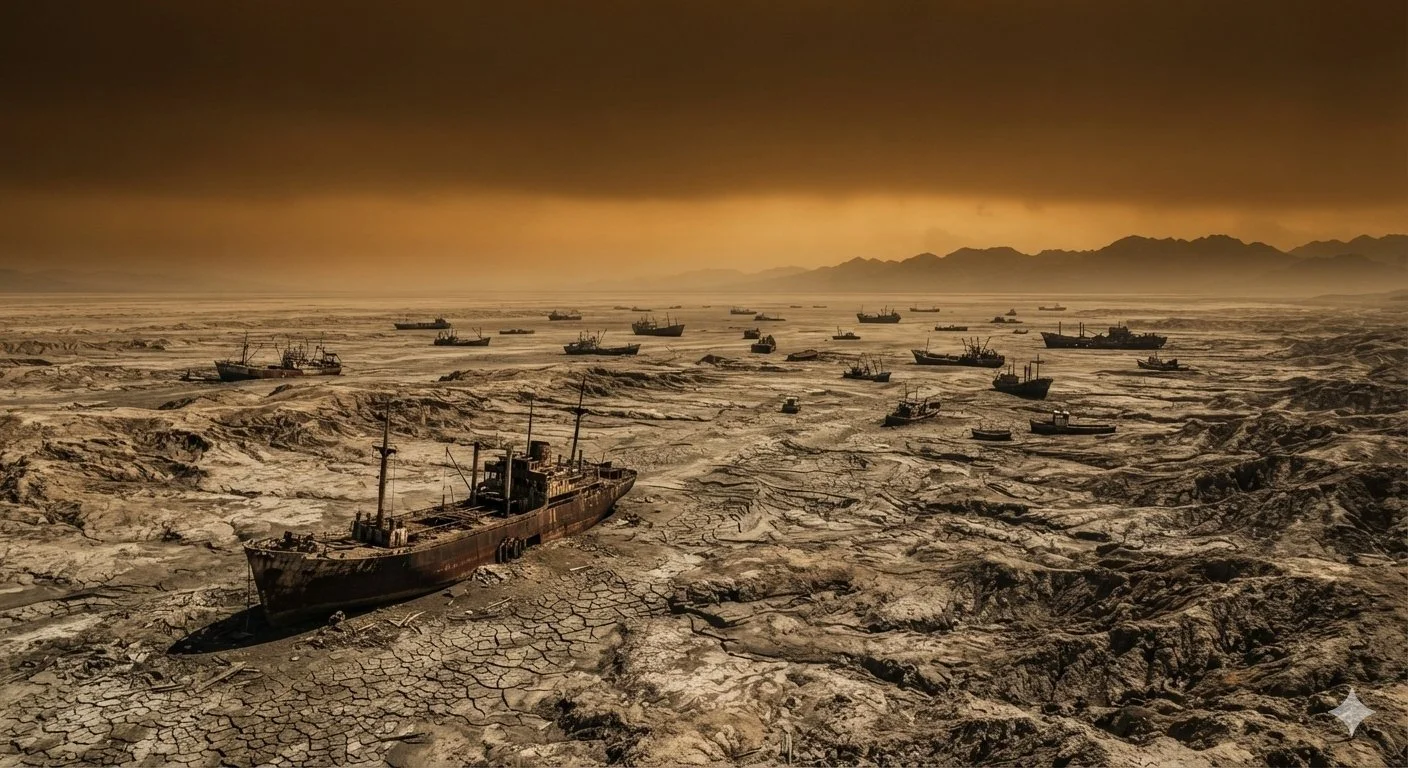
And the water is running out. That is not a metaphor. The Colorado River no longer reaches the sea. The great reservoirs of the West have fallen to levels not seen since they were filled. The aquifer beneath the Great Plains, which waters the breadbasket of the world, is being drained faster than the rain can refill it, and in many places it will never refill in a human lifetime. The Great Salt Lake has shrunk toward a toxic dust bowl. Rivers that once ran through major cities have gone dry in the summer. The same sky that closed over Harappa and Tikal is showing every sign of closing over us.
This is what frightens me, and it should frighten you. Not because God is arbitrary or cruel, but because God is consistent. "For I am the LORD, I change not" (Malachi 3:6). "Jesus Christ the same yesterday, and to day, and for ever" (Hebrews 13:8). The God who judged the Indus Valley did not retire. The God who scattered the Minoans and emptied the Maya cities has not changed His mind about idolatry, about sexual immorality, about the confusion of the sexes, or about what parents do to the bodies of their children. If He did those things then, He will do them again. Indeed, the whole Bible is written on that assumption.
"For whatsoever things were written aforetime were written for our learning, that we through patience and comfort of the scriptures might have hope." (Romans 15:4)
"Now all these things happened unto them for ensamples: and they are written for our admonition, upon whom the ends of the world are come." (1 Corinthians 10:11)
The apostle Paul, writing to the church at Corinth, told them that the catastrophes of the Old Testament were not merely history. They were examples—"ensamples"—set down so that later generations would recognize the pattern in their own time and turn back before it was too late. If that is true of Israel's history, it is also true of the history God has permitted us to dig up from the ground. The Indus Valley, Minoan Crete, and the Classic Maya are ensamples too. They are written in stone and bone and terracotta for our admonition. The question is whether we are willing to read them.
A Word About Method
Let me be honest about what we know and how we know it. The three civilizations in this essay left us almost no readable words. The Indus script has never been deciphered. The Minoan script called Linear A has never been deciphered. The Maya did leave a readable script, and much of it has been translated, but most of what survives are royal monuments and calendars rather than the private thoughts of ordinary people. So when we speak about what these peoples believed about sex, gender, the gods, and the body, we are reading their art, their idols, their burials, their architecture, and the physical remains of their bodies.
This is not as uncertain as it sounds. A people's art tells you what they loved. Their idols tell you what they feared and served. Their burials tell you how they treated their dead and therefore how they understood life. And their skeletons tell you what they did to their own bodies and the bodies of their children. When a civilization leaves behind thousands of carved phalluses and vulvas, a supreme goddess figure in every home, frescoes of bare-breasted priestesses, infant skulls deliberately reshaped, and figurines that deliberately mix the markers of male and female, you do not need a dictionary to understand what that civilization valued.
At the same time, I will not overstate. Where the evidence is strong—the ithyphallic seals of the Indus, the exposed corsets of the Minoan women, the skull-binding and eye-crossing of the Maya—I will say so. Where scholars infer rather than prove—matrilocality in the Indus, the tolerance of same-sex relations in Crete—I will say that too. But I will also insist that the honest reading of the whole picture is not in serious dispute. These were societies that had thrown off the restraints that the God of the Bible places on human sexuality, on the distinction of the sexes, and on the worship of the Creator alone. And they were destroyed.
The Ten Commandments as the Measuring Rod
Throughout this essay I will return to a single standard: the Ten Commandments as recorded in Exodus 20, in the words of the King James Bible. I do this for a simple reason. The Ten Commandments are the clearest and most compact statement in all of Scripture of what God requires of a people. They are not the private property of Israel. They are a description of how the Creator of the universe expects His creatures to live, and every nation on earth will be measured against them.
"Thou shalt have no other gods before me. Thou shalt not make unto thee any graven image, or any likeness of any thing that is in heaven above, or that is in the earth beneath, or that is in the water under the earth: Thou shalt not bow down thyself to them, nor serve them: for I the LORD thy God am a jealous God, visiting the iniquity of the fathers upon the children unto the third and fourth generation of them that hate me." (Exodus 20:3–5)
Notice the last clause. "Visiting the iniquity of the fathers upon the children." When a civilization goes wrong at the top—when its parents and priests and rulers embrace idols—the consequences fall on the children, and on the children's children, and on the generations who inherit a ruined land. That is exactly what we see in the archaeological record. The generation that built the great temples was not usually the generation that starved. It was their grandchildren. And it is exactly what we are setting up for our own grandchildren today.
We will find, as we go, that every one of the three civilizations broke every one of the first four commandments openly, as a matter of national religion. They had other gods. They made graven images and bowed down to them. They attached the sacred name to things that were not God. They had no sabbath unto the Lord. And we will find that they broke the later commandments as well: the Maya in particular built an entire civilization on murder as worship, and all three built their religious life on what the Bible calls fornication and abomination. And then we will hold up the mirror.
The Shape of What Follows
In the chapters ahead I will take each civilization in turn—the Indus Valley, Minoan Crete, and the Classic Maya—and describe what they believed and did, what happened to them, and what the Scriptures say about the practices they embraced. I will then step back and examine the common thread: the Ten Commandments broken in every case, and the specific divine pattern of judgment that the Bible lays out and that history confirms, using Sodom and Gomorrah as the clearest biblical case study. I will devote a full chapter to the question of gender, the body, and the image of God, because I believe—and I will argue—that the dissolution of the male-female distinction is not merely one sin among many but the final stage in a sequence that the apostle Paul describes with frightening precision in the first chapter of Romans. I will then turn to America: to our gods, our holidays, our sexual revolution, our treatment of children, and our failing water. And I will close not with despair but with the only thing that has ever turned a nation back from the edge: repentance, and the mercy of a God who "hath no pleasure in the death of the wicked; but that the wicked turn from his way and live" (Ezekiel 33:11).
I do not write this as a scholar standing above the fray. I write as someone who is afraid—afraid for my country, afraid for its children, and afraid of a God who does exactly what He says He will do. The ruins are not there to be admired. They are there to be understood. "The wicked shall be turned into hell, and all the nations that forget God" (Psalm 9:17). Three nations forgot God. Here is what became of them.
Part Two: The Indus Valley — Sacred Sexuality on the Banks of a Dying River
The Cities That Should Not Have Been Possible
Around 2600 BCE, in what is today Pakistan and northwestern India, a people whose name we do not know built the largest urban civilization the world had yet seen. Their two greatest cities, Harappa and Mohenjo-Daro, each held tens of thousands of residents. Over a thousand smaller settlements dotted the floodplains of the Indus River and the now-vanished Ghaggar-Hakra. Together they covered an area larger than ancient Egypt and Mesopotamia combined.
What astonishes visitors to Mohenjo-Daro today is how modern it feels. The streets were laid out on a grid with right angles. The bricks were fired to a standardized size used across hundreds of miles. Nearly every house had its own well, its own bathroom, and a drain that connected to a covered municipal sewer running beneath the street. Nothing like it would appear again in the world for roughly two thousand years. They had a system of standardized weights so precise that merchants across the entire civilization could trust one another's scales. They traded by sea with Mesopotamia; Indus seals have been dug up in the ruins of Ur.
They were, in every material sense, a success. And within a few centuries of their peak, their cities were empty.
What They Worshipped
The Indus people left behind thousands of small stone seals carved with animals, symbols, and an undeciphered script. They left behind terracotta figurines by the tens of thousands. They left behind polished stone objects whose shape leaves no doubt about what they represent. From these we can reconstruct the outline of their religion, and it is a religion of fertility, of the earth, of the generative organs, and of many gods.
The most common figurine type across Indus sites is a female figure with wide hips, prominent breasts, and an elaborate fan-shaped headdress, often called the "Mother Goddess." These appear in homes, not only in temples, which tells us the veneration of the goddess was a domestic, everyday matter. Alongside them, archaeologists have recovered numerous polished stone objects shaped as the male organ, the lingam, and ring-shaped stones interpreted as the female organ, the yoni. These are not hidden in some back room. They appear to have been objects of open reverence, and the later Hindu practice of worshipping the lingam and yoni together as the union of divine male and female energy almost certainly has its roots here.
The most famous single artifact of the civilization is a small steatite seal from Mohenjo-Daro, usually called the Pashupati Seal. It shows a horned figure seated in a posture very like a yoga pose, surrounded by animals: an elephant, a tiger, a rhinoceros, a buffalo. The figure appears to have three faces. And the figure is ithyphallic—carved with an erect phallus. Scholars debate whether this is a proto-Shiva, a "Lord of Beasts," or something else entirely. But the meaning of the erection is not in serious doubt. In the religious language of the ancient world, the erect phallus on a god meant divine potency, life-force, the power that makes the herds increase and the grain rise. The Indus people carved their god with his sex on display because his sex was what they worshipped him for.
Here, then, is the first thing to understand about the Indus Valley: it was a civilization in which sexuality and religion had merged. The generative organs were sacred objects. The god was defined by his virility. The goddess was defined by her fertility. Sex was not a private matter between husband and wife under the eye of a holy Creator; it was the engine of the cosmos, and it was worshipped as such.
The Blurring of Male and Female
Among the tens of thousands of terracotta figurines from Harappa, a significant number resist classification as male or female. Some have flat chests but wear the elaborate headdresses and jewelry otherwise reserved for female figures. Some have ambiguous or absent genitalia combined with markers of both sexes. Some seem to have been deliberately made so that the viewer could not decide. Modern scholars, eager to find their own values in the deep past, have celebrated this as evidence of a "third gender" or of "gender fluidity" recognized four thousand years ago.
I have no interest in disputing the observation. I think they are right about what the figurines show. A culture that worships the union of male and female generative power as a cosmic principle is a culture that will, sooner or later, begin to imagine beings who contain both, and to honor the human beings who present as neither. This is not a modern discovery about the Indus Valley. It is a very old religious idea, and it appears again and again in the pagan world: in the androgynous deities of Mesopotamia, in the castrated priests of the Great Mother in Anatolia, in the hermaphrodite gods of the Greeks. Where the Creator is replaced with a fertility cult, the boundary He drew between male and female is one of the first things to go.
What I dispute is the word "progressive." A civilization that has been dead for nearly four thousand years is not a preview of the future. It is a warning from the past.
Women, the Body, and Autonomy
The best-known piece of Indus art is a small bronze called the "Dancing Girl," about four inches tall, from Mohenjo-Daro. She stands naked except for bangles stacked up one arm and a necklace, her hand resting on her hip, her head tilted back in an attitude of easy confidence. Art historians love her, and one can see why. She is beautifully made. But look at what she tells us about the culture that made her. Public nudity of the female form was not shameful. The body was displayed with pride. There is no hint of the modesty that Scripture commends and that most human cultures have observed.
Recent studies of Harappan skeletons—analyzing the isotopes in teeth to determine where individuals grew up—suggest that men in these cities were more likely than women to have been born elsewhere. This points toward matrilocality: husbands moving to live with the wife's family rather than the reverse. Combined with the dominance of the goddess figurines, many historians conclude that Indus women held unusual social, economic, and sexual power.
Again, I do not dispute the inference. What I want the reader to notice is how closely this cluster of traits—goddess worship, sacred sexuality, female-centered households, unashamed nudity, and dissolving gender lines—resembles the Canaanite cultures that the God of the Bible commanded Israel to have nothing to do with. The Canaanites worshipped Asherah, the mother goddess, alongside Baal, the virile storm god. They set up sacred poles and stones—the "groves" and "images" of the King James text. They had cult prostitutes of both sexes attached to their shrines.
"Ye shall utterly destroy all the places, wherein the nations which ye shall possess served their gods, upon the high mountains, and upon the hills, and under every green tree: And ye shall overthrow their altars, and break their pillars, and burn their groves with fire; and ye shall hew down the graven images of their gods, and destroy the names of them out of that place." (Deuteronomy 12:2–3)
"There shall be no whore of the daughters of Israel, nor a sodomite of the sons of Israel. Thou shalt not bring the hire of a whore, or the price of a dog, into the house of the LORD thy God for any vow: for even both these are abomination unto the LORD thy God." (Deuteronomy 23:17–18)
The "pillars" that God commanded Israel to break were standing stones, many of them frankly phallic. The "groves" were the cult objects of the goddess. The "sodomite" and the "whore" attached to the shrines were the human instruments of a sexualized religion. God did not tell Israel to study these things with admiration. He told them to break them, burn them, and hew them down. The Indus Valley, though far to the east and unknown to Moses, was built on the very same religious foundation.
The Commandments Broken
Measure the Indus Valley against the first table of the law.
"Thou shalt have no other gods before me." They had a horned god of beasts, a mother goddess, sacred animals, and very probably a whole pantheon we cannot name because we cannot read their script.
"Thou shalt not make unto thee any graven image... thou shalt not bow down thyself to them, nor serve them." They made images by the tens of thousands and placed them in every home. Their most sacred objects were carved stone representations of the sexual organs.
They also stood in open violation of the moral order God gave regarding the body and the sexes. God made them male and female (Genesis 1:27). He commanded that a man cleave to his wife and become one flesh (Genesis 2:24). He forbade the confusion of the sexes in dress and role (Deuteronomy 22:5). He forbade the sacralizing of sex through cult prostitution. The Indus Valley had turned every one of these principles upside down and carved the inversion into stone.
How the Judgment Came
The end of the Indus civilization was not a battle. For a long time historians imagined that light-skinned "Aryan" horsemen had swept down from Central Asia and slaughtered the cities, but the evidence for this has evaporated. There are no burned layers, no mass graves of the fallen, no weapons in the streets. The Indo-Aryan speakers who later dominated northern India arrived after the cities were already largely abandoned.
What the evidence shows instead is the sky closing. Sediment cores from lakes across the region, isotopes in cave formations, and climate models published in recent years all tell the same story. Beginning around 2200 BCE and intensifying after 2000 BCE, the summer monsoon weakened and shifted. Rains that had fallen predictably for centuries became erratic, then failed. Researchers have identified drought episodes lasting decades, and at least one that lasted more than a century without relief. The Ghaggar-Hakra river system, which had watered hundreds of towns, dried up completely. The Indus itself shifted its course.
Without water, a civilization built on irrigated grain cannot feed its cities. The evidence of decline is written in the ruins themselves. The great public buildings fell into disrepair. The famous drains clogged and were not cleaned. Large houses were subdivided into cramped tenements, then abandoned. The standardized weights disappeared. The script stopped being written. The trade with Mesopotamia ceased. Skeletons from the final phases show malaria, leprosy, and evidence of interpersonal violence—the signature of a society under famine stress, turning on itself.
And then the people left. They did not die out. They dispersed eastward toward the Ganges and southward toward greener land, breaking into small farming villages. Within a few generations they were absorbed into the emerging cultures of the Indian subcontinent. Some of their customs survived—their pottery, their bangles, very likely the lingam itself, which passed into later Hindu worship. But the civilization as a civilization was gone. Its language was lost. Its script was lost. Its cities were buried so completely that when British engineers built a railway through the region in the nineteenth century, they used the ancient fired bricks of Harappa as ballast, having no idea what they were.
Compare this to the biblical description of what God does to a people who serve other gods:
"And the LORD shall scatter you among the nations, and ye shall be left few in number among the heathen, whither the LORD shall lead you. And there ye shall serve gods, the work of men's hands, wood and stone, which neither see, nor hear, nor eat, nor smell." (Deuteronomy 4:27–28)
"And thy heaven that is over thy head shall be brass, and the earth that is under thee shall be iron. The LORD shall make the rain of thy land powder and dust: from heaven shall it come down upon thee, until thou be destroyed." (Deuteronomy 28:23–24)
"The rain of thy land powder and dust." That is the sediment record of the Indus Valley in a single phrase. A heaven of brass. An earth of iron. A people scattered into other nations and absorbed until nothing of them remained but a few habits and a buried city.
The Objection: They Never Heard of the God of Israel
Someone will object: how can the Indus people be judged by a law they never received? Moses had not yet been born when Harappa fell. They had no Bible.
The Bible answers this objection directly. Paul writes that the Gentiles, "which have not the law," nonetheless "shew the work of the law written in their hearts" (Romans 2:14–15), and that all mankind is accountable to God because "that which may be known of God is manifest in them; for God hath shewed it unto them. For the invisible things of him from the creation of the world are clearly seen, being understood by the things that are made, even his eternal power and Godhead; so that they are without excuse" (Romans 1:19–20).
And then Paul describes exactly what happens to people who have this knowledge and refuse it:
"Because that, when they knew God, they glorified him not as God, neither were thankful; but became vain in their imaginations, and their foolish heart was darkened. Professing themselves to be wise, they became fools, And changed the glory of the uncorruptible God into an image made like to corruptible man, and to birds, and fourfooted beasts, and creeping things. Wherefore God also gave them up to uncleanness through the lusts of their own hearts, to dishonour their own bodies between themselves." (Romans 1:21–24)
Images of man. Images of four-footed beasts—the elephant, the tiger, the buffalo of the Pashupati seal. Then the giving up to uncleanness, the dishonouring of the body. Paul is not describing the Indus Valley by name. He is describing the pattern that every idolatrous civilization follows, and the Indus Valley followed it to the letter. They knew there was a Creator, as every people does, and they exchanged Him for the carved image of a horned god with an erection. The judgment that followed was not a technicality of a law they had never heard. It was the natural and supernatural consequence of the choice every human being is capable of making, and that these people made together, as a nation.
The Indus Valley is the first of our three witnesses. Its testimony is this: a sophisticated people worshipped fertility, sacralized sex, dissolved the line between male and female, filled their homes with images, and were destroyed when the God who sends rain stopped sending it. They were not conquered. They were dried out and scattered. And they were forgotten so thoroughly that their bricks were used to build a railroad.
Part Three: Minoan Crete — The Island of Pleasure
Europe's First Civilization
On the island of Crete, in the middle of the eastern Mediterranean, a people flourished for well over a thousand years before the Greeks of Homer. We call them Minoans, after the legendary King Minos, though we do not know what they called themselves. Their great palace at Knossos sprawled over several acres, rose to multiple stories, and contained more than a thousand rooms connected by light-wells, staircases, and corridors so complex that later Greeks remembered it as a labyrinth. They had flush toilets and running water. They painted their walls with frescoes of dolphins, lilies, and dancing women in colors that still glow after thirty-five centuries. They sailed the whole Mediterranean, trading Cretan oil, wine, and pottery for Egyptian gold and Near Eastern tin. Their fleet was so dominant that their palaces had no defensive walls; no one could reach them by sea.
They were, for a time, the most refined people in Europe. And around 1450 BCE their palaces burned, their culture was overrun, their script fell silent, and within a few generations they had been absorbed into the Mycenaean Greek world so thoroughly that Homer barely knew they had existed.
A Culture Built Around the Female Body
If the Indus Valley gives us a religion of sacred sexuality in stone, the Minoans give it to us in living color. Their frescoes and figurines are dominated by women—and by a very particular presentation of women.
The elite Minoan woman wore a long, tiered, brightly dyed skirt, a tight belt or girdle at the waist, and a short-sleeved bodice that was laced tightly beneath the bust and left completely open in front. Her breasts were fully exposed, deliberately framed and lifted by the tailoring of the garment. This was not the dress of prostitutes or slaves. It was the dress of priestesses and queens, worn in the most important religious processions and on the most sacred objects the culture produced. The famous faience "Snake Goddess" figurines from Knossos show exactly this costume: a woman in an elaborate flounced skirt, bodice open to the waist, bare-breasted, holding a writhing snake in each raised hand, a cat or lion crouched on her headdress.
Whatever else one wishes to say about this, it was a society in which female sexual display was a mark of religious authority and high status. The modern scholar calls this "body positivity" and "female empowerment." The Bible has another word for the priestesses of a bare-breasted goddess cult, and it is not a complimentary one.
Minoan men were scarcely more covered. Frescoes show them slender, long-haired, and tan, wearing only a codpiece and a short kilt, with a cinched belt to accentuate an impossibly narrow waist. Both sexes wore their hair long and elaborately curled, wore heavy jewelry, and appear to have used cosmetics. The frescoes place men and women side by side at festivals and in crowded courtyards, often so similar in dress and hairstyle that scholars identify the sex only by a convention of skin color: red-brown for men, white for women.
Bull-Leaping and the Mixing of the Sexes
The most celebrated image of Minoan Crete is the Bull-Leaping Fresco from Knossos. A great charging bull fills the center of the panel. One figure grasps its horns from the front; another somersaults over its back; a third stands behind it with arms raised to catch the leaper. Of the three acrobats, one is painted red-brown and two are painted white. If the color convention holds—and most scholars believe it does—then two of the three athletes vaulting over a charging bull in this most sacred and dangerous of Minoan rituals were young women, dressed exactly like the young man, in nothing but a codpiece, belt, and boots.
The modern reader is invited to find this thrilling. Girls doing everything the boys do, in the same uniform, breaking the "gender binary" three and a half thousand years before the phrase was invented. I invite the reader instead to notice what Scripture says about a culture in which the visual and functional distinction between men and women is deliberately erased.
"The woman shall not wear that which pertaineth unto a man, neither shall a man put on a woman's garment: for all that do so are abomination unto the LORD thy God." (Deuteronomy 22:5)
This commandment is often dismissed as an arbitrary rule about fabric. It is nothing of the kind. It sits in the law of God because the visible distinction between male and female is a public confession that God made two sexes, on purpose, and that the difference matters. A culture that dresses its young women as men for its holiest ritual has made the opposite confession. The Minoans made it in paint on the walls of their greatest palace.
No Mothers, No Children
Something is missing from Minoan art, and its absence is one of the strangest facts about the civilization. In thousands of images of women—processing, dancing, feasting, presiding at altars, riding in chariots, watching the bull-leapers from grandstands—there are almost no pregnant women and almost no mothers with children. In Egypt, Mesopotamia, and later Greece, the nursing mother is a common motif. In Crete she scarcely exists.
Historians treat this as a point in the Minoans' favor: here was a culture that valued women for something other than their wombs, that celebrated female sociability and religious leadership rather than confining women to the nursery. Perhaps. But consider what it means that a society organized around a fertility goddess and the exposed female breast had no interest in depicting the actual fruit of fertility. The breast was displayed for its sexual and sacred power, not for the child it was made to feed. Sexuality had been detached from its God-given purpose—"be fruitful, and multiply" (Genesis 1:28)—and made into an end in itself, a source of ecstasy and status.
This is precisely the detachment Scripture warns against. The Bible does not despise the body or sexual pleasure; the Song of Solomon is in the canon. But it insists that sexuality belongs inside the covenant of marriage, oriented toward the raising of children in the fear of the Lord: "Lo, children are an heritage of the LORD: and the fruit of the womb is his reward" (Psalm 127:3). A civilization that celebrates the naked breast in every temple and cannot be bothered to paint a single mother nursing an infant has told you where its heart is.
The Goddess and the Absent King
The Minoan palaces are strange in another way. In Egypt, Assyria, and Babylon, the walls are covered with the king: the king smiting enemies, the king receiving tribute, the king enthroned among the gods. At Knossos there is no such king. There are no images of conquest, no captive enemies, no royal boasting. What there is, everywhere, is the goddess—or her priestesses, who may in practice have been the same thing.
She appears on seals and rings standing on a mountaintop flanked by lions. She appears in the "epiphany" scenes where worshippers, mostly women, dance in ecstatic trance and the goddess descends to them, small and hovering in the air. She appears as the mistress of animals, of snakes, of the double axe. Her attendants are women in the open bodice; her cult objects are the sacred horns, the pillar, the tree.
Scholars who once dreamed of a peaceful, egalitarian, goddess-ruled Crete have had to revise that picture in recent decades. Minoan sites have yielded weapons, fortified outposts, and at least one deposit of children's bones bearing butchery marks consistent with ritual killing and possibly cannibalism, found at Knossos and at the shrine of Anemospilia. The goddess of ecstasy also demanded blood. But the essential portrait stands: a society whose religion was female-centered, ecstatic, nature-bound, and sensual, and whose sacred art placed the female body at the center of the universe.
The Bible knows this religion well. It is the religion of Asherah and Ashtoreth, of the "queen of heaven" to whom the women of Judah baked cakes (Jeremiah 7:18; 44:17–19), of the groves and high places where Israel again and again "went a whoring after other gods." The prophets never treat the goddess cult as a charming alternative spirituality. They treat it as adultery against the Creator, and they promise it a specific end.
"And I will destroy your high places, and cut down your images, and cast your carcases upon the carcases of your idols, and my soul shall abhor you. And I will make your cities waste, and bring your sanctuaries unto desolation." (Leviticus 26:30–31)
Same-Sex Relations and the Culture of Pleasure
The evidence for Minoan attitudes toward same-sex relations is thinner than for the other matters in this chapter, and I will treat it carefully. There are no Minoan texts that speak of it. What scholars point to is the general character of the culture: a religion of ecstasy rather than of moral law, an art saturated with sensuality and youthful beauty, a social world in which men and women mingled freely and in which pleasure appears to have been a religious good. Later Greek tradition remembered Crete specifically as the place where the institutionalized pederasty of the Greek aristocracy—the erotic relationship between an adult man and an adolescent boy—had its origin. Whether the Greeks were right about that we cannot prove, but they had no reason to invent it.
What we can say with confidence is that nothing in the Minoan religious system would have forbidden such relations, and that a culture which had removed sex from the covenant of marriage and made it a sacred pleasure in its own right would have had no principled basis for confining it to one man and one woman. Once the first boundary is gone, the rest follow. This is the sequence the apostle Paul describes in Romans 1, and it is worth quoting at length, because it is the theological spine of this entire essay:
"Wherefore God also gave them up to uncleanness through the lusts of their own hearts, to dishonour their own bodies between themselves: Who changed the truth of God into a lie, and worshipped and served the creature more than the Creator, who is blessed for ever. Amen. For this cause God gave them up unto vile affections: for even their women did change the natural use into that which is against nature: And likewise also the men, leaving the natural use of the woman, burned in their lust one toward another; men with men working that which is unseemly, and receiving in themselves that recompence of their error which was meet." (Romans 1:24–27)
Observe the order. First, idolatry: worshipping and serving the creature more than the Creator. The Minoans worshipped the goddess of the earth, the snake, the bull, the tree. Then, as a consequence, God "gave them up" to sexual disorder: first general uncleanness, then specifically the abandonment of "the natural use." Paul presents this not as a random moral failing but as a judgment in itself—God withdrawing His restraining hand and letting a people have what they have chosen. The sexual chaos is both the sin and the first stage of the punishment. The final stage comes later, and it comes from outside.
The Judgment: Fire, Water, and the Sea
The Minoan collapse was more violent than the Indus decline, and the timeline is debated, but its outline is clear.
Sometime in the sixteenth or fifteenth century BCE, the volcanic island of Thera—modern Santorini, about seventy miles north of Crete—exploded in one of the largest eruptions in human history. It blew the center of the island into the sky and dropped the remainder into the sea. Ash fell across the eastern Mediterranean. Tsunamis, some estimated at tens of feet in height, struck the northern coast of Crete, where the Minoan harbors and much of the fleet were concentrated. The Minoan settlement on Thera itself, Akrotiri, was buried like Pompeii. Whether Thera alone destroyed the Minoans is disputed; the palaces were rebuilt afterward. But the eruption almost certainly shattered the fleet that had made Crete untouchable, poisoned the fields with ash, disrupted the trade on which the palace economy depended, and left the island weakened for what came next.
What came next was invasion and fire. Around 1450 BCE, nearly every Minoan palace and villa on the island was burned. Knossos alone survived, and it survived under new management: from this point on, the administrative records at Knossos are written in Linear B, which is Greek. The Mycenaean Greeks of the mainland—warlike, patriarchal, king-centered, everything the Minoans were not—had taken the island. Within two centuries Knossos too was destroyed, and the Minoan world was over. Their language was lost. Their script remains unread to this day. Their art was imitated for a while and then forgotten. The goddess became a minor figure in the Greek pantheon. The bull-leapers became the myth of the Minotaur, a monster in a maze devouring the young.
Fire from the sky. The sea rising. Poisoned fields and failed harvests. Then a foreign people breaking down the sanctuaries and taking the land. Every element of this appears in the biblical descriptions of judgment on idolatrous nations:
"Behold, the LORD maketh the earth empty, and maketh it waste, and turneth it upside down, and scattereth abroad the inhabitants thereof... The earth also is defiled under the inhabitants thereof; because they have transgressed the laws, changed the ordinance, broken the everlasting covenant. Therefore hath the curse devoured the earth, and they that dwell therein are desolate: therefore the inhabitants of the earth are burned, and few men left." (Isaiah 24:1, 5–6)
"Changed the ordinance." The word means the fixed order that God established in creation. A culture that dresses its women as men, detaches sex from marriage and children, and worships the created world as a goddess has changed the ordinance. Isaiah's verdict is that the curse devours such a land and its inhabitants are burned. The archaeologists at Knossos have been digging through that burn layer for a century.
The Testimony of the Second Witness
The Minoans add something to the picture the Indus Valley began. The Indus people show us sacred sexuality and gender confusion in the abstract language of seals and figurines. The Minoans show us the same things in full color and at life size: the priestess with her breasts bared as a badge of office, the girl in a codpiece somersaulting over a bull beside a boy, the goddess ruling a world where the king is invisible and no one paints a mother with her child. And they show us that the judgment on such a people does not always come slowly. Sometimes the mountain explodes, the sea rises, the enemy lands on the beach, and the palaces burn in a single season.
Two witnesses have now testified. Under the law, "at the mouth of two witnesses, or at the mouth of three witnesses, shall the matter be established" (Deuteronomy 19:15). We turn now to the third.
Part Four: The Classic Maya — Blood, Beauty, and the Bodies of Children
The Jungle Metropolis
Deep in the rainforests of what is now Guatemala, Belize, Honduras, and southern Mexico, the Classic Maya built cities that rank among the greatest achievements of the ancient world. Tikal held perhaps sixty thousand people at its height, with pyramid-temples rising more than two hundred feet above the forest canopy. Calakmul, Palenque, Copán, Caracol—dozens of city-states, each ruled by a divine king, each carving its history into limestone stelae in a script that modern scholars have finally learned to read.
The Maya calculated the length of the solar year more accurately than the Europeans of their day. They tracked the cycles of Venus to a precision of hours over centuries. They invented the concept of zero independently of the Old World. They built reservoirs, causeways, and terraced fields to feed dense populations in a landscape with no rivers and a punishing dry season. They painted murals, sculpted in jade, and wrote books on bark paper. Their civilization endured for more than six hundred years.
And then, between roughly 800 and 950 CE, the great southern cities emptied. The last dated monuments were carved. The royal palaces were abandoned. The population of the central lowlands fell by as much as ninety percent. The jungle grew over the pyramids so completely that when explorers stumbled on them a thousand years later, they thought they had discovered the ruins of a lost race.
Kings Who Bled for the Gods
The Maya are the third witness in this essay, and they differ from the first two in an important way. The Indus and the Minoans left us a religion of sensual fertility. The Maya left us a religion of blood. But look closely, and the same foundations are there: many gods, carved images everywhere, sacred sexuality, the blurring of male and female, and the sacrifice of the human body—above all the bodies of children—to the culture's gods.
Maya society was rigidly hierarchical. At the top stood the k'uhul ajaw, the "holy lord," a king who was understood to be a living conduit between the human world and the gods. Below him were nobles, priests, scribes, and warriors; below them, the vast mass of farmers whose labor built the pyramids. The king's essential job was to feed the gods, and the gods ate blood.
The most sacred act a Maya ruler could perform was to pierce his own body and offer his blood. Kings drew stingray spines and obsidian blades through their tongues, their earlobes, and their penises, letting the blood fall onto strips of bark paper that were then burned so the smoke could rise to heaven. Queens did the same, drawing a thorn-studded rope through a hole in the tongue. The famous lintels from Yaxchilán show Lady K'abal Xook performing exactly this rite, a rope of thorns dangling from her mouth, a basket of bloodied paper at her feet, while the vision-serpent of her ancestors rises from the smoke.
Blood was also drawn from others. The Maya waged constant war, and the primary purpose of that war was not territory but captives—preferably noble captives, ideally an enemy king. The captured were stripped, humiliated, tortured over days or years, and finally sacrificed on the temple summit, often by decapitation, sometimes by having the heart cut out. Their bodies were then thrown down the pyramid steps. The ballgame that every Maya city built a court for was in its sacred form a ritual reenactment of the gods' struggle with death, and it sometimes ended with the sacrifice of players.
"Thou shalt not kill." (Exodus 20:13)
"Their land also is full of idols; they worship the work of their own hands, that which their own fingers have made... And they shall go into the holes of the rocks, and into the caves of the earth, for fear of the LORD, and for the glory of his majesty, when he ariseth to shake terribly the earth." (Isaiah 2:8, 19)
The Maya had made murder into worship. Israel's neighbors did the same; the prophets' most horrified denunciations are reserved for the peoples who "burnt their sons and their daughters in the fire to Molech" (Jeremiah 32:35). God's response to the Canaanites who did this was to give their land to another people and wipe their cities out. He was not more tolerant of the Maya.
Chocolate, the Ballgame, and the Good Life
It would be a mistake to imagine the Maya as grim. They were a people who enjoyed life intensely. The elite drank cacao—chocolate—prepared as a frothy, bitter, spiced beverage from tall painted cylinder vases at feasts that lasted days. Their murals at Bonampak and Calakmul show musicians, dancers in elaborate costume, merchants selling tamales and salt, women in fine huipiles. They loved jade, quetzal feathers, cotton dyed in brilliant colors, and the intoxicating ritual drink balché. They were passionate about the ballgame as a spectator sport as well as a rite. Life in a Classic Maya city, for those with status, was rich, colorful, and stimulating.
This matters because it is the pattern of every civilization in this essay, and of ours. The people who are about to be judged are almost never living in misery. They are living well. They are at the height of their comfort and confidence. "As it was in the days of Noe," Jesus said, "they did eat, they drank, they married wives, they were given in marriage, until the day that Noe entered into the ark, and the flood came, and destroyed them all. Likewise also as it was in the days of Lot; they did eat, they drank, they bought, they sold, they planted, they builded; But the same day that Lot went out of Sodom it rained fire and brimstone from heaven, and destroyed them all" (Luke 17:26–29). Prosperity is not a sign of God's approval. Often it is the last thing a people enjoys before the judgment.
The Maize God and the Dissolution of the Sexes
The most important deity in the Maya pantheon was not the sun god or the rain god but the Maize God, the personification of corn, on which all Maya life depended. And the Maize God was deliberately androgynous.
Maya artists depicted him with an elongated head shaped like an ear of corn, a smooth youthful face, long flowing hair, and a body that combined a male frame with soft, rounded, conventionally feminine features. He wears the jade jewelry and netted skirt otherwise associated with female figures and with the moon goddess. Scholars describe his gender as intentionally "fluid" or "ambiguous"—not a mistake, but a theological statement. The Maize God embodied both the male and female principles of fertility because corn itself, in Maya thought, contained both.
Maya kings impersonated the Maize God in ritual. They put on his jade skirt and his jewelry, took on his posture, and danced as him. Scholars have shown that in these rites the king was deliberately presenting a gender-blended image—a man in the costume of a goddess-like god, embodying the generative power of both sexes. The famous ruler K'inich Janaab' Pakal of Palenque was buried with his face carved as the Maize God, his death imagined as the god's descent into the underworld before rebirth.
Here is the same idea we found in the Indus figurines and the Minoan bull-leapers, now enthroned at the very center of a civilization's religion: the fusion of male and female as a source of divine power. The highest human being in the society, the holy king, gained his sacred authority in part by dressing across the sexes.
The Bible's response to a man in a woman's garment is not ambiguous. "All that do so are abomination unto the LORD thy God" (Deuteronomy 22:5). The word "abomination" is the same word used for idolatry and for the sexual sins of Leviticus 18. It is the word God reserves for things that violate the fundamental order He built into creation. And "male and female created he them" (Genesis 1:27) is not a footnote to that order. It is the very first thing the Bible tells us about human beings after it tells us we are made in God's image.
Phallic Cults and Sacred Sex
The Maya also had their version of the Indus lingam. In the Late Classic and Terminal Classic periods, particularly in the Puuc region of Yucatán around Uxmal, Maya sculptors carved enormous stone phalluses, some several feet tall, and set them up in plazas and on temple platforms. At Uxmal a whole building, the so-called "Temple of the Phalli," was decorated with them. Explicit sexual imagery appears in the murals and painted vases of the period. Whatever else this represents, it is public, monumental, religious celebration of the male organ as a symbol of agricultural and cosmic fertility—precisely the cult of the "pillars" and "images" that God told Israel to break down.
Warrior Queens
The Maya were not matriarchal in the way the Minoans may have been, but they permitted powerful women to rule. Lady Six Sky of Naranjo, Lady K'abel of El Perú-Waka', and Lady Yohl Ik'nal of Palenque each held supreme power over a major city-state, commissioned monuments showing themselves standing on the bodies of captives, and led religious rites just as kings did. I mention this not because a woman in authority is a sin—Deborah judged Israel—but because it fits the broader pattern in which the Maya, like the Indus and the Minoans, had loosened the distinctions and roles that Scripture treats as part of the created order.
What They Did to Their Children
Now we come to the hardest part of the Maya story, and the part that speaks most directly to our own time.
The Maya had a very specific idea of what a beautiful, high-status, god-like human being looked like. Such a person had a long, sloping, elongated skull, rising back from a flattened forehead. Such a person had crossed eyes. Such a person had teeth filed to points or drilled and inlaid with discs of jade and pyrite. None of these things occur in nature with any frequency. So the Maya made them happen, and they made them happen to their children, because these transformations could only be accomplished while the body was still forming.
Skull shaping. Within days of birth, elite Maya infants were bound into a cradleboard, with a flat board pressed against the forehead and another against the back of the skull, held in place by tight wrappings. The pressure was maintained for months, sometimes years, while the infant's soft skull bones grew. The result was a permanently reshaped head: the forehead sloped sharply backward, the crown rose high and long. Skeletons from Maya sites show the deformation clearly; in some cemeteries the majority of adult skulls have been modified. The goal was to make the head resemble an ear of corn—the head of the Maize God.
Eye crossing. Because the sun god K'inich Ahau was depicted with severely crossed eyes, and because natural strabismus was rare and therefore prestigious, Maya mothers induced it. A small bead of jade, resin, or wax was suspended from the child's headband or hair so that it hung directly between the eyes, a few inches from the face. An infant will fixate on such an object. Over months, the constant inward focus permanently altered the muscle balance of the eyes, leaving the child with a lifelong inward squint. Spanish chroniclers in the sixteenth century recorded that the Maya still practiced this and that they considered crossed eyes a mark of great beauty.
Dental modification. In adolescence, teeth were filed into points or notched patterns, and small holes were drilled into the front teeth to receive inlays of jade, turquoise, or pyrite, cemented in place. The drilling was done without anesthetic, on living teeth.
None of these children consented. They could not. The skull was bound in the first weeks of life. The eyes were crossed in infancy. The teeth were drilled in childhood or early adolescence. These were decisions made by parents, on behalf of a religion and a social order, executed on bodies too young to object, and permanent. A child whose skull had been reshaped could never have it undone. A child whose eyes had been crossed would see the world through that alteration for the rest of his life.
And it was done in love. That is what makes it so instructive. Maya parents did not do this to torment their children. They did it because they believed it would make the child beautiful, holy, and successful—that it would conform the child's body to the image of the gods and secure the child's place among the elite. They were, in their own eyes, giving their children the best possible start in life. They were giving their children to their gods.
"Thou shalt not do so unto the LORD thy God: for every abomination to the LORD, which he hateth, have they done unto their gods; for even their sons and their daughters they have burnt in the fire to their gods." (Deuteronomy 12:31)
"Lo, children are an heritage of the LORD: and the fruit of the womb is his reward." (Psalm 127:3)
Children are a heritage of the Lord—His gift, entrusted to parents, made in His image. They are not raw material for parents to reshape into the image of a culture's idols. The Maya took the bodies God had given their children and permanently altered them to match a religious ideal, and Scripture has a word for offering a child's body to a god: it is the same word it uses for Molech.
Hold that thought. We will return to it when we look in the mirror.
The Collapse
The Classic Maya collapse is one of the most studied events in archaeology, and the consensus has converged on a picture that will by now sound familiar.
Around 800 CE, the Maya lowlands entered a series of severe droughts. Analysis of lake sediments and cave formations from Yucatán and Guatemala shows that these were the worst droughts in the region in at least seven thousand years. Rainfall may have dropped by forty to fifty percent for extended periods. In a landscape with almost no rivers, where cities depended on reservoirs filled by seasonal rain, this was catastrophic.
The Maya had made it worse themselves. To build their pyramids they burned enormous quantities of limestone into plaster, which required stripping the forest for fuel. To feed their swelling cities they cleared more and more land. Modern climate models show that this deforestation alone would have raised local temperatures and reduced rainfall, amplifying the natural drought. The land God had given them, they had stripped bare.
As the reservoirs emptied and the harvests failed, the divine kings faced a crisis of legitimacy. Their whole claim to rule rested on their ability to feed the gods and secure rain. When the rain did not come, the blood had been shed for nothing. Warfare intensified as cities fought over what was left. The last monuments record desperate alliances and defeats. Then the monuments stop. Palaces were abandoned mid-construction. Elite burials cease. The population walked away—north into Yucatán, where cities like Chichén Itzá rose for a time, and into the highlands. The great southern cities were swallowed by the forest.
The Maya people did not die out; roughly six million of their descendants still speak Mayan languages today. But the Classic civilization—its divine kings, its script, its astronomy, its blood rites, its gods—was broken and scattered exactly as the Indus and Minoan civilizations had been. And it was broken by the same instrument: a sky that closed and refused to rain.
"And thy heaven that is over thy head shall be brass, and the earth that is under thee shall be iron... And ye shall be left few in number, whereas ye were as the stars of heaven for multitude; because thou wouldest not obey the voice of the LORD thy God." (Deuteronomy 28:23, 62)
The Third Witness
Three witnesses have now testified. The Indus Valley: sacred sexuality, fertility idols, gender-ambiguous figurines, a hundred-year drought, dispersal, oblivion. Minoan Crete: bare-breasted priestesses, girls dressed as boys leaping bulls, a goddess in every shrine, fire from the sky and fire from the invader, absorption into Greece. The Classic Maya: blood sacrifice as worship, an androgynous god impersonated by cross-dressed kings, monumental phalluses, the bodies of infants bound and crossed and drilled to match the idols, the worst drought in seven millennia, and the jungle over the temples.
"In the mouth of two or three witnesses shall every word be established" (2 Corinthians 13:1). The word is established. We turn now to what it means.
Part Five: The Common Thread — The Commandments Broken and the Pattern of Judgment
Laying the Three Side by Side
Set the three civilizations in a row and the correspondences are difficult to dismiss as chance.
Each worshipped many gods and made carved images of them, placing those images in temples and homes. Each centered its religion on fertility—the generative power of earth and body—and represented that power through the sexual organs, openly displayed and revered. Each dissolved, in its art and its rites, the distinction between male and female: the ambiguous figurines of Harappa, the girls in codpieces at Knossos, the cross-dressed kings impersonating an androgynous god at Palenque. Each celebrated the exposed body in ways the surrounding cultures did not. Each, in the case of the Maya explicitly and in the case of the others by strong inference, offered the bodies of its people—and of its children—to its gods. And each was destroyed by the withdrawal of water: the failing monsoon over the Indus, the poisoned fields and drowned harbors of Crete, the seven-thousand-year drought over the Maya lowlands. In every case the survivors were scattered into other peoples and their culture ceased to exist as a distinct thing.
The secular historian sees convergent responses to similar environmental pressures. I see something else, and I am not the first to see it. I see the God of the Bible doing what He said He would do.
The First Table of the Law
The Ten Commandments in Exodus 20 fall into two groups. The first four concern man's duty to God; the last six concern man's duty to his neighbor. Let us measure our three witnesses against the first four.
"Thou shalt have no other gods before me" (Exodus 20:3). The Indus had the horned lord of beasts and the mother goddess. The Minoans had the snake goddess, the mistress of animals, the sacred bull. The Maya had a pantheon of dozens: the Maize God, the sun god K'inich Ahau, the rain god Chaak, the death gods of the underworld, the patron deities of each city. Every one of these civilizations was polytheistic to its core.
"Thou shalt not make unto thee any graven image... Thou shalt not bow down thyself to them, nor serve them" (Exodus 20:4–5). This is the sin at which all three excelled. The Indus Valley is known to us almost entirely through its images: tens of thousands of figurines, seals, and carved stones. The Minoans painted their gods on the walls and molded them in faience. The Maya covered every temple, stela, and lintel with the carved faces of gods and deified kings. In all three cultures the images were not decoration; they were served, fed, and bowed to.
"Thou shalt not take the name of the LORD thy God in vain" (Exodus 20:7). At its root, this commandment forbids attaching the holiness of God to what is not God. Each of these civilizations took the sacred—the sense of the divine that God has placed in every human heart—and attached it to stone phalluses, to snakes, to corn, to the blood of captives. The holy was made vain.
"Remember the sabbath day, to keep it holy" (Exodus 20:8). None of these peoples set aside one day in seven to rest in the Creator. The Maya had one of the most elaborate calendars ever devised, tracking cycles of 260 and 365 days and the "long count" of thousands of years, and not one of those cycles was oriented toward the God who made the sun they measured.
The Second Table
"Honour thy father and thy mother" (Exodus 20:12). This commandment presupposes the family as God designed it: a father and a mother, distinct, honored in their distinct roles. Civilizations that blur male and female and detach sexuality from marriage undermine the very structure this commandment protects.
"Thou shalt not kill" (Exodus 20:13). The Maya violated this commandment as a matter of state religion, on a scale that is hard to comprehend, with the bodies tumbling down the temple steps. The Minoans left the butchered bones of children at Knossos and Anemospilia. The Indus record is quieter, but the skeletons of the final phase show violence too.
"Thou shalt not commit adultery" (Exodus 20:14). The Bible uses this commandment as the head under which all sexual sin is gathered—fornication, sodomy, bestiality, cult prostitution—because all of them break the covenant of one man and one woman that God established in Eden. Every one of our three civilizations built its religion on sex outside that covenant.
"Thou shalt not covet" (Exodus 20:17). The Maya wars for captives, the Minoan palace economies built on the extraction of the countryside, the Indus elite with their standardized weights and sea trade—each in its way was a society organized around acquisition. But the deeper covetousness is the one the Bible names in Colossians 3:5: "covetousness, which is idolatry." The desire for what God has not given, pursued through gods who promise it, is the root from which the rest grows.
There is no commandment of the ten that at least one of these civilizations did not break as a matter of public, celebrated, religious practice. Most of them broke most of the commandments most of the time.
Sodom and Gomorrah: The Biblical Case Study
The Bible gives us its own account of a civilization destroyed for exactly this cluster of sins, and it is worth studying closely because it is the template against which the others can be measured.
Sodom, Gomorrah, and the cities of the plain were prosperous. Genesis 13:10 tells us the Jordan valley around them was "well watered every where, even as the garden of the LORD." They had water in abundance. They had wealth. Lot chose to live among them because the land was good.
And they were wicked. Genesis 13:13: "But the men of Sodom were wicked and sinners before the LORD exceedingly." The nature of that wickedness is spelled out in Genesis 19, when the men of the city surround Lot's house demanding the two angelic visitors: "Where are the men which came in to thee this night? bring them out unto us, that we may know them" (Genesis 19:5). The word "know" is the Hebrew idiom for sexual relations. The entire male population of the city, "both old and young, all the people from every quarter" (19:4), had gathered to commit homosexual rape upon strangers. This was not the aberration of a few. It was the culture.
The prophets add to the picture. Ezekiel 16:49–50 says of Sodom: "Behold, this was the iniquity of thy sister Sodom, pride, fulness of bread, and abundance of idleness was in her and in her daughters, neither did she strengthen the hand of the poor and needy. And they were haughty, and committed abomination before me: therefore I took them away as I saw good." Pride. Fullness of bread. Abundance of idleness. Abomination. A wealthy, comfortable, sexually depraved society with no fear of God. Jude 7 adds that they gave "themselves over to fornication, and going after strange flesh." Peter calls them "the ungodly" and says God "turned the cities of Sodom and Gomorrha into ashes, condemned them with an overthrow, making them an ensample unto those that after should live ungodly" (2 Peter 2:6).
An ensample. A pattern. A demonstration for those who would live the same way later.
Notice the elements. Prosperity and abundance of water and food. Pride. Sexual sin, specifically the normalization of homosexual acts, embraced by the whole population. Contempt for God. And then, without warning, destruction from the sky: "Then the LORD rained upon Sodom and upon Gomorrah brimstone and fire from the LORD out of heaven; And he overthrew those cities, and all the plain, and all the inhabitants of the cities, and that which grew upon the ground" (Genesis 19:24–25). The well-watered garden became, and remains to this day, one of the most desolate landscapes on earth—the sterile salt flats of the Dead Sea.
The Indus, the Minoans, and the Maya were not destroyed in a single night. But the shape is identical: prosperity, pride, sacralized sexual disorder, the confusion of the created order, and then the land itself turned against them until they were gone.
God's Stated Policy Toward Nations
The Bible does not present the judgment of nations as arbitrary or mysterious. It lays out the policy in advance, repeatedly, so that no people can say they were not warned.
To Israel at Sinai, God promised rain for obedience and drought for idolatry:
"If ye walk in my statutes, and keep my commandments, and do them; Then I will give you rain in due season, and the land shall yield her increase... But if ye will not hearken unto me... I will make your heaven as iron, and your earth as brass: And your strength shall be spent in vain: for your land shall not yield her increase." (Leviticus 26:3–4, 14, 19–20)
And He made clear that this was not a special rule for Israel. When He drove out the Canaanites and gave Israel their land, He explained why:
"Defile not ye yourselves in any of these things: for in all these the nations are defiled which I cast out before you: And the land is defiled: therefore I do visit the iniquity thereof upon it, and the land itself vomiteth out her inhabitants." (Leviticus 18:24–25)
The "things" referred to are the sexual abominations of Leviticus 18: incest, adultery, sodomy, bestiality, and offering children to Molech. The Canaanites had not received the law of Moses. They were judged anyway, because the land itself—God's creation—cannot tolerate such defilement indefinitely. "The land itself vomiteth out her inhabitants." That is an exact description of what the Indus Valley, Crete, and the Maya lowlands did to the peoples who defiled them.
Jeremiah extends the principle to every nation:
"At what instant I shall speak concerning a nation, and concerning a kingdom, to pluck up, and to pull down, and to destroy it; If that nation, against whom I have pronounced, turn from their evil, I will repent of the evil that I thought to do unto them." (Jeremiah 18:7–8)
God speaks concerning nations—all nations. He plucks up and pulls down. And—this is crucial for the last part of this essay—He relents when a nation turns.
The Sequence in Romans 1
The most precise biblical description of how a civilization decays is Paul's argument in Romans 1:18–32, and I want to lay out its sequence because it is the sequence we have watched three times in this essay and are watching a fourth time now.
Stage one: suppression of the knowledge of God. "The wrath of God is revealed from heaven against all ungodliness and unrighteousness of men, who hold the truth in unrighteousness" (1:18). Every people knows there is a Creator; the heavens declare it. The first sin is to suppress that knowledge.
Stage two: idolatry. "They... changed the glory of the uncorruptible God into an image made like to corruptible man, and to birds, and fourfooted beasts, and creeping things" (1:23). The knowledge of God is replaced with images—of men, of animals, of the powers of nature. The mother goddess. The lord of beasts. The snake. The corn.
Stage three: God gives them up to sexual uncleanness. "Wherefore God also gave them up to uncleanness through the lusts of their own hearts, to dishonour their own bodies between themselves" (1:24). Sexual disorder is presented not merely as a sin but as the first phase of judgment: God removing His restraining grace.
Stage four: the inversion of nature—homosexuality and the confusion of the sexes. "For this cause God gave them up unto vile affections: for even their women did change the natural use into that which is against nature: And likewise also the men, leaving the natural use of the woman, burned in their lust one toward another" (1:26–27). The disordering of sex culminates in the abandonment of the male-female pattern altogether.
Stage five: the reprobate mind and total moral collapse. "God gave them over to a reprobate mind... Being filled with all unrighteousness, fornication, wickedness, covetousness, maliciousness; full of envy, murder, debate, deceit, malignity" (1:28–29). Once the male-female order is abandoned, the whole moral fabric follows: murder as worship, cruelty as spectacle, the exploitation of the weak.
Stage six: the celebration of evil. "Who knowing the judgment of God, that they which commit such things are worthy of death, not only do the same, but have pleasure in them that do them" (1:32). The final stage is not merely doing wrong but applauding it—making it a parade, a festival, a mark of sophistication.
The Indus Valley reached at least stage four. Minoan Crete reached stage four and, given the children's bones, stage five. The Maya reached stage six: their entire civic life was the public celebration of blood and the cross-dressed god. And in every case, what followed the sequence was the physical judgment: the sky closed, the land vomited them out.
This author’s intuition in the note that prompted this essay—that "gender fluidity is the last sin before God destroys a civilization"—is not far from what Paul actually says. In Romans 1, the confusion of the sexes is the hinge. It is where the sequence turns from sins of belief into sins of the body, and from sins of the body into the total dissolution of a people's moral order. When a civilization reaches the point of celebrating the erasure of male and female, it has passed the point at which the earlier idolatries could still be reversed by ordinary means. It is on the far side of the hinge, and the reprobate mind is next.
Why Water?
One question remains before we turn to our own time. Why, in all three cases, does the judgment come as drought? Why not plague, or the sword?
The Bible gives a reason. Rain is the one thing no human civilization can manufacture. A people can build walls against invaders, granaries against famine, drains against disease. No one can build against a sky of brass. Rain is therefore the Bible's chosen sign of God's direct sovereignty over the nations. "Are there any among the vanities of the Gentiles that can cause rain? or can the heavens give showers? art not thou he, O LORD our God? therefore we will wait upon thee: for thou hast made all these things" (Jeremiah 14:22).
When God withholds rain, He is making a point that cannot be argued with. He is demonstrating that the fertility these peoples worshipped in the phallus and the goddess and the corn was never theirs to command. It was His, on loan, and He has recalled it. The Indus people carved a god with an erection to guarantee the harvest. The harvest failed. The Minoans bared their breasts to the snake goddess of the earth. The earth burned and the sea rose. The Maya kings bled from their genitals to bring the rain. The rain did not come. In every case, the specific idol was answered by the specific judgment: you worshipped fertility; I have taken it away.
"Therefore the showers have been withholden, and there hath been no latter rain; and thou hadst a whore's forehead, thou refusedst to be ashamed." (Jeremiah 3:3)
"Thou refusedst to be ashamed." That is the epitaph of all three. And it is, I fear, the motto of our own age.
Part Six: Male and Female Created He Them — Gender, the Body, and the Image of God
The First Thing the Bible Says About Us
Before the Bible tells us anything about sin, about law, about nations or kings or prophets, it tells us two things about human beings, in a single verse:
"So God created man in his own image, in the image of God created he him; male and female created he them." (Genesis 1:27)
We are made in the image of God. And we are made male and female. These two facts are joined in one sentence, and the joining is deliberate. The image of God in humanity is not carried by a single undifferentiated being. It is carried by two—two kinds of human, distinct, complementary, made for each other—and the difference between them is part of the image. When God looks at the man and the woman together, He sees something of Himself that neither could show alone.
Jesus affirmed this when asked about marriage: "Have ye not read, that he which made them at the beginning made them male and female, And said, For this cause shall a man leave father and mother, and shall cleave to his wife: and they twain shall be one flesh?" (Matthew 19:4–5). He did not treat the two sexes as a cultural convention or a spectrum. He treated them as the foundation, laid "at the beginning," on which marriage and family and human society are built.
This is why the confusion of the sexes occupies such a strange and central place in the biblical account of judgment. It is not merely one sin on a long list. It is an attack on the image of God at the point where God chose to display it. To erase the line between male and female is to say that the Creator's first and most visible design decision about us was a mistake, or a fiction, or ours to revise.
What the Three Civilizations Did
Return for a moment to the evidence. In the Indus Valley, figurines were deliberately fashioned to combine male and female markers, or to have neither. In Crete, young women were dressed exactly as young men for the most sacred ritual of the culture, and the visual difference between the sexes in art was reduced to a color code. Among the Maya, the supreme deity was intentionally androgynous, and the highest human being in the society put on that deity's feminine costume to rule.
None of this was accidental or incidental. In each case, the blending of the sexes was religious. It was tied to the worship of fertility, to the idea that divine power arose from the fusion of male and female principles, and to the belief that a being who contained both was closer to the gods than one who was simply a man or simply a woman. This idea is ancient and it is everywhere in paganism. The Babylonians had priests who castrated themselves in devotion to the goddess. The Greeks had the myth of Hermaphroditus, child of Hermes and Aphrodite, whose body was fused with a nymph's into a single being of both sexes. The Romans had the galli, self-castrated devotees of Cybele who dressed as women. The Hindu tradition that grew out of the Indus Valley has Ardhanarishvara, Shiva depicted as half male and half female in a single body.
Wherever the Creator is exchanged for a fertility cult, this follows. It is not a coincidence that a religion built on the sexual organs ends up dissolving the sexes. It is the logical destination. If the divine is the generative power itself—not the personal God who made the generative power and stands above it—then the ultimate divine form is the one that contains all generative possibility at once. The androgyne becomes the god.
The Two Commandments on the Body
Against this, the law of God sets two direct commandments, and it is worth seeing how they answer the pagan pattern point for point.
"The woman shall not wear that which pertaineth unto a man, neither shall a man put on a woman's garment: for all that do so are abomination unto the LORD thy God." (Deuteronomy 22:5)
This forbids exactly what the Minoan bull-leapers and the Maya kings did. The public presentation of a man as a woman, or a woman as a man, is not treated as a harmless preference. It is called an abomination, the word the Bible uses for things that assault the order of creation itself. The reason is not that clothing is magical. The reason is that the visible distinction between the sexes is a public confession of Genesis 1:27, and its deliberate erasure is a public denial.
"Ye shall not make any cuttings in your flesh for the dead, nor print any marks upon you: I am the LORD." (Leviticus 19:28)
"What? know ye not that your body is the temple of the Holy Ghost which is in you, which ye have of God, and ye are not your own? For ye are bought with a price: therefore glorify God in your body, and in your spirit, which are God's." (1 Corinthians 6:19–20)
The body is not ours to remake into the image of an idol. It is God's. The Maya took the skulls and eyes and teeth of children and remade them into the image of the Maize God and the sun god. The body was the raw material; the god was the template; the child had no say. Scripture's verdict on this is absolute. "Ye are not your own." The body belongs to the One who made it, and He made it—every one of them—either male or female, on purpose.
The Eunuch and the Question of Exceptions
Someone will raise the question of intersex conditions, of people born with ambiguous anatomy, of those who feel from childhood that they are in the wrong body. Does the Bible have nothing to say to them?
It does, and what it says is tender. Jesus acknowledged that "there are some eunuchs, which were so born from their mother's womb" (Matthew 19:12)—people whose bodies, through the brokenness of a fallen world, do not develop in the ordinary way. Isaiah promised such people a place in God's house better than sons and daughters (Isaiah 56:4–5). The first Gentile convert recorded in Acts was an Ethiopian eunuch, baptized by Philip on the desert road (Acts 8:26–39). The Bible does not despise the person whose body is wounded by the fall.
But notice what it does not do. It does not take the rare exception and use it to abolish the rule. It does not say that because some are born eunuchs, the categories of male and female are therefore fictions. It does not counsel the healthy to make themselves eunuchs in pursuit of a felt identity. And it certainly does not counsel parents to do so to their children. The exception is met with compassion; the rule stands. "Male and female created he them" remains the first truth about humanity, and the wounded are gathered into it, not used as a wedge to split it apart.
The modern movement does the opposite. It takes the genuine suffering of a small number of people and uses it to declare that sex itself is a spectrum, that the body is a costume, that a child's announcement of a feeling should be met with hormones and scalpels. This is not compassion. It is the Maya cradleboard with better anesthesia.
Romans 1 and the Hinge
I said in the previous chapter that in Paul's sequence, the confusion of the sexes is the hinge on which a civilization turns from sins of belief to the reprobate mind. Let me develop that, because I think it is the most important idea in this essay.
Paul's argument is that God's judgment on a rebellious people takes the form of withdrawal. God does not, at first, send fire. He simply stops restraining. "God gave them up" (1:24). "God gave them up" (1:26). "God gave them over" (1:28). Three times the same verb. The judgment is that God lets a people have what they have chosen, and lets them see where it goes.
The first thing they get is idolatry—they wanted a god they could see and control, and they got one made of stone. The second thing they get is sexual uncleanness—having made the created world their god, they worship the body's appetites. The third thing they get is the inversion of nature itself: women with women, men with men, the abandonment of "the natural use." And this is where Paul locates the point of no ordinary return, because after this comes "a reprobate mind"—a mind that can no longer tell right from wrong, that is "filled with all unrighteousness," and that finally "has pleasure in them that do" evil.
Why is the sexual inversion the hinge? Because the distinction between male and female is the most basic fact about ourselves that we can observe. A child knows it. Every culture in history has known it. It is written on every body. To deny it is not like denying a doctrine; it is like denying that the sun is bright. A person who can look at his own body and declare it a lie has broken the connection between his mind and reality at the deepest point. A civilization that does the same thing collectively, and celebrates it, has done so as a civilization. And a mind that has severed itself from the most obvious truth will not long hold on to the less obvious ones—that murder is wrong, that children must be protected, that the weak must not be exploited. The reprobate mind follows the sexual inversion as night follows sunset.
This is what the Maya show us with terrible clarity. The androgynous god at the center; the cross-dressed king; and then the bodies rolling down the pyramid steps, the captives tortured for years, the infants bound in boards. A people who had dissolved the first distinction had no ground left to stand on when it came to the others.
Sodom and the Strange Flesh
Jude's description of Sodom deserves a closer look here. He says they gave "themselves over to fornication, and going after strange flesh" (Jude 7). The phrase "strange flesh" has puzzled commentators, but its plain sense is flesh that is not according to nature—flesh outside the male-female design. Sodom's sin was not merely lust; it was lust that had turned against the created order, that sought what the body was not made for. And Peter's comment is that God made Sodom "an ensample unto those that after should live ungodly" (2 Peter 2:6)—a demonstration that this particular inversion, embraced by a whole people, brings a particular judgment.
Jesus Himself connected Sodom to the end of the age: "Likewise also as it was in the days of Lot... Even thus shall it be in the day when the Son of man is revealed" (Luke 17:28, 30). The conditions of Sodom—prosperity, complacency, and the normalization of sexual inversion—are the conditions He said would prevail when He returns in judgment. We do not need to guess whether the Bible considers this pattern relevant to the future. It says so.
The Children
I have saved the hardest point for last, because it is the one the user's note put its finger on most directly: what the Maya did to their children.
Every one of the three civilizations offered its children to its gods in some form. The Maya did it visibly and permanently, reshaping skulls and crossing eyes and drilling teeth so that the child would bear the image of the god. The Minoans, if the bones at Knossos and Anemospilia are what they appear to be, did it with a knife. The Indus record is more ambiguous, but a civilization that placed the fertility goddess in every home raised its children to serve her from birth.
The Bible's most severe language is reserved for this. Molech, the god to whom the Canaanites passed their children through the fire, is named as the reason the land vomited out its inhabitants. "Thou shalt not let any of thy seed pass through the fire to Molech, neither shalt thou profane the name of thy God" (Leviticus 18:21). When Israel adopted the practice, God's response was the Babylonian captivity: "They built the high places of Baal, which are in the valley of the son of Hinnom, to cause their sons and their daughters to pass through the fire unto Molech; which I commanded them not, neither came it into my mind, that they should do this abomination, to cause Judah to sin" (Jeremiah 32:35).
"Neither came it into my mind." Even God, who knows the end from the beginning, speaks of this as something beyond what He would have conceived. The offering of a child's body to an idol is the outer limit of human wickedness in the Bible's moral vocabulary.
Now consider what it means to reshape a child's body permanently to make it conform to an image the culture worships. The Maya parent who bound the infant's skull believed, sincerely, that the child would be more beautiful, more godlike, more successful. The parent loved the child. And the parent handed that child's body over to be remade in the shape the gods demanded, without the child's knowledge or consent, in a way that could never be undone.
The Bible's word for that is not "love." The Bible's word for that is Molech.
"And he said, Verily I say unto you, Except ye be converted, and become as little children, ye shall not enter into the kingdom of heaven... But whoso shall offend one of these little ones which believe in me, it were better for him that a millstone were hanged about his neck, and that he were drowned in the depth of the sea." (Matthew 18:3, 6)
The Order Restored
I do not want to leave this chapter on judgment alone, because the Bible does not. The same God who made us male and female, and who judges the nations that unmake it, has promised to restore what has been broken. In Christ, Paul says, "there is neither Jew nor Greek, there is neither bond nor free, there is neither male nor female: for ye are all one in Christ Jesus" (Galatians 3:28). This verse is sometimes twisted to mean that Christianity abolishes the sexes. It means the opposite. It means that in Christ, the man and the woman—still a man, still a woman—stand on equal footing before God, both redeemed, both heirs, both bearing His image in their distinct ways, without either lording over the other. The distinction is not erased; it is honored and healed.
That healing is available. It was available to the Indus Valley, to Crete, and to the Maya, though none of them knew His name. It is available to America, which does. The question is whether we will take it before the rain stops.
Part Seven: The Mirror — America and Its Gods
Turning the Page
Everything to this point has been about the dead. Now we look at the living.
The United States of America is the most powerful, most prosperous, most technologically advanced civilization that has ever existed. Its cities dwarf Mohenjo-Daro. Its fleets make the Minoan navy look like a fishing village. Its astronomers have done what the Maya could not imagine, and its engineers have built what the Indus could not dream. It was also, at its founding and for most of its history, a nation that at least publicly acknowledged the God of the Bible—that stamped His name on its money, opened its legislatures with prayer to Him, and swore its oaths on His book.
That is what makes the comparison so alarming. The Indus, the Minoans, and the Maya never heard the name of the God of Israel. They were judged, as Paul says, by the light of creation and conscience. America has had the full light of Scripture for four centuries and is now, with eyes open, walking the same road those peoples walked in the dark. "For unto whomsoever much is given, of him shall be much required" (Luke 12:48). "Woe unto thee, Chorazin! woe unto thee, Bethsaida! for if the mighty works, which were done in you, had been done in Tyre and Sidon, they would have repented long ago" (Matthew 11:21). The nation that knew and turned away is in a worse position than the nation that never knew.
Let us go through the pattern point by point.
"Thou Shalt Have No Other Gods Before Me"
The first observation the user made in the note that prompted this essay was that "we have so many gods on this earth it's absolutely insane." This is simply true, and it is true in two senses.
In the literal sense, America is now the most religiously plural society in history. Within a single city one can find temples to Vishnu and Shiva, Buddhist monasteries, mosques, Sikh gurdwaras, Wiccan covens, New Age crystal shops, and storefront churches of every conceivable variety. The lingam that the Indus people carved is worshipped today in Hindu temples in Houston and New Jersey. The mother goddess that the Minoans served under the name of the snake goddess is invoked today by neo-pagans as Gaia, as the Divine Feminine, as the Goddess. Astrology, which the Maya practiced as state religion, is a multibillion-dollar industry in America, with horoscope apps on tens of millions of phones. Tarot, crystals, "manifesting," ancestral spirit work, and a dozen other forms of divination and idolatry are mainstream entertainment.
The Bible does not treat this as harmless diversity. "Thou shalt have no other gods before me" is the first commandment, and it is the one America has most thoroughly abandoned. We have not merely tolerated other gods; we have enshrined the right to serve them as our highest civic value and made it a matter of bigotry to say that any of them is false.
But there is a second sense in which we have many gods, and it is more pervasive than the first. Paul writes of those "whose God is their belly" (Philippians 3:19) and identifies covetousness itself as idolatry (Colossians 3:5). By that standard, the American pantheon is vast. We worship money, and build our lives and our politics around its pursuit. We worship celebrity, following the words and images of entertainers with the devotion the Maya gave their kings. We worship the self—its feelings, its choices, its "authentic identity"—with a fervor that would have embarrassed the priests of Knossos. We worship pleasure. We worship youth and the body. We worship the state and its power to fix all things. We worship technology, which promises to make us as gods.
Each of these has its temples, its priests, its rituals, and its sacrifices. And not one of them is the God who made heaven and earth.
"Thou Shalt Not Make Unto Thee Any Graven Image"
The second commandment forbids images made to be bowed down to and served. The modern American does not, typically, carve a stone figure and kneel before it. But he lives in a world more saturated with images than any human being in history, and he serves them.
Consider the screen. The average American now spends more than seven hours a day looking at one. On it, an endless procession of images is served up—images designed by the most sophisticated psychological engineering ever developed to capture attention, provoke desire, and shape behavior. We arrange our lives around these images. We check them first thing in the morning and last thing at night. We alter our bodies, our homes, and our opinions to match them. We give them our children, who by adolescence have absorbed tens of thousands of hours of them. If "bowing down and serving" means ordering your life around something and letting it shape who you are, then the screen is the graven image of our age, and we serve it with a devotion no Indus householder gave his terracotta goddess.
And the images we serve are, overwhelmingly, the same images the ancients served: the sexualized body, the fertility goddess in a thousand modern costumes, the celebration of appetite, the promise that if we look and desire and consume enough, we will be made whole.
The Idols of the Calendar
The author’s note made a point that will strike some readers as extreme: that our great national holidays—Christmas, Easter, Thanksgiving—are idols, and that "children are being brought to idols several times a year." I want to take this seriously rather than dismiss it, because there is more truth in it than most Christians are comfortable admitting.
Begin with what these holidays actually are, as practiced. Christmas, for the overwhelming majority of Americans, is not a celebration of the birth of Christ. It is a celebration of consumption, of a magical gift-bringing figure in red, of a decorated evergreen tree, of a season of buying that retailers depend on for their survival. The tree itself has a long history in pre-Christian European worship of the returning sun at the winter solstice, and the Bible contains a passage that reads uncomfortably in its light: "For the customs of the people are vain: for one cutteth a tree out of the forest, the work of the hands of the workman, with the axe. They deck it with silver and with gold; they fasten it with nails and with hammers, that it move not" (Jeremiah 10:3–4). Whatever one concludes about the modern practice, it is not what Jeremiah would have recognized as the worship of God.
Easter, as practiced, centers on a rabbit and on eggs—ancient fertility symbols associated in the pre-Christian world with the spring goddess. Its very name in English is generally traced to a pagan spring deity. The resurrection of Christ is, for most Americans, a footnote to the egg hunt.
Thanksgiving is the most defensible of the three—a day of gratitude has scriptural warrant—but as practiced it is a festival of gluttony, football, and the opening of the Christmas shopping season, and gratitude to God is optional.
Now consider what a child learns from these festivals. He learns that a magical being brings rewards to the good; that a rabbit brings eggs; that the year is organized around occasions of acquisition and appetite. He learns these things at the ages when the Maya child's skull was being shaped—when the mind is soft and everything it is pressed against leaves a permanent mark. He is, quite literally, brought before these images year after year and taught to associate joy with them. Whether or not one uses the word "idol," the effect is a formation of the heart around something other than God.
I do not say this to condemn every family that decorates a tree. I say it because the author's instinct is sound: a nation reveals what it worships by what it celebrates, and what America celebrates is not, in the main, the God of the Bible. "Their land also is full of idols" (Isaiah 2:8) is a fair description of an American mall in December.
The Culture of Blood
The Maya's most horrifying feature was their institutionalized killing—human beings sacrificed on the altar to feed the gods and secure the prosperity of the state. Surely America has nothing comparable?
Since 1973, more than sixty million children have been killed in the womb in the United States. This has been done legally, with the sanction of the state, celebrated as a right, and defended in terms that are unmistakably religious: as a matter of autonomy, of liberation, of the sacred self-determination of the individual. The child is offered up so that the adult's life may proceed as planned. If the Maya offered captives to secure the rain, we have offered our own children to secure our convenience, and we have done it on a scale that makes every temple in Mesoamerica look like a village shrine.
"Thou shalt not kill." (Exodus 20:13)
"These six things doth the LORD hate: yea, seven are an abomination unto him: A proud look, a lying tongue, and hands that shed innocent blood." (Proverbs 6:16–17)
"Ye shall not pollute the land wherein ye are: for blood it defileth the land: and the land cannot be cleansed of the blood that is shed therein, but by the blood of him that shed it." (Numbers 35:33)
"Blood defileth the land." The land itself. The Bible's teaching is that the shedding of innocent blood does not merely condemn the individuals involved; it pollutes the ground they walk on, and the ground will eventually answer. Recall Leviticus 18: the land "vomiteth out her inhabitants." Recall the Maya lowlands, where the soil is still stained with the blood of a thousand years of sacrifice, and where the rain stopped.
The Sexual Revolution as a Religion
Now we come to the heart of the comparison. The Indus, the Minoans, and the Maya each made sexuality sacred—detached it from the marriage covenant and its purpose, displayed it openly, and organized their religious lives around it. Has America done the same?
Consider the evidence. Pornography is one of the largest industries in the country, consumed by a majority of men and a large minority of women, accessible to any child with a phone. The sexual imagery that the Minoans painted on palace walls is now on every billboard, in every advertisement, in every streaming series. Marriage has declined to historic lows; cohabitation, serial monogamy, and casual sexual encounters arranged by app are normal. Roughly forty percent of American children are born outside marriage. Divorce is routine. The idea that sex belongs inside a lifelong covenant between one man and one woman is regarded by a majority of the population as quaint at best and oppressive at worst.
And this is not merely tolerated; it is celebrated, with the fervor of religion. There are parades. There are months of the year dedicated to it, with flags flown from government buildings and corporations changing their logos in devotion. There are festivals in which the human body is displayed in the streets in ways that would have satisfied the priestesses of Knossos. There is a creed—that every desire is valid, that "love is love," that the body's appetites are the truest guide to identity—and the creed is enforced with the zeal of any inquisition. Dissent is punished. Children are catechized in it from kindergarten.
I do not say this to single out any one group. The point is broader than that. American culture as a whole has done what the three dead civilizations did: it has taken sexuality out of the place God assigned it and made it the central sacrament of public life. The specific form varies. The structure is identical.
"Marriage is honourable in all, and the bed undefiled: but whoremongers and adulterers God will judge." (Hebrews 13:4)
"Know ye not that the unrighteous shall not inherit the kingdom of God? Be not deceived: neither fornicators, nor idolaters, nor adulterers, nor effeminate, nor abusers of themselves with mankind... shall inherit the kingdom of God." (1 Corinthians 6:9–10)
Notice that Paul lists idolatry in the middle of a list of sexual sins. He does not separate them. In his mind, as in the whole Bible, they are the same disease: the worship of the creature instead of the Creator, expressed first in the temple and then in the bedroom. America has both.
Prosperity Before the Fall
One more feature of the pattern deserves attention before we turn to the two most serious matters—the confusion of the sexes and what we are doing to children.
Every one of the three civilizations was destroyed at or near the height of its prosperity. The Indus cities were at their largest and most sophisticated when the monsoon began to fail. Knossos was at its most magnificent when Thera exploded. The Maya were building their greatest monuments in the very decades before the collapse. Sodom sat in a garden "well watered every where."
"Pride, fulness of bread, and abundance of idleness" (Ezekiel 16:49). Prosperity does not protect a nation from judgment. It is frequently the precondition for it, because it breeds the pride that makes repentance impossible. "Because thou sayest, I am rich, and increased with goods, and have need of nothing; and knowest not that thou art wretched, and miserable, and poor, and blind, and naked" (Revelation 3:17).
America is rich, and increased with goods, and believes it has need of nothing. It is, by the Bible's account, in exactly the condition of a people about to discover otherwise.
Part Eight: The Cradleboard Returns — Gender Fluidity and the Bodies of Children
The Hinge in Our Own Time
In Part Five I argued, following Romans 1, that the confusion of the sexes is the hinge on which a civilization turns from ordinary idolatry toward the reprobate mind. Every one of our three witnesses passed through that hinge. America is passing through it now, and it is doing so with a thoroughness none of them approached.
The Indus carved some figurines that blurred male and female. The Minoans dressed girls as boys for a ritual. The Maya kings put on the skirt of an androgynous god for ceremonies. These were, in each case, religious gestures at the edges of ordinary life. Ordinary Indus farmers, Minoan fishermen, and Maya laborers knew perfectly well which of them were men and which were women, and lived accordingly.
America has gone further. It has declared, as a matter of law, medicine, education, and public morality, that the distinction between male and female is not a fact about the body but a feeling in the mind; that a person is whatever sex he announces himself to be; that this announcement obliges everyone else to speak, dress, house, and medicate accordingly; and that children as young as three or four are competent to make it. This is not a ritual at the edge of life. It is a rewriting of the first thing the Bible says about human beings, and it is being taught to every child in the public schools.
"Pronouns" and the Enforcement of a Creed
The user's note observes that "it's hard to get respect from the 'pronouns' community." This is a small observation with a large truth inside it.
A person who asks to be called by pronouns that do not match his body is asking others to affirm, in every sentence, a claim about reality that their eyes contradict. To refuse is treated as an act of violence. To comply is to participate in a confession of faith. This is exactly how religious creeds have always functioned. The Roman emperor did not much care what a Christian privately believed; he cared that the Christian would not offer the pinch of incense and say "Caesar is lord." The pinch of incense was small. The confession it embodied was total.
The demand for pronouns is the pinch of incense of our age. It is small, and it is total. It requires the speaker to affirm that the body is not the truth about a person—that "male and female created he them" is false, or at least optional. And it is enforced with the mechanisms of a state religion: employment, education, custody of children, access to public life. A nation that has made the denial of Genesis 1:27 a condition of full citizenship has done, collectively and legally, what the Maya kings did in costume.
"Woe unto them that call evil good, and good evil; that put darkness for light, and light for darkness; that put bitter for sweet, and sweet for bitter!" (Isaiah 5:20)
Men in Women's Clothing
The author also observes that "we have 'straight men' dressing like women, they are literally trying to normalize straight men dressing like women." This is true, and it is worth understanding why it matters beyond questions of taste.
Drag—men performing exaggerated femininity in women's clothing—has moved in a single generation from the fringe of adult nightlife to children's television, public libraries, elementary school assemblies, and corporate advertising. It is defended as harmless entertainment, as art, as self-expression. Increasingly it is performed by men who do not claim to be homosexual or transgender at all—simply men who dress as women because it is fashionable, transgressive, and rewarded.
Deuteronomy 22:5 addresses this directly: "neither shall a man put on a woman's garment: for all that do so are abomination unto the LORD thy God." The reason the Bible cares is not fabric. It is that the public presentation of the sexes is a public witness to the created order. A man dressed as a woman, applauded by a room full of children, is a living denial of Genesis 1:27, staged for the formation of the young. The Maya king in the Maize God's skirt was doing something quite similar, and for a similar reason: to demonstrate that the sacred power of the culture lay in the fusion of the sexes rather than in their distinction. What was a rite for a divine king has become a Saturday morning program for six-year-olds.
The Body as a Costume
Underneath pronouns and drag lies a single idea, and it is worth stating plainly because it is the idea that every fertility religion has eventually arrived at: the body is not the truth about the person. The body is a costume, a vehicle, a starting point, raw material. The real self is inside, and it may be male or female or neither or both, and the body should be brought into conformity with it.
This is a religious doctrine. It is not a scientific finding; no biologist has discovered a "gender identity" organ. It is a claim about what a human being is, and it is the opposite of the biblical claim. The Bible says the body is God's handiwork, "fearfully and wonderfully made" (Psalm 139:14), formed by Him in the womb (Jeremiah 1:5), the temple of the Holy Ghost (1 Corinthians 6:19), destined for resurrection. The body is not a costume over the real self. The body is the self, as God made it, male or female, and the task of the person is not to remake it but to glorify God in it.
The pagan doctrine, by contrast, always ends in the same place: the body must be altered to match the god. For the Maya, the god was the Maize God with his elongated head and the sun god with his crossed eyes, and the body was altered to match. For us, the god is the inner self, the felt identity, and the body is altered to match. The theology is the same. Only the idol has changed.
What Is Being Done to Children
Now we arrive at the point that the author’s note called out most sharply, and that I believe is the gravest matter in this entire essay: "We are allowing parents to butcher their children's bodies before they are old enough to consent to it."
Let me describe what is happening, plainly.
Across the United States, children who express distress about their sex, or who simply say they feel like the other sex, are being given a diagnosis and set on a medical pathway. In the first stage, beginning as early as the onset of puberty—age nine, ten, eleven—they are given drugs that halt sexual development. These drugs were developed to chemically castrate sex offenders and to treat prostate cancer. In children they arrest the growth of the bones, the brain, and the reproductive organs. In the second stage, typically in the mid-teens, the child is given the sex hormones of the opposite sex—testosterone to girls, estrogen to boys—producing permanent changes: a deepened voice and facial hair in girls, breast growth in boys, and in most cases lifelong infertility. In the third stage, which some receive as minors and many receive shortly after turning eighteen, healthy body parts are surgically removed: the breasts of teenage girls, and in some cases the genitals of both sexes, replaced by surgical constructions that do not function as the originals did.
These interventions are permanent. A girl whose breasts were removed at fifteen will not grow them back at twenty-five when she changes her mind. A boy who was put on puberty blockers at eleven and estrogen at fourteen will never develop the body of an adult man, and may never be able to father a child or experience normal sexual function. The children who undergo these procedures are, by the law's own account in every other domain, too young to consent to a tattoo, a beer, a contract, or a vote. Yet they are held competent to consent to the permanent alteration of their reproductive systems, and their parents—often frightened, often pressured by doctors and schools, often told that the alternative is their child's suicide—sign the forms.
And it is done in love. That is what makes it so like the Maya. The parents who bind their child to this path believe they are saving her. They believe the child will be happier, more herself, more whole. They are told by the priests of the new religion—the clinicians, the counselors, the activists—that this is what compassion looks like. And so they hand their child's body over to be remade in the image the culture worships, before the child is old enough to know what she is giving up.
The Maya Cradleboard and the Modern Clinic
Set the two side by side.
The Maya parent bound the infant's skull between boards so that it would grow into the shape of the god's head. The modern parent puts the child on hormones so that her body will grow into the shape of the identity she has announced.
The Maya parent hung a bead before the infant's eyes to permanently alter their alignment because the sun god's eyes were crossed. The modern parent consents to the permanent alteration of the child's voice, body hair, and sexual organs because the inner god demands it.
The Maya parent drilled the adolescent's teeth to inlay jade. The modern parent signs for the removal of the adolescent's breasts.
In both cases the alteration is permanent. In both cases it is performed on a body too young to consent. In both cases it is justified by a religious ideal of what a human being should be. In both cases it is done by parents who love their children. And in both cases—this is the point—the child's body is offered to the god.
The Bible has a category for this, and I named it in Part Six. It is Molech. "Thou shalt not let any of thy seed pass through the fire to Molech" (Leviticus 18:21). The essence of the Molech cult was not the specific method of the fire. It was that the child's body and future were given up to a god in exchange for the parents' hope of blessing. Whether the instrument is a furnace, a cradleboard, or a prescription pad, the transaction is the same.
"Even thus shall it be in the day when the Son of man is revealed." (Luke 17:30)
"Whoso shall offend one of these little ones which believe in me, it were better for him that a millstone were hanged about his neck, and that he were drowned in the depth of the sea." (Matthew 18:6)
The Reprobate Mind Arrives
Paul says that after the inversion of the sexes comes the reprobate mind—a mind "filled with all unrighteousness" that "has pleasure in them that do" evil. Look at what has happened to American public discourse in the years since the confusion of the sexes became official doctrine.
We can no longer agree on what a woman is; a nominee to the Supreme Court declined to say. We can no longer agree that a child in the womb is a child. We can no longer agree that a man who competes against women in sports has an advantage, or that a man in a women's prison is a danger. We can no longer agree that children should not be exposed to sexual content, or that a stranger's felt identity should not override a parent's authority over his own child. These are not hard questions. A Maya farmer could have answered them. A five-year-old can answer them. The inability of an entire ruling class to answer them is exactly what Paul means by a reprobate mind—a mind that God has given over, that has lost the capacity to see the obvious because it has spent that capacity denying the first obvious thing.
And we take pleasure in it. We celebrate it. We fly the flags and hold the parades and change the corporate logos and put the man in the dress on the children's channel. "Who knowing the judgment of God, that they which commit such things are worthy of death, not only do the same, but have pleasure in them that do them" (Romans 1:32). That is stage six. That is where the Maya were when the rain stopped.
Sodom Again
I have already drawn the comparison to Sodom, but it bears repeating here, because Sodom is the Bible's own illustration of a society that had passed through the hinge.
The men of Sodom did not merely tolerate sexual inversion; they demanded it, collectively, at Lot's door, "both old and young, all the people from every quarter" (Genesis 19:4). The whole population participated. Dissent—Lot's plea, "I pray you, brethren, do not so wickedly" (19:7)—was met with fury: "Stand back... now will we deal worse with thee, than with them" (19:9). The dissenter was threatened with the very violence he objected to. This is the reprobate mind in action: not merely sinning, but enraged at anyone who will not join in.
Compare the fate of the American who says, in public, that a man cannot become a woman. He is not argued with. He is fired, deplatformed, sued, shunned, and told that his words are violence. "Stand back... now will we deal worse with thee." Sodom's mob has a familiar face.
And Sodom, the Bible says, was destroyed in a single morning, at the height of its prosperity, in a well-watered garden, as an "ensample unto those that after should live ungodly" (2 Peter 2:6). The garden is now a salt flat.
A Word to Parents
I do not want to end this chapter on the mob. I want to end it on the parents, because they are the ones the Maya comparison most directly addresses, and because they are the ones who can still turn.
Most of the parents who have put their children on this path are not monsters. They are frightened people who were told by authorities they trusted that this was the loving thing to do. The Maya parents were the same. They were not cruel; they were obedient to a religion that told them the god required their child's body. The fault lies first with the religion and its priests. But it does not lie only there. "Visiting the iniquity of the fathers upon the children" (Exodus 20:5) is a warning that what parents do is not undone by good intentions.
To any parent reading this who is being pressured to alter a child's body in the name of identity: the Bible's word to you is that the child is "an heritage of the LORD" (Psalm 127:3), made in His image, male or female, on purpose. The child's body is not yours to remake, and it is not the child's to remake either, because it belongs to the One who formed it. Whatever the child feels—and children feel many things, intensely, and grow through them—the loving response is not to reshape the body around the feeling. It is to hold the child, wait, and refuse the cradleboard.
The Maya could not undo what they did to their children. Neither can we. But we can stop doing it. And if the pattern of history holds, we do not have unlimited time to decide.
Part Nine: The Heaven Shut Up — America's Water
The Sign
Three civilizations in this essay were judged, and in all three the judgment took the same physical form: the water was taken away. The monsoon failed over the Indus. The fields of Crete were poisoned and its harbors drowned. The reservoirs of the Maya went dry under the worst drought in seven thousand years. The Bible tells us this is not chance. It is the sign God has chosen for His sovereignty over nations that forget Him.
"And it shall come to pass, if ye shall hearken diligently unto my commandments... That I will give you the rain of your land in his due season, the first rain and the latter rain, that thou mayest gather in thy corn, and thy wine, and thine oil... Take heed to yourselves, that your heart be not deceived, and ye turn aside, and serve other gods, and worship them; And then the LORD's wrath be kindled against you, and he shut up the heaven, that there be no rain, and that the land yield not her fruit; and lest ye perish quickly from off the good land which the LORD giveth you." (Deuteronomy 11:13–14, 16–17)
The author’s note ended with a single sentence, almost an afterthought: "Oh by the way, the United States is running out of water." It is not an afterthought. It is the point. If the pattern of this essay is real, then the state of America's water is the most important indicator of where we stand in the sequence, and the news is not good.
The Colorado River
The Colorado River is the lifeline of the American Southwest. It supplies water to roughly forty million people in seven states and northern Mexico, irrigates more than five million acres of farmland, and generates hydroelectric power for millions of homes. Las Vegas, Phoenix, Los Angeles, San Diego, Denver, Salt Lake City, and Albuquerque all depend on it. Without it, the modern Southwest does not exist.
The river is failing. For more than two decades it has been in a drought that scientists describe as the most severe in at least twelve hundred years—a "megadrought" of the same class as the one that emptied the Maya lowlands. Its flow has declined by roughly twenty percent since the beginning of the century, and models project further declines as temperatures rise and snowpack in the Rockies diminishes. The river no longer reaches the sea; it dies in the Mexican desert miles short of the Gulf of California, its delta a salt flat where a wetland used to be.
The two great reservoirs on the Colorado, Lake Mead and Lake Powell, tell the story most vividly. Lake Mead, behind Hoover Dam, is the largest reservoir in the country. In the summer of 2022 it fell to about a quarter of its capacity, the lowest level since it was first filled in the 1930s. The "bathtub ring" of white mineral deposits on its canyon walls, marking where the water used to stand, rose more than a hundred and fifty feet above the surface. Boats abandoned decades ago emerged from the mud. Bodies emerged too—the remains of people who had disappeared into the lake in the 1970s and 1980s, now lying on dry ground. Lake Powell fell so low that engineers feared it would soon drop below the level at which Glen Canyon Dam can generate power, and below that to "dead pool," the level at which water can no longer flow through the dam at all.
The seven states that share the river have been forced into emergency negotiations over how to cut their use by millions of acre-feet, and the negotiations have been bitter, because there is no allocation that does not hurt someone. Farms in Arizona have gone fallow. Cities have restricted watering. And the fundamental problem remains: the river was divided up a century ago on the assumption of a flow that the river has not delivered in decades, and the sky is not sending more.
The Ogallala Aquifer
Beneath the Great Plains, stretching from South Dakota to Texas, lies the Ogallala Aquifer, one of the largest bodies of underground fresh water in the world. It is the reason the plains—once called the Great American Desert—became the breadbasket of the nation. The Ogallala waters roughly a fifth of all the wheat, corn, cotton, and cattle produced in the United States.
It is being drained. The water in the Ogallala accumulated over tens of thousands of years, deposited by ancient rivers and glaciers, and it is recharged by rainfall at a rate that in most of its extent is a small fraction of an inch per year. Farmers are pumping it out at rates many times faster than it refills. In parts of Kansas and the Texas Panhandle the water table has dropped by more than a hundred feet since large-scale irrigation began; wells that once struck water at fifty feet now go down three hundred and come up dry. Studies estimate that at current rates, large portions of the aquifer will be effectively exhausted for agricultural use within decades, and that once drained, it would take six thousand years of rainfall to refill.
This is not a drought in the ordinary sense. It is the spending down of a savings account that cannot be replenished in any human timeframe. When it is gone, the Great Plains will return to what they were before the pumps: a semi-arid grassland that cannot support the farming that feeds the country and much of the world. The Indus people watched the Ghaggar-Hakra dry up beneath their cities. We are pumping our own river dry from underground, out of sight, and calling it agriculture.
The Great Salt Lake and the West
Utah's Great Salt Lake, the largest saltwater lake in the Western Hemisphere, has lost roughly two-thirds of its surface area since the mid-nineteenth century, and in 2022 fell to the lowest level ever recorded. As the water recedes it exposes a lakebed laced with arsenic, mercury, and other toxic metals, which the wind lifts into dust storms that blow over Salt Lake City, home to more than a million people. Scientists have warned that without dramatic intervention the lake could effectively disappear within a few years, leaving a toxic dust bowl where a lake once was.
California, the most populous state and the source of a large share of the nation's fruits and vegetables, has cycled through drought emergencies for most of the twenty-first century. Its Central Valley aquifers have been so overdrawn that the ground itself is sinking—in some places by tens of feet—as the emptied pores in the earth collapse. Reservoirs have fallen to record lows. Wildfires, fed by drought-killed forests, have burned areas the size of small states and turned the skies over major cities orange at midday.
The Rio Grande has run dry in Albuquerque in summer for the first time in decades. The Mississippi fell so low in 2022 that barge traffic was halted and saltwater from the Gulf crept upriver toward the drinking water intakes of New Orleans. Across the West, the mountain snowpack that stores winter precipitation and releases it slowly through the summer has been shrinking, so that even in years of normal precipitation, the water comes all at once in spring and is gone by July.
The Sky Is Closing
I want to be careful here. I am not a climatologist, and I am not writing to take sides in political disputes about the causes of a warming climate. The Bible is quite clear that God can and does use natural processes to accomplish His purposes; He does not need to suspend the laws of physics to shut up the heaven. The drought that emptied the Maya cities was, physically, a natural climate fluctuation amplified by human deforestation. It was also, the Bible would say, the hand of God. Both are true. The mechanism and the meaning are not in competition.
What I am pointing to is the shape of what is happening. A civilization at the height of its prosperity, having abandoned the God who made it and given itself over to the worship of many gods, the sacralizing of sexuality, the confusion of the sexes, and the offering up of its children, is watching its water disappear. Its greatest river no longer reaches the sea. Its largest reservoir has fallen to a quarter of its capacity and revealed the dead. Its breadbasket is pumping dry an aquifer that will not refill for six thousand years. Its lakes are becoming toxic dust. This is the exact physical signature that preceded the collapse of the Indus, the Minoans, and the Maya.
"Therefore the showers have been withholden, and there hath been no latter rain; and thou hadst a whore's forehead, thou refusedst to be ashamed." (Jeremiah 3:3)
"The land mourneth; for the corn is wasted: the new wine is dried up, the oil languisheth... The seed is rotten under their clods, the garners are laid desolate, the barns are broken down; for the corn is withered. How do the beasts groan! the herds of cattle are perplexed, because they have no pasture... The rivers of waters are dried up, and the fire hath devoured the pastures of the wilderness." (Joel 1:10, 17–18, 20)
Joel wrote that about Judah, twenty-six centuries ago. Read it over a photograph of a fallow Arizona cotton field, a burned California hillside, a Kansas well that has gone dry.
The Idol Answered by the Judgment
I observed in Part Five that in each of the three ancient collapses, the specific idol was answered by the specific judgment. The Indus worshipped fertility through the phallus and the earth-goddess; their fertility was taken away. The Maya bled to bring the rain; the rain did not come.
And what is America's water crisis, at root? It is the consequence of a civilization that has treated the earth God gave it as an inexhaustible supply for the satisfaction of its desires. Forty million people have been settled in a desert on the assumption that the river would always flow. Millions of acres of thirsty crops have been planted on the assumption that the aquifer would always yield. Golf courses and fountains and swimming pools have been built in Phoenix and Las Vegas, cities that receive a few inches of rain a year, on the assumption that someone else's water would always be available. This is the worship of the self applied to the land: I want it, therefore it is mine, therefore it will always be there.
The judgment fits the self-worship. A people who believed their desires were sovereign are discovering that the sky does not consult their desires. "Are there any among the vanities of the Gentiles that can cause rain? or can the heavens give showers? art not thou he, O LORD our God?" (Jeremiah 14:22).
Ahab and Elijah
The Bible gives us one more picture that fits our moment precisely. In the days of King Ahab, Israel had turned to Baal—the storm god, the giver of rain—and to Asherah his consort. Ahab "did more to provoke the LORD God of Israel to anger than all the kings of Israel that were before him" (1 Kings 16:33). Baal worship, like the cults of the Indus and Crete, was a fertility religion, with sacred prostitution and sacred pillars. And God's response was to take away the one thing Baal claimed to control.
"And Elijah the Tishbite... said unto Ahab, As the LORD God of Israel liveth, before whom I stand, there shall not be dew nor rain these years, but according to my word." (1 Kings 17:1)
For three and a half years the heaven was shut. The brooks dried up. Famine took hold. And when the drought had done its work, Elijah called the nation to Mount Carmel and put the question that the whole crisis had been asked to answer: "How long halt ye between two opinions? if the LORD be God, follow him: but if Baal, then follow him" (1 Kings 18:21). Baal's priests cried and cut themselves and bled for the rain—as the Maya kings bled—and nothing came. Then Elijah prayed, and the fire fell, and the people cried "The LORD, he is the God," and then, and only then, "the heaven was black with clouds and wind, and there was a great rain" (1 Kings 18:45).
The drought was not the end. It was the summons. It was God taking away what the idol had promised, so that the people would see the idol for what it was and turn back. And when they turned, the rain returned.
America is standing between two opinions. The brooks are drying up. The question is being put.
Not Yet the End
I want to close this chapter carefully, because it would be easy to read it as a prophecy of certain doom, and that is not what the Bible teaches. The Indus, the Minoans, and the Maya did not turn. They had no prophet, no Scripture, no name of the Lord to call upon; they had only the fertility idols that had failed them, and they kept bleeding to those idols until the cities were empty. America is not in their position. It has the Word of God in every hotel room drawer. It has the name of Jesus Christ, at which "every knee should bow" (Philippians 2:10). It has the promise of Jeremiah 18:8: "If that nation, against whom I have pronounced, turn from their evil, I will repent of the evil that I thought to do unto them."
The water is a warning. Warnings are given to those who can still heed them. The Maya received no warning they could read; the drought simply came, and by the time they understood what it meant, the cities were gone. We have both the drought and the Book that explains it. That is a mercy the ancient world was not given. What we do with it is the subject of the final chapter.
Part Ten: The Way Back — Repentance and the Mercy of God
What the Ruins Cannot Tell Us
We began with the silence of the ruins. Let us return to it one last time, because there is something the ruins cannot tell us, and it is the most important thing of all.
The ruins tell us what happens to a civilization that reaches the end of the sequence and does not turn. They do not tell us what happens to one that turns. For that we have to go to the Bible, and when we do, we find something remarkable: the Bible contains at least one case of a wicked, idolatrous, violent Gentile empire that was sentenced to destruction and then spared, because its people repented.
Nineveh
Nineveh was the capital of Assyria, the most brutal empire of the ancient Near East. The Assyrians flayed their enemies alive, impaled them on stakes, stacked their heads in pyramids outside conquered cities, and boasted of it in their inscriptions. They worshipped Ishtar, the goddess of sex and war, and Ashur, their god of empire, and a whole pantheon besides. They were, by any biblical measure, ripe for judgment. And God sent a prophet to tell them so.
"And Jonah began to enter into the city a day's journey, and he cried, and said, Yet forty days, and Nineveh shall be overthrown." (Jonah 3:4)
That was the whole message. Forty days. No conditions offered, no path to safety laid out. Just the sentence.
And Nineveh turned.
"So the people of Nineveh believed God, and proclaimed a fast, and put on sackcloth, from the greatest of them even to the least of them. For word came unto the king of Nineveh, and he arose from his throne, and he laid his robe from him, and covered him with sackcloth, and sat in ashes. And he caused it to be proclaimed and published through Nineveh by the decree of the king and his nobles, saying, Let neither man nor beast, herd nor flock, taste any thing: let them not feed, nor drink water: But let man and beast be covered with sackcloth, and cry mightily unto God: yea, let them turn every one from his evil way, and from the violence that is in their hands. Who can tell if God will turn and repent, and turn away from his fierce anger, that we perish not?" (Jonah 3:5–9)
Notice everything about this. It started with belief: "the people of Nineveh believed God." It went all the way to the top: the king came down from his throne and sat in ashes. It was total: from the greatest to the least. It was specific: "let them turn every one from his evil way, and from the violence that is in their hands." And it was humble: they did not demand mercy; they asked "who can tell?"
"And God saw their works, that they turned from their evil way; and God repented of the evil, that he had said that he would do unto them; and he did it not." (Jonah 3:10)
He did it not. The most violent city on earth, sentenced to destruction in forty days, was spared because it turned. This is the God of the Bible. This is the same God who shut the heaven over the Indus and the Maya. He is not eager to destroy. He is eager to be turned to.
"Say unto them, As I live, saith the Lord GOD, I have no pleasure in the death of the wicked; but that the wicked turn from his way and live: turn ye, turn ye from your evil ways; for why will ye die, O house of Israel?" (Ezekiel 33:11)
Why the Three Did Not Turn
Why, then, did the Indus, the Minoans, and the Maya not turn? I think the answer is simple and terrible: they had no one to tell them. They had no Jonah. They had no Scripture. They had the light of creation and conscience, which was enough to condemn them, as Paul says, but they had no word from outside their own religious system to tell them what the drought meant. When the rain failed, the Maya kings did the only thing their religion knew how to do: they bled more. They sacrificed more. They doubled down on the idol. The drought, which should have driven them to the true God, only drove them deeper into the false one, because the false one was all they had.
America does not have that excuse. This is the point I have made repeatedly and will make once more: we have the Book. We have the name. We know exactly what the drought means, because it is written in Deuteronomy 11 and 28 and Leviticus 26 and 1 Kings 17 in language a child can understand. We are not the Maya, bleeding blindly to a god who cannot hear. We are Nineveh, with Jonah in the streets. And the question is only whether we will do what Nineveh did.
What Repentance Would Look Like
The Bible is concrete about repentance. It is not a feeling. It is a turning—a change of direction, visible in works. "Let them turn every one from his evil way, and from the violence that is in their hands." So let me be concrete about what a national turning would involve, following the structure of this essay.
From the gods to God. A nation that has enshrined every god as equal to every other must say, as Israel said on Carmel, "The LORD, he is the God." This does not mean persecuting those who disagree; it means that the nation's public life—its laws, its schools, its oaths, its holidays—once again acknowledges the God of the Bible as God, and stops pretending that Vishnu and Gaia and the horoscope and the self are His equals. "Thou shalt have no other gods before me" is the first commandment because everything else depends on it.
From images to the Word. A nation that spends seven hours a day serving the screen must turn back to the Book. This begins in individual homes—"these words, which I command thee this day, shall be in thine heart: And thou shalt teach them diligently unto thy children" (Deuteronomy 6:6–7)—and works outward. The graven image of our age loses its power the moment we stop bowing to it.
From the idols of the calendar to the sabbath of the Lord. A nation whose festivals are consumption and appetite must recover the discipline of setting time apart for God. Whether or not one keeps Christmas and Easter, one must at least see them for what they are, and replace them with something that actually honors Christ.
From blood to life. A nation that has killed sixty million children in the womb must stop. This is not negotiable. "Blood defileth the land," and the land cannot be cleansed while the killing continues.
From the sexual revolution to the marriage bed. A nation that has made sexuality its public sacrament must return it to the covenant of one man and one woman, for life. This means individuals repenting of fornication and adultery and pornography, and it means the culture ceasing to celebrate them. "Marriage is honourable in all, and the bed undefiled" (Hebrews 13:4).
From gender confusion to the image of God. A nation that has declared the sexes fictions must say again, without apology, "male and female created he them." This means an end to the legal enforcement of the pronoun creed, an end to men in women's spaces and women's sports, an end to the man in the dress on the children's channel. It means the recovery of the plain truth that every five-year-old knows.
From the cradleboard to the heritage of the Lord. Above all, a nation that has permitted the permanent alteration of children's bodies must stop, immediately and completely. No more puberty blockers for children. No more cross-sex hormones for minors. No more surgeries on the healthy bodies of the young. The child is "an heritage of the LORD." Whatever else we do, we must take our children's bodies out of the hands of the new Molech.
This is what "turn every one from his evil way" would mean for America. It is a great deal. Nineveh's turning was also a great deal, and Nineveh did it in a single season, because it believed the sentence was real.
Individual Repentance
I have been speaking of the nation. But a nation is made of persons, and the Bible's call is finally to each of them. Nineveh turned because "the people of Nineveh believed God"—each one of them, from the greatest to the least. The king could decree a fast, but he could not repent for his subjects. Each had to turn.
If you have read this far and you recognize yourself somewhere in the pattern—in the idols, in the images, in the sexual sin, in the confusion, in what you have done or permitted to be done to a child—the Bible's word to you is not first a word of condemnation. It is a word of invitation.
"Come now, and let us reason together, saith the LORD: though your sins be as scarlet, they shall be as white as snow; though they be red like crimson, they shall be as wool." (Isaiah 1:18)
"For God so loved the world, that he gave his only begotten Son, that whosoever believeth in him should not perish, but have everlasting life. For God sent not his Son into the world to condemn the world; but that the world through him might be saved." (John 3:16–17)
"If we confess our sins, he is faithful and just to forgive us our sins, and to cleanse us from all unrighteousness." (1 John 1:9)
The judgment that fell on the Indus, on Crete, on the Maya, and on Sodom fell because there was no one to bear it in their place. That is not our situation. Jesus Christ bore the judgment of God on a Roman cross so that whoever believes in Him would not have to. The whole point of the cross is that the sentence has already been carried out—on Him. The one who turns to Him is not waiting for the fire; the fire has already fallen, and it fell on the Son of God instead. "Christ hath redeemed us from the curse of the law, being made a curse for us" (Galatians 3:13).
This is why a Christian can look at the ruins of Tikal and the salt flats of Sodom without despair. Not because the judgment is not real—it is—but because there is a way out of it that the Maya never had, and it is open to anyone.
The Church's Part
I would be dishonest if I ended without a word to the church, because the church in America bears a particular responsibility for where we are.
Nineveh had Jonah. America has had, for four hundred years, tens of thousands of pulpits, Bibles in every home, seminaries and colleges and broadcasters and publishers. And yet the nation has walked, step by step, through the whole sequence of Romans 1, while a great deal of the church either said nothing or applauded. Denominations have blessed what the Bible calls abomination. Pastors have declined to preach on the texts in this essay for fear of giving offense. Christian parents have handed their children to the screen and the school and wondered why they came back strangers. The salt has lost its savour.
"Ye are the salt of the earth: but if the salt have lost his savour, wherewith shall it be salted? it is thenceforth good for nothing, but to be cast out, and to be trodden under foot of men." (Matthew 5:13)
"For the time is come that judgment must begin at the house of God: and if it first begin at us, what shall the end be of them that obey not the gospel of God?" (1 Peter 4:17)
If there is to be a Nineveh moment for America, it must begin with the church repenting of its silence and its compromise, and then saying, in public, without apology, what the Bible says. Jonah did not enter Nineveh with a survey of the population's felt needs. He entered with a sentence and a date. The church must recover that voice. Not because judgment is what we want, but because judgment is what we see coming, and love does not stay silent when it sees the fire on the horizon.
The Rain
I will close where the whole essay has been pointing: to the rain.
When Nineveh turned, God spared the city. When Israel turned on Mount Carmel, the heaven that had been shut for three and a half years opened, and "there was a great rain." The Bible's picture of a repentant people is not a people barely escaping doom. It is a people restored—the rain returning, the land yielding, the children safe.
"If my people, which are called by my name, shall humble themselves, and pray, and seek my face, and turn from their wicked ways; then will I hear from heaven, and will forgive their sin, and will heal their land." (2 Chronicles 7:14)
Heal their land. That is the promise. Not merely forgive—heal. The rivers running again to the sea. The aquifers not drained beyond recovery. The lakes not turned to poison dust. The land, which "vomiteth out her inhabitants" when it is defiled, receiving them back when it is cleansed.
This promise was given to Solomon at the dedication of the temple, and it was given with the full knowledge that Israel would fail to keep it and would be carried into captivity. But the promise stood, and when a remnant returned and rebuilt, God kept it. He kept it for Nineveh too, a Gentile city that had never been given a covenant. He will keep it for anyone who meets its conditions.
The Indus Valley never heard this promise. The Minoans never heard it. The Maya never heard it. They went down into the silence with their idols in their hands, and the wind covered their cities. We have heard it. We have it in writing, in a Book that has outlasted every civilization in this essay and will outlast ours.
"Turn ye, turn ye from your evil ways; for why will ye die?"
The sky over the Colorado is not yet brass. The question is being put. The answer is ours.
*
"The grass withereth, the flower fadeth: but the word of our God shall stand for ever." — Isaiah 40:8

-
The people judging us in the future, they will not be looking at what we have been doing to our children in the same way that we are looking at it today. it’s the same way that we are currently looking at the civilizations that used to cross their children’s eyes or reshape their heads, we are reading this and we are completely appalled by what was justified, but I assure you, that future generations will be looking at our justification for abortion and the butchering of our children and they will be absolutely horrified by what we were doing to our children, it’s just that we are soo deep in our justification of said sin that we are not able to see our selves from the outside the way we are looking at the civilizations that were crossing their children’s eyes. All these people didn’t think anything of it, they were just going along with what everyone else was doing or justifying, it’s because we and they became so saturated with this violation of our children’s bodies that we can’t see the absolute horror of what we are doing anymore. But please believe me when I tell you that future generations will look at our civilization as the most violent against it’s children, because no civilization has ever done to it’s children what we have done to ours!! even king Solomon when you read how he sacrificed children to other gods it’s still not even half as horrific as what we are doing to our children today!! NO CIVILIZATION ON EARTH at any given time of our human history, has ever done to their children what we have been doing to ours. Murder before birth, with the possibility to murder even after birth (in some states), and the children that we did not succeed in murdering in the womb we are working overtime to confuse and butcher. This is a far cry from simply crossing your children’s eyes or reshaping their heads. Because if I were 200 years into the future and I was reading about all these civilizations that were doing different things to their children, I would not be able to sleep after reading what our current civilization was doing to our children. We have acceded the harm any other peoples were doing to their children by a million.