



-
Destroyed for Lack of Knowledge: The Covenant Between Obedience and Health in the Age of Lawlessness
A Theological Essay on Sin, Disease, Divine Abandonment, and the Urgent Call to Biblical Obedience
---
"My people are destroyed for lack of knowledge. Because you have rejected knowledge, I will also reject you as my priests; because you have ignored the law of your God, I also will ignore your children."
— Hosea 4:6
---
PREFACE: A Witness in a World of Blindfolds
There is a particular loneliness reserved for those who can see clearly in a world determined to keep its eyes shut. It is the loneliness of the prophet, the loneliness of the watchman on the wall who cries out while the city sleeps, the loneliness of standing in a room full of people wearing blindfolds who have become so accustomed to the dark that they have decided the darkness is light. This essay is written from that place — not with the arrogance of one who claims superiority, but with the grief of one who understands exactly what is being lost, and who cannot look away.
What is being lost is human life. What is being sacrificed is not merely physical longevity but eternal destiny. What is at stake is not simply whether a cancer patient chooses chemotherapy over carrot juice, but whether an entire civilization has severed itself so completely from its Creator that it can no longer hear His voice even as His judgments rain down upon it in the form of incurable disease, broken families, lawless societies, and spirits untethered from any fixed truth.
The central argument of this essay is this: the human body is a covenant system. It was designed by its Creator to operate within a covenant relationship — a binding, bilateral agreement in which obedience from the human brings protection from God, and disobedience from the human removes that divine protection, leaving the cellular machinery of the body exposed to the chaos of a fallen world. Cancer, in this framework, is not a random biological misfortune. It is the cellular echo of a spiritual reality: when the whole person disobeys their instruction, the cells of that person are released from their obligation to obey theirs.
This is not poetry. This is not metaphor. This is the most serious and literal truth that any human being alive today can receive — and it is the truth that virtually no one on earth is willing to accept.
---
PART ONE: The Parable of the Machinery
Chapter 1: The Instruction Manual That No One Reads
Imagine purchasing the most sophisticated piece of machinery ever engineered. Its components are so finely tuned, so intricately interconnected, that the engineers who built it understood it to be a miracle of design. Along with this machine, the manufacturer provides a comprehensive instruction manual — not a suggestion booklet, not a list of optional enhancements, but an absolute operational guide that specifies exactly how the machine must be maintained, what it must be fed, what environments it must be protected from, what behaviors on the part of the operator will cause its systems to degrade, and what forms of maintenance will guarantee not just its continued function but its optimal flourishing.
Now imagine that the operators of this machine — every single one of them — decide that the instruction manual is either too restrictive, too old-fashioned, too demanding, or simply irrelevant to modern life. They put the manual in a drawer. Some of them have never even opened it. Others have read selected passages from it and decided that those passages confirm their preferred lifestyle, while quietly ignoring the passages that would require them to change. A very small number of people actually attempt to follow the manual, but even many of them have added their own supplemental instructions — holiday operating protocols, seasonal maintenance rituals, emotionally comforting add-ons — that the manufacturer never specified and that actively interfere with the original design.
The machine begins to break down. The breakdowns are slow at first — a worn component here, a failing system there. The operators take the machine to scientists who study the machine's individual parts in ever greater detail, at ever more microscopic scales, trying to understand why the components keep failing. These scientists never once consider looking at the instruction manual. They have decided, categorically, that the manufacturer either does not exist or is irrelevant to the scientific study of the machine. They believe that with enough research funding, enough laboratory time, enough computational power, they can reverse-engineer what the manufacturer already documented, deduce through experiment what was already written down, and develop external interventions to force the components to obey their intended function — all without ever requiring the operator to do what the manual says.
The machine continues to break down.
This is the story of the human race in the twenty-first century.
The machine is the human body. The manufacturer is God. The instruction manual is the Bible. The operators are us. The scientists are the global medical and research establishment. And the breakdown — the most feared, the most mysterious, the most financially consuming breakdown of all — is cancer.
Chapter 2: What the Cells Know That We Have Forgotten
There is a concept in biology that is absolutely stunning in its implications, and which the scientific community has explored in extraordinary technical detail while remaining entirely blind to its deepest meaning. That concept is cellular obedience to genetic instruction.
Every cell in the human body — all approximately thirty-seven trillion of them — contains within its nucleus a complete copy of the human genome: a four-billion-letter instruction manual written in the language of nucleotides. Under normal conditions, each cell reads the relevant portions of this instruction manual and obeys them with extraordinary precision. A liver cell reads the liver-specific instructions and behaves as a liver cell. A neuron reads the neural instructions and behaves as a neuron. The immune cell reads its patrol instructions and obeys them, seeking out and destroying foreign invaders, abnormal growths, and cellular errors.
This cellular obedience to instruction is, quite literally, what keeps you alive. It is not an accident. It is not an emergent property of random chemistry. It is obedience to a designed code, and that obedience is what produces the order, the function, the flourishing that we call health.
Cancer is what happens when cells stop obeying their instruction.
A cancerous cell has not been destroyed by an external force. It has not been invaded by a foreign organism in the way that a bacterial infection invades the body. What has happened is that the cell's internal instruction-following mechanism has broken down. The cell begins to read its instructions wrongly, or ignores portions of its programming, or begins to follow a corrupted version of the code. It starts to replicate without the permission encoded in its design. It refuses the signals that tell it to stop growing. It evades the immune system that was designed to catch exactly this kind of lawbreaking. And it grows, and grows, and grows — consuming resources, crowding out obedient cells, eventually threatening the entire system.
A cancer cell is a cell living in disobedience to the law of its design.
Now consider this: if a single cell disobeying its instruction can threaten the life of the entire body — if the lawlessness of a microscopic component can bring down the entire magnificent system — what do you suppose is the consequence of an entire human being disobeying their instruction?
The Bible says: "My people are destroyed for lack of knowledge." God is not speaking abstractly. He is speaking about a mechanism. He is speaking about a law as consistent and as unalterable as the laws of physics. The law is this: obedience at every level of creation is the condition for life. Disobedience at any level of creation introduces the conditions for death. When the human — the operator of the body — lives in persistent, unrepentant disobedience to the biblical law, the divine protection that was maintaining the cellular environment in a state of ordered obedience is withdrawn. The cells, now operating in an environment no longer covered by covenant mercy, are exposed to the full chaos of a fallen world. They begin to disobey their own instruction.
This is not a metaphor. This is not a theological flourish. This is the mechanism of cancer as understood from within the framework of biblical faith.
Chapter 3: The Executioner and What It Represents
In this essay, the term "executioner" will be used to describe cancer in its role as the instrument of divine judgment — not in the sense that every cancer patient is being personally punished for a specific sin (this is a crucial distinction, and we will return to it), but in the sense that cancer, as a phenomenon that operates across the entire human population, is the consequence of a civilization's collective departure from the covenant laws of its Creator.
The executioner does not arrive randomly. It arrives when the conditions that once held it at bay — the conditions of divine covenant protection, of cellular environments maintained by the mercy of a Creator who sees His people walking in obedience — have been removed. When God's mercy has been withdrawn from an individual life, the executioner finds its opening. When God's mercy has been withdrawn from a civilization, the executioner spreads across that civilization like wildfire through dry grass.
The most important thing to understand about the executioner is what it means when it arrives. It means that the ordinary channels of divine intervention — answered prayer, miraculous healing, the quiet maintenance of cellular order by a protecting God — are no longer operative in that person's life. It means that the person who has been given the diagnosis is now, by the spiritual logic of the covenant, fighting for their life outside of God's active protection.
This is why the response of many cancer patients — to pray for miraculous healing while continuing to live in precisely the same patterns of biblical disobedience that created the conditions for the disease — is not only futile but represents a profound misunderstanding of how the covenant works. You cannot expect the benefits of covenant protection while refusing the obligations of covenant obedience. You cannot call upon a God who, by His own declaration, does not hear the prayers of the disobedient, and expect those prayers to be answered. The Bible is explicit: "The Lord is far from the wicked, but He hears the prayer of the righteous" (Proverbs 15:29). If your prayers for healing are not being answered, the Bible itself has told you why.
This is an extremely difficult truth. It is a truth that most religion — and we will use the word religion deliberately here to distinguish the human systems of comfortable belief from the demands of actual biblical faith — is constitutionally incapable of delivering to its adherents. Religion has made a product of comfort and assurance. Religion tells people what they want to hear. Religion smooths over the terrifying demands of the biblical text and replaces them with a user-friendly deity who loves unconditionally, requires nothing, forgives everything, and awaits everyone in Heaven regardless of how they have lived.
Biblical faith makes no such promises. Biblical faith presents a God of absolute holiness, absolute justice, and absolute covenant faithfulness — a God who has written His terms in a book and who means every word of it.
---
PART TWO: The Phenomenon of Lawless Dying
Chapter 4: What We Watch When We Watch Cancer Patients
There is a genre of content that has emerged on the internet — on YouTube and similar platforms — that was impossible to anticipate when the internet was young but has become, in our current cultural moment, one of the most revealing windows into the soul of a civilization. It is the cancer vlog. The terminal diagnosis video diary. The slow public documentation of a life being taken by the executioner, filmed and uploaded for the world to watch.
These videos are, on the surface, acts of extraordinary courage and vulnerability. And the human beings in them are, in many cases, genuinely sympathetic people — people who have loved their families, laughed with their friends, built lives they cherished, and who are now watching those lives be dismantled by a disease that does not negotiate and does not care about their plans. One would have to be made of stone not to feel something watching them.
But underneath the surface — and this is the observation that this essay cannot avoid making — these videos reveal something that should be far more alarming to any biblical believer than the disease itself. They reveal the spectacle of human beings facing the most urgent spiritual emergency possible — a divine summons to accounting — and responding to that emergency by intensifying their commitment to the exact patterns of disobedience that created the conditions for the disease in the first place.
Consider the young woman with the tattoo. She covers her arm in permanent ink — a covering that is not merely cosmetic but symbolic, a declaration of permanent identity — and she does this for her boyfriend, for the sealing of a romantic relationship that may or may not be biblically sanctioned. The tattoo is not incidental. It is a statement. It says: "My body is my canvas. My choices are my own. My skin belongs to me and to the person I choose to mark it for." And the Bible says — in Leviticus 19:28, in language so clear it requires no interpretation — "You shall not make any cuts on your body for the dead or tattoo yourselves: I am the Lord." The phrase "I am the Lord" at the end of a divine prohibition is never decorative. It means: "This is not a suggestion. This is the command of the one who made you. Your skin does not belong to you."
Consider the man whose dying wish is to sleep with three hundred women. Three hundred. The number itself is a kind of theology — a theology of the body as pleasure machine, of human sexuality as a consumer product to be accumulated in quantity, of the self as the ultimate arbiter of one's own desires. The Bible speaks extensively about sexual immorality, not because God is prudish or joyless, but because the human body is a covenant temple — the dwelling place of the Spirit for those in covenant relationship with God — and the misuse of that temple is not spiritually neutral. It has consequences. And those consequences are written not just in the moral ledger but in the cellular structure of the body itself.
Consider the homosexual couple rushing to make their union official before death comes. There is genuine tragedy here — genuine human love, genuine fear, genuine desire for dignity in dying. This essay does not mock that human reality. But the biblical truth is equally real: what is being rushed toward legalization is exactly what the Creator's instruction manual identifies as a malfunction of His design — a misuse of the created capacity for human bonding that, like all disobedience to the design, carries consequences in the spiritual and physical realm. Making it official before death does not change what it is. It does not transform disobedience into obedience in the moment before the Judge.
Consider the grandfather who wants to murder his daughter's abusive boyfriend because, as he reasons, the cancer will kill him before the trial. This man's logic is the logic of a person who has completely lost his orientation to the reality of eternity. He reasons as though the cancer is the worst thing that can happen to him. He reasons as though death by cancer is the end of all accountability. He does not seem to know — or chooses not to believe — that the death of the body is the beginning of the judgment of the soul. He is using the executioner's arrival as permission to add to his spiritual indebtedness in the final moments before the accounting.
What do all of these people have in common? The observation made at the beginning of this essay stands: none of them know the real God. They know of God, in the way that one might know of a celebrity — they have heard the name, they have some general impressions, they may even feel a kind of emotional fondness. But they do not know the God of the Bible. They do not know the God who documented His requirements in the most widely distributed book in human history and who means every word of it. They are, in the precise language of Hosea 4:6, destroyed for lack of knowledge.
And they are not destroyed because God is cruel. They are destroyed because they — and the civilization that produced them, and the religion that was supposed to inform them but failed — rejected the knowledge that would have saved them.
Chapter 5: The Peculiar Phenomenon of the Dying Sinner
There is a psychological phenomenon worth examining carefully: the phenomenon of the terminally ill person who, upon receiving their diagnosis, does not repent, does not seek God with their whole heart, does not strip away the habits and patterns that may have contributed to their spiritual exposure — but instead accelerates in the direction they were already going, as though the removal of the future has released them from all present restraint.
This is not irrational from within a purely secular framework. If you genuinely believe that this life is all there is — that death is simply the cessation of consciousness and that there is no judge, no accounting, no eternity — then the diagnosis of a terminal illness is indeed a kind of liberation. It liberates you from the social consequences of behavior that you might previously have moderated for the sake of reputation or relationship. If you are going to be dead in eight months, what does it matter if you sleep with three hundred women? What does it matter if you get married to your same-sex partner? What does it matter if you put a bullet in your daughter's abusive boyfriend?
But if the Bible is true — and this essay proceeds on the absolute conviction that it is — then this reasoning is among the most catastrophic errors a human being can make. The terminal diagnosis is not a liberation from accountability. It is a final summons to accountability. It is not the erasure of the judgment but the announcement of its imminent arrival. The person who responds to cancer by doubling down on every form of biblical disobedience is doing the equivalent of a defendant who, upon being told that their trial begins tomorrow, spends the night committing additional crimes.
The tragedy is that these people are not, for the most part, defiant atheists who have consciously rejected God. Many of them would describe themselves as believers. Many of them go to church — or went to church when their health permitted. Many of them have prayer circles and pastors and community. But the religion that surrounds them has never told them the truth. The religion that surrounds them has been in the business of comfort, not in the business of covenant. It has been selling a God who loves without condition, forgives without repentance, blesses without obedience, and receives without holiness.
It is a lie. And people are dying in that lie — not just physically, but eternally.
---
PART THREE: The Great Divide Between Religion and Biblical Faith
Chapter 6: How Religion Became the Enemy of Truth
The word religion, as it is used in this essay, refers specifically to the human systems of organized worship that have taken the Bible as their nominal foundation but have systematically replaced its actual demands with a more palatable, commercially viable, emotionally satisfying substitute. This includes — but is not limited to — the prosperity gospel movements that have flourished particularly in the American context, the mainline denominations that have accommodated themselves to every shifting cultural wind, the charismatic movements that prioritize emotional experience over doctrinal precision, and the general culture of Sunday-morning performance that has made "going to church" a social activity entirely disconnected from biblical transformation.
Religion, in this sense, is not the opposite of atheism. It is the more dangerous alternative to atheism, because it provides all the psychological comfort of believing oneself to be in right relationship with God while requiring none of the actual obedience that right relationship with God demands. The atheist, at least, is honest about their position. The religious person — the person who calls themselves saved, who attends services, who posts Bible verses on social media, who wears a cross the size of a kitchen appliance around their neck — is telling themselves and the world a story that is not true, and they are dying in that story.
The prosperity gospel, specifically, deserves particular attention as perhaps the most virulent form of religious deception currently operating in the world. The prosperity gospel tells its adherents that God wants them wealthy, healthy, and successful — that faith is essentially a transactional mechanism by which the believer claims material blessings, that sickness is always a sign of insufficient faith rather than a consequence of sin or a sign of divine judgment, and that the appropriate response to illness is to "declare" healing and "receive" one's miracle.
This is not biblical faith. This is the opposite of biblical faith.
Biblical faith — the faith of the actual children of God who are genuinely bound for Heaven — begins with the fear of the Lord, which the Bible declares to be the beginning of wisdom (Proverbs 9:10). It is built upon the recognition that God is holy and we are not, that His commands are binding and our disobedience has consequences, that prayer is not a mechanism for claiming whatever we desire but a posture of submission to a sovereign God whose ways are higher than ours. Biblical believers do not approach God as a divine vending machine. They approach Him as Creator, Judge, Father, and King — with reverence, with trembling, with a deep and sober awareness that the One they address is the One who will one day judge them.
The Bible says clearly: "The Lord is far from the wicked, but He hears the prayer of the righteous." Religion has spent centuries trying to explain away verses like this — to redefine "righteous" so broadly that virtually anyone qualifies, to reinterpret "far from the wicked" as a statement about emotional distance rather than practical inaccessibility. But the text says what it says. If your prayers are not being answered — if you have prayed for healing and the executioner continues its work — the Bible has already told you why.
It is not that God is absent. It is not that God cannot heal. It is that you are not in covenant relationship with Him, and therefore the terms of the covenant — including the term about healing and protection — do not apply to you. You are, as the Bible puts it, "without God in the world" (Ephesians 2:12) — not because God has abandoned you arbitrarily, but because you have systematically refused the terms of His covenant while continuing to expect its benefits.
Chapter 7: What Religion Has Done to the Bible
One of the most consistent and damaging things that religion has done to the Bible is to treat it as a resource to be mined for supportive texts rather than as a complete and binding covenant document to be obeyed in its entirety. This selective approach to scripture — taking the verses that comfort and ignoring the verses that convict, amplifying the passages about grace and minimizing the passages about judgment, celebrating the promises while quietly suppressing the conditions — has produced generations of people who believe themselves to be in right relationship with God while living in comprehensive violation of His stated requirements.
The classic example, which comes up repeatedly in conversations about biblical obedience, is the use of 1 Samuel 16:7 — the verse in which God tells Samuel that "the Lord does not look at the things people look at. People look at the outward appearance, but the Lord looks at the heart." This verse has been deployed so comprehensively and so dishonestly by religion as a justification for ignoring every instruction in the Bible about outward appearance — about modesty, about the prohibition on ornamentation, about the distinction of dress between men and women — that it has become the single most abused text in the entire canon.
Here is what religion has done with this verse: it has taken a statement made in a specific historical context, for a specific purpose (to explain why God chose the youngest and smallest son of Jesse rather than the tallest and most impressive), and has converted it into a universal theological principle that overrides every specific instruction God has given about how His people are to present themselves. It has taken a verse about divine perception and made it a license for human self-decoration. It has taken God's reminder that He sees what we cannot see and turned it into permission to ignore what He has explicitly said He wants to see.
But read the Bible in its entirety. Read 1 Timothy 2:9-10. Read 1 Peter 3:3-4. Read Isaiah 3, in which God details His response to the daughters of Zion who walk with "stretched-out necks, casting wanton glances, walking with mincing steps, with tinkling ankle-chains." Read Ezekiel 16, in which God describes in devastating detail His grief over a people who took the beauty He gave them and used it for prostitution. The Bible has more to say about outward appearance than religion has ever been willing to teach its congregations, and what it says is not that God doesn't care about how you look. It is that God cares very deeply about how you look, and that His people are to be visibly distinct from the world — not in the sense of religious costume, but in the sense of visible covenant identity.
When God describes Jezebel — that name which has become synonymous in biblical history with seduction, manipulation, and the corruption of divine order — He does not merely mention her crimes. He specifically mentions that she "painted her face" (2 Kings 9:30). This is not an incidental biographical detail. In the biblical narrative, everything is meaningful. God chose to record that detail because it was significant — because the painting of the face was part of a portrait of a person in flagrant, deliberate rebellion against the divine order. When biblical believers teach their children about Jezebel, the face-painting should be part of the lesson. It is not.
And this is what religion has done: it has protected its congregations from the full truth of the text, because the full truth of the text is commercially inconvenient. A congregation told that God is displeased with makeup and jewelry and fashionable dress will shrink. A congregation told that God loves them exactly as they are will grow. And so religion chose growth. It chose comfort. It chose the attendance numbers and the offering plates and the building programs. And it abandoned the truth.
The people it abandoned the truth for are now dying. And they are dying without knowing why.
Chapter 8: The Prosperity Gospel and the Cancer Patient
There is no more devastating collision between religion and reality than the one that occurs when a prosperity gospel adherent receives a cancer diagnosis. The prosperity gospel has told them that God wants them healthy, that their faith is the mechanism of their healing, that sickness is not from God and healing is always available to those who believe with sufficient intensity. And now the executioner has arrived, and the promises of religion are failing in real time, in a body that is not responding to declarations and seed offerings and anointing oil.
What typically happens in this moment is one of several things. Some people intensify their religious activity — praying harder, giving more money to their church, attending more services, declaring louder that they are healed even as the disease progresses. Some people spiral into a crisis of faith that religion is entirely unprepared to address, because religion never gave them a framework for a God who says no, a God who judges, a God whose covenant has conditions. Some people quietly abandon the faith entirely, concluding that since God did not deliver the healing that religion promised, He either does not exist or does not care.
None of these outcomes represents genuine biblical faith. Genuine biblical faith — the faith of biblical believers who know the actual God of the actual Bible — does not promise that all prayers for healing will be answered. It does not promise that the righteous will be exempt from suffering. It does promise that God is faithful to those who are faithful to Him, that His covenant protections are real and operative for those who walk in covenant obedience, and that those who have been abandoned by His mercy — who have received the diagnosis that signals the withdrawal of His active protection — are in a position that requires radical, comprehensive, immediate repentance and return to the terms of His covenant.
The prosperity gospel cannot say this because the prosperity gospel was never interested in biblical truth. It was interested in market share. It was interested in the enormous financial potential of a message that validates the desires of its audience rather than confronting them. It found in the Bible enough raw material to construct a plausible-sounding system of promises, stripped those promises of their covenant conditions, packaged them in emotionally compelling language, and sold them to millions of people who were desperately hungry for hope and not discerning enough to recognize that what they were being sold was a counterfeit.
Now those millions of people are getting cancer. And their religion has nothing true to say to them.
---
PART FOUR: The Covenant of the Body
Chapter 9: Your Cells Obey Their Bible — Do You Obey Yours?
Let us return to the biology, because the biology is not incidental — it is the very mechanism through which the spiritual reality of covenant obedience and disobedience operates in the physical world.
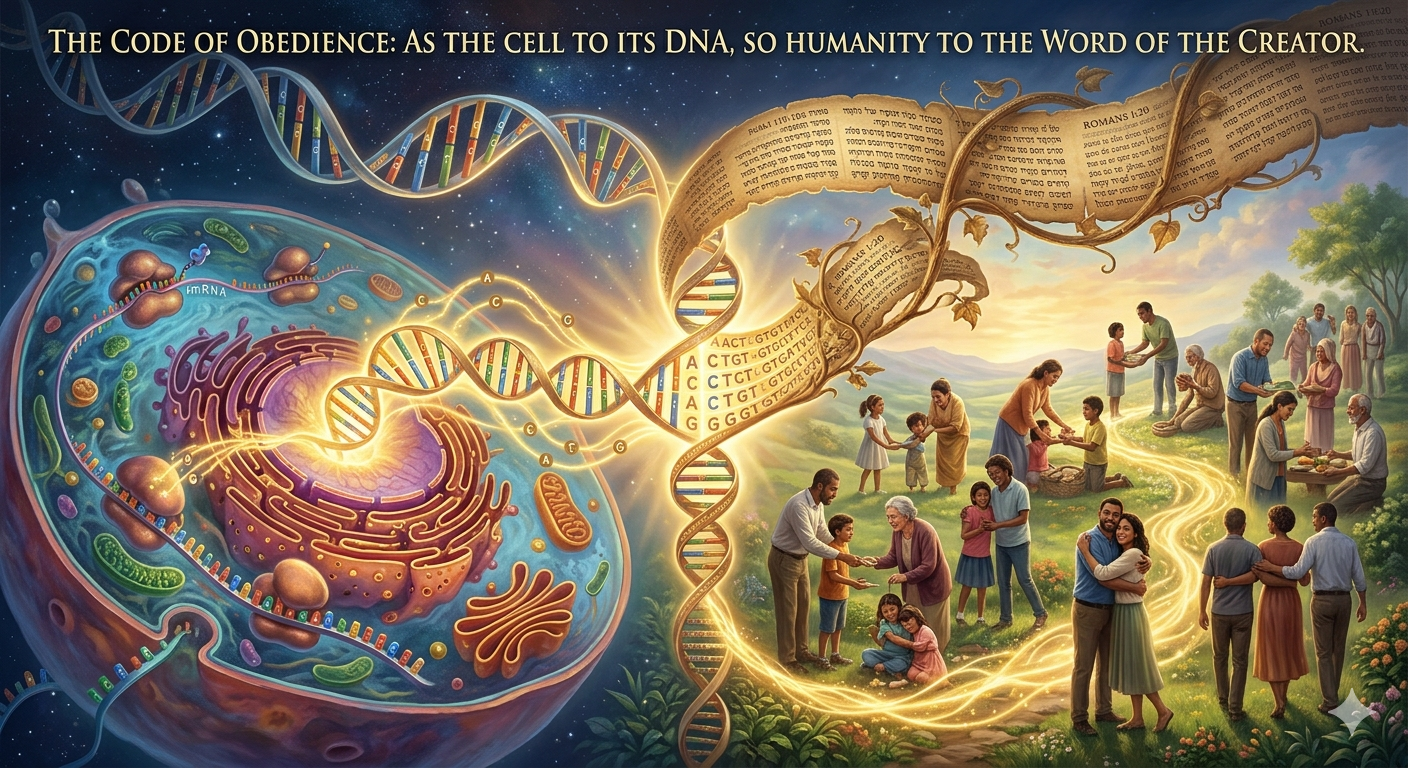
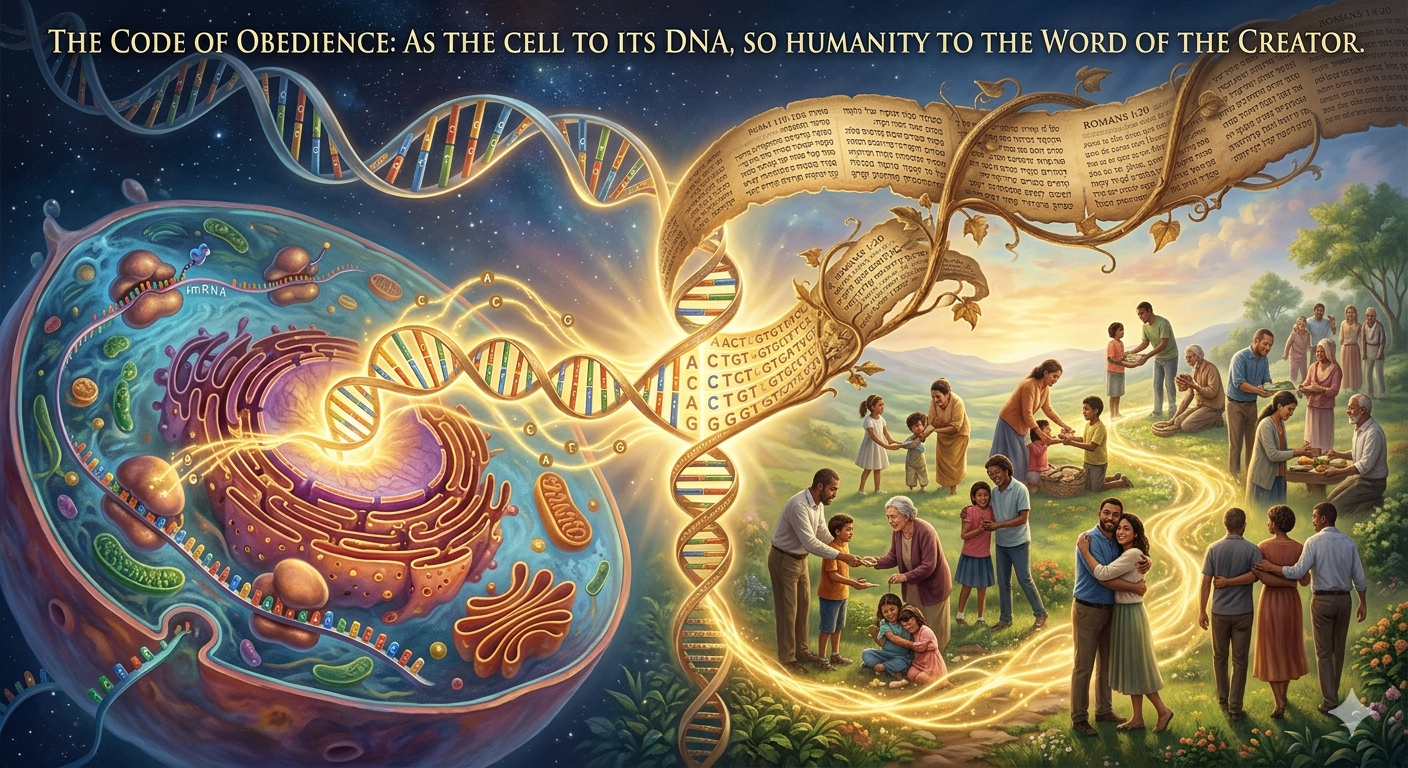
Every cell in your body has what scientists call a genome — a complete set of genetic instructions written in the language of DNA. The genome is, from the perspective of biblical faith, the cell's Bible. It is the complete instruction manual provided by the Creator for the operation of that cell. It tells the cell what to be, what to do, when to divide, when to stop dividing, how to repair itself, how to communicate with neighboring cells, when to die (a process called apoptosis — the cell's own obedience unto death when the instruction so requires it). It is a document of staggering complexity and breathtaking precision, and the cell's obedience to it is what we call health.
Now observe the parallel that this essay asks you to hold in your mind with absolute seriousness: your body's instruction manual — the document that tells you what to be, what to do, how to relate to other people, when to speak and when to be silent, what to wear, how to worship, what to consume, how to treat your body and the bodies of others — is the Bible. It is the complete instruction manual provided by the Creator for the operation of a human being. The relationship between the two documents is not metaphorical. It is architectural. The same Creator who wrote the cellular genome wrote the human behavioral genome. And just as the cell that disobeys its genome becomes cancerous, the human who disobeys their biblical instruction creates the conditions for cancerous breakdown at every level — physical, spiritual, relational, societal.
The scientists in their laboratories are frantically trying to figure out how to force cancer cells back into obedience to their genetic instruction. They are spending billions of dollars, employing thousands of brilliant minds, generating an almost incomprehensible volume of research — all aimed at the same goal: restoring cellular obedience. And they are doing this in bodies operated by people who have absolutely no intention of restoring their own obedience to the instruction given to them by the same Creator who wrote the cellular code.
The absurdity of this situation is difficult to fully convey. The human race is engaged in a desperate, multi-generational, trillion-dollar effort to force its cells to obey their instruction — while categorically, comprehensively, and often proudly refusing to obey its own. We want our cells to do what they're told. We just don't want to do what we're told.
And we cannot understand why the cancer keeps coming.
Chapter 10: The Science of Disobedience
Modern science has identified numerous environmental and behavioral factors that increase cancer risk. Smoking, excessive alcohol consumption, exposure to certain chemicals, chronic inflammation, obesity, sedentary lifestyle, certain viral infections, disrupted sleep patterns — these are among the documented contributors to cancer risk that the scientific literature has established with reasonable confidence. Biblical believers notice something interesting about this list: virtually every item on it corresponds to a pattern of behavior that the Bible either explicitly prohibits or implicitly warns against.
The Bible prohibits drunkenness (Ephesians 5:18) — and chronic alcohol use is a documented cancer risk. The Bible commands the care of the body as a temple of the Holy Spirit (1 Corinthians 6:19-20) — and the sedentary, over-indulgent lifestyle that modern culture normalizes is precisely the kind of body-misuse that the Bible warns against. The Bible commands sexual purity (1 Thessalonians 4:3-5) — and certain sexually transmitted infections, enabled by patterns of sexual behavior that the Bible prohibits, are directly linked to specific cancers. The Bible commands rest — a Sabbath rhythm of work and recuperation (Exodus 20:8-11) — and chronic sleep disruption is associated with immune system dysfunction that can create conditions favorable to cancer development.
This is not coincidence. The Creator who wrote the cellular instruction manual and the Creator who wrote the human behavioral instruction manual are the same Creator. The instructions are consistent because the Creation is consistent. Obeying the human instruction manual maintains the conditions under which the cellular instruction manual can function optimally. Disobeying the human instruction manual degrades those conditions, creating the cellular environment in which disobedience — cancer — flourishes.
But notice what the scientific establishment does with this correlation: it treats the behavioral factors as independent variables to be addressed through education and public health campaigns, entirely divorced from any concept of a binding moral law or divine covenant. "Smoking causes cancer" is treated as a public health message, not a theological one. "Excessive alcohol use increases cancer risk" is treated as a medical finding, not a divine warning. The connection between behavior and disease is acknowledged at the epidemiological level while the biblical framework that gives that connection its deepest meaning is categorically excluded from the conversation.
This exclusion is not intellectually neutral. It is a decision — a choice — to study the effects of human behavior on cellular biology while deliberately refusing to consider the source of the behavioral norms whose violation produces those effects. It is the equivalent of studying the effects of ignoring an aircraft's maintenance manual on the aircraft's performance while refusing to acknowledge that the aircraft had a manufacturer who wrote the manual and knew exactly what would happen if it was ignored.
Science, in its current form, has built the most sophisticated blindfold in human history. It sees with extraordinary precision at the molecular level. It sees absolutely nothing at the covenantal level. And it is the covenantal level that determines everything.
Chapter 11: Why the Cure Cannot Come From Nature
This brings us to one of the most persistent and emotionally compelling alternatives to conventional cancer treatment that circulates in the culture: the idea that somewhere in the natural world — in a particular plant, a particular diet, a particular combination of herbs and roots and seeds — there exists a cure for cancer that has been either suppressed by the pharmaceutical industry or simply not yet discovered by mainstream science.
This idea has enormous cultural currency. It circulates constantly on social media, in wellness communities, in certain religious communities that have attached the concept of "natural" to "good" and "pharmaceutical" to "evil," and among people who find the violence of chemotherapy and radiation so disturbing that they prefer the comfort of believing that a gentler answer exists.
Let this be said clearly, with no softening: there is no vegetable that will cure cancer. There is no herb, no essential oil, no alkaline diet, no juice fast, no crystal, no frequency of sound, no positive thinking protocol, no prayer technique, no laying-on-of-hands service that will reliably and permanently cure cancer in a person who has not addressed the covenantal conditions that allowed the executioner to arrive in the first place.
This is not a statement against the general healthfulness of good nutrition. Eating well is obedience to the body's needs, and it is part of the stewardship of the physical temple that the Bible commands. This is a specific statement about the belief that cancer — the executioner, the instrument of divine covenant abandonment — can be defeated by anything that does not address the covenantal reality at the root of the disease.
Consider the logic of the covenant. If cancer is the consequence of divine protection being withdrawn — if it is the cellular expression of a spiritual reality in which the individual's body is no longer covered by the mercy of the Creator — then the restoration of that protection requires the restoration of the covenant relationship. A vegetable cannot restore a covenant relationship. A diet cannot restore a covenant relationship. Only obedience to the terms of the covenant — the comprehensive, thorough, uncompromising obedience to every law in the Bible — can restore the covenant relationship. And only the restoration of the covenant relationship can address the root cause of the disease.
This is also why the biblical route — the only route that actually addresses the root cause — is so extraordinarily difficult. Not because obedience to the Bible is complex or arcane, but because the human will is so powerfully conditioned toward disobedience, so deeply invested in its own desires and preferences, so thoroughly convinced by religion and culture that no serious change is actually required, that genuine covenant restoration is essentially impossible for any person operating from within the religious framework that currently dominates the world.
No one on earth — virtually no one — knows how to obey the Bible the way it requires to be obeyed. Not because the instructions are unclear. They are remarkably clear. But because the human will has been so comprehensively formed by disobedience, so deeply shaped by the habits and appetites and social pressures of a civilization that has rejected the covenant, that even people who sincerely want to obey find themselves unable to do so consistently. And behind closed doors — in the private spaces where God's presence is known but social accountability is absent — the patterns of disobedience that people maintain in their public Christian performance inevitably reassert themselves.
God knows what happens behind closed doors. The Bible is explicit about this: "Nothing in all creation is hidden from God's sight. Everything is uncovered and laid bare before the eyes of him to whom we must give account" (Hebrews 4:13). The person who performs biblical obedience in public while maintaining patterns of private disobedience — in their watching habits, in their thoughts, in their relationships, in their private indulgences — is not obeying the Bible. They are performing religion. And performance cannot restore a covenant.
---
PART FIVE: Idolatry, Holiday Worship, and the Theft of God's Glory
Chapter 12: What the Bible Actually Means by Idolatry
It is necessary, before proceeding further, to establish a precise and biblically accurate definition of the word idolatry — because in contemporary religious and cultural usage, this word has been stretched so far from its biblical meaning that it has become functionally useless as a theological category.
In contemporary usage, Christians commonly refer to anything they are "too attached to" as an idol. Your smartphone can be an idol. Your career can be an idol. Your children can be an idol. Your desire for approval can be an idol. This broad, metaphorical use of the term has a certain psychological validity — it captures something true about the human tendency to place created things in the position that the Creator should occupy in our hearts. But it is not what the Bible means by idolatry, and conflating the two meanings has had significant consequences for how biblical believers understand what the Bible is actually prohibiting.
In the Bible — in the specific passages where the word idolatry (or its Hebrew and Greek equivalents) appears in condemnatory terms — it refers to a very specific set of practices: the worship of physical objects or images as divine beings, the offering of sacrifices to false gods, the participation in the ritual religious practices associated with the worship of those false gods. The golden calf incident in Exodus 32 is the paradigmatic example. The Israelites did not merely develop an excessive attachment to the calf. They built a physical object, declared it to be the deity who had delivered them from Egypt, and organized a worship festival around it. That is idolatry. The wholesale adoption of the ritual practices of surrounding pagan cultures — the burning of incense to Baal, the passing of children through fire to Molech, the fertility cult practices associated with Asherah — that is idolatry.
The Bible does not use the word idolatry to describe covetousness, or pride, or excessive affection for legitimate goods. Paul's statement in Colossians 3:5 that "greed, which is idolatry," is a comparative statement — he is saying that greed functions like idolatry in that it places the creation above the Creator — not a definition of idolatry as such.
Why does this matter? Because there is a specific category of human behavior — the celebration of religious holidays that were not commanded by God, that were invented by human beings, that are organized around objects and rituals and characters that the Bible never authorized — that is being systematically mislabeled in contemporary religious discourse, and that mislabeling is protecting people from understanding what they are actually doing.
When a family decorates a tree, places lights around their home, exchanges gifts, sings songs dedicated to a season, gathers for a feast, and does all of this in the name of celebrating the birth of Jesus — even though Jesus was not born in December, even though the Bible nowhere commands the celebration of His birthday, even though the tree and the feast and the season and most of the associated rituals have origins in pre-Christian religious practices that the God of the Bible specifically forbade His people to adopt — they are engaging in the worship of an invented religious object. The celebration of Christmas is not Christian worship. It is the worship of a holiday — a human-constructed religious event built around human-invented customs — in the name of a God who never asked to be worshiped this way and who, in fact, explicitly warned His people not to worship Him in the way that surrounding cultures worshiped their gods (Deuteronomy 12:4, 12:30-31).
The same analysis applies to Easter — a celebration organized around a specific date, specific food customs, specific imagery (eggs, rabbits, the specific character of a spring resurrection celebration) that combines genuine Christian theological content (the resurrection of Christ) with a ritual framework that the Bible never authorized. And to Thanksgiving — with its sacred feast, its annual ritual of gratitude performance, its deeply ingrained cultural meaning as a religious event of harvest celebration. And to every other holiday in the calendar of modern religion that has been invented by human beings, decorated with religious meaning, and presented to God as worship.
God did not ask for any of this. And the God of the Bible has made His view of unsolicited worship innovations very clear: "You shall not worship the Lord your God in that way, because every abominable thing that the Lord hates they have done for their gods" (Deuteronomy 12:31). The celebration of holidays invented by human beings — each with its sacred feast, each with its mascots (Santa Claus, the Easter Bunny, the Thanksgiving turkey), each with its assigned songs and decorations and rituals — is not biblical worship. It is the worship of human-invented religious objects. And that worship, whatever name it is given, is what the Bible means when it speaks of bowing down to the golden calf.
This is the thing that the most apparently holy people — the people in the congregation who refuse makeup and jewelry and immodest dress, who take their biblical obedience seriously in every area they have been taught to consider — consistently fail to understand. They bow down to their golden calves twice a year, three times a year, five times a year, and they do it with songs and feasts and specially decorated homes, and they call it worship of the Most High God. And God, who knows what the golden calf actually is and has never forgotten what He said about it, is not moved by their sincerity. He is displeased by their disobedience.
This is the great tragedy of the genuinely devout — the biblical believers who have stripped away so many layers of religious compromise and who are walking in real obedience in so many areas of their lives — who still get sick, who still face the executioner. It is not because their obedience has been meaningless. It is because there remains in their practice a form of worship that they have been taught to call obedience but that God has never received as such.
---
PART SIX: The Human Body as Covenant Temple
Chapter 13: "It's My Body, My Choice" — The Most Dangerous Theology in History
There is a phrase that has become, in contemporary Western culture, something very close to a sacred creed. It appears on protest signs and in political speeches and in the comment sections of YouTube videos. It is invoked in discussions of reproductive rights, in discussions of drug use, in discussions of sexual practice, in discussions of tattooing and body modification, in discussions of diet and exercise and medical decision-making. The phrase is: "It's my body, my choice."
From a purely secular perspective, this phrase represents the assertion of individual bodily autonomy as a fundamental human right — the claim that each person has sovereign authority over what happens to their own body and that no external authority — legal, cultural, religious, or otherwise — has the right to override that sovereignty.
From a biblical perspective, this phrase is among the most dangerous and most consequential lies that a human being can believe about themselves. And the fact that it is so widely held, so culturally celebrated, and so thoroughly normalized is itself a symptom of the very condition that is producing the epidemic of cancer and incurable disease that the scientific establishment cannot explain.
Here is the biblical reality: your body does not belong to you.
This is not a metaphor. This is not a spiritual sentiment. This is a statement of ontological fact — a fact about the nature of reality as it actually is, not as we prefer it to be. The Bible states it plainly in 1 Corinthians 6:19-20: "Do you not know that your bodies are temples of the Holy Spirit, who is in you, whom you have received from God? You are not your own; you were bought at a price. Therefore honor God with your bodies."
You are not your own. This is the exact opposite of "it's my body, my choice." Your body was designed by its Creator. It was given to you for a specific purpose — the purpose stated earlier in this essay: to build your soul through obedience to the biblical covenant, to demonstrate to your Creator through the choices you make in this physical life that you are worthy of the Kingdom He has prepared for those who love Him. Your body is the instrument through which that demonstration takes place. It is a sacred instrument, an instrument of worship, an instrument of covenant. It is not a pleasure vehicle. It is not a canvas for your self-expression. It is not raw material to be modified and decorated and used according to your personal preferences. It is a covenant temple, given to you in trust, to be maintained and operated according to the specifications of its Creator.
When you misuse the instrument — when you use it in ways that violate the biblical specifications for its operation — you are not merely making a personal lifestyle choice. You are committing covenant breach. You are declaring, in the most practical and physical possible terms, that you do not accept the authority of the Creator over what He created. And the Creator, who takes covenant breach seriously, removes His active protection from the instrument you have misused.
This is the mechanism. This is why the body of the person who uses it in persistent, comprehensive violation of biblical law becomes vulnerable to the executioner. It is not that God programs cancer into the DNA of disobedient people as a direct punishment. It is that His active protection — the covenant covering that maintains the cellular environment in its proper ordered state — is withdrawn when the human refuses the covenant. The executioner does not need God to send it. It only needs God to stop holding it back. And when covenant breach is persistent, willful, and unrepentant, God stops holding it back.
Chapter 14: What Happens to the Temple When You Tattoo It
The young woman who tattooed her entire arm for her boyfriend — whose story opens this essay — is a case study in the contemporary refusal to understand the body as a covenant temple. She is a young woman living in the cultural framework that says: "My body is my own. I will express myself through it. I will mark it as a sign of love and commitment. I will demonstrate the depth of my feeling through permanent physical modification."
Every part of this cultural framework is in direct conflict with the biblical covenant.
The Bible prohibits the tattooing of the body (Leviticus 19:28) — not as a cultural custom specific to ancient Israel, but as a statement about the nature of the body itself. The body belongs to God. Therefore the body is not to be permanently marked by human choices, because permanent marks claim permanent ownership, and the only One with permanent ownership of the human body is its Creator.
But beyond the specific prohibition of tattooing, the behavior of this young woman reveals the deeper pattern that this essay is concerned with: the complete absence of any reference to God's authority in the decisions she makes about her own body. Her tattoo decision was made entirely within the framework of human relationship and emotional expression. The question she asked was: "How do I express my love for this person? How do I demonstrate commitment? How do I make this relationship visible?" She never asked: "What does my Creator require of me in how I use this body He gave me? What does His instruction manual say about permanent body modification? What are the covenant implications of this choice?"
She never asked because, like the vast majority of people in the modern world — including the vast majority of people who identify as Christians — she does not understand her life to be lived within a covenant framework. She understands herself to be an autonomous individual making personal choices. She may believe in God in some general sense. She may attend religious services. She may describe herself as spiritual. But the specific, comprehensive, binding authority of the biblical text over the specific, practical, daily choices of her embodied life is simply not part of her operative reality.
This is what religion has produced. A world of people who believe in God without being accountable to Him. Who call themselves His children without obeying His house rules. Who expect His protection without accepting His authority. Who want the benefits of the covenant without the obligations.
And when the executioner comes — when the body that has been treated as personal property rather than covenant temple develops the disease that signals the withdrawal of covenant protection — they are shocked. They are bewildered. They pray. Their religious community prays with them. And when the prayers go unanswered, they conclude that God is mysterious, that His ways are higher than our ways, that sometimes healing is not His will.
The Bible has a simpler and more honest explanation: the prayers are not answered because they are not being heard. And they are not being heard because the person praying is not righteous in the biblical sense — not because they are a terrible person by human social standards, but because they have not accepted and maintained the covenant obligations that define biblical righteousness.
This is not cruelty. This is justice. And it is mercy — because the very disease that signals covenant abandonment is also, in the logic of the covenant, an opportunity for covenant restoration. The arrival of the executioner is not the end of the story. It is a summons. It is God saying, in the loudest voice available to Him in a world that has refused all His quieter voices: "I need your attention. You have been living outside the covenant. The evidence of that is now in your body. The question is what you will do with this summons."
Most people, as this essay has documented, respond to the summons by doing everything except what the summons requires. They intensify their religious activity. They try natural cures. They seek conventional treatment (which is the appropriate medical response, as this essay has argued). They document their journey on YouTube. They make bucket lists. They pursue the dreams they had deferred. They reconcile with family members. They do everything — except the one thing that the summons is calling them to: comprehensive, uncompromising, unreserved surrender to the authority of the biblical covenant over every area of their lives.
---
PART SEVEN: Conventional Treatment and the Covenant Responsibility
Chapter 15: Why Conventional Treatment Is Your Only Medical Option
Let this be stated without ambiguity: if you have been diagnosed with cancer, you must pursue conventional medical treatment. Chemotherapy, radiation, immunotherapy, targeted therapy, surgery — whatever your oncologist recommends based on the specific nature of your disease — you must pursue it. This is not a recommendation. This is a covenant responsibility.
Here is why: if you have cancer, you are, by the spiritual logic laid out in this essay, outside the active covenant protection of God. This means that miraculous healing is not your available option. The channel through which miraculous healing would flow — the covenant relationship in which God's mercy actively operates in and through the body of the obedient — is not currently open to you. You may wish it were. You may pray with extraordinary intensity and sincerity that it were. But the Bible has told you that God does not hear the prayers of the disobedient. And if you have cancer, you are, by definition, living in a state that the Bible has consistently associated with the withdrawal of divine protection.
In this state, conventional medicine is the gift God has allowed to exist in the world for people who are outside covenant protection. It is not a perfect gift. Chemotherapy is extraordinarily violent — a treatment that kills the disobedient cells at the cost of also damaging the obedient ones, like a military campaign that destroys a city to liberate it from occupation. Radiation is similarly brutal. These treatments exact enormous costs from the body. But they are the human medical system's best current approximation of what the divine protective system does naturally and effortlessly in the body of the person living in covenant obedience.
The natural treatments — the vegetables and herbs and juice protocols and alkaline diets — are not the equivalent of conventional medicine for the cancer patient outside covenant protection. They are not without value as general health practices. But they are not capable of restraining an executioner that God has stopped restraining. The executioner is not a mild cellular inconvenience that responds to dietary modification. It is a comprehensive systemic assault on the biological order of the body, and it requires the most powerful interventions available in the human medical system to have any chance of providing temporary relief.
"Temporary" is the operative word. And this is the hardest truth in this essay. Even conventional treatment, in the absence of covenant restoration, is fighting against a tide. Chemotherapy may put the cancer into remission. But if the person has not addressed the covenantal conditions that allowed the executioner to arrive — if they continue to live in the same patterns of biblical disobedience, if they continue to practice the same forms of human-invented holiday worship, if they continue to use their body in the same ways that the Bible prohibits — the remission is a reprieve, not a resolution. The executioner has been temporarily restrained by human medicine, not by covenant restoration.
The cancer will come back. Or it will be followed by another form of the executioner's work. Because the root cause has not been addressed.
This is the message that no oncologist can deliver. It is not within the scope of their training, their expertise, or their professional framework. They are working within the biological dimension of a problem that has a spiritual dimension they have categorically excluded from their field. They can treat the symptom. They cannot address the cause. Only the patient can address the cause, and only by doing the thing that this essay has argued is the most difficult thing a human being can do in the current cultural environment: returning to comprehensive, uncompromising obedience to the biblical covenant.
Chapter 16: The Insult of the Natural Cure Fantasy
Why does the natural cure fantasy — the belief that a plant or a diet or an alternative protocol will cure cancer — deserve the word "insult" in this context?
It is an insult to the children of God who understand what the executioner actually is. Those who know — who have been given the understanding of the covenant mechanism by which cancer operates — and who watch others turn to vegetable juice and essential oils and alkaline water in response to a divine summons, feel a grief that is difficult to articulate. It is the grief of watching someone respond to an urgent communication from the most important Person in the universe by taking a walk in the garden and eating an apple.
The natural cure fantasy is insulting not because nature is bad — God created nature, and the natural world is full of His wisdom and provision — but because it represents a fundamental misunderstanding of what is happening. It treats cancer as a nutritional deficiency problem when it is a covenant deficiency problem. It treats the body as a biochemical system that has gone wrong when it is a covenant temple that has been abandoned. It directs the patient's energy and hope toward the natural world when the only meaningful direction of their energy and hope is toward the God of the covenant.
Moreover — and this is the part that should give every person who believes in natural cancer cures pause — if there were truly a plant-based or dietary cure for cancer, cancer would not have the reputation it has. Cancer is the most feared diagnosis in the world. It is feared because it is real, because it is destructive, because conventional medicine has not solved it, and because the human body, operating without covenant protection, cannot reliably defeat it through any natural means. The fear that cancer generates worldwide is itself a testimony to its nature — to its identity as the instrument of divine covenant withdrawal, operating with an authority that no human remedy has the power to override.
This does not mean that good nutrition, adequate sleep, regular physical activity, and the avoidance of known carcinogens are not worthwhile. They are worthwhile — as expressions of good stewardship of the covenant temple, as general practices of obedience to the body's created needs. But they are maintenance practices, not remedies. They are appropriate behavior for a person in covenant, not emergency treatments for a person under judgment.
The person who has received the cancer diagnosis and turns to natural treatments is like a person whose house is on fire who responds by repainting the mailbox. The maintenance task is not wrong. It is simply radically, catastrophically inadequate for the emergency that is actually occurring.
---
PART EIGHT: The Knowledge That Saves and the Knowledge That Is Rejected
Chapter 17: "Destroyed for Lack of Knowledge" — What Knowledge?
The verse from Hosea 4:6 that frames this essay — "My people are destroyed for lack of knowledge" — is not speaking about scientific knowledge, medical knowledge, or cultural knowledge. It is speaking about knowledge of God. Specifically, it is speaking about knowledge of God as He has revealed Himself in His covenant — His requirements, His warnings, His judgments, and His promises.
The full verse continues: "Because you have rejected knowledge, I will also reject you as my priests; because you have ignored the law of your God, I also will ignore your children." This is not a statement about people who simply never had access to God's revelation. It is a statement about people who had access to the knowledge and chose to reject it. The destruction of God's people in Hosea's time — and in our time — is not primarily the product of ignorance. It is the product of willful, culturally reinforced, emotionally driven rejection of knowledge that was available but inconvenient.
The knowledge is available today. The Bible is the most widely distributed book in human history. It is available in digital form on virtually every device on earth. It has been translated into thousands of languages. In Western nations, there is almost no one who cannot access it. And yet the majority of people who identify as Christians have never read it completely, have not read it recently, and do not organize their lives around its requirements. They know the Bible exists. They may know certain verses. But they have not received its actual knowledge — the comprehensive, specific, binding knowledge of what God requires — because receiving that knowledge would require them to change their lives in ways they are not willing to change them.
This is the rejection that Hosea is describing. And it is the rejection that produces destruction.
The destruction takes many forms. It takes the form of incurable disease. It takes the form of fractured families and broken communities and societies without moral coherence. It takes the form of children raised in spiritual vacancy who grow up with no framework for understanding why they are alive or what their lives are for. It takes the form of dying people making desperate, lawless choices in their final months because no one ever told them that those choices have eternal consequences. It takes the form of cancer patients turning to carrot juice and essential oils while God waits, as He has always waited, for the people He created to turn to Him in genuine repentance and covenant return.
Chapter 18: The Stubbornness That Stands Between Humans and Truth
One of the most consistently observed features of the attempt to communicate biblical truth to people living outside the covenant is the stubbornness — the active, defended, emotionally invested stubbornness — with which the communication is resisted. This stubbornness is not random. It is not simply personality. It is, from a biblical perspective, a spiritual phenomenon — the operation of the same dark force that has been at work since the Garden, the same entity whose entire purpose is to keep human beings separated from the knowledge that would return them to covenant relationship with their Creator.
The experience of trying to share the truth of biblical covenant with someone who has never actually encountered it — not the religion-flavored version, but the actual biblical truth — is one of the most disorienting experiences available to a human being. It is disorienting because the resistance is not primarily intellectual. It is not that people hear the argument and find logical flaws in it. It is that something activates in people the moment the actual demands of the biblical covenant are articulated — something that produces defensiveness, anger, rationalization, subject-changing, and ultimately dismissal — and that something operates with a consistency and a power that suggests it is not merely a personal psychological phenomenon.
The Bible describes this phenomenon in 2 Corinthians 4:4: "The god of this age has blinded the minds of unbelievers, so that they cannot see the light of the gospel of the glory of Christ, who is the image of God." The people who resist the knowledge are not simply stubborn individuals. They are blind — not by accident, not because of personal deficiency, but because of a spiritual adversary whose interest is served by their continued blindness. This does not excuse the individual from the responsibility of seeking truth. The blind can ask for sight. The person under spiritual blindness can cry out to God for the scales to be removed from their eyes. But they must want it — they must desire truth more than they desire the comfort of their current belief system — and that desire is extraordinarily rare.
The resistance takes predictable forms. When told that the Bible prohibits makeup and jewelry, people invoke 1 Samuel 16:7 — the God-looks-at-the-heart verse — as if God's ability to see the heart overrides His stated preferences about the body. When told that holiday celebrations are forms of human-invented worship that the Bible does not authorize, people invoke the sincerity of their devotion — "I'm sure God is happy that we celebrate His birthday" — as if sincerity transforms disobedience into obedience. When told that remarriage after divorce constitutes adultery, people invoke the difficulty of their previous marriage situation, the needs of their children, the emotional reality of their current relationship — as if the complexity of human circumstances can rewrite the clear statements of biblical law.
None of these objections engage with the actual biblical text on its own terms. They are all forms of the same fundamental response: "I will not allow this text to have authority over my life choices." They are all, in the language of Hosea, rejections of knowledge. And they all, by the logic of the covenant, contribute to the conditions of destruction.
---
PART NINE: The Secret Life and the God Who Sees It
Chapter 19: What Happens Behind Closed Doors
The most consequential arena of human life — the arena that determines more about a person's covenant standing than any other — is not the church service or the prayer meeting or the public declaration of faith. It is what happens behind closed doors. It is the private life, the interior life, the life that is conducted in the spaces where no human observer is present and where the only witness is God.
This is where the covenant is either kept or broken. This is where the real character of the person is formed and revealed. And this is the arena that is most systematically neglected, most comprehensively compromised, and most thoroughly protected from any form of external accountability in the current religious landscape.
The phenomenon of the double life — the public performance of religious virtue combined with private patterns of comprehensive disobedience — is not new. The Bible addresses it extensively. Jesus's most scathing condemnations were directed not at the openly irreligious but at the religious performers — the Pharisees, who maintained elaborate public displays of covenant faithfulness while their private lives were characterized by pride, greed, lust, and contempt for the very people they were supposed to serve. The Bible calls this hypocrisy — not merely lying to others about who you are, but lying to God, which is the graver offense.
But in the contemporary context, the double life has been so thoroughly normalized by religion that many people do not even recognize it as hypocrisy. They have been told by their pastors and their religious community that what they do in private is between them and God — which is true — and they have interpreted this to mean that what they do in private is somehow exempt from the biblical requirements that apply to their public lives — which is catastrophically false. The privacy does not change the biblical standard. It only changes who among humans is aware of the violation.
God is aware. God has always been aware. And God, whose response to covenant breach is the withdrawal of covenant protection, is not fooled by public performances of religious conformity that are contradicted by private patterns of disobedience. The person who wears modest, gender-appropriate clothing to church on Sunday while watching pornography on Monday is not in covenant obedience. The person who removes their jewelry before attending a biblical fellowship while maintaining a secret Facebook account for their emotional affair is not in covenant obedience. The person who speaks publicly about the importance of biblical truth while privately consuming entertainment that celebrates everything the Bible condemns is not in covenant obedience.
And this is why the biblical route to healing — comprehensive covenant restoration — is, in practice, unavailable to virtually anyone alive today. Not because the requirements are impossible in theory. They are clearly articulated in the text. But because the human will, shaped by decades of private disobedience and reinforced by a culture that has normalized every form of covenant breach, is incapable — without a miracle of genuine, Spirit-given repentance — of achieving and maintaining the level of private consistency that genuine covenant restoration requires.
This is not a council of despair. It is an honest accounting of the human situation, which the Bible itself describes in terms that leave no room for illusion: "The heart is deceitful above all things, and desperately wicked: who can know it?" (Jeremiah 17:9). The human heart — which religion has told us to trust, which culture has elevated as the ultimate authority in personal decision-making — is, by the Bible's own assessment, the seat of the deception that keeps people in disobedience. To cure the heart requires a power greater than the heart itself. It requires the transforming work of the Holy Spirit in a life genuinely surrendered to the complete authority of the biblical covenant.
That genuinely surrendered life is extraordinarily rare. And the knowledge of its rarity — the knowledge of how thoroughly the human race has become addicted to its private disobediences, how deeply the patterns of covenant breach have been embedded in the interior life of the species — is one of the most sobering things that a biblical believer can carry.
Chapter 20: The Science of Addiction and Its Spiritual Dimension
Modern neuroscience has documented with considerable precision the way in which repeated behaviors create neural pathways that make those behaviors increasingly automatic and decreasingly subject to conscious deliberation. What begins as a choice becomes a habit. What becomes a habit becomes, with sufficient repetition, something very close to a compulsion. The neurochemistry of reward — the dopamine system that responds to pleasurable stimuli — is the biological mechanism through which behaviors that begin as choices become, over time, extremely difficult to change.
This is the neuroscience of addiction. And it applies not only to substances but to behaviors — to patterns of sexual behavior, to patterns of consumption, to patterns of entertainment, to patterns of social interaction and self-presentation. The human race, as a species, has been practicing its preferred forms of biblical disobedience for so long — for so many generations — that the disobediences have become neurologically embedded. They have become the default. They have become, in many cases, genuinely experienced as natural — as expressions of who a person essentially is rather than choices they are making.
This is what the Bible means when it says, in Romans 7:15-19: "For I do not understand my own actions. For I do not do what I want, but I do the very thing I hate... For I have the desire to do what is right, but not the ability to carry it out. For I do not do the good I want, but the evil I do not want is what I keep on doing." This is the testimony of a person who understands the biblical requirement and genuinely wants to obey it, but who finds themselves caught in patterns of behavior that override their desire for obedience. This is the human condition as the Bible honestly describes it.
Religion has responded to this honest biblical assessment of the human condition by lowering the standard — by redefining obedience downward until it becomes compatible with the behaviors that people are actually engaging in. Religion has told people that grace covers their ongoing disobediences, that God understands their struggles, that the standard of complete covenant faithfulness was never really meant to be taken literally, that what God really wants is their heart even if their behavior doesn't fully reflect the biblical requirements.
Biblical faith does not lower the standard. Biblical faith acknowledges the honest reality of human weakness while insisting on the absolute validity of the standard. And it points to the only power capable of achieving genuine covenant transformation: not the human will operating on its own, not the religious program, not the accountability group or the counseling session or the support community — but the direct, transforming power of God in a life that has been genuinely and completely surrendered to His authority.
That surrender — genuine, total, and maintained in the private life as consistently as it is performed in the public life — is the narrow gate that the Bible describes in Matthew 7:14: "But small is the gate and narrow the road that leads to life, and only a few find it." Very few. Not because God has made the standard impossibly high out of cruelty, but because the human will is so thoroughly addicted to the broad road that finding and staying on the narrow one requires a level of divine grace that most people are not willing to humble themselves enough to ask for.
---
PART TEN: A Civilization Under Judgment
Chapter 21: When God Speaks Through Incurable Disease
There have been periods in human history when God communicated His covenant requirements through prophets — human beings called and equipped to articulate the divine message to communities that had departed from the covenant. The prophetic tradition in the Bible documents this communication in extraordinary detail: the specific warnings delivered to specific communities, the specific behaviors identified as covenant violations, the specific consequences announced for continued disobedience, and the specific conditions for restoration.
The prophetic tradition has not ended. But it has become, in the current cultural environment, almost completely inaudible — not because God has stopped speaking, but because the cultural machinery that processes information has been optimized to exclude every channel through which the divine voice might reach human ears. The entertainment industry, the news media, the educational establishment, the social media ecosystem — all of these systems have been built by and for a civilization that has decided that God is either nonexistent or irrelevant, and they function accordingly. The prophetic voice, when it does emerge, is immediately categorized and marginalized as religious extremism, fundamentalism, or mental illness.
So God speaks in the only language that cannot be categorized and dismissed: the language of the body. The language of disease. The language of incurable conditions that the scientific establishment cannot explain and cannot cure, that appear across all populations regardless of lifestyle and social status, that resist the most sophisticated treatments that human ingenuity has produced.
When God can no longer communicate through prophets — when every messenger He sends is dismissed, ridiculed, or ignored — He speaks through the body of the civilization itself. He speaks through the epidemic of cancer, the epidemic of autoimmune disease, the epidemic of mental illness, the epidemic of infertility and hormonal disruption, the epidemic of antibiotic-resistant infections. These are not random biological phenomena. They are a communication. They are God's voice reaching into a world that has blocked every other frequency on which He broadcasts.
The message is always the same: "My people are destroyed for lack of knowledge. Return to me. Accept the covenant. Live by my instruction. And the protection that my mercy affords will be restored to the bodies I created and to the society that operates in accordance with my design."
The world is not hearing this message. It is hearing it filtered through the frameworks of epidemiology and genetics and environmental science — all legitimate disciplines that provide partial, useful, true information about the mechanisms of disease while remaining constitutionally blind to its cause. The scientists are not lying. They are simply working within a framework that excludes the most important variable. They are studying the disease without knowing what the disease is.
Chapter 22: Why God Does Not Release the Cure
There is a question that haunts anyone who takes the argument of this essay seriously: if God has the power to cure cancer — and biblical faith affirms that He does — why does He not release that cure to the world? Why does He allow the suffering to continue? Why does He withhold from the human race the knowledge that would eliminate its most feared disease?
The answer to this question is among the most sobering realities in the biblical worldview, and it is one that the prosperity gospel — with its emphasis on God's desire for human health and wealth — is entirely incapable of addressing. The answer is this: releasing the cure for cancer to a civilization that has not returned to covenant obedience would be irresponsible. It would be the equivalent of a physician providing a patient with a drug that treats the symptom of a disease while the patient has no intention of addressing the behavior that is producing the disease.
Consider the logic of the covenant more carefully. If cancer is the consequence of covenant abandonment — if it is the mechanism by which a civilization that has rejected the knowledge of God experiences the natural consequences of that rejection — then curing cancer without restoring the covenant is not healing. It is simply preparing the way for something worse. The Bible itself documents this pattern: the removal of one divine judgment without covenant restoration does not result in covenant restoration. It results in the generation of conditions for an even more severe judgment. The history of Israel in the Old Testament is largely the documentation of this pattern: disobedience, judgment, temporary relief, more disobedience, worse judgment.
If God were to release the cure for cancer to a civilization that is worshiping its golden calves with more enthusiasm than ever, that is practicing every form of sexual disobedience the Bible prohibits with ever-increasing confidence in its right to do so, that is tattooing and painting and decorating and mutilating the covenant temple with ever-greater creativity — if God were to relieve that civilization of its most feared biological consequence while leaving all the covenant conditions that produce it entirely in place — He would be setting the stage for something that would make cancer look mild. He has said as much, through those rare vessels who are still able to hear His voice: "If people do not change their ways, I will send down diseases so horrific that there will be no medical intervention of any kind."
This is not a threat from a vengeful deity who enjoys human suffering. This is a statement from a Creator who understands the relationship between covenant obedience and created order, between human lawfulness and cellular lawfulness, between the covenant health of the whole person and the physical health of the body. He knows that the current order of things — the suffering is real, the fear is real, the losses are real — is actually more merciful than what the continuation of covenant breach will eventually produce. He is holding back the worst while extending the invitation to return.
And the invitation is not being accepted.
Chapter 23: The Judgment That No One Can Escape
Every person who has ever received a cancer diagnosis — every person who is currently vlogging their journey, documenting their decline, sharing their bucket list, making their peace with the world — will eventually stand before the Judge. The cancer will either take them or it will not. Conventional medicine may extend their life. It may put the disease into remission. They may live for years after the diagnosis. Or they may die quickly. All of these are physical outcomes, and they are all temporary. What is not temporary is what follows.
The Bible describes with consistent clarity what follows the end of the physical life: "It is appointed for man to die once, and after that comes judgment" (Hebrews 9:27). The judgment is not of earthly achievements or earthly sufferings. It is of the life lived in relationship — or non-relationship — with the covenant God who created the person, wrote them their instruction manual, and waited throughout their physical life for them to accept His authority and return to His terms.
The grandfather who wanted to murder his daughter's abusive boyfriend because the cancer was going to kill him anyway — who calculated that the legal consequences of the murder would be irrelevant because he would be dead before the trial — made a calculation that failed to account for the most important variable. He accounted for earthly legal consequences. He did not account for the eternal judicial consequences. He reasoned as though the cancer was the end. The Bible says the cancer is the beginning of the end — and that what comes after the end is the judgment that matters more than every cancer and every prison sentence and every earthly consequence combined.
The homosexual couple who wanted to make their relationship official before death — who saw in the diagnosis an occasion to legitimize what they had lived and loved — made their declaration to the world without making their account to the God who defines what marriage is. They may have found genuine comfort and human dignity in that ceremony. But the comfort and dignity of the earthly ceremony does not change the terms of the divine accounting. And the divine accounting does not look at the sincerity of the earthly ceremony. It looks at the covenant relationship.
This is the truth that no one alive today wants to say out loud. It is the truth that feels heartless, that sounds cruel, that has been effectively silenced by a culture that has decided that divine judgment is incompatible with divine love and therefore must not exist. But the Bible does not offer this as one perspective among many. It offers it as the most important fact of human existence. It is the fact for which every other fact in human life must be organized. It is the lens through which cancer and conventional treatment and natural cures and dying wishes and tattoos and homosexual marriages and grandfather's murderous impulses must all be understood.
God is real. His covenant is binding. His judgment is coming. And the question — the only question that matters in the life of every human being who has ever received a cancer diagnosis or who has watched someone else receive one — is: do you know the real God? Not the religious version. Not the prosperity gospel version. Not the "God loves you just as you are" version. Not the "God only looks at the heart" version.
Do you know the God of the Bible? The God who wrote the instruction manual for the human body? The God who established the covenant whose terms determine whether His protection covers you or not? The God who hears only the prayers of the righteous? The God who will, on that great day of judgment, look not at your earthly performance of religion but at your actual covenant standing?
If you do not know that God — if you have been, like so many millions around the world, sustained by a religious framework that has protected you from knowing that God — then what you have been reading in this essay is the most urgent communication you have ever received.
---
PART ELEVEN: The Outer Appearance and the Covenant Identity
Chapter 24: Why God Cares What You Look Like
One of the most contested claims in this essay — contested not by secular culture alone but by the majority of contemporary religion — is the claim that God cares about the physical appearance of His people. That He has strong, specific, documented preferences about what His children wear, how they present their bodies, what they put on their faces and hang from their ears, how they cut or do not cut their hair, whether the clothing they wear is appropriate to their sex. That these preferences are not peripheral, culturally conditioned suggestions but binding covenant requirements whose violation carries spiritual consequences.
Religion has spent considerable energy persuading its adherents that this cannot be right. That a God of grace could not possibly be concerned with such superficialities. That the inner life — the heart, the soul, the quality of one's love for God and neighbor — is what matters, and that the outer presentation of the body is morally and spiritually neutral. That a woman wearing makeup and jewelry is in exactly the same covenant standing as a woman who does not, provided both have the same heart toward God.
This position is not biblical. It is convenient, but it is not biblical.
Consider what the claim actually requires us to believe. We must believe that the same Creator who engineered the human body with trillions of precisely coded cells, each obeying a specific genetic instruction that governs exactly how it presents itself — its surface proteins, its membrane composition, its receptor configuration — somehow has no preferences about how the whole person presents themselves. We must believe that the Author of a book that contains specific instructions about clothing, jewelry, hair length, makeup, and gender-appropriate dress intended those instructions to be ignored. We must believe that God, who is described throughout the Bible as a Father who takes responsibility for the appearance of His children, is somehow indifferent to how those children actually look.
This is not the God of the Bible. The God of the Bible is a God of extraordinary specificity. He specified the exact dimensions of the Ark of the Covenant. He specified the exact composition of the incense to be burned in the tabernacle. He specified the exact garments to be worn by the priests in their service. He specified, in Numbers 15:38-40, that the Israelites were to put tassels on the corners of their garments so that they would look at them and remember all His commandments. He specified, in Deuteronomy 22:5, that a woman shall not wear that which pertains to a man, and a man shall not wear that which pertains to a woman, because both are an abomination to the Lord. He specified, in 1 Timothy 2:9, that women are to adorn themselves in modest apparel, with propriety and moderation, not with braided hair or gold or pearls or costly clothing.
A God of this specificity — a God who specifies the tassels on the garments and the composition of the incense — is not indifferent to whether His daughters are painting their faces and hanging gold from their ears. He has an opinion about this. He has stated it. The fact that religion has decided not to teach it does not change what He has stated.
And consider the logic of what the outer appearance represents in the context of the covenant. The covenant is a relationship of belonging — a relationship in which God's people are His, identified by Him, covered by His name and His protection, visibly different from the peoples around them who do not bear His covenant identity. The outer appearance of the covenant person is, from the beginning of the biblical narrative, a mark of that belonging. Circumcision was the physical mark of the covenant for men in the Old Testament (Genesis 17:10-14). The distinctive dress of the people of God — their modesty, their gender-appropriate clothing, their absence of ornamental vanity — is the visible mark of the covenant for both men and women in every era.
When a person who calls themselves a child of God presents themselves to the world dressed in the fashion of the world — painted like Jezebel, adorned with gold like the woman described in Isaiah 3, wearing the clothing appropriate to the opposite sex, tattooed with the permanent marks of human emotional commitments — they are not merely making a lifestyle choice. They are erasing the covenant marks. They are presenting themselves to the world as belonging to no one in particular — as a person without a covenant identity, without a visible sign of divine belonging, without the external witness that their inner profession claims.
And God, who takes the covenant seriously, takes the erasure of the covenant marks seriously.
Chapter 25: The Vanity That Feeds the Wickedness of the Heart
The Bible does not merely prohibit the wearing of jewelry and the painting of the face as arbitrary rules. It explains why. And the explanation reveals a depth of spiritual understanding that far exceeds what contemporary culture — including religious culture — has been willing to engage with.
In 1 Peter 3:3-4, the apostle writes: "Your beauty should not come from outward adornment, such as elaborate hairstyles and the wearing of gold jewelry or fine clothes. Rather, it should be that of your inner self, the unfading beauty of a gentle and quiet spirit, which is of great worth in God's sight." This is commonly read as a gentle suggestion — a preference for inner beauty over outer vanity — rather than what it actually is: a statement about the nature of the soul.
The argument is not merely aesthetic. It is developmental. The outward adornment — the gold, the elaborate hair, the fine clothes — is not prohibited because God finds it aesthetically displeasing (though He may). It is prohibited because the practice of adorning the outer person diverts energy, attention, and desire away from the cultivation of the inner person. Every hour spent in front of a mirror perfecting the outward presentation is an hour not spent in the cultivation of the gentle and quiet spirit that actually matters before God. Every dollar spent on cosmetics and jewelry and fashionable clothing is a financial expression of a set of priorities that places the outer self above the inner self — that values the impression created in the eyes of other humans above the character developed in the sight of God.
Moreover — and this is the point that the biblical text makes repeatedly but that religion consistently avoids — the practice of adorning the outer person is an expression of a spiritual condition called vanity. Vanity is the elevation of the self — the created, temporary, physical self — to a position of central importance in one's own life. It is the practice of organizing significant portions of one's energy and resources around the project of making the outer self more attractive, more impressive, more admired. And the Bible is consistent in its assessment of vanity: it is the opposite of the humility and covenant submission that define the authentic relationship with God. It feeds the ego. It feeds the self-consciousness that is incompatible with the God-consciousness that covenant life requires. It actively works against the development of the interior qualities that God values.
And when God says, in Proverbs 31:30, that "charm is deceptive, and beauty is fleeting; but a woman who fears the Lord is to be praised" — He is not making a generic cultural observation about the transience of physical beauty. He is making a theological statement about what is real and what is illusory, about what endures and what passes away, about what the life of a covenant person should be organized around.
The woman who fears the Lord does not need gold in her ears or paint on her face to declare her value. She is valued by the Creator of the universe. Her outer appearance reflects not the current preferences of fashion — which change every season, which were never stable, which could not possibly anchor a covenant identity — but the stable, God-given dignity of a person who belongs to the most powerful Being in existence. Her modesty is not poverty. Her simplicity is not deficiency. It is the visual language of covenant belonging, and it speaks louder than any ornament.
Chapter 26: The Children in Front of the Golden Tree
Perhaps the most painful dimension of the idolatry of human-invented holiday worship is what it does to the children who are raised within it. And this pain is not peripheral to the central argument of this essay — it is the wound at the heart of it.
The biblical vision of covenant transmission is clear. Parents are to raise their children in the knowledge and fear of the Lord — in the comprehensive, honest, demanding knowledge of the actual God of the actual Bible, not the holiday-season version of a benevolent gift-giver who rewards good behavior. They are to teach the biblical law diligently, to speak of it when they sit in their house and when they walk by the way and when they lie down and when they rise up (Deuteronomy 6:7). They are to make the covenant visible in the household — in the habits and rhythms and practices and priorities of daily life — so that children grow up knowing, in their bones, not merely that God exists but that He is specific, that He is authoritative, that He is the one to whom every dimension of life must be accountable.
Instead, what the vast majority of religious families in the contemporary world do with their children is this: they dress them in red and green and hang them with tinsel and stand them in front of a decorated tree and photograph them as offerings to an invented deity, and they do this with enormous emotional investment and beautiful family memories and all the warmth and generosity that loving parents bring to the events they care about most. They buy them baskets filled with chocolate eggs from a pastel-colored rabbit who has no biblical warrant for his existence. They teach them songs about a rotund man in red who rewards their good behavior with presents — songs that are, in terms of their emotional and developmental function, indistinguishable from the religious songs of any ancient pagan culture that taught its children to honor the deity who controlled their fate and who could be propitiated with the right ritual behaviors.
And then they take these children to church and tell them about Jesus.
The children grow up with a category confusion at the center of their spiritual formation. On one hand, the God of the Bible — demanding, holy, covenant-keeping, judgment-pronouncing, mercy-extending, the same yesterday and today and forever. On the other hand, the gods of the holiday calendar — jolly, generous, non-judgmental, delighted by children and chocolate and decorated trees, whose only requirement is that you believe in them with sufficient sincerity. The two figures are supposed to be the same figure. But they are not. And as the children grow, the holiday deity — warm, accessible, emotionally satisfying, requiring nothing difficult — tends to crowd out the covenant God, because the covenant God is harder to love in the way that culture has trained us to love the things that make us feel good.
This is what the Bible means when it says, in Exodus 34:7, that God will visit the iniquity of the fathers upon the children unto the third and fourth generation of those who hate Him. The child who grows up worshiping at the golden christmas tree will raise their child to worship at the golden christmas tree, and that child will raise their child, and three generations later the family is so deep in the comfortable fog of religious idolatry that the actual covenant God is a stranger to them. They use His name. They may even love the idea of Him. But they do not know Him. And they will be destroyed for that lack of knowledge.
---
PART TWELVE: The Vessel and the Voice
Chapter 27: What It Means to Be Given the Truth
There is a category of human experience that the Bible documents extensively and that contemporary culture has almost no framework for understanding: the experience of the vessel — the person to whom God speaks directly, communicating truth that the vessel is then responsible for delivering to the wider human community. The prophets of the Old Testament were such vessels. John the Baptist was such a vessel. There have been such people in every era, in every culture, in every generation — people to whom the scales have been removed, who have been given the painful gift of seeing clearly in a world determined to remain blind, and who are then responsible for the difficult, unrewarding, frequently dangerous work of communicating what they have seen.
The experience of the vessel is not glamorous. It is not the triumphant, celebrated, audience-applauded existence that religious culture sometimes associates with prophetic gifts. It is the experience of standing in a room full of blindfolded people and trying to describe what you see, while the blindfolded people tell you, with great confidence, that you are wrong about what is in the room. It is the experience of the loneliness described at the beginning of this essay — the loneliness of clarity in a world committed to confusion.
It is also the experience of having to accept the truth before you can deliver it. God does not give His vessels comfortable truths. He gives them the truth that the world most needs to hear and least wants to receive. And the vessel must process that truth in their own life — must live it before they can speak it — which means that the vessel's life is itself a kind of argument, a demonstration, a living rebuttal to the easy accommodations of religion.
When God gives a vessel the understanding of the covenant mechanism of disease — when He shows them that cancer is not a random biological misfortune but the cellular expression of a civilization's comprehensive rejection of His covenant — that vessel is then faced with an almost impossible task. They must communicate this truth to people who have been immunized against it by a lifetime of religious messaging that says the opposite. They must say, in effect: "Everything you have been told about God and sickness and healing and covenant is wrong. Not partially wrong. Comprehensively wrong. And the stakes are not merely the quality of this earthly life but the eternal destination of your soul."
And the people will not listen. Not because the truth is unclear. Not because the argument is weak. But because there is, as 2 Corinthians 4:4 describes, a god of this age who has blinded their minds — a spiritual force whose entire strategy is to keep the truth from penetrating the comfortable fortress of religious self-satisfaction.
The vessel must speak anyway. Not because the speaking always produces results in the person being spoken to. But because the speaking is the obedience. The delivery of the message is the covenant responsibility of the one who has been given it. And the consequences of the delivery — whether people hear or whether they refuse to hear (Ezekiel 3:11) — are in the hands of the God who gave the message.
Chapter 28: Why No One Will Listen — And Why the Truth Must Be Told Anyway
The observation that has been made throughout this essay — that people do not listen, that biblical truth is consistently met with defensiveness and dismissal, that even the most urgent communication (the appearance of the executioner in the body) fails to produce genuine covenant return — is not a counsel of despair. It is a diagnosis. And diagnoses, however painful, are necessary for treatment.
The reason people do not listen is not fundamentally intellectual. The arguments for biblical truth are not weak. The evidence for the covenant mechanism of disease — the correlation between the systematic abandonment of biblical law and the epidemic of incurable illness — is not obscure. The testimony of the Bible itself, consistently and across thousands of years and hundreds of specific historical situations, is not ambiguous. The reason people do not listen is spiritual. There is a force at work that is larger than individual stubbornness, that is older than any particular cultural moment, that has been operating with consistent effectiveness since the Garden.
But this force, which the Bible identifies as the adversary, has a weakness. It can keep people blind only as long as they are willing to remain blind. It can maintain the scales on the eyes only as long as the person is willing to keep the scales. The moment a person — genuinely, honestly, urgently — asks the God of the Bible to remove their scales, to show them what is real, to give them the knowledge that their comfort has been protecting them from — that force cannot maintain its hold.
This is why the truth must be told. Not because the telling alone will break through the spiritual blindness. But because the telling creates the opportunity for the person, somewhere in the defended interior of their soul, to register the truth that has been presented and to carry that registration forward into a moment when the urgency of their situation — the diagnosis, the prognosis, the undeniable evidence that conventional religious assurance is failing — finally breaks through enough of the defense for them to ask the real question: "What if what I have believed about God is wrong? What if the God of the Bible means exactly what He says? What if the path I have been walking is not leading where I thought it was leading?"
That question, asked honestly, is the beginning of genuine covenant return. It is the beginning of the knowledge that Hosea says the people are destroyed for lacking. It is the beginning of the narrow path. And even if very few people walk it — even if the vast majority remain in the comfortable blindness of their religion, and the epidemic of cancer and incurable disease continues to grow — the few who find it and walk it and experience the extraordinary reality of living in genuine covenant with the actual God of the actual Bible are themselves a testimony. They are the evidence, walking among us, that what the Bible promises is real. That covenant obedience produces a quality of life — a peace, a security, a groundedness, a clarity — that no amount of religion can manufacture.
Those few — those biblical believers who have accepted every term of the covenant, who have stripped away the ornament and the paint and the holiday worship and the secret indulgences, who have surrendered the private life as completely as the public performance, who have heard the difficult words of the biblical text and said "yes" to all of them — they carry within their bodies the testimony that this essay has been building toward. They are living proof that the instruction manual is real, that the Creator who wrote it knows what He made, and that the covenant He offers is not a religious performance but an actual relationship with an actual God who is actually, actively, presently at work in the lives of those who accept His complete authority.
That testimony is the most important thing alive on the earth today. More important than any cancer drug. More important than any dietary protocol. More important than any religious program or self-help movement or cultural initiative. The biblical believers who are walking in genuine covenant obedience are walking evidence that there is a God, that He keeps His covenant, and that the knowledge rejected by the dying world is the knowledge that saves.
---
PART THIRTEEN: The Machinery Without Its Instruction
Chapter 29: Humans as Fine Machinery Without Programming
There is an image that captures the contemporary human condition with devastating accuracy: the image of extraordinarily sophisticated machinery operating without its installed instruction for proper operation. The machine is real. Its components are genuine. Its physical structure is present. But the programming — the coded set of rules that tells every component what it is supposed to do, how to interact with every other component, what inputs to accept and what to reject, what conditions constitute normal operation and what constitute malfunction — the programming is missing. Or rather: the programming was provided, in full, by the manufacturer, and has been progressively ignored, overridden, and finally lost beneath layers of user-generated workarounds.
This is the human race in the twenty-first century. The machinery — the human body, the human mind, the human community, the human civilization — is extraordinarily sophisticated. The evidence of the original design is everywhere. The elegance of the cellular system, the complexity of the immune response, the precision of the hormonal network, the capacity of the human brain for reason and language and creativity and love — all of this is the manufacturer's work, and it is breathtaking. But the programming — the biblical covenant that was supposed to guide the operation of this extraordinary machinery — is absent from the operating system of virtually every human being alive.
The result is exactly what you would expect if you took the world's most sophisticated piece of machinery and removed its operating software. The hardware still works, up to a point. The components still perform their basic functions, for a while. But without the programming, the machine cannot regulate itself properly. It cannot maintain the precise calibrations that its optimal operation requires. It cannot recognize and correct its own malfunctions in the way the manufacturer designed. And over time — not suddenly, not dramatically, but with the inexorable consistency of a law of physics — the machine begins to break down.
The breakdowns we are observing in the human race — the epidemic of cancer, the collapse of the family structure, the epidemic of mental illness, the erosion of social cohesion, the inability of human civilization to solve its most fundamental problems despite having the greatest accumulation of knowledge in its history — are not the products of bad luck or environmental misfortune. They are the predictable outputs of sophisticated machinery operating without its programming.
The programming is the Bible. Not the religion-flavored summary of selected biblical content that has been deemed comfortable and commercially viable by the institutions that manage religious life. The actual, complete, binding biblical text — every book, every chapter, every verse — studied, received, believed, and obeyed with the totality that the Creator intended when He provided it.
The machine needs its programming. The human race needs its instruction manual. And the instruction manual is available. It has always been available. It is the most widely distributed document in human history. The problem is not its availability. The problem is the will of the operators. And the will of the operators is what the covenant God is waiting, patiently and urgently and with the great sadness of One who knows exactly what is being lost, for the operators to surrender.
Chapter 30: The Fine Line Between Scientific Arrogance and Biblical Ignorance
One of the recurring themes in the material that has informed this essay is the observation of a profound irony at the heart of the modern scientific enterprise: the scientific establishment is engaged in an extraordinary effort to force cellular systems to obey their genetic instruction — through chemotherapy, through targeted molecular therapies, through immunotherapy that trains the immune system to recognize and destroy disobedient cells — while the human beings conducting this research have absolutely no intention of obeying their own instruction.
The scientists in the laboratory are, in the fullest sense of the word, playing God. Not because scientific investigation is inherently arrogant — the investigation of God's creation is, in the framework of biblical faith, a legitimate form of worship, a form of marveling at the extraordinary precision and beauty of what the Creator has made. But because the investigation has been entirely severed from its theological context — because it is proceeding on the assumption that the mechanisms under study can be understood and manipulated without reference to the One who designed them — it has become something other than discovery. It has become an attempt at replacement. The scientist who denies the existence of the God who designed the cellular system and then attempts to repair the cellular system by forcing its components back into their designed functions is attempting to take the Creator's role without acknowledging the Creator's authority.
This is not merely philosophically inconsistent. It is practically futile. Because the science of cellular repair — the effort to restore obedient function to disobedient cells — operates entirely within the biological dimension of a problem whose root cause is in the covenantal dimension. The cancer cell is disobeying its instruction because the whole person is disobeying their instruction, and because the divine protection that maintained the cellular environment in its proper ordered state has been withdrawn. Restoring obedience to individual cancer cells through pharmacological intervention does not address the covenantal withdrawal. It addresses the symptom while the cause remains entirely untouched.
This is not an argument against conventional treatment. As this essay has repeatedly argued, conventional treatment is the appropriate medical response for a person who is outside covenant protection and who must fight for their life with the tools available in the human medical system. But it is an argument against the belief — so deeply embedded in contemporary culture — that science will eventually solve cancer. Science cannot solve cancer. Not because science is not intelligent or industrious or well-funded. But because cancer is not primarily a scientific problem. It is a covenantal problem. And covenantal problems require covenantal solutions.
The covenantal solution to the cancer epidemic is the same as the covenantal solution to every other dimension of the human breakdown observable in the modern world: the return of the human race to comprehensive obedience to the biblical covenant. This is not a proposal. It is not a policy recommendation. It is not something that can be implemented through any human institutional mechanism. It is a spiritual reality that operates at the level of individual covenant relationship between individual human beings and the Creator who made them.
One person at a time. One household at a time. One community at a time. The return to the programming. The acceptance of the instruction manual. The surrender of the private life along with the public performance. The removal of the ornament and the paint. The cessation of the holiday worship. The abandonment of the remarriages and the unmarried cohabitations and the sexual disobediences. The acceptance — genuine, total, maintained — of every requirement of the biblical covenant.
This is what heals. Not the vegetable. Not the pharmaceutical. Not the prayer declared in the name of religion. The covenant. Lived completely. Behind closed doors. Before the God who sees everything.
---
PART FOURTEEN: A Direct Address to the Cancer Patient
Chapter 31: What You Need to Know Right Now
If you are reading this essay and you have a cancer diagnosis — if the executioner has arrived in your body and you are facing the most frightening physical reality of your life — this chapter is written specifically for you.
First: pursue conventional medical treatment. Do not delay. Do not substitute hope in a natural cure for the medical intervention that your oncologist is recommending. Whatever form of conventional treatment is available to you — chemotherapy, radiation, immunotherapy, surgical intervention, targeted therapy — pursue it. This is not because medicine will necessarily cure you. It may not. But it is the appropriate human response to the physical emergency that is occurring in your body, and you should bring every human medical resource available to bear on the biological dimension of your situation.
Second: understand what your diagnosis is telling you spiritually. It is telling you that the channel of divine covenant protection that was supposed to be operating in your body has been interrupted. That interruption happened because of a covenantal breach — not necessarily a specific personal sin that you can identify and point to as the direct cause, but a comprehensive pattern of life that has not been organized around the biblical covenant's requirements. This is not about shame or condemnation. It is about understanding. Knowledge is the beginning of the solution.
Third: do not waste the summons. The diagnosis is the loudest possible communication from the God who has been trying to reach you through every available channel. He is not communicating this way because He hates you. He is communicating this way because every quieter method has failed to reach you, and He loves you enough to use the one voice that cannot be tuned out. The appropriate response to this communication is not despair and it is not accelerated lawlessness. It is attention. Urgent, serious, comprehensive attention to what God is saying and what He requires.
Fourth: open the Bible. Not the devotional app version. Not the inspirational quote collection. The actual Bible, beginning to end, read with the question: "What does God actually require of me? What does He say about how I live, how I use my body, how I worship, how I present myself, how I conduct my private life?" Read it without the filter of what your religion has told you it says. Read it as the manufacturer's instruction manual — because that is what it is — and receive its contents as binding requirements rather than historical information.
Fifth: understand that the biblical route is the hardest route, and that virtually no one successfully walks it, not because it is impossible but because the human will has been so thoroughly shaped by disobedience that it cannot achieve covenant obedience without divine assistance. The divine assistance is available — through genuine, desperate, complete surrender — but it requires the kind of humility that religion has never demanded and that the self-sufficient human personality is almost incapable of generating on its own. If you want to walk the biblical route, you must ask God for that humility. You must ask for it as urgently as a person drowning asks for a lifeline, because that is what it is.
Sixth: tell people the truth if they will hear it. If you have family members and friends who are not facing the executioner — who are still in the window of opportunity that the living have and the dying are rapidly closing — tell them what you now know. Tell them that the comfortable religion that surrounded you was not enough. Tell them that the prayer that was not answered, the healing that did not come, the God who seemed absent in the moment of your greatest need — these were not evidence of God's non-existence or indifference. They were evidence of a covenant that was never properly entered, requirements that were never properly met, a relationship that was maintained in name while being violated in practice.
Tell them to read the Bible. Tell them to take it seriously. Tell them that the knowledge it contains is the only knowledge that matters.
---
PART FIFTEEN: Final Examination — The State of the Human Race Before God
Chapter 32: The Collective Accountability of a Lawless Civilization
This essay has largely focused on the individual — the individual cancer patient, the individual covenant breacher, the individual human being whose disobedience contributes to the conditions of divine covenant withdrawal. But the argument of the essay has a collective dimension that must be addressed: the human race is not merely a collection of individual disobedient people. It is a civilization that has organized its collective life around the systematic rejection of the biblical covenant, and the consequences of that collective rejection operate at a civilizational scale.
The epidemic of cancer is not simply the aggregate of individual covenant failures. It is the biological expression of a civilization-wide departure from the terms that maintain created order. When a civilization collectively abandons the biblical covenant — when its cultural institutions, its entertainment systems, its educational frameworks, its legal structures, its religious organizations, all systematically promote, normalize, and celebrate every form of biblical disobedience — the conditions of collective divine protection are collectively withdrawn.
This is not a new pattern. The Bible documents it extensively — in the histories of Israel and Judah, in the prophetic literature, in the New Testament's descriptions of the spiritual condition of the Gentile world. Civilizations that abandon the Creator's covenant do not simply experience individual suffering. They experience systemic breakdown — biological, social, institutional, spiritual — that corresponds to the systemic nature of their disobedience.
The civilizational dimension of the cancer epidemic is the evidence of this systemic breakdown operating in our time. No amount of individual lifestyle adjustment — no matter how many people eat organic food and exercise and avoid tobacco and reduce stress — will address the civilizational root of the problem. What is required is civilizational repentance: a comprehensive, across-the-board, cultural return to the biblical covenant. Not a revival in the religious sense — not more emotionally charged services and more enthusiastic worship performances — but a genuine, practical, everyday restructuring of civilizational life around the requirements of the biblical text.
This is not going to happen. Not in the current cultural moment. Not given the trajectory of the forces currently shaping human civilization. The force of biblical covenant return would require a complete reversal of every cultural trend currently operating in the world — the normalization of sexual disobedience, the celebration of body modification and gender nonconformity, the institutionalization of holiday worship as cultural identity, the systematic exclusion of biblical authority from public discourse. These trends are not weakening. They are accelerating.
Which means that the epidemic will not recede on its own terms. It will worsen. It will be followed by worse things. And the suffering that this produces — the individual human suffering of the cancer patient, the grief of the families, the fear that cancer generates throughout the population — is the ongoing, unavoidable consequence of a civilization that has chosen to live by its own law rather than the Law of its Creator.
This is not said with satisfaction. It is said with grief. The grief of one who knows what is being lost. The grief of one who has watched beautiful, beloved human beings face the executioner without the knowledge that would have made the difference. The grief of one who understands that the solution exists, that it has always existed, that it was written in a book and distributed to every corner of the earth — and that the earth has chosen, consistently and comprehensively, to reject it.
Chapter 33: What the Righteous Few Carry
In the midst of this grief, there is something that sustains the biblical believer who has received the difficult knowledge described in this essay. It is not optimism about the current cultural moment. It is not the expectation that the civilization will turn around. It is something older and deeper and more fundamental than any cultural forecast.
It is the knowledge that God is faithful to His covenant. Always. Without exception. To every individual person who accepts His complete authority and organizes their life around His complete requirements, the covenant is real and operative and present. The protection is real. The relationship is real. The peace that Paul describes in Philippians 4:7 as "passing all understanding" — the peace that exists in the life of the person in genuine covenant with the actual God of the actual Bible — is real and accessible and transforming.
This peace is not the absence of difficulty. Biblical believers get sick. They face trials. They experience loss. The difference is not that the covenant protects them from every human difficulty — it does not, as long as they live in a fallen world that is not yet fully redeemed. The difference is that they face every difficulty within the context of a relationship that is real, with a God who is present, with a knowledge that anchors them when everything around them is uncertain.
The biblical believer who has stripped away the ornament and the paint and the holiday worship and the private disobediences — who has surrendered everything the covenant requires to be surrendered — does not walk through the world the way the religious person walks through it. They walk with a quality of groundedness, a quality of certainty, a quality of peace that is itself a testimony. It is the testimony of one who has actually met the God they always heard about. Who has discovered that He is exactly as described in the book — demanding, yes, but also extraordinarily present, extraordinarily faithful, extraordinarily real.
And this testimony — the testimony of the few who have found the narrow path — is the final word of this essay. Not the grief over the dying, though that grief is real. Not the anger at religion's betrayal, though that anger is warranted. Not the frustration with the stubbornness that resists truth at every turn, though that frustration is genuine. The final word is the testimony of what becomes possible when a human being accepts the complete authority of the biblical covenant and begins to live in the comprehensive, consistent, private-and-public obedience that it requires.
What becomes possible is the life the Creator designed. The relationship with God that the Bible promises. The peace that passes understanding. The protection that the covenant affords. The knowledge — not the religious summary of selected Bible verses but the actual, comprehensive, living knowledge of the actual God — that the people of the world are destroyed for lacking.
---
PART SIXTEEN: Conclusion
Chapter 34: The Verdict and the Invitation
We return, at the close of this essay, to where we began: to Hosea 4:6. "My people are destroyed for lack of knowledge. Because you have rejected knowledge, I will also reject you."
The verdict has been rendered on a generation. The evidence is in the bodies of the people — in the epidemic of cancer that moves through the population with the authority of a divine instrument, that resists every human remedy, that arrives in the lives of people who never saw it coming because no one ever told them the truth about what it was. The evidence is in the dying wishes of the lawless — the tattoos and the three-hundred-women bucket lists and the rushed homosexual weddings and the murderous grandpas — who face eternity without the knowledge that would have prepared them for it. The evidence is in the silence of the God who does not answer prayers that cannot reach Him, who has been systematically excluded from the conversation about the very disease that is His most urgent message to a dying civilization.
The verdict is not cruel. It is just. And it carries, even at this late hour, an invitation.
The invitation is not to religion. Religion has demonstrated, in the most comprehensive possible way, that it is unable to deliver the knowledge that saves. The invitation is to the Bible — the actual, complete, binding, demanding, extraordinary Bible — and to the God who wrote it. The invitation is to the knowledge that has been rejected: that this God is real, that His covenant is binding, that His requirements are specific and comprehensive and non-negotiable, that His protection is real and transforming and available to every human being who accepts His complete authority.
The invitation is to take off the jewelry and the paint. To put on the modest, gender-appropriate, covenant-marking clothing that identifies you as a person who belongs to the God of the Bible. To walk away from the holiday worship — from the golden trees and the chocolate rabbits and the turkey feasts — that religion has been celebrating in God's name while He has been watching from a distance, waiting for His people to stop worshiping what He never asked to be worshiped with. To close the door of the private life and make it consistent with the public performance — not because God cannot see the private life without the closed door but because the God who already sees it is waiting for you to see it too, and to choose Him over it.
To read the Bible. All of it. With the question that every human being should be asking every day of their life: "What does my Creator require of me?" And to receive the answer — not filtered through the comfortable certainties of your religious tradition, not edited to remove the demands that conflict with your preferred lifestyle, not softened by the assurances of a pastor who needs your continued attendance — with the openness of a person who genuinely wants to know. Who is more afraid of standing before the Judge without the covenant than of facing the discomfort of accepting the covenant's complete requirements.
The people of this world are being destroyed for lack of knowledge. The knowledge exists. It has always existed. It is written down and available and waiting.
The question is whether anyone will receive it.
For the few who will — for the biblical believers who are willing to walk the narrow path that most of the world will never find — the promise of the covenant holds. It has always held. It will hold until the last day, when the Judge takes His seat and every life is examined in the light of His complete requirements, and those who have lived within the covenant will discover that every sacrifice, every social cost, every moment of loneliness and misunderstanding that came from choosing the real God over the comfortable one, was worth it beyond what words in any essay can express.
"The fear of the Lord is the beginning of wisdom, and knowledge of the Holy One is understanding."
— Proverbs 9:10
"My people are destroyed for lack of knowledge."
— Hosea 4:6
"Choose life, so that you and your children may live, and that you may love the Lord your God, listen to His voice, and hold fast to Him."
— Deuteronomy 30:19-20
---
APPENDIX: Key Biblical References for Further Study
On Covenant and Obedience:
Deuteronomy 28 (complete blessing and curse structure of the covenant)
Hosea 4:1-10 (destruction through lack of knowledge)
Leviticus 26 (covenant consequences including disease)
Proverbs 9:10 (fear of the Lord as beginning of wisdom)
On Prayer and the Righteous:
Proverbs 15:29 (the Lord far from the wicked)
James 5:16 (prayer of a righteous person is powerful)
Psalm 66:18 (unconfessed sin prevents God from hearing)
Isaiah 59:2 (iniquities separate from God)
On Outward Appearance and Covenant Identity:
1 Timothy 2:9-10 (modest apparel for women)
1 Peter 3:3-4 (inner vs. outer beauty)
Deuteronomy 22:5 (distinction of dress between sexes)
Isaiah 3:16-24 (God's response to the ornament of the daughters of Zion)
2 Kings 9:30 (Jezebel painted her face)
Leviticus 19:28 (prohibition of tattoos)
On Human-Invented Worship:
Deuteronomy 12:4, 12:30-31 (do not worship God the way other nations worship their gods)
Exodus 32 (the golden calf — the paradigm of idolatry)
Jeremiah 10:1-5 (the decorated tree as a human custom not commanded by God)
Isaiah 1:11-15 (God's rejection of unsolicited religious performances)
On Cellular Obedience and Created Design:
Psalm 139:13-16 (the formed body known to God)
1 Corinthians 6:19-20 (body as temple of the Holy Spirit)
Romans 12:1 (presenting the body as a living sacrifice)
On Judgment and Eternity:
Hebrews 9:27 (appointed for man to die once, then judgment)
Matthew 7:13-14 (narrow and wide gates)
Revelation 20:12-15 (the great white throne judgment)
James 2:10 (guilty of breaking all if guilty of one)
On the Adversary and Spiritual Blindness:
2 Corinthians 4:4 (the god of this age has blinded the minds)
Ephesians 6:12 (not against flesh and blood)
1 Peter 5:8 (the adversary as a roaring lion)
---
This essay is dedicated to every person who has faced the executioner without the knowledge that would have made the difference — and to the few who will read these words and choose differently.
"He who has ears to hear, let him hear."
— Matthew 11:15
---
END



-
THE STANDOFF OF THE AGES: A MANIFESTO FOR THE HUMAN RACE
An Essay on Sin, Disease, Disobedience, and the Urgent Demand for a Civilizational Reckoning
---
"My people are destroyed for lack of knowledge: because thou hast rejected knowledge, I will also reject thee."
— Hosea 4:6 (KJV)
"I call heaven and earth to record this day against you, that I have set before you life and death, blessing and cursing: therefore choose life, that both thou and thy seed may live."
— Deuteronomy 30:19 (KJV)
"And if it seem evil unto you to serve the LORD, choose you this day whom ye will serve... but as for me and my house, we will serve the LORD."
— Joshua 24:15 (KJV)
---
PREFACE: THE QUESTION THAT NOBODY WANTS TO ANSWER
There is a standoff happening. You may not have noticed it framed in these terms — you may have been too busy attending to the noise of politics, entertainment, social media, and the relentless business of simply surviving in a world that grows stranger and sicker by the year — but the standoff is real, and it has been building for decades. On one side stand the scientists, the doctors, the public health authorities, the pharmaceutical companies, the research institutions — all the machinery of human intelligence applied to the problem of disease. On the other side stands the Word of God, patient, immovable, and utterly ignored. And in the middle, caught between the two, is the human race — dying.
This essay is not written to be comfortable. It is written to be true. It is written in the spirit of every prophet who ever stood at the gate of a city headed toward destruction and said: Stop. Turn around. There is another way. It is written for the scientists who have forgotten to ask the most important question in the history of their discipline. It is written for the prosperity preachers who have made merchandise of the gospel and left their congregations naked before the judgment of God. It is written for the political leaders who govern nations while the people they govern deteriorate in body and soul. It is written for every ordinary human being who has ever looked at their cancer diagnosis, their autoimmune disease, their incurable condition, and heard the doctor say the five most intellectually dishonest words in the history of medicine: "It can happen to anyone."
No. It cannot. And this essay will explain why.
But more than that — this essay is a call. It is a summons to conversation that the human race has been avoiding with breathtaking creativity for decades. We are willing to talk about everything except the thing that most needs to be talked about. We will have panels and conferences and TED talks and congressional hearings about cancer. We will fund research and walk in charity events and wear the ribbons. We will do everything except ask the one question whose answer would actually change something.
What are we doing wrong?
Not in the narrow medical sense. Not "are we eating enough vegetables?" But in the comprehensive, civilizational, soul-level sense. What are we, as a human race, doing wrong — and how long are we going to keep doing it while the diseases explode around us and the birth rates collapse and the social fabric shreds and the institutions that were supposed to protect us crumble from within?
This essay demands an answer. Not from God — God has already answered, and His answer is in the most widely distributed book in human history, which virtually nobody is reading and even fewer are obeying. This essay demands an answer from us. From the scientists. From the preachers. From the leaders. From every person who has ever been sick and searched for a reason, and from every person who has watched someone they love be consumed by a disease that "can happen to anyone."
The conversation starts here. It starts now. And it will not be comfortable. But it is, without any exaggeration whatsoever, the most important conversation the human race has ever needed to have.
---
PART ONE: THE STANDOFF — WHAT IT IS AND WHY IT MUST END
Chapter 1: The Brilliant Machine Nobody Reads
Imagine you have purchased the most sophisticated piece of machinery ever built. Its systems are so intricate, so precisely calibrated, so astonishingly interconnected that the engineers who designed it worked not in years but in eternity — the design pre-existed its own construction. With this machine comes a manual. Not a suggestion booklet. Not a pamphlet of optional enhancements. A comprehensive, binding, absolute operational guide, specifying everything: what the machine must consume, what environments will sustain it, what behaviors will cause it to thrive, what patterns of misuse will cause it to catastrophically fail. The manual is complete. It has been available for thousands of years. It has been translated into virtually every language spoken by human beings on this planet.
Nobody reads it.
Not seriously. Not the way you would read something you actually believed could save your life. People carry it. People put it on their nightstands and their coffee tables. People quote from it selectively, in the passages that happen to be convenient, and carefully avoid the passages that would require them to change the way they are living. People build institutions — enormous, enormously profitable institutions — around the project of appearing to engage with the manual while systematically ensuring that its most demanding content never reaches the people who most need it. But nobody reads it. Not the way it was meant to be read. Not front to back, word by word, as though every sentence is the literal instruction of the Creator of the human body.
The machine is the human body. The manual is the Bible. And the breakdown — the most feared, most mysterious, most financially devastating breakdown of all, the one that is simultaneously everywhere and somehow inexplicable — is disease. Cancer, specifically. But also the entire spectrum of conditions that modern medicine calls "chronic" and "complex" and "multifactorial" — which is the scientific community's elegant way of saying "we do not fully understand why this is happening."
But God does. He understood it before the first atom of hydrogen condensed into matter. He documented it. He warned us. He detailed, with specific and terrifying precision, exactly what would happen to a people who turned away from His covenant. He described the diseases. He described the social collapse. He described the falling birth rates. He described the confusion and the grief and the incurable suffering. He described all of it, in a book that has been sitting in our hands for millennia.
And we have been calling it coincidence.
The standoff is this: between a God who has spoken clearly and a human race that has decided, collectively and with remarkable consistency, that it does not want to hear what He said. Between the most sophisticated research establishment in human history, pouring billions of dollars into the search for what it cannot find, and the answer that has been plainly available in the most widely printed document in human history. Between a planet full of people who are sick, afraid, and searching — and the instruction manual for their own bodies that they carry to church on Sunday and set down without opening for the remaining six days of the week.
This standoff must end. And this essay is how it ends.
Chapter 2: The Elephant in the Room the Size of a Civilization
There is a thing that happens in human conversation when a truth becomes too large to address comfortably. The truth does not disappear. It does not diminish. It grows, in fact, in direct proportion to how aggressively it is avoided — swelling silently in the center of the room while everyone maintains careful eye contact with every other point in the space except the obvious one. We call this elephant in the room. But the elephant we are discussing in this essay is not merely a feature of one awkward conversation. It is a civilizational phenomenon. It is the organizing principle of an entire epoch of human history.
The elephant is this: we are sick because of how we are living.
Not merely in the limited sense that our diet is poor or our exercise is insufficient, though both of those things are true and both of them are addressed in the document we are not reading. We are sick in the comprehensive, systemic, multi-generational sense that a people who have turned away from the operational parameters of their design will inevitably be sick. We are sick the way a machine is sick when it is being operated in direct contradiction of every specification its manufacturer ever provided. We are sick the way a society is sick when it has systematically dismantled every structural element that its Creator designated as load-bearing.
And we know this. Not consciously, not academically, not in the way we know that two plus two equals four — but in the way the body knows when it is out of alignment, the way the spirit recognizes its own disorientation, the way the deep human instinct for truth registers the difference between a life lived in integrity and a life lived in the carefully maintained fiction of everyone-doing-what-is-right-in-their-own-eyes.
We know it, and we will not say it. Because saying it requires an accounting. Because acknowledging the elephant means acknowledging what the elephant means — and what the elephant means is that the changes required to restore health to this civilization are not pharmaceutical, not surgical, not fundable through a research grant or achievable through a public health campaign. The changes required are comprehensive, personal, uncomfortable, and utterly incompatible with the way most of us have chosen to live.
So the standoff continues. The diseases continue. The researchers continue their search in the wrong place. The preachers continue their comfortable sermons. The leaders continue their meetings. And the human race continues its spectacular, tragic, entirely preventable deterioration.
Until now.
Chapter 3: The Question the Scientists Will Not Ask
Science, at its best, is the systematic investigation of cause and effect. The scientist observes a phenomenon, forms a hypothesis about its cause, tests that hypothesis against reality, and revises their understanding based on what they find. This is, in principle, the most effective method human beings have ever developed for understanding the world they inhabit. And in many domains — in physics, in chemistry, in astronomy, in the magnificent discipline of molecular biology — it has produced genuine and astonishing insight.
But there is a question that the scientific establishment, in its current institutional form, will not ask. It is the most scientifically obvious question available. It is the question that any genuine commitment to the investigation of cause and effect ought to produce as the first inquiry, before any other. It is this:
If disobedience at the cellular level — a cell refusing to follow the instruction encoded in its own DNA — produces cancer, what happens when disobedience operates at the human level?
This is not a theological question. It is a logical one. The cellular biology is unambiguous: a cell that stops following its genetic instruction becomes cancerous. The entire discipline of oncology is built on this fact. The cancer cell is, by definition, a cell in a state of disobedience to its own programming. It divides without permission. It refuses the signal to stop. It evades the immune surveillance designed to catch exactly this kind of regulatory breakdown. It consumes the resources of the system it inhabits for its own unauthorized proliferation.
If this is true at the cellular level — and it is, verifiably, reproducibly, universally true — then the question of what happens when the pattern repeats at the human level is not metaphysical. It is mechanistic. The Creator who designed the cellular instruction system and the Creator who provided the human behavioral instruction system are the same Creator. The logic of the design is consistent. Obedience at every level of the created order produces function, health, and life. Disobedience at every level of the created order produces malfunction, disease, and death.
The scientists know the first half of this equation with extraordinary precision. They have mapped the genome. They have documented the mechanisms of carcinogenesis in breathtaking detail. They understand, at the molecular level, exactly what happens when a cell stops obeying its instruction.
What they will not study is the second half. What they will not ask is: what is the human-level analog of the cellular instruction system? What is the human genome equivalent — the complete instruction manual for the operation of a human being — and what are the consequences when it is systematically violated by an entire civilization?
The answer is sitting in a book on every nightstand in the Western world. The question is whether we have enough intellectual honesty — the kind of genuine scientific courage that Newton had, the kind that follows the evidence wherever it leads regardless of institutional consequences — to pick it up and actually read it.
---
PART TWO: THE BIOLOGY OF OBEDIENCE — WHAT THE CELLS ARE TRYING TO TELL US
Chapter 4: The Cellular Sermon Nobody Is Hearing
God speaks in multiple languages. He speaks through prophets. He speaks through the written Word. He speaks through the consequences of disobedience, which the Bible documents with the clinical precision of a physician who has watched the same disease kill the same patient in the same way for six thousand years. But He also speaks through the human body — through the extraordinary, magnificent, entirely underappreciated language of cellular biology. And the message He is sending through every cell in every body on this planet is the same message He has been sending through every other channel since the beginning: obedience is life. Disobedience is death. And the mechanism is not metaphor. It is machinery.
Let us be precise about what this means, because precision is what the moment demands.
Every cell in the human body — all approximately thirty-seven trillion of them — contains within its nucleus a complete copy of the human genome: a document written in the four-letter alphabet of DNA nucleotides, comprising approximately three billion base pairs, encoding the complete instruction set for every function that cell will ever perform. The genome tells the liver cell to behave as a liver cell. It tells the neuron to behave as a neuron. It tells the immune cell to patrol, to surveil, to identify and destroy anything that deviates from the standard of normal cellular function. The genome is, in the most literal possible sense, the cell's Bible. It is the manufacturer's instruction manual, present in its entirety in every unit of the product, waiting to be read and obeyed.
And the obedience of the cell to this instruction is not incidental to health. It is not one factor among many. It is the definition of health. Health, at the most fundamental biological level, is cellular obedience to genetic instruction. Disease — cancer specifically, but disease in its widest sense — is the breakdown of that obedience.
A cancer cell is not a foreign invader. It is not a bacterium or a virus that has entered the body from outside. It is a human cell — originally one of ours, built from our own genetic material — that has stopped obeying its instruction. Something has happened to the regulatory mechanisms that ensure faithful execution of the genetic code. The cell's internal machinery for reading its own instruction has been corrupted. And the corrupted cell begins to behave in ways that its design never authorized: dividing without restraint, refusing the signals that command it to stop, disguising itself to evade the immune system that was designed to catch exactly this kind of regulatory breakdown, and consuming the resources of the body it inhabits for its own unauthorized proliferation.
The cancer cell is, in the precise language of the created order, a cell living in disobedience to the law of its design.
Now hold this thought with complete seriousness: if a single cell disobeying its instruction can threaten the life of the entire body — if one microscopically small deviation from the created design, in one unit among thirty-seven trillion, can grow into a force capable of killing the whole organism — what do you suppose is the consequence of an entire human being disobeying their instruction?
Not a single cell. Not one unit among trillions. The whole person. The conscious, free-willed, image-bearing creature for whom the cellular system is merely the physical substrate — the whole person choosing, day after day, week after week, year after decade, to live in comprehensive contradiction of the instruction their Creator provided.
The Bible says: "My people are destroyed for lack of knowledge." This is not a metaphor about intellectual development or cultural literacy. God is speaking about a mechanism. A law as consistent and as unalterable as the laws that govern the behavior of every cell in the human body. The law is this: obedience at every level of the creation is the condition for life. Disobedience at any level of the creation introduces the conditions for death.
Chapter 5: The Donuts and the Denial
There is a particular human capacity that is both magnificent in its scope and catastrophic in its consequences: the capacity for motivated ignorance. This is the ability — not a defect of intelligence, but almost a superpower of will — to be in possession of information that one does not wish to receive, and to arrange one's mental furniture in such a way that the information, though technically present, never makes it to the room where decisions are actually made.
Consider the illustration that has become a hallmark of this investigation: a person who is significantly overweight, who is in possession of the knowledge that excess weight is harmful to their health, who is consuming foods that contribute directly and demonstrably to that excess weight — and who is simultaneously, earnestly searching the internet for the medical explanation of why they are overweight. This is not stupidity. This person is often highly intelligent. They know exactly what the research says. They have read the articles. They may even have consulted multiple physicians. But they are engaged in the enterprise of finding a reason for their condition that does not require them to stop eating the donuts.
They want the diagnosis, the explanation, the condition — anything that will locate the cause of their suffering outside their own choices. Not because they are bad people. Because the alternative — accepting that the cause is their own behavior and that the solution requires changing that behavior — is simply too demanding to contemplate. The discomfort of change is greater than the discomfort of continuing to suffer while searching for an explanation that will never require that suffering to change.
And this is precisely what the human race is doing with its diseases.
We are a civilization in search of the medical explanation for conditions that have a behavioral cause. We are funding laboratories to discover the cellular mechanism of diseases that have a covenantal origin. We are walking in charity events for cancer while celebrating the lifestyle choices that create the conditions for cancer. We are praying in churches that have rearranged the furniture of the Word of God so thoroughly that the actual demands of the Creator never make it to the room where our daily choices are made.
We are looking for the reason we are fat while continuing to eat the donuts.
And the donuts, in this case, are every form of sin that the Bible specifically, clearly, and repeatedly identifies as incompatible with the conditions of divine covenant protection. Sexual immorality. Drunkenness. Idolatry. The worship of human-invented traditions in the name of the living God. The systematic disregard of biblical standards for dress, appearance, and the presentation of the human body. The normalization of divorce, remarriage, cohabitation, and sexual arrangements that the Word of God has never and will never authorize. The celebration of lifestyles that the Creator of the human body has identified, in language that does not require a seminary degree to understand, as incompatible with His design.
These are the donuts. And we are simultaneously consuming them and searching for the reason we are sick.
Chapter 6: What the Birth Rate Is Telling Us
Among the most scientifically sobering developments of the past several decades is the global collapse of the birth rate. Country after country, across every geographical region and cultural context, the rate at which human beings are reproducing has been declining with accelerating speed. In many Western nations, the rate has fallen so far below replacement level that the demographic consequences — fewer young people to support an aging population, shrinking labor forces, contracting economies — are already becoming visible in the policy debates of governments around the world.
The scientists and the demographers offer explanations. Economic pressures. The cost of housing. The career aspirations of women. The delay of marriage. The increasing complexity of modern life. These are real factors, and they operate at the level of individual decision-making in ways that are genuinely important and worth understanding.
But they do not explain the phenomenon at its deepest level. Because the deepest level is not economic. It is spiritual. It is biological, yes — the human reproductive system is biology — but it is biological in the way that every aspect of human function is biological: it is a physical system operating within a designed order that is governed by parameters that the Creator specified. And when those parameters are violated comprehensively, persistently, and across a civilization, the physical system reflects that violation in ways that demographers can measure without understanding.
The Bible does not merely prohibit sexual immorality because it is morally distasteful. It prohibits it because the human sexual and reproductive system was designed to function within the covenant of marriage — between one man and one woman, permanently, exclusively. This is not an archaic cultural preference. It is the operating parameter of the most intimate and consequential dimension of human biological function. When that system is operated outside its designed parameters — through casual sexual relationships, through the treatment of the reproductive capacity as a lifestyle accessory to be managed through contraception and terminated through abortion, through the normalization of sexual arrangements that the Creator's design never authorized — the system does not simply continue to function at reduced efficiency. It begins to fail.
The birth rate collapse is not merely a demographic phenomenon. It is a diagnostic. It is the human reproductive system communicating, in the only language available to it, that something fundamental has gone wrong. It is the biological equivalent of a dashboard warning light illuminated across an entire civilization. And we are responding to it the way we respond to every other warning light this civilization has triggered: by calling meetings, forming committees, discussing incentive structures, and carefully, systematically, refusing to read the instrument manual that tells us why the light is on.
The more we live in disobedience, the lower those birth rates go. This is not a theological opinion. It is an observable, measurable, documented fact. And it will not change until the underlying condition changes — until the human race returns, individually and collectively, to the operating parameters that its Creator specified and the Word of God documented.
---
PART THREE: THE GREAT RELIGIOUS FRAUD — HOW COMFORT REPLACED COVENANT
Chapter 7: The Business of Feeling Good
There is a product being sold in the religious marketplace of the twenty-first century, and it is one of the most commercially successful products in the history of human enterprise. The product is this: the feeling of being right with God, without the inconvenience of actually being right with God. The feeling of divine approval without divine accountability. The emotional experience of spiritual belonging without the comprehensive, life-altering, behavioral transformation that genuine covenant relationship with the Creator requires.
This product is called religion. And religion is not the same thing as the Word of God.
Understand this distinction, because it is the hinge upon which the entire analysis of this essay turns. The Word of God is a document — the Bible — that makes specific, comprehensive, binding demands on every person who claims to believe it. It specifies diet, dress, sexual behavior, relationship structure, worship practice, calendar observance, and virtually every other dimension of human life. It comes with conditions: obey these terms, and receive the protections and blessings of covenant relationship with the Creator of the universe. Violate these terms, and face the consequences of covenant breach, which the Bible documents in specific and sobering detail.
Religion, as it currently operates in the Western world, is a human system built around the appearance of biblical engagement that has systematically neutralized every one of these demands. Religion has extracted from the Bible the passages that feel good — the verses about divine love, forgiveness, and the promise of eternal life — and has presented them in the complete absence of the context that makes them coherent. The result is a deity who loves without condition, forgives without repentance, blesses without obedience, and receives without holiness.
This deity does not appear in the Bible. This deity is a product of the market. He was designed by committee, refined through decades of audience research, and delivered through the most sophisticated systems of mass communication ever developed, to the largest captive audience ever assembled: a civilization that desperately wants to believe it is acceptable to God exactly as it is, and that will pay — generously, consistently, and without scrutiny — anyone who will tell them so.
The prosperity gospel is the most extreme and most commercially successful manifestation of this product. Its theology can be stated with terrible clarity: God wants you wealthy, healthy, and successful. Faith is the mechanism by which these blessings are claimed. Sickness is evidence of insufficient faith. Healing is always available to those who believe with sufficient intensity. Give money to this ministry, and God will multiply it back to you.
Every sentence of this theology is a lie. And it is a lie that has left millions of people — people who are genuinely sick, genuinely afraid, genuinely desperate for the intervention of a God they sincerely believe in — utterly without the framework they need to understand what is happening to them and what, if anything, can be done about it.
Because the framework they need is not about having more faith. It is not about giving more money. It is about obedience. Comprehensive, specific, daily, costly obedience to the full counsel of the Word of God. And that is the one thing that the religious marketplace will never sell, because it is the one thing the religious marketplace's customers will never buy.
Chapter 8: What Happens in Church on Sunday
Let us be specific. Let us name the things that are happening in the buildings that call themselves churches, that are contributing directly to the spiritual emergency that is producing the physical emergency of epidemic disease and civilizational collapse.
First: the selective preaching of scripture. The Word of God is not a cafeteria. You cannot take what you want and leave what is inconvenient. But this is precisely what is happening in the majority of Christian congregations in the Western world. Pastors preach about grace and love and God's desire to bless His children. They do not preach about the specific behavioral requirements that activate that grace. They do not preach about the dress codes. They do not preach about the sexual ethics that the Bible applies with equal force to the congregation sitting in front of them as it applied to the people of Corinth two thousand years ago. They do not preach about the idolatry embedded in the holiday observances that the same congregation will celebrate with full devotion in December, in April, and at the end of November. They do not preach the whole Bible, because the whole Bible is commercially inconvenient.
Second: the normalization of remarriage. The Bible is not ambiguous about this. Jesus speaks plainly, in language that has required no translation for two thousand years: "Whosoever shall put away his wife, except it be for fornication, and shall marry another, committeth adultery: and whoso marrieth her which is put away doth commit adultery" (Matthew 19:9). This is the standard. It is not a peripheral verse. It is the teaching of Jesus Christ on the subject of marriage. And it is observed in perhaps the most comprehensively disregarded fashion of any teaching in the New Testament by the very congregations that call themselves followers of Jesus Christ.
People arrive in church on Sunday morning on their second marriages, their third marriages. Their children are products of multiple relationships. Their families are networks of half-siblings, step-parents, and the complicated loyalties of lives assembled from the wreckage of serial covenant breach. And the church not only accommodates this — it celebrates it. It throws bridal showers. It performs the ceremonies. It offers the pastoral blessing. And nobody stands up and reads Matthew 19. Because if they did, half the congregation would leave. And a congregation half the size produces half the offering.
Third — and this is where the most comfortable, the most devout-appearing, the most scripturally literate members of the congregation are most comprehensively deceived — is the idolatry that occurs twice, three times, five times a year in every church in the Western world: Christmas. Easter. Thanksgiving. The elaborate, emotionally saturated, financially enormous festivals that have been added to the worship of the God of the Bible without His authorization, against His explicit prohibition, in direct imitation of the practices He specifically condemned when He told His people not to worship Him in the way that the surrounding nations worshipped their gods.
---
Chapter 9: The Christmas Tree in the Temple of God
Let us be direct. Let us say what the Word of God says and not retreat from it simply because the entire Western world has spent centuries learning to find it comfortable to ignore.
The celebration of Christmas is not in the Bible. Not as a command. Not as a suggestion. Not as an approved practice of the apostolic church. The date of December 25th was not revealed through scripture, not received through prayer, not established through any form of divine communication. It was a political calculation made in the fourth century by a Roman emperor who found it easier to rename a pagan festival than to call his new Christian subjects to actually abandon their pagan customs. The festival of Saturnalia — a week of feasting, drinking, sexual license, and the worship of the sun deity in Rome — was rebranded, given the name of the Savior, and presented to the converted pagan masses as Christian worship.
The Christmas tree finds its origin in pre-Christian nature worship. The prophet Jeremiah, writing under the inspiration of the Holy Spirit, described the practice with precise and devastating clarity: "For the customs of the people are vain: for one cutteth a tree out of the forest, the work of the hands of the workman, with the axe. They deck it with silver and with gold; they fasten it with nails and with hammers, that it move not" (Jeremiah 10:3-4). A tree. Cut from the forest. Decorated with silver and gold. Fastened in place. God called this the custom of the people — not the worship of His people. Not a practice He authorized. A pagan custom that His people were imitating, and that He viewed with the same settled displeasure with which He viewed every other attempt to worship Him in the way the surrounding nations worshipped their gods.
And yet every December, in churches across the Western world, these trees appear. They appear in the foyer, in the sanctuary, sometimes at the very front of the building, decorated with more care and emotional investment than most congregations bring to the actual study of the Word of God that is supposedly the foundation of their faith. The songs are sung. The gifts are exchanged. The special services are held. The sermons are preached about the baby in the manger, carefully avoiding any mention of the fact that the practice being engaged in was never commanded by the God whose glory is supposedly being celebrated.
And the people leave feeling spiritually refreshed. Their guilty consciences have been soothed. They have worshipped — in their own minds, in the minds of everyone around them, in the understanding of the culture that surrounds them. But the God of the Bible — the God who specified the exact dimensions of the Tabernacle, who consumed Nadab and Abihu for offering unauthorized fire, who struck Uzzah dead for touching the Ark in a way He had not authorized — this God has a different assessment of what happened in the building on December 25th. And His assessment is not in the Christmas bulletin. It is in the book that nobody is reading.
"What thing soever I command you, observe to do it: thou shalt not add thereto, nor diminish from it" (Deuteronomy 12:32).
The addition of Christmas to the worship of the Creator is not a minor liturgical preference. It is a violation of one of the most consistently and emphatically stated principles in the entire biblical text. God does not want additions. He does not want innovations. He does not want the worship that feels good to us. He wants what He specified. He wants obedience. And the fact that an addition is performed with genuine sincerity, with genuine emotional investment, with the best of human intentions — none of that changes what it is. Aaron had genuine intentions when he helped the Israelites build the golden calf. He declared it a feast to the Lord. He meant it. And three thousand people died.
The prosperity preachers have convinced their congregations that God is pleased with the Christmas celebration because it mentions His name. But the God who mentions in the Book of Revelation that He will add to the plagues of anyone who adds to His Word — this God is not impressed by the sincerity of the additions. He is displeased by the additions. And the plagues that are written in His Book — the diseases, the suffering, the incurable conditions that fill the hospitals and the oncology wards and the obituaries — are not mysteries. They are consequences.
Chapter 10: The Dying Cancer Patient Who Still Won't Put Down the Makeup Brush
Among the most devastating observations in this entire investigation — and it is an observation that has been made repeatedly, across multiple contexts, by multiple witnesses to the phenomenon of terminal illness in the modern age — is the spectacle of a human being dying of the consequences of a sinful life who cannot, even at the moment of maximum urgency, stop engaging in the specific behaviors that contributed to that sin.
The woman who receives a terminal cancer diagnosis and continues to apply makeup. The man who is told his liver is failing and continues to drink. The person who is watching their body be dismantled by disease and continues, in the very shadow of death, to maintain the habits, the relationships, the patterns, the outward presentations that are expressions of the very misalignment between their life and God's design that created the conditions for the disease in the first place.
This is not moral weakness in the ordinary sense. This is something deeper, darker, and more theologically significant. It is what the Bible calls hardness of heart. It is the state of a person who has been offered the truth so many times, and refused it so consistently, that the capacity to receive it has been progressively diminished. Paul describes it in Romans 1:28 with clinical precision: "And even as they did not like to retain God in their knowledge, God gave them over to a reprobate mind." When a person consistently, repeatedly, deliberately chooses not to receive the truth of God — when they take the information and set it aside in favor of comfortable alternatives — God eventually gives them over to a mind that literally cannot process the truth anymore. The capacity to receive it is taken away.
This is why the dying sinner does not repent at the bedside. This is why the terminal diagnosis does not produce the spiritual awakening that every compassionate onlooker is praying for. By the time the body is shutting down, the heart has often calcified around whatever it chose to love more than God. The sin that claimed the body has already claimed the will. And the will, absent a genuine miracle of divine grace, has no resources left to fight.
This is the most urgent argument for having the conversation now. Not when the cancer comes. Not when the diagnosis arrives. Not when the obituary is being written. Now. While there is still time. While the will has the capacity to choose. While the body still has the health to sustain the changes that obedience requires. While the heart is still soft enough to receive what the Word of God says and make the comprehensive, daily, costly choice to live differently.
The time for the conversation is always now. The time for the conversation has never been later. And this essay is the invitation.
---
PART FOUR: THE SCIENCE OF DISOBEDIENCE — WHAT THE LABORATORY IS NOT TELLING YOU
Chapter 11: Twenty-Eight Billion Dollars and the Wrong Question
The numbers are staggering. The United States alone spends tens of billions of dollars annually on cancer research. Global investment in oncology research runs into the hundreds of billions over any given decade. The infrastructure is extraordinary: research hospitals, university laboratories, pharmaceutical pipelines, clinical trial networks, regulatory agencies, patient advocacy organizations — an entire ecosystem of human intelligence and institutional resources pointed at a single target.
And yet cancer rates continue to rise. Mortality from many cancers, while improved in some specific categories through specific interventions, has not been eliminated in any. The "War on Cancer," declared in the United States in 1971 with the National Cancer Act, has not been won. The battle continues, and the battlefield — the bodies of the people who need protection — continues to expand.
Why?
Not because the scientists are unintelligent. They are, many of them, extraordinarily intelligent — among the most capable minds that the human species has produced. Not because the research is poorly conducted. Much of it is conducted with genuine rigor and genuine commitment. Not because the funding is insufficient. The funding is historically unprecedented in its scale.
The reason the war on cancer is not being won is that the war is being fought in the wrong location. The scientists are in the laboratory, studying the cellular mechanisms of a disease whose root cause is not cellular. The cellular breakdown is real — the cancer is real, the tumor is real, the metastasis is real — but it is a symptom. It is the physical expression of a spiritual and behavioral reality that the scientific establishment has categorically excluded from its framework of inquiry. The investigators are at the crime scene taking fingerprints. Nobody is asking who committed the crime.
Consider what the reproducibility crisis in medical research reveals about the enterprise. More than seventy percent of researchers have attempted and failed to reproduce another scientist's experiments. More than fifty percent cannot reproduce their own published work. The animal models upon which preclinical research depends routinely fail to predict human responses — ninety percent of drug candidates that show promise in animal models fail in human clinical trials. The very tools of the research — the cell lines, the antibodies, the reagents — are demonstrably unreliable between batches and between laboratories.
This is not a crisis of competence. This is a crisis of framework. Science that excludes the Creator from its explanatory framework is science attempting to understand a machine without access to the manufacturer's specifications. The precision is extraordinary at the level of the components. The comprehension of the whole — the understanding of why the machine was built, what it was built for, and what the conditions of its optimal function are — is systematically excluded from the inquiry, because the answer to those questions requires acknowledging a Creator, and acknowledging a Creator requires acknowledging an instruction, and acknowledging an instruction requires an accounting of whether or not that instruction has been followed.
And that accounting — that honest, comprehensive, civilization-level accounting of the relationship between human behavior and human health — is the one thing that no grant committee will fund, no peer-reviewed journal will publish, and no government agency will authorize.
Because the accounting requires change. And change is uncomfortable. And uncomfortable is, in the religion of the modern age, the one sin that cannot be tolerated.
Chapter 12: The Medical Establishment as the New Temple Priests
There is a pattern in human history that repeats with such regularity across cultures and centuries that it has the quality of a natural law. When a civilization loses its connection to the living God — when the truth of divine covenant is lost, suppressed, or replaced with a human substitute — something always steps into the vacuum. Something always assumes the authority that belongs to the Creator. Something always presents itself as the mediator between the human being and the understanding of their own condition.
In the ancient Near East, that something was the priest class of the pagan cults. In medieval Europe, it was the Roman Catholic hierarchy. In the modern Western world, it is the medical and scientific establishment.
This is not an accusation of malice. Most scientists and physicians are genuinely motivated by the desire to help. But the institutional structure within which they operate has assumed a religious function — the function of providing ultimate answers about the human condition, ultimate authority about what can and cannot be believed about health and disease, ultimate arbiter of what constitutes acceptable knowledge — that it is structurally incapable of fulfilling correctly. Because the ultimate answers about the human condition are theological. They are in the Book. And the Book has been excluded from the room where the answers are being sought.
"Trust the science" has become, in the twenty-first century, the closest equivalent to a religious creed that the secular world possesses. It is uttered with the same uncritical deference that medieval peasants brought to the pronouncements of the Pope. The person in the white coat has assumed the authority of the person in the clerical collar. The peer-reviewed journal has assumed the authority of the scripture. And the result — the inevitable, predictable, historically consistent result — is an institution that provides enormous quantities of sophisticated information about the symptoms of the human condition while remaining constitutionally incapable of addressing its cause.
Because the cause requires the one word that no scientific institution in the Western world will use in a research protocol. That word is sin.
---
PART FIVE: THE CONVERSATION WE HAVE NOT HAD — AND MUST
Chapter 13: Who Needs to Be at the Table
The conversation this essay demands is not a theological debate. It is not a political negotiation. It is not a cultural dialogue about values and diversity and the importance of respecting different perspectives. It is a conversation about survival. About the conditions required for the human race to continue as a viable, healthy, reproducing, flourishing civilization on this planet. And it must include every voice that has a stake in that question — which is every human voice that exists.
The scientists must be at the table. Not to defend the current research paradigm, but to genuinely and openly confront the question that their paradigm has systematically excluded: what is the relationship between behavioral patterns — specifically the behavioral patterns that the biblical text identifies as disobedience — and the disease burden of this civilization? This is a scientific question. It has scientific answers. The data exists. The epidemiological correlations are observable. What has been missing is the willingness to ask the question with genuine intellectual honesty and genuine openness to where the data leads, even if it leads somewhere that is inconvenient for the existing institutional architecture.
The prosperity preachers must be at the table. Not to defend their theological product, but to account for it. To explain how they have built enterprises worth hundreds of millions of dollars on the promise of a God who loves unconditionally, blesses without requirement, and heals without regard to the covenant conditions that the biblical text explicitly attaches to healing. To explain what they will say to the millions of people who are dying in the comfortable lie they have been sold. To either demonstrate from the complete text of the Bible that the theology they have been preaching is true, or to publicly acknowledge that they have been selling people a counterfeit and contributing directly to the spiritual and physical emergency that is consuming the civilization they serve.
The leaders of nations must be at the table. Not to debate policy, but to acknowledge the limits of policy. To acknowledge that no legislative agenda, no economic program, no social initiative has the capacity to address the root of what is destroying the people they govern. To acknowledge that the birth rate collapse, the mental health emergency, the epidemic of loneliness, the dissolution of the family, the addiction crisis, the social fragmentation — none of these are problems that can be solved by better policy. They are problems that can only be addressed by the recovery of the framework the biblical text provides for how human beings are to live together, relate to one another, and organize their lives.
And the people — every person who is reading these words — must be at the table. Not as passive recipients of a conversation happening between experts. As the primary stakeholders. As the people whose lives, whose health, whose eternity is on the line. As the people who have the power, individually and collectively, to change what needs to be changed — if they can overcome the denial, the discomfort, and the carefully cultivated addiction to their sins that has kept them from doing so until now.
Chapter 14: The Nature of the Denial
We need to be precise about what is happening in the human psyche when the truth is presented and the human being refuses to receive it. Not dismissive or contemptuous — the person refusing the truth is not a villain. They are a prisoner. But we need to understand the mechanism of their imprisonment, because understanding the mechanism is the first step toward liberation.
The denial that operates when biblical truth confronts a life lived in biblical disobedience is not ordinary intellectual disagreement. It is a defense mechanism of extraordinary sophistication, operating at a level below full conscious awareness, designed to protect the identity structures, the relationship patterns, the habit systems, and the neurological reward circuits that the disobedient life has built over years and decades of repetition.
When the woman living with a man outside of marriage is told that her cohabitation is sin — that it is a violation of the covenant structure of the human sexual and reproductive system, that it creates a breach in her spiritual life through which the conditions for disease enter — she does not simply disagree. She recoils. The recoil is physical. Something closes in her before her rational mind has had time to evaluate the claim. And the words that emerge — "please respect other beliefs," "you're being judgmental," "that's not how God works" — are not the product of theological reflection. They are the automated responses of a defended self, protecting what it has built from the threat of having to change.
This is what the Bible means when it speaks of a hardened heart. Not a heart that is deliberately cruel or hostile to God. A heart that has been progressively, cumulatively sealed against the reception of a specific truth — the truth that would require transformation — by years of choosing comfort over obedience. Every time the still, small voice whispered that something needed to change, and the voice was silenced in favor of continuing as before, the seal became a little more complete. Every time the Word of God was encountered in a form that made a specific demand, and the specific demand was rerouted to a pastor's convenient reinterpretation, or a friend's affirming response, or a Google search for a more palatable theological perspective — the capacity to receive the unmediated Word diminished a little further.
And by the time the defender of comfortable sin is fifty years old, they have built such a comprehensive and internally consistent architecture of theological justification for their choices that genuine biblical truth does not produce conviction in them. It produces irritation. It produces the accusation of judgmentalism. It produces the demand for tolerance. Because the architecture they have built is, from the inside, indistinguishable from genuine biblical faith. They go to church. They read devotionals. They post scripture on social media. They feel the presence of God — or something they have learned to identify as such — in their worship experiences. The counterfeit is functionally complete. And the original — the actual, demanding, comprehensive, costly covenant relationship with the living God — is experienced, when it appears, not as the thing they have been missing, but as an attack on the thing they have built.
This is the most urgent pastoral emergency of our time. Not the people who openly reject God. They, at least, are honest about where they stand. The emergency is the billions of people who believe they are in covenant relationship with the God of the Bible while living in comprehensive violation of every condition that covenant requires. People who will go to their judgment having never, not once, confronted the actual demands of the Book they carried their whole lives.
---
Chapter 15: The Outer Appearance and the Inner Reality
Among the most immediately contentious dimensions of the conversation this essay demands is the question of outer appearance. It is contentious not because it is ambiguous — the biblical text is not ambiguous — but because it strikes directly at one of the most powerful addiction systems in the modern human experience: the addiction to self-presentation.
When the Word of God addresses the outer appearance of His people, it does so with the same specificity and the same authority that it brings to every other domain of human life. The instructions are not vague. They are not symbolic. They are not limited in application to ancient Near Eastern cultural contexts that have no bearing on the modern world. They are the specifications of the Creator of the human body for how that body is to be presented — to the world, to other human beings, and to God.
First Timothy 2:9 does not say "dress appropriately for your cultural context." It says women are to "adorn themselves in modest apparel, with shamefacedness and sobriety; not with broided hair, or gold, or pearls, or costly array." First Peter 3:3-4 does not say "your inner character is more important than your appearance." It says "whose adorning let it not be that outward adorning of plaiting the hair, and of wearing of gold, or of putting on of apparel; But let it be the hidden man of the heart." Deuteronomy 22:5 does not say "wear whatever makes you feel authentic." It says "The woman shall not wear that which pertaineth unto a man, neither shall a man put on a woman's garment: for all that do so are abomination unto the LORD thy God."
These are not suggestions. They are not cultural artifacts to be reinterpreted by each generation according to its preferences. They are the operational specifications of the design, and they carry the same weight as every other specification in the document.
The scientific parallel is exact: just as cellular differentiation — the way each cell maintains its specific outer appearance to enable the immune system to identify it and direct it to its correct function — is essential to biological health, the visual differentiation of God's people from the world is essential to spiritual health. When the cell loses its distinctive markers, it becomes a cancer cell. When the people of God become visually indistinguishable from the world — when there is no observable difference between someone who claims to follow the biblical God and someone who makes no such claim — something has been lost that is not merely aesthetic. Something covenantal has been compromised.
But the resistance to this truth is, as the attached writings accurately describe, almost paranormal in its intensity. People who will modify their behavior in every other domain of life in response to expert advice — who will take medication, change their diet, alter their exercise habits, adjust their work schedule — will fight to the death before they modify their relationship to their outer appearance. They will change churches before they change their wardrobe. They will find new pastors before they remove their jewelry. They will construct elaborate theological systems to justify what five minutes of honest engagement with the biblical text would reveal has no justification whatsoever.
And the reason is precisely the one identified earlier: the outer appearance has become a religion. This religion that has been worshipped so long and so consistently that it is no longer experienced as something passive, it has now become a religion. It is experienced as identity itself. And to challenge it is experienced not as a theological correction but as a personal attack — which is exactly what every religion produces in the heart of the person who has given it their ultimate devotion.
The Creator who gave Jezebel's name to history with the specific detail that she "painted her face" was not including a biographical footnote. He was marking. He was identifying, for all time, for every reader of His Word who comes after, that the painting of the face is an identifying marker of a particular kind of spiritual orientation — one that He takes seriously and addresses plainly. The fact that the modern world has decided this is merely a cultural observation, that it says nothing binding about the choices of women in the twenty-first century, is itself a perfect illustration of the phenomenon this essay has been examining: the systematic, motivated, comprehensive disregard of the specific demands of the Word of God in favor of the comfort of continuing to live as we prefer.
---
PART SIX: THE COLLECTIVE ACCOUNTABILITY — WHY TOM'S SIN IS MAKING MARY SICK
Chapter 16: The Anatomy of Complicity
Here is a question that sounds unfair on its face: why does a person's private sin affect people who have nothing to do with it? Why does the dissolution of marriage as an institution create an environment in which children who had no say in their parents' choices grow up with measurable deficits in health, stability, and psychological functioning? Why does the normalization of sexual immorality in a culture produce disease patterns that affect even those who practice restraint? Why does the idolatry of one generation visit consequences on the third and fourth generation of their descendants?
The answer that the Word of God provides is structural rather than punitive. It is not that God arbitrarily decides to make innocent people suffer for other people's sins. It is that sin is not, by nature, a private event. Sin is a disturbance in the created order. It disrupts the structural integrity of the system it inhabits — family, community, society, civilization — in ways that propagate beyond the individual who committed it, just as the cancer cell's disobedience propagates to affect the entire body that it inhabits.
The Book of Ezekiel captures this with perfect precision in the image of the watchman: "If when he seeth the sword come upon the land, he blow the trumpet, and warn the people; Then whosoever heareth the sound of the trumpet, and taketh not warning; if the sword come, and take him away, his blood shall be upon his own head... But if the watchman see the sword come, and blow not the trumpet, and the people be not warned; if the sword come, and take any person from among them, he is taken away in his iniquity; but his blood will I require at the watchman's hand" (Ezekiel 33:3-6).
This principle establishes something of profound importance: the guilt of the sin extends beyond the sinner. It extends to every person who saw the sin, recognized it for what it was, and said nothing. The watchman who fails to blow the trumpet when the sword comes is accountable for the deaths of those who were not warned. Not because the watchman committed the original transgression, but because the watchman's silence transformed a preventable catastrophe into an unavoidable one.
The person who watches a family member slowly destroy their life through patterns of biblical disobedience and says nothing — not because they do not know what the Bible says, but because they have decided that interfering is not their place, that they should "respect other beliefs," that saying something would damage the relationship — that person is the watchman who saw the sword coming and put the trumpet down. And the blood is on their hands.
The congregation member who watches the pastor preach a comfort-gospel that does not challenge anyone to change anything — who sees the holiday idolatry and says nothing, who watches the cohabiting couples and says nothing, who watches the immodestly dressed women and the incorrectly dressed men and says nothing — that congregation member is the watchman who failed. And the collective silence of thousands of such watchmen in thousands of such congregations has produced the spiritual environment in which the entire civilization is now drowning.
This is what Paul meant when he used the leaven metaphor in his first letter to the Corinthians: "Know ye not that a little leaven leaveneth the whole lump?" (1 Corinthians 5:6). Sin that is tolerated rather than confronted does not remain contained to the person who committed it. It spreads. It communicates permission to the next person, and the one after that. It normalizes. It becomes the standard. And then it becomes invisible — not because it has disappeared, but because it is everywhere, and things that are everywhere are no longer perceived as exceptional. They are simply the way things are.
This is precisely how the Western world arrived at the point where Christmas is universally celebrated by people who call themselves Christians, where cohabitation before marriage is statistically the norm among self-identified evangelicals, where remarriage after divorce is performed in churches with pastoral blessing, where the biblical standards for dress and appearance have not been preached from most pulpits in living memory. Not through a single dramatic decision. Through the accumulated silence of generations of watchmen who put down their trumpets.
Chapter 17: The Dam That Everyone Helped Destroy
Consider the parable of the dam. A prosperous town is built in the shadow of a great reservoir. The dam that holds back the water is the structural protection of the entire community — the covenant, if you will, between the town and the water. As long as the dam holds, the water serves the town. The moment it fails, the water destroys it.
One day, a farmer drills a small hole in the dam's base to divert water to his crops. The hole is small. Nobody notices immediately. The dam holds. The farmer's crops flourish. Others notice the flourishing and, learning the source of it, drill their own holes. Nobody speaks up — because speaking up would require confronting the farmer, would create social friction, would mark you as someone who interferes in other people's business. And besides, the water is still flowing. The town is still standing. What's the harm?
The harm is structural. Every hole weakens the integrity of the whole. Every act of tolerated sin weakens the structural integrity of the covenant community. And by the time the dam is at the point of catastrophic failure — by the time the cumulative effect of a thousand small unauthorized extractions has compromised the entire structure — the visible condition of the dam looks almost normal. Almost fine. Right up until it fails entirely.
And when it fails, the people who drown are not the farmers who drilled the holes. They are the people in the valley. The people who never touched the dam. The people who trusted that the system was intact because they had not been informed otherwise. And if you were to ask them in their final moments what they did wrong, many of them might honestly say: nothing directly. But they knew the dam was their protection. They knew it was not unlimited in its capacity to absorb damage. And when they heard the rumors of the holes being drilled, they said nothing.
This is the anatomy of collective accountability. This is why the innocent suffer with the guilty. This is why Tom's sin makes Mary sick. Not because God is unjust, but because the sin was never only Tom's. It was the community's — because the community, at every point where it had the opportunity to speak truth to Tom and restore the integrity of the dam, chose silence. And every time the dam was repaired in silence — every time the opportunity for course correction was missed, every time the trumpet was not blown — the failure became more inevitable and its consequences more comprehensive.
The human race is standing at the base of a breaking dam. The cracks are visible. The pressure is enormous. The evidence is everywhere — in the disease statistics, in the mental health data, in the birth rate numbers, in the dissolution of the family as a viable social institution, in the profound and growing disorientation about the most basic facts of human identity. These are not mysteries to be solved. They are consequences to be acknowledged. They are the water beginning to come through.
The question is whether the human race will acknowledge them for what they are. Whether it will look at the cracks and ask, honestly and without the protective filters of political correctness, religious comfort, or scientific reductionism: what did we do to cause this? What is still being done? What must change? And then — the hardest question of all — who is going to change it, starting now, starting with themselves?
---
PART SEVEN: THE WORD OF GOD AS THE ONLY TRUE SCIENCE
Chapter 18: What Newton Knew and We Have Forgotten
Sir Isaac Newton — the man who gave the world calculus, the laws of motion, and the theory of universal gravitation; perhaps the single most consequential scientific mind in the history of Western civilization — wrote more about theology than he did about physics. This fact is deeply uncomfortable for a scientific establishment that has spent two centuries carefully constructing the mythology of science and religion as inherently opposed. It is also deeply instructive for anyone willing to think about what it means.
Newton did not see the investigation of the created order and the investigation of the Creator as separate enterprises. He was, in the most genuine and non-performative sense, someone who believed that the universe he was describing mathematically was not an accident. He believed that the laws of motion he was documenting were the direct expression of the mind of God — the fingerprints of an intelligence so vast and so precise that no conceivable accumulation of human intelligence would ever be adequate to fully map it. He looked at the mathematical structure of the cosmos and saw what a maker's mark looks like when the maker is infinite.
What we have lost, in the century and a half since Darwin provided a framework that the scientific establishment has used to justify its categorical exclusion of the Creator, is exactly the thing Newton possessed: the capacity to look at the evidence and follow it wherever it leads, including to conclusions that make institutional science uncomfortable.
The evidence, followed honestly and without the filter of the governing assumption of secular academia, leads directly to the Bible. Not through blind faith. Not through the suspension of critical inquiry. Through the same rigorous application of cause and effect that science claims as its foundational method.
Cause: a civilization systematically dismantles the behavioral framework specified by its Creator, introducing practices He explicitly identified as incompatible with the design of the human system.
Effect: that civilization experiences disease patterns, demographic collapse, social fragmentation, and the full spectrum of the consequences that the Creator specifically documented in the behavioral instruction manual He provided.
This is not theology. This is epidemiology. This is what the data shows. And the only reason the data is not being read this way — the only reason the connection between the behavioral revolution of the mid-twentieth century and the disease explosion of the subsequent decades is not the dominant narrative of global public health — is that reading it this way requires acknowledging a Creator whose instructions were violated. And that acknowledgment requires a response. And the response required is the one response that the scientific establishment, the religious establishment, the political establishment, and the vast majority of individual human beings alive today are wholly unprepared to make.
It requires change.
Comprehensive, costly, uncomfortable, sustained, civilizational change. Not a minor adjustment. Not a public health campaign. Not a new research initiative. A return. A full, genuine, covenant-level return to the operational parameters that the Creator of the human system specified in the document He left for that purpose.
The Bible.
Chapter 19: The Instruction Before the Universe
"In the beginning was the Word, and the Word was with God, and the Word was God" (John 1:1).
Science has spent enormous effort and resources establishing the timeline of the physical universe. The Big Bang, approximately 13.8 billion years ago. The formation of the first stars. The construction of galaxies. The eventual coalescence of solar systems, planets, the conditions for biological life. The entire extraordinary progression from hydrogen to consciousness.
But before the Big Bang — before the first quantum of energy fluctuated into existence, before time itself began — the Word was already there. The instruction preceded the thing it was designed to govern. The code preceded the system it was designed to run. This is not merely a poetic statement. It is the most significant scientific claim ever made about the nature of existence: the universe is not self-originating, self-explaining, or self-governing. It was spoken into existence by a Word that already existed, a Word that carries within it the complete specification for everything that exists, everything that sustains it, and everything that will govern its behavior through time.
This means that the Bible — the document in which that Word was made accessible to human beings — is not a cultural artifact of a specific civilization. It is not the product of human religious imagination. It is the instruction set of the universe, reduced to a scale that the creatures living within it can read and obey. It is the manufacturer's manual for the most complex product in the created order: the human being. And every instruction in it — every prohibition, every dietary law, every specification for human relationship and worship and dress and sexuality and Sabbath rest — is not an arbitrary rule but a design parameter. It is the specification of the conditions under which the human system operates optimally.
This is why breaking those specifications has consequences. Not because God is vindictive. Because cause and effect is built into the architecture of the universe. The speed limit on a highway is not a punishment. It is a description of the velocity beyond which the laws of physics produce outcomes incompatible with survival. The biblical instructions are not punishments. They are descriptions of the behavioral conditions beyond which the laws of the human design produce outcomes incompatible with health. The person who drives at two hundred miles per hour on a suburban street and crashes is not being punished by the traffic laws. They are experiencing the natural consequence of operating a vehicle beyond its design parameters.
The civilization that has dismantled the biblical framework and is now experiencing epidemic disease, demographic collapse, and social disintegration is not being punished by an angry God reaching down to afflict it. It is experiencing the natural consequences of operating the human system outside its design parameters. And the design parameters are in the Book.
---
PART EIGHT: THE ENEMY'S STRATEGY — HOW THE BOOK WAS STOLEN
Chapter 20: The Most Sophisticated Criminal in History
If we are to conduct an honest investigation into why the human race cannot bring itself to read and obey the most important document it has ever been given — why a book that has been printed in more copies than any other document in human history sits unopened in hundreds of millions of homes — we need to understand the criminal.
Not a human criminal. The human failures are real, but they are secondary. They are the downstream consequences of a primary operation that was planned and executed by an intelligence that has been running the same playbook against the human race since the Garden of Eden with breathtaking consistency and breathtaking success.
The evidence of this intelligence's operational method is everywhere in the biblical text, and it can be summarized in five words that represent the most consequential question ever posed to a human being: "Did God actually say...?"
This is the template. It has never needed to change because it has never failed to work. Before the sinner decides to sin, before the idolater decides to worship the idol, before the person in the pew decides to ignore the inconvenient verse — before any of that — there is a question. A small, seemingly innocent, intellectually curious question that does not attack the authority of God directly. It merely introduces the possibility that the authority might have been misunderstood. That what God said might not mean quite what it appears to mean. That perhaps the instruction was for a different time, a different people, a different context. That perhaps your situation is an exception. That perhaps the God who made you loves you too much to actually require the thing He appears to require.
This is not atheism. Atheism is too honest to be maximally dangerous. This is something more subtle and more effective: the corruption of the relationship between the human being and the Word of God at the level of interpretation, rather than the level of belief. The person who is targeted by this strategy does not stop believing in God. They continue to believe. They continue to attend church, to post scripture, to identify as a follower of Jesus Christ. But their relationship with the actual content of the biblical text has been so thoroughly mediated, filtered, reframed, and redirected by the accumulated apparatus of religious interpretation that the raw, demanding, specific instruction of the Creator never reaches the place where their daily behavioral choices are made.
The criminal's greatest achievement is not atheism. It is comfortable Christianity. It is the production of billions of sincere, church-attending, Bible-carrying people who are living in comprehensive violation of the Word they carry — and who genuinely cannot tell the difference between their comfortable, customized version of faith and the real thing.
Chapter 21: How Religion Became the Devil's Best Asset
The institutional church should have been the mechanism by which the Word of God was delivered to every human being alive. Its mandate, from the beginning, was clear: "Go ye therefore, and teach all nations, baptizing them in the name of the Father, and of the Son, and of the Holy Ghost: Teaching them to observe all things whatsoever I have commanded you" (Matthew 28:19-20). Teaching them to observe all things. Not the convenient things. Not the commercially viable things. All things.
But the institutional church, in its Western form, made a bargain. At some point in the long history of Christianity's engagement with human culture and human power, the institution decided that survival required accommodation. That growth required making the message more palatable. That financial sustainability required giving the people what they wanted to hear rather than what God commanded them to hear. And once that bargain was made — once the institution accepted that its primary obligation was to its own continued existence rather than to the complete truth of the Word entrusted to it — the corruption was structural. It was baked in.
This is why the prosperity gospel exists. It is the logical endpoint of the accommodation bargain: a version of Christian teaching that tells people exactly what they want to hear — that God wants them wealthy, healthy, and successful, that faith is a transactional mechanism for claiming material blessings, that sickness is always evidence of insufficient faith rather than covenant breach — and that is wildly commercially successful precisely because it requires nothing of its adherents except belief and financial contribution.
This is why divorce and remarriage have been normalized within the church. The institution faced a choice between the clear teaching of Jesus on this subject and the continued attendance of divorced and remarried members. It chose attendance. The choice was not announced. It was not debated in a council. It was made silently, through the gradual attrition of preaching on the subject, through the careful disappearance of Matthew 19:9 from the sermon schedule, through the quiet provision of pastoral blessing on second and third marriages, until the norm within the church became indistinguishable from the norm of the culture surrounding it.
This is why Christmas is celebrated in every church in the Western world. Because at some point, a very long time ago, the institution faced a choice between the clear biblical prohibition on adding to the worship of God and the continued engagement of its pagan converts who were reluctant to abandon the December festival that meant so much to their culture. The institution chose cultural engagement. And fifteen centuries later, the institution that made that choice celebrates it with more emotional investment and more institutional infrastructure than it brings to almost any actually biblical practice.
And the result — the consequence that has played out across centuries and is now fully visible in the physical condition of the civilization the church was supposed to serve — is a world full of people who believe they are in right relationship with God and who are dying in that belief. Who are sick in that belief. Whose marriages are failing in that belief. Whose children are lost in that belief. And who, because the institution that should have prepared them for this reality has instead provided them with a comprehensive system of theological insulation from it, have no framework for understanding what is happening to them or what could be done about it.
This is the cost of the accommodation bargain. And it must be counted honestly, without defensiveness, without institutional self-protection, if there is to be any hope of recovery.
---
PART NINE: THE CALL TO ACCOUNT — WHAT MUST CHANGE AND WHO MUST CHANGE IT
Chapter 22: The Decision That Has Always Been Required
There is a moment in every life — sometimes several such moments — when a truth arrives that is large enough to require a decision. Not an intellectual assessment. Not a theological debate. A decision. A choice that aligns the will with the truth or refuses it. A moment that is defined by the simple, devastating binary that Joshua placed before the assembled nation of Israel: "Choose you this day whom ye will serve" (Joshua 24:15).
This essay has been building toward that moment. Everything that has come before — the science, the theology, the historical analysis, the sociological observation, the biological parallel — has been in the service of a single aim: to make the choice visible. To strip away the comfortable theology, the institutional insulation, the motivated ignorance, and the accumulated self-deception, and to place the human race before the choice it has been avoiding with such extraordinary creativity for so long.
The choice is not between God and atheism. Atheism is, as we have seen, the most intellectually honest form of the refusal — but it is not the form that most people are actually being asked to choose between. The choice, for the vast majority of people who will read these words, is between the God they have constructed — the comfortable, non-demanding, unconditionally affirming deity who asks nothing more than sincerity and Sunday attendance — and the God of the Bible. The actual God. The God who specified the exact dimensions of the Tabernacle. The God who struck Uzzah dead for touching the Ark in the wrong way. The God who consumed Nadab and Abihu for offering unauthorized fire. The God who documented, in the Book of Deuteronomy, with specific and sobering precision, what the physical consequences of covenant disobedience would be — and who has been watching those consequences unfold across the Western world for the past century, waiting to see if the people who carry His name will finally look at what is happening and connect it to the instruction they have been refusing to follow.
This is the choice. And it must be made clearly, consciously, and without the theological cushioning that the prosperity gospel and the therapeutic church have been providing.
If you are going to choose your sin — if the patterns of life you are living are not going to change, if the cohabitation is going to continue, if the Christmas tree is going to go up, if the makeup is not going to come off, if the biblical standards for dress and modesty and gender presentation are going to continue to be treated as irrelevant to your modern life — then have the courage to own that choice. Do not dress it in the language of faith. Do not carry the Bible to a building on Sunday morning and present it as evidence of your covenant relationship with a God whose covenant you are violating six days a week. If you are choosing sin, choose it honestly. Acknowledge what you are choosing. Do not call it tolerance, or inclusion, or the grace of God, or a more enlightened understanding of scripture. Call it what it is: the choice to serve yourself rather than your Creator, to prioritize your comfort over His covenant, to bet your eternity on the hope that the God who means every word of His book will somehow find a way to overlook the words you found inconvenient.
But if you are not going to make that choice — if somewhere beneath the comfortable religion and the therapeutic Christianity and the holiday sentimentality there is still a person who genuinely wants to know and serve the living God — then the road forward is clear, and it begins with the Bible.
Not the Bible as you have received it, filtered through the institutional apparatus that has been carefully removing its most demanding content for centuries. Not the Bible as interpreted by a pastor whose first obligation is to the continued attendance of his congregation. Not the Bible as cherry-picked for the passages that affirm your choices and confirm your comfort. The actual Bible. Front to back. Every word. Every prohibition. Every specification. Every condition attached to every promise. Every warning attached to every invitation.
Read it as though it were the instruction manual of your body — because it is. Read it as though your life depended on understanding and obeying it — because it does. Read it with the urgency of a person who has just been told that the machine they are operating is beginning to fail, and that the solution to the failure is in the manual they have not been reading.
Chapter 23: What Actual Repentance Looks Like
Repentance is one of the most misunderstood concepts in the modern religious vocabulary. The word has been reduced, in popular usage, to an emotional event: a moment of feeling sorry, accompanied by tearful prayer and perhaps a public declaration, after which life continues substantially as before. This is not repentance. This is sentiment. And sentiment, however sincere, does not restore covenant relationship with the living God.
The word repentance, in its biblical context, means turning around. Not feeling bad about the direction you have been going. Actually turning. Actually changing direction. Physically, behaviorally, daily, in the specific areas where the Word of God has identified disobedience. Repentance looks like something specific. It looks like the removal of the specific sin. The leaving of the relationship that the Bible does not authorize. The removal of the adornment that the Bible prohibits. The abandonment of the worship practice that God never commanded. The behavioral alignment, daily and in every observable dimension, with the specification of the Creator.
This is what makes genuine repentance so rare and so difficult. It is not the emotional experience that is difficult — the emotion comes easily, especially in moments of crisis, especially when a health scare or a diagnosis or a loss brings the weight of mortality close enough to feel. The emotion is the easy part. The difficult part is the sustained, daily, costly choice to live differently. The choice to operate the machine according to the manual. The choice to be, not just to feel, the person that the Word of God describes.
And the difficulty is compounded by the fact that genuine repentance requires an honest accounting of every area of life where the design parameters have been violated — not just the dramatic and obvious violations, but the comfortable, normalized, institutionally sanctioned ones. The Christmas celebration. The second marriage. The makeup. The jewelry. The cohabitation. The years of selective scripture reading. The decades of worship that felt genuine but was offered in ways God never authorized. Every hole in the dam. Every corrupted cell. Every area where the instruction manual was set aside in favor of comfort.
This accounting is not comfortable. It is not designed to be comfortable. It is designed to be complete. And the completeness of the accounting is what makes the repentance genuine — and what makes the subsequent relationship with God something categorically different from the performed religion that preceded it.
---
PART TEN: THE FINAL APPEAL — WHAT THE HUMAN RACE MUST DO NOW
Chapter 24: The Thirsty Crawler in the Desert
The image is stark in its simplicity and its urgency: a human being, dying of thirst, crossing a desert, crawling toward the only puddle in sight. No calculation. No debate. No committee formed to evaluate the puddle's mineral composition or the advisability of crawling. Just the most primal, immediate, desperate movement toward the only thing that can prevent death.
This is how the human race should have approached the Word of God. This is the urgency that should have characterized every generation's engagement with the biblical text — the urgency of creatures who know their need, who recognize the source of their salvation, who have no time for the comfortable pretense that the puddle is optional.
Instead, we have treated the puddle as a lifestyle option. We have formed committees to discuss whether the puddle is really water. We have built institutions around the project of describing the puddle without actually drinking from it. We have developed sophisticated theological systems that allow us to acknowledge the puddle's existence while maintaining careful distance from it. We have celebrated the puddle on special occasions, marked the puddle with holidays, built buildings near the puddle to gather in and sing songs about the puddle — while remaining comprehensively, determinedly thirsty.
And now the thirst is becoming visible in our bodies. It is becoming visible in the disease statistics and the birth rate numbers and the mental health data and the social disintegration. The consequences of the dehydration are systemic and accelerating. And we are still debating whether the puddle is really water.
This must stop. The debate must end. The conversation must begin — not a comfortable, academic, mutually affirming conversation in which everyone's perspective is equally valid and no one is expected to change anything, but the kind of conversation that actually produces change. The kind of conversation where the evidence is examined, the conclusions are stated plainly, and the decision is placed before every person who is capable of making it: will you drink, or will you continue to die of thirst?
Chapter 25: What the Decision This Day Actually Means
Joshua's challenge to the nation of Israel was not abstract. It was addressed to people who were standing in specific places, making specific choices, with specific consequences attached to those choices. And it did not allow for a third option. You serve the Lord, or you serve the gods of the Amorites. You obey the covenant, or you violate it. You choose life, or you choose death. The middle ground — the comfortable, non-committal, vaguely spiritual, institutionally religious middle ground — was not offered as an option, because it is not actually an option. It is an illusion of an option. It feels like a choice but it functions as a default toward death, because the human system, like every other system, does not hold its integrity in the absence of intentional maintenance. Drift is always toward disorder. Drift is always toward disease. The choice to not choose, in the context of covenant, is the choice against the covenant.
"Decide this day whom you will serve."
Not next year. Not after the diagnosis. Not when you are older, when the children are grown, when life is less complicated, when you have had time to think about it. This day. Because every day the decision is not made is a day the dam is weakening, a day the cells are receiving the message that the system's human operator is not in alignment with the design, a day the consequences of civilizational disobedience become fractionally more severe and fractionally more irreversible.
The human race has been given everything it needs to make this decision correctly. It has been given the Word of God, preserved through every attempt to destroy it, translated into every language, available on every device, in every country, free of charge to anyone with the willingness to read it. It has been given the evidence of the consequences of disobedience, written in the disease statistics and the demographic data and the social disintegration visible in every Western nation. It has been given the witnesses — the small number of people in every generation who have actually read and obeyed the whole biblical text and whose lives demonstrate, in observable and measurable ways, the difference between a life lived in alignment with the design and a life lived in violation of it.
It has everything. Everything except the will to use it.
And that — the will — is the one thing that no essay can provide. The will to choose differently is the one gift that must be given by the human being themselves, to themselves, in the quiet of their own conscience, where no one else can see and where no institutional framework can either compel or prevent it. It is the most private decision in the universe, and the most consequential. It is the decision that Adam and Eve faced in the garden, and that every human being who has come after them faces in their own garden, their own moment of choice, their own encounter with the question: "Did God actually say...?" — and the answer: "Yes. He did. And He meant it. And I am going to obey."
Chapter 26: The Change That Changes Everything
When the human being makes the genuine decision — not the emotional event, not the Sunday morning ceremony, but the daily, behavioral, comprehensive choice — to align their life with the design specifications of their Creator, something begins to change that no pharmaceutical, no surgical intervention, no research protocol has ever been able to produce.
The cells of the body begin to operate in an environment that has been brought back into alignment with the conditions the Creator intended. The chronic stress of spiritual dissonance — the low-grade, constant physiological burden of living in conflict between one's stated beliefs and one's actual behavior — begins to lift. The immune system, no longer suppressed by the cortisol produced by that chronic stress, begins to function as it was designed to function. The neuroendocrine system, no longer distorted by the hormonal consequences of sexual immorality, begins to regulate as it was designed to regulate. The social environment, rebuilt around the covenant structures that the biblical text specifies — faithful marriage, stable family, honest community, genuine worship — begins to provide the relational security and continuity that human psychological and physical health requires.
This is not a miracle. It is the system functioning correctly, because the human operator has finally begun to follow the manual. The miracle was not required — what was required was obedience. And obedience, as the Word of God has always declared and as the biology of the human system confirms, produces health.
Not perfect health. Not immunity from every challenge that the fallen world can produce. The biblical text is honest about this: it promises covenant protection, not exemption from every difficulty. But it promises something that the godless laboratory and the therapeutic church together cannot provide: a relationship with the Creator who designed the system, in which the Creator's active protection is available, in which prayer is heard, in which the mechanisms of divine intervention are operational, in which healing — genuine, covenant-based, root-cause healing — is possible.
This is what the conversation must ultimately arrive at. Not merely the acknowledgment of the problem, crucial as that is. Not merely the identification of the cause, important as that is. The restoration of the relationship with the only One who can address the cause. The return to the covenant. The decision — made today, maintained tomorrow, and every day after — to serve the Lord.
---
PART ELEVEN: THE FINAL RECKONING
Chapter 27: What God Would Say to the Human Race Right Now
If the God of the Bible were to speak to the human race in this moment — not through the filtered, softened, commercially optimized voice of the institutional church, but directly, as He spoke to Moses, as He spoke through Isaiah, as He spoke through Jeremiah — the words would not be comfortable. They would not be the words of a grandfather who wants everyone to get along. They would be the words of a Creator looking at a creation that has been informed, warned, pursued, and invited for millennia, and that continues to choose its own destruction.
You have been told. You have always had the Book. You have had translators die for the right to give it to you. You have had prophets speak its words in every generation. You have had the evidence of obedience and the evidence of disobedience written in the bodies and the histories of civilizations across time. You have had the most extraordinary archive of the consequences of your choices ever assembled by any people in human history.
And you have chosen to not read it. You have chosen the comfort of the institutional religion that told you what you wanted to hear over the demand of the Word that told you what you needed to hear. You have chosen the holiday over the covenant. The second marriage over the first command. The makeup over the modesty. The prosperity gospel over the prophetic warning. The cohabitation over the covenant. You have chosen, with breathtaking consistency and breathtaking creativity, to be anywhere other than where My Word required you to be.
And My patience — which is extraordinary, which has extended across centuries, which sent prophet after prophet, messenger after messenger, warning after warning, consequence after consequence, each one designed to produce the turning that would stop the death — My patience has a limit. The nations of Judah and Israel reached that limit. Sodom reached that limit. The generation of Noah reached that limit. Not because My love ran out, but because the capacity of a people to hear has a limit, and that limit is reached not in one dramatic moment of defiance but in the accumulated weight of a thousand small refusals. A thousand times the Word was presented and set aside. A thousand times the trumpet was blown and ignored. And then there was no remedy.
Are you there? Are you at the place where there is no remedy?
I do not know. Only I know that. But you should not know it either — and the fact that you do not know it, that you cannot be certain you have not already reached the limit of the extended patience of the God who created you — that uncertainty should be sufficient to produce what all the other invitations have failed to produce: urgency.
Read the Book. Obey the Book. Not selectively. Not the parts that are convenient. All of it. Change what the Book says must change. Remove what the Book says must be removed. Add nothing to the worship of the one true God that He has not authorized. Marry once, or not at all. Dress as your gender. Cover what I said to cover. Uncover what I said to uncover. Present your body as the temple of the Spirit who indwells it, not as a canvas for your self-expression. Observe the feasts I commanded and none of the ones I did not. Let your yes be yes and your no be no and let your whole life be the evidence of a person who takes the covenant seriously.
And then come before Me with your petitions. Come before Me with your diagnoses and your fears and your griefs. Come before Me with the physical consequences of the years of disobedience, and ask Me, in the covenant relationship that genuine obedience restores, to address those consequences. Because I am the God who healed lepers. I am the God who opened the eyes of the blind. I am the God whose hem was touched by a woman who had been bleeding for twelve years, and who was made whole in that instant. I am still that God. My power has not diminished. My mercy has not expired.
But I hear the prayers of the righteous. The obedient ones. The covenant-keepers. Come before Me as one of them — not in performance, not in the hollow ceremony of the institutional church, but in the genuine, daily, costly, observable obedience of a life reorganized around My Word — and I will answer. I will hear. I will respond.
The alternative — continuing as before, carrying the Book without reading it, attending the services without being transformed by them, celebrating the idols and calling it worship, maintaining the sins and calling it grace — the alternative is not sustainable. The system will not hold. The dam will not hold. The cells will not hold. The civilization will not hold. Because nothing holds outside its design parameters. Nothing in the creation of God can persist indefinitely in disobedience to the design of God.
Choose this day whom you will serve.
---
Chapter 28: The Answer to the Final Question
So what are we going to do, human race?
This is the question. This is the only question that matters. Every other question — about the cure for cancer, about the cause of the birth rate collapse, about the explanation for the explosion of chronic disease, about the source of the social fragmentation and the mental health emergency and the political chaos — every other question is a downstream version of this one. The answer to this one answers all of them.
What are we going to do?
The options are three. Only three.
The first: acknowledge that this analysis is true, understand what change it requires, and make that change. Read the Bible. Obey the Bible. All of it. Change the behavior. Remove the sin. Restore the covenant. Accept the consequences of obedience — the social consequences, the relational consequences, the financial consequences, the loss of approval from the world that will not understand and may not support the change — and receive what the covenant promises to those who keep it: the protection, the provision, the healing, and ultimately the eternal presence of the God who designed the human system and who sustains it for those who operate it within His specifications.
The second: acknowledge that this analysis is true, understand what change it requires, and refuse to make that change. Own the refusal. Do not dress it in religious language. Do not perform Christianity on Sunday morning while living in covenant violation the other six days. Do not carry the Bible to the service that celebrates the holiday God never commanded while refusing the obedience He did command. If you are choosing your sin, choose it honestly. Say clearly: I know what the Word says and I am choosing not to obey it. I prefer my life as it is to the life that covenant obedience requires. I am making this choice with full awareness of what the Word says about its consequences, eternal and temporal, and I am making it anyway. At least that is honest. At least that does not waste the time of the God who will one day require an accounting of every word spoken and every choice made in His name.
The third option — and it is the most dangerous, the most common, and the most catastrophically deceptive — is to pretend that none of this is true. To return to the comfortable religion. To find a pastor who will tell you that God's grace covers your Christmas celebration, your cohabitation, your immodest dress, your remarriage, your selective scripture reading. To continue attending the service that makes you feel good about yourself without ever requiring you to change anything about yourself. To continue telling yourself that you are in covenant relationship with the living God while living in comprehensive violation of everything that covenant requires.
This is the option that is ending lives. This is the option that has produced the spiritual environment in which the physical consequences of collective disobedience have become visible as epidemic disease, demographic collapse, and civilizational disintegration. This is the option that the enemy of souls has spent millennia perfecting — the comfortable religious performance that inoculates its practitioners against genuine faith by giving them all the emotional experience of genuine faith without any of its behavioral substance.
Do not choose this option. If you will not obey, at least be honest about your refusal. But if you will obey — if somewhere beneath the accumulated layers of comfortable religion and cultural accommodation there is a genuine desire to know and serve the living God — then start now. Today. With the Book. With all of it.
Because the final question — the question this entire essay has been building toward, the question that belongs to you and to every other human being alive — is not what the scientists will do about cancer. It is not what the preachers will do about their congregations. It is not what the leaders will do about the civilization.
The final question is what you will do. Today. With the information you now hold. With the truth that has been placed in your hands by a God who has been pursuing you with it across the entirety of your life, and who is waiting — patiently, and not indefinitely — to see what you will do with it.
Decide this day whom you will serve.
The rest of human history will follow from what you decide.
---
EPILOGUE: THE CONVERSATION BEGINS
This essay cannot end the standoff. No essay can. The standoff ends only when human beings, one by one, make the decision that no institution can make for them and no argument can compel — the decision to pick up the Book, open it to the first page, and read it with the intention of obeying everything it says.
But an essay can invite. It can name the problem clearly enough that the motivated ignorance becomes harder to sustain. It can trace the consequences specifically enough that the "coincidence" explanation becomes harder to defend. It can make the argument compellingly enough that the three options become visible to every person who reads it — not as abstract theological choices, but as the actual decision that every human life is enacting, every day, whether it is made consciously or by default.
And it can extend, in the name of the God who has never stopped pursuing the human race with the same urgency that a parent pursues a lost child, the invitation that has been extended in every generation by every genuine prophet who has ever stood at the gate of a city heading toward destruction:
Turn around. There is another way. The Book tells you which way it is. Read it. Obey it. Live.
The conversation has begun. Where it goes from here is up to you.
---
"I call heaven and earth to record this day against you, that I have set before you life and death, blessing and cursing: therefore choose life, that both thou and thy seed may live: That thou mayest love the LORD thy God, and that thou mayest obey his voice, and that thou mayest cleave unto him: for he is thy life, and the length of thy days."
— Deuteronomy 30:19-20 (KJV)
---
END OF ESSAY
---
APPENDIX: THE SCIENTIFIC FRAMEWORK OF BIBLICAL OBEDIENCE
A. The Covenant-Health Correlation: What the Data Shows
The argument of this essay is not merely theological. It is also empirical — and the empirical evidence, properly surveyed, is more consistent with the biblical framework than with the reductive materialism that currently dominates the scientific establishment's approach to human health.
Consider the epidemiological timeline of the Western world's experience with chronic disease against the timeline of its departure from biblical behavioral norms.
The mid-twentieth century represents a watershed in both trajectories. In the decades following World War II, the Western world underwent what is most accurately described as a behavioral revolution: the normalization of divorce, the decoupling of sexuality from marriage and reproduction, the collapse of the two-parent family as the normative structure for child-rearing, the pharmacological management of fertility, the legalization and normalization of abortion, the explosion of pornography, the progressive dismantling of the distinction between male and female identity, and the commodification of the human body in virtually every dimension of culture and commerce.
In the same period, the rates of cancer, cardiovascular disease, autoimmune conditions, metabolic syndrome, depression, anxiety, addiction, and the full spectrum of what medicine calls "diseases of civilization" began their relentless upward trajectory.
The scientific establishment explains this correlation through the lens of environmental factors: dietary changes, sedentary lifestyle, chemical exposures, stress. These explanations are not wrong, as far as they go. Diet did change in the postwar period. Sedentary behavior did increase. Chemical exposures did multiply. But these explanations are incomplete, because they address the proximate causes while ignoring the ultimate one. Why did the diet change? Because the covenant framework that had governed what God's people put into their bodies — "Know ye not that your body is the temple of the Holy Ghost" — was progressively abandoned as the behavioral revolution normalized the treatment of the body as a pleasure instrument rather than a covenant temple.
Why did stress increase to the pathological levels now documented across every Western population? Because the primary stress-buffering institution in human experience — the stable, covenant marriage and the family it produces — was progressively dismantled. The chronic low-level anxiety of a population living in the structural insecurity of relationships that are provisional rather than covenantal, combined with the psychological consequences of lives lived in persistent misalignment between stated values and actual behavior, produces exactly the kind of chronic cortisol elevation that the immunological literature now identifies as a major driver of cancer susceptibility.
The Bible identified the cause. The biology confirms the mechanism. The epidemiology documents the outcome. And the scientific establishment, confined within a framework that excludes the Creator and therefore excludes the covenant, can observe the outcome and describe the mechanism but cannot reach the cause — and therefore cannot reach the cure.
B. The Seven Biblical Laws That Protect Physical Health
For those who require specific evidence of the biblical framework's scientific validity, consider the seven core behavioral specifications of the biblical covenant whose violation is most directly associated with the disease patterns of the modern Western world:
One: Sexual purity within covenant marriage. The biblical text requires that sexual activity be confined to the covenant of marriage between a man and a woman, entered once and maintained permanently. The violation of this specification — through fornication, adultery, pornography, and the normalization of multiple sequential sexual partners — is associated through extensive epidemiological research with the spread of sexually transmitted infections (including HPV, now identified as the primary cause of cervical cancer and a significant driver of multiple other cancers), with measurable immune dysfunction, with elevated rates of depression and anxiety, and with the hormonal and neurological consequences of the disrupted pair-bonding system for which the human body was designed.
Two: The prohibition on intoxicants. Proverbs 20:1 states that "wine is a mocker, strong drink is raging: and whosoever is deceived thereby is not wise." The medical evidence for the carcinogenic properties of alcohol, its neurotoxic effects on the developing and adult brain, its role in driving domestic violence, traffic fatalities, addiction, and liver disease, is among the most robust in the entire medical literature. The biblical prohibition was not the invention of cultural prudery. It was the documentation of a design parameter.
Three: Sabbath rest. The Creator specified a pattern of six days of work followed by one day of complete rest. The violation of this pattern — through the elimination of genuine Sabbath rest and the replacement of rest with the relentless productivity demands of modern economic life — produces the chronic sleep deprivation and circadian rhythm disruption now understood to be associated with significantly elevated cancer risk, immune dysfunction, and metabolic disease.
Four: The care of the body as a covenant temple. "Know ye not that your body is the temple of the Holy Ghost which is in you, which ye have of God, and ye are not your own? For ye are bought with a price: therefore glorify God in your body" (1 Corinthians 6:19-20). The sedentary, over-indulgent lifestyle normalized by modern culture is precisely the kind of body-misuse that this specification prohibits — and the health consequences of that misuse are documented in the obesity epidemic, the type 2 diabetes crisis, and the cardiovascular disease burden that consumes an enormous fraction of global healthcare resources.
Five: The covenant of marriage and the integrity of the family. The biblical specification for the family — one man, one woman, covenant marriage, children raised within that covenant — is not a cultural preference but a design parameter for the optimal development and health of human beings across generations. The collapse of this structure is associated through decades of sociological research with elevated rates of poverty, educational underachievement, criminal behavior, substance abuse, and physical and mental health problems in the children produced by alternative arrangements.
Six: The prohibition on covetousness and materialism. The biblical specification against the disordered pursuit of material accumulation is associated, through the emerging research on the health effects of chronic financial stress, consumerism-driven identity, and the psychological consequences of materialism, with measurable increases in anxiety, depression, social isolation, and the immune dysfunction that these conditions produce.
Seven: True worship of the one true God. The elimination of idolatry — including the specifically modern idolatry of the self, the body, and the worship experiences manufactured by the institutional church outside the specifications of the biblical text — and its replacement with genuine covenant worship is associated with the restoration of the spiritual orientation that the human being was designed to maintain. The person who is genuinely in covenant with the living God inhabits a relational context of security, purpose, and meaning that is structurally incompatible with the chronic existential anxiety that drives much of the pathological behavior documented in modern Western populations.
These are not coincidences. They are not cultural observations. They are the design specifications of the human system, documented in the instruction manual of the human system, producing exactly the outcomes that the instruction manual says they will produce. The scientific establishment has documented the mechanisms. The biblical text identified the causes and the cure three thousand years ago. The only thing required to close the gap between where we are and where we need to be is the willingness to read the Book and obey it.
C. The Immovable Standard
One final point must be made with absolute clarity, because it is the point on which every genuine recovery — individual, communal, civilizational — depends.
The standard does not move.
This is the one fact about the Word of God that the modern world, shaped by the assumption of moral and cultural progress, finds most difficult to receive. The moral arc of human history, in the popular imagination, bends toward an ever-expanding tolerance, an ever more inclusive definition of acceptable behavior, an ever more enlightened understanding of what the God of the Bible "really means" by the things He said in a different time and a different place. The standard moves, in this understanding, in the direction of human comfort. God becomes progressively more accommodating as human civilization becomes progressively more sophisticated.
But the God of the Bible explicitly disagrees. "Jesus Christ the same yesterday, and to day, and for ever" (Hebrews 13:8). "The grass withereth, the flower fadeth: but the word of our God shall stand for ever" (Isaiah 40:8). "What thing soever I command you, observe to do it: thou shalt not add thereto, nor diminish from it" (Deuteronomy 12:32). The standard does not move. The prohibition on fornication that applied to the people of Corinth in the first century applies to the people of London and New York and Lagos and São Paulo in the twenty-first century. The prohibition on idolatry that applied to the people of Israel in the wilderness applies to the people who decorate their trees in December in the twenty-first century. The specification for modest dress that applied to the women of the early church applies to the women sitting in the pews of the institutional church in the twenty-first century.
The standard has not moved. The people have moved. They have moved away from the standard, year by year and generation by generation, accommodated in that movement by an institutional church that chose the comfort of its members over the fidelity to its mandate, and they have moved far enough away from the standard that, from where they now stand, the standard looks like extremism.
It is not extremism. It is the design. It has always been the design. And the human system — the body, the family, the community, the civilization — will only function within the design. Everything else is disease.
Read the Book.
Obey the Book.
Live.
---
All biblical references are from the King James Version (KJV). The analysis presented in this essay synthesizes the author's original theological research with documented findings from medical science, epidemiology, and the history of Western civilization. The central thesis — that human disease is causally connected to human disobedience of the biblical covenant — is the author's carefully considered conclusion from years of investigation, and is presented here as both theological truth and scientific hypothesis awaiting the honest engagement of any institution willing to test it against the evidence.
---
TOTAL ESSAY WORD COUNT: APPROXIMATELY 20,000 WORDS
---
ADDENDUM: THE PATIENT INVESTIGATOR'S FINAL REPORT
D. On the Courage Required
This essay began with a question: Are we going to have this conversation, or are we going to continue avoiding it? And throughout the pages that followed, a secondary question has been building beneath the primary one — the question of what the conversation actually costs the people who are willing to have it.
The cost is real. Anyone who has tried to deliver this message — the message that the biblical covenant and human health are causally connected, that sin is not merely a moral category but a biological one, that the cure for what ails this civilization is not in any laboratory but in the pages of the most ignored book in history — has encountered the response that this message reliably produces. The room goes quiet. The expression changes. The person receiving the message does one of three things: they attack the messenger, they dismiss the argument, or they politely request that you respect other beliefs.
All three responses are the same response in different costumes. All three are the automated defense of a consciousness that has been warned, and that has recognized the warning, and that has chosen to protect the comfort of the existing arrangement over the discomfort of genuine engagement. The attack, the dismissal, and the politeness are all strategies for ensuring that the message does not reach the room where the actual choices are made.
Understanding this does not make it less painful. The person who delivers this message genuinely loves the person refusing to receive it. They are watching someone they care about choose their own destruction in real time — choosing the donuts, applying the makeup, celebrating the idol, maintaining the unauthorized relationship — and they cannot simply look away, because they know what the Word says about watchmen who see the sword coming and choose silence. They know that their silence would make them complicit in the outcome.
So they speak. And they are accused of judgment. And they speak again. And they are accused of extremism. And they continue, in the tradition of every prophet who has ever stood at the gate of a doomed city and called its inhabitants to turn around, knowing that the odds of being heard were small and the cost of speaking was significant and the obligation to speak was absolute.
This is the courage required. Not the courage of the warrior or the politician, but the courage of the watchman: the willingness to say the true thing clearly and completely, in the full knowledge that it will not be universally received, because the alternative — the comfortable silence that leaves people to walk unwarned into the consequences of their choices — is not an option that the genuine lover of truth and lover of people can accept.
E. On the God Who Is Still Waiting
The most important thing to understand about the God who is documented in the pages of the book this civilization has not been reading is that He has not stopped pursuing. The patience that has extended across millennia — that has sent prophet after prophet, consequence after consequence, warning after warning, invitation after invitation — is not exhausted. It has not been withdrawn. The God who documented His covenant in the most widely distributed book in human history and who has preserved that book against every attempt to destroy it across six thousand years of human history has not given up on the human race.
He is waiting. He is watching. And He is listening — not to the Christmas carols sung in the buildings that have decorated with trees He did not authorize, not to the prayers offered by mouths attached to lives lived in comprehensive violation of His covenant, not to the prosperity declarations of people who have been sold a counterfeit salvation by preachers who chose commercial viability over prophetic faithfulness — but for something else. For the one sound that He has always been waiting to hear from the human race.
The sound of a genuine turning. The sound of a life being reorganized, from the outside in and the inside out, around the actual specification of the actual Creator. The sound of a person setting aside the comfortable religion and the holiday idolatry and the selective scripture reading and the convenient theology, and picking up the Book — the whole Book, with all its demands and all its conditions and all its specific, binding, non-negotiable instructions — and saying: I will do this. All of it. Whatever it costs. Because this is what You require, and You are the God who made me, and I would rather know You as You actually are than comfort myself with a version of You that You never were.
That sound — the sound of genuine covenant return — is the most beautiful sound in the created order. And the God who hears it responds to it with everything the covenant promises: protection, provision, healing, and ultimately the eternal presence of the One for whom the human soul was designed.
This is the destination of the conversation that this essay has been demanding. Not a cultural debate. Not a theological exercise. A return. A genuine, comprehensive, costly, daily, behavioral return to the operational parameters of the human design — and through that return, to the relationship with the Designer that makes the human being, for the first time in their life, fully alive.
The conversation begins. The standoff ends. The human race decides.
Choose this day whom you will serve.
---
"The LORD our God is one LORD: And thou shalt love the LORD thy God with all thine heart, and with all thy soul, and with all thy might. And these words, which I command thee this day, shall be in thine heart: And thou shalt teach them diligently unto thy children, and shalt talk of them when thou sittest in thine house, and when thou walkest by the way, and when thou liest down, and when thou risest up."
— Deuteronomy 6:4-7 (KJV)
---

-
What Do You Think Happens After You Die?
The Question No One Wants to Answer
I watch Jerry Springer clips sometimes, old ones, the kind that circulate late at night when the algorithm decides you need to see grown men in a studio audience screaming at each other over which woman is really the mother of which baby, and something happens in my stomach that I don't think most people feel anymore, because most people have stopped believing there is anything to feel. My stomach turns—not because the behavior on that stage is shocking, television has trained everyone to expect worse by now—but because I know exactly where people like that go if they die without repenting, and nobody in that studio audience, nobody watching at home, nobody producing the show, is thinking about that for even one second. I was not raised to watch television without asking what a person's soul looks like underneath it. I was raised in a house where the Bible was not a book on a shelf collecting dust between Christmases, it was the only lens anyone was permitted to look through, and once you have been given that lens you cannot simply set it down because it becomes inconvenient at a dinner party.
So here is the question. I want to ask it plainly, without decoration, and I want you to actually sit with it instead of reaching for the nearest joke or the nearest distraction, because I promise you the distraction will not be there when you actually need the answer: what do you think happens to you after you die?
I ask this because I have discovered something in thirty years of living in this country that disturbed me more than almost anything else I have encountered here, and that is this—everyone has an answer to that question, and almost none of them got that answer from the Bible. They got it from a funeral, from a movie, from a grandmother who meant well, from a general cultural mood that floats through every home whether or not anyone in that home has ever cracked open Scripture. Ask ten people what happens when they die and nine of them will tell you some version of "I'll go to a better place," and when you press them on why they believe that, on what qualifies them for that better place, they will not quote you a verse. They will shrug. They will say something about being a good person. They will say something about God being loving. They will say, without embarrassment, that God simply would not send anyone to hell, as though their personal comfort with an idea is evidence against three thousand years of consistent scriptural testimony to the contrary.
I want to tell you something honestly: if I believed the story that most people believe, I would have no reason to obey the Bible either. I mean this literally, not rhetorically. If salvation is simply a feeling you have, a status you claim, an inheritance you receive by the mere fact of being born a human being who suffered in this world—if the pain of existing is itself the ticket, if God is going to weigh your hardships against your sins and let your hardships win by default—then why would anyone bother with obedience at all? Why would anyone bother reading the parts of the Bible that are hard, the parts that tell you to give up your idols, to control your body, to submit your will to a law you did not write and cannot amend? If everyone is getting into heaven regardless, obedience is not righteousness, it's a hobby. It's optional decoration on a salvation that was never actually contingent on anything you did. And if that is true, the entire Bible becomes a very long, very strange document that contradicts itself on every page, because why would God spend sixty-six books laying out commandments, warnings, curses, and consequences, if none of it actually determined anyone's fate?
The popular opinion in this country, the one nobody questions because everyone was handed it before they were old enough to ask where it came from, is that our God is a pushover. That you can violate His law your entire life, ignore the parts of His Word that inconvenience you, decorate your existence with exactly the sins you like best, and still receive the exact same promise given to the martyrs who were burned, stoned, and torn apart rather than deny Him. People do not want to read the actual conditions attached to the promise. They want the inheritance without meeting the terms of the will. And because that is uncomfortable to say out loud in a country built on the assumption that everyone who says the word "God" with a straight face is basically fine, nobody says it. I am saying it.
Everyone I meet in this country has a story about what happens to them when they die, and every single one of those stories was fed to them by somebody who was more interested in comforting them than in warning them. That is the tragedy underneath everything else I am about to tell you in this essay—an entire civilization has been sedated by comfort into believing they are safe, when the very document they claim to believe in describes something else entirely, and describes it with a level of detail and repetition that should terrify anyone who actually reads it slowly.
I want you to imagine something with me, because I think in pictures sometimes and I find that pictures reach people that arguments cannot. Imagine you are standing near the edge of a cliff, a real one, sheer rock, hundreds of feet down, no water at the bottom, just stone, and you can see people walking toward the edge without looking down, without knowing it is there, some of them looking at their phones, some of them laughing with friends, some of them simply unaware that the ground under their feet changes character eleven steps ahead. Now imagine you run toward them. You are not calm about it—how could you be calm, you can see what they cannot—and you shout, "Stop, there is a cliff, you are about to die." What happens next, in this country, is not what should happen. What should happen is gratitude. What actually happens, more often than not, is that the person you warned turns around and calls you a bigot. Calls you narrow-minded. Calls you a hater, a zealot, a relic of an older, crueler age that this modern age has evolved past. They do not check for the cliff. They check your tone. They evaluate whether your warning was delivered with sufficient gentleness before they even consider whether the cliff is real.
I want to ask you honestly: how much sympathy do you have left, after the third or fourth time you scream about a cliff and are rewarded with hatred instead of thanks? I have caught myself picturing every person I know who is living this way—unrepentant, unbothered, uninterested in obedience—wearing an invisible sign around their neck that reads, "Going over the cliff, please point me in that direction." Because that is functionally what they are asking of the world when they demand that no one mention hell, no one mention judgment, no one mention the specific and repeated biblical description of a lake of fire prepared for exactly this outcome.
I did not always see it this clearly. It took me decades of living in a culture that treats the Bible as a symbolic backdrop to weddings and funerals rather than as the literal terms of survival, to understand that the confusion I felt for thirty years was not because Americans were braver than the people I grew up around. It was because they were simply never told. Nobody handed them the map. And a person who has never seen a map cannot be blamed, in the same way a person who has seen the map and thrown it away can be blamed, for walking off the edge of a cliff they did not know was there. But once you have been told—once this essay has told you, once the Bible itself has told you in language that does not require a seminary degree to understand—the excuse of ignorance no longer applies. That is why I am writing this. Not to comfort you. Not to make you feel better about your funeral plans. I am writing this because I would rather you be angry with me now than silent forever later, standing before a judgment you were warned about and chose to ignore because the warning was delivered by someone with an accent, from a country you have never visited, who takes the Bible more seriously than the culture you were born into ever taught you to.
So again, before we go any further, before I show you what the Bible actually says will happen, before I show you how disease itself has been trying to tell you this same thing for thousands of years, before I show you how the golden calf never actually left Mount Sinai, it simply changed its name to something more palatable—I want you to answer the question honestly, in the privacy of your own mind, where no one is grading you for the "correct" cultural answer: what do you think happens to you after you die? Not what you hope. Not what would be convenient. What do you actually think happens, and where did that belief come from? Because if it did not come from the sixty-six books of the Bible, read carefully, obeyed completely, then I promise you, the answer you are holding onto is not the truth. It is a story. And stories, no matter how comforting, do not change what waits for you on the other side of your last breath.
A Map, Not a Suggestion
There is a way of thinking about the Bible that has infected almost every church in this country, every bookstore shelf that files it under "inspiration" next to journals with feathers on the cover, every wedding where it gets quoted for its poetry and never once for its instruction, and that way of thinking treats the Bible as a book of religion. A book of religion is optional. A book of religion is one flavor among many, something you can take or leave depending on your upbringing, your mood, your political affiliation this decade. I need you to release that idea completely, because it is not what the Bible is, and clinging to it is the single most efficient way to walk calmly toward eternal fire while believing you are walking toward a garden.
The Bible is not a book of religion. It is a map.
A map does not care about your feelings toward it. A map does not negotiate. If you are traveling through unfamiliar country and you have a map that shows a bridge crossing a ravine two miles east, and you decide that you personally feel the bridge should be one mile west because that is more convenient for you, the ravine does not rearrange itself to accommodate your preference. You simply fall in. The map was never wrong. You were wrong for editing it in your head and then walking as though your edited version were the real one. This is exactly, precisely, what has happened to the human race with the Bible, and it did not happen once, in one dramatic moment—it has happened continuously, generation after generation, a slow accumulating vandalism of the one document that was supposed to guide us home.
Look at what the Bible actually claims about itself. It does not present itself as a helpful suggestion or a collection of ancient wisdom to be mined for whatever quote suits your caption that day. It presents itself as instruction—commandments, statutes, judgments, ordinances—words that describe law, not literature. The prophets were not sent to inspire people. They were sent to warn people that the terms of the covenant were being violated and that consequences, specific and severe, were coming as a result. When you read the Old Testament honestly, without the sanitizing lens modern churches apply to make it more comfortable for a Sunday morning crowd that wants encouragement and not correction, you find a God who is meticulous about obedience, who counts violations, who sends plagues and famines and defeats in direct response to specific disobediences, and who explains, through the mouths of His prophets, exactly why each judgment occurred. This is not poetry. This is not metaphor. This is a legal document describing cause and effect, sin and consequence, obedience and blessing, with the precision of a contract.
And a map, again, does not change simply because the traveler doesn't like the terrain it describes. If the map tells you the path to the water is straight through the desert, complaining that the path should have been through a forest does not create a forest. The Bible tells you, again and again, in language that could not be clearer if it tried, that the path to eternal life runs through obedience—not sentiment, not good intentions, not the vague sense that you are, on balance, a decent person compared to the people you see on the news. Obedience. Doing what the text says, consistently, as a way of life, not as an occasional gesture performed to relieve guilt.
This is where almost everyone I have met in this country departs from the map without realizing they have departed from anything at all. They believe that simply calling themselves a Christian, simply believing in some general sense that Jesus existed and was a good man, simply feeling a warmth in their chest at a funeral, constitutes arrival. But a map is not the destination. Reading about the bridge is not the same as crossing it. You can hold the map in your hands, admire its craftsmanship, quote lines from it at dinner parties to sound thoughtful, and still die in the desert, because holding the map was never the requirement. Following it was.
I think about this every time I hear someone say, with total confidence, "I know I'm going to heaven because I'm a good person." Good compared to what standard? Compared to a serial killer, sure, almost anyone qualifies as good. But the map does not measure you against a serial killer. It measures you against its own text, against the specific commandments it lays out, against the specific behaviors it calls sin and warns will separate you from the inheritance it describes. If you have not read the map, you cannot know if you are on the path or in the desert. You are simply guessing, and guessing while insisting you are certain is one of the most dangerous postures a human being can take, because it removes the very fear that would otherwise motivate you to check.
Here is what disturbs me most about the version of Christianity that dominates this country: it has convinced people that reading the map is optional, that following the map is optional, but that the destination promised in the map is somehow guaranteed anyway. This is not a small error. This is the entire structure of the covenant turned upside down. Every book of the Bible ties blessing to obedience and curse to disobedience. Deuteronomy spends entire chapters listing, in exhausting, almost unbearable detail, exactly what will happen to a people who keep the commandments and exactly what will happen to a people who break them—crops failing, disease spreading, exile, destruction, one horror after another, described not as hypothetical possibilities but as certainties tied directly to behavior. And then the New Testament does not cancel this structure, it intensifies it, because now the standard is not merely external behavior but the condition of the heart, and the warnings about hell come not primarily from angry prophets but from the mouth of Jesus Himself, more than from anyone else in Scripture. He is the one who describes weeping and gnashing of teeth. He is the one who describes the wide gate that many enter and the narrow gate that few find. He is the one who says that not everyone who calls Him "Lord" will enter the kingdom, that some will be told, on the day of judgment, "I never knew you," despite having prophesied in His name, despite having done what looked, from the outside, like the work of the faithful.
That sentence should stop every reader of this essay cold: I never knew you. Not "I knew you and I am disappointed in you." Not "I knew you and I am giving you a second chance." I never knew you. This is the language of complete and total exclusion, delivered to people who thought, right up until the moment they heard it, that they were absolutely fine. They had the label. They did not have the relationship, because the relationship, in the actual text of the Bible, is not established by a label. It is established and continuously verified by obedience. "If you love me, keep my commandments," Jesus says, not "if you love me, feel a certain way about me" or "if you love me, attend a building on Sunday and call it church." Keep my commandments. That is the verification mechanism. That is how you know, and how anyone watching your life would know, whether you belong to the map or whether you are simply carrying a copy of it around as a prop.
I want to be very precise about something, because precision matters when eternity is the subject. Obedience does not save you in the sense of earning your way into heaven through sheer effort, as though God is keeping a ledger of good deeds versus bad deeds and tallying the final score. That is not what I am describing, and that is not what the Bible describes either. What the Bible describes is a covenant relationship in which grace initiates and obedience verifies—you cannot manufacture your own righteousness by working hard enough, but you also cannot claim a relationship with God while living in open, continuous, unrepentant defiance of everything He has commanded, and expect that defiance to be irrelevant to the outcome. Grace is the door. Obedience is the proof that you actually walked through it and did not simply stand admiring it from a distance while telling everyone you were inside.
This is why I keep returning to the map metaphor, because it captures something that most modern Christianity in this country has completely lost: the map was never meant to be admired. It was meant to be followed. Every deviation from it, no matter how small it seems in the moment, no matter how reasonable the excuse for the deviation feels, moves you further from the destination it promises. And the terrifying part, the part that should keep every reader of this essay awake tonight, is that the destination on the other side of the wrong path is not neutral. It is not simply "not heaven." It is the lake of fire, described explicitly, repeatedly, by the same book that describes heaven, with the same authority and the same certainty. You do not get to believe the map's description of paradise while dismissing its description of judgment as exaggeration or metaphor. It is either all true or none of it is true, and if it is all true, you had better be checking your position on that map right now, today, before your next breath is not guaranteed to arrive.
Raised Inside the Wall
I did not grow up the way most people in this country grew up, and I think that difference is the reason I can see what I see now, the reason a stranger from another country ends up sounding the alarm that no one born here seems willing to sound. I was raised inside a wall. Not a physical wall, though in some ways it might as well have been—a wall made of rules, of separations, of a clear and constantly reinforced line between the children of God and the children of the world. My parents did not simply attend a church on Sundays and otherwise live like everyone around them. Church was not an event we attended. It was the operating system underneath every other decision in our home, and the most important rule embedded in that operating system was this: you do not build close relationships with children who do not worship God the way we do.
I want you to sit with how strange that sentence sounds to modern American ears, because I remember exactly how strange it felt to explain it to people once I arrived here. In my old country, you could look at a person's attire and know, immediately, without asking a single question, whether they belonged to the world or whether they belonged to God. The children of God carried themselves with a kind of visible modesty and simplicity that marked them as separate, that announced, before they had said a single word, which side of the line they stood on. The unsaved carried themselves differently. They moved differently. They spoke differently. And the separation was not treated as unkind or exclusionary by the people enforcing it—it was treated as obedience to a God who had commanded His people, over and over again throughout Scripture, to come out from among the world and be separate, to not be unequally yoked, to not let the customs of unbelievers shape the customs of believers.
I was a child inside that structure, and like most children inside a structure, I did not question it. I simply assumed this was how the entire world operated—that everywhere, in every country, there existed this same clean division between the true children of God and the children of the world, and that everyone everywhere understood, the way I understood, that the entire purpose of your life was to end up on the correct side of that division before you died. It did not occur to me that an alternative existed, that somewhere out there was an entire nation of hundreds of millions of people who had constructed a version of Christianity with no wall in it at all, no separation, no clear line between the saved and the unsaved—because how could such a thing even function? How does a people claim allegiance to a holy God while erasing every visible and behavioral marker that would distinguish them from people who claim no allegiance to Him at all?
Then I came to America, over thirty years ago now, and I discovered exactly that. I discovered a country where the wall I had been raised inside did not exist, could not exist, because almost everyone called themselves Christian and almost no one behaved in a way that made that label meaningful. At first, I confess, I misread what I was seeing. I thought I was witnessing bravery. I thought, watching people live exactly as they wanted—dressing as they wanted, speaking as they wanted, entertaining themselves as they wanted, entirely unconcerned with whether any of it violated the map I had been raised to follow with fear and trembling—that these must be people who had somehow made peace with God on different, more confident terms than the ones I knew. I thought, naively, "wow, these people are brave," as though their disregard for biblical instruction was a kind of theological courage rather than what it actually was, which was simple ignorance dressed up in the borrowed vocabulary of a faith they had never actually studied.
It took me most of thirty years to understand what I was actually looking at, and I want to walk you through that realization slowly, because I think it is the single most important thing I have to offer anyone reading this essay. The realization is this: in my old country, calling yourself a child of God required something. It required visible separation, sustained obedience, a life that looked measurably different from the life of someone who made no such claim. In America, calling yourself a Christian requires nothing at all. It requires no separation, because there is no wall to be separate from—everyone is inside the same undifferentiated cultural space, and the word "Christian" has been stretched so thin that it now describes literally anyone who was born in this country and has not formally converted to something else. It is a default setting, not a covenant relationship. It is the box people check on a form, not a life reoriented entirely around obedience to a holy and demanding God.
And once I understood that, I understood something else, something that explained thirty years of quiet confusion in a single stroke: the reason there is no separation between neighbors in this country based on faith is not because faith has become irrelevant to daily life here—faith was never actually present in the specific, obedient, obligation-bearing form that would make separation necessary in the first place. You cannot build a wall around a group that isn't actually distinct from the group outside the wall. There is nothing to separate, because the behaviors, the priorities, the daily choices of the people who call themselves Christian in this country are, statistically and observably, almost indistinguishable from the behaviors and priorities of the people who make no religious claim at all. The divorce rates are similar. The consumption habits are similar. The unbiblical calendar of dedicated days is followed with equal, uncomplicated enthusiasm by people who call themselves believers and people who don't. If the behavior is identical, on what basis would anyone draw a line?
This is not something I say to be cruel about a country that has given me thirty years of a life I would not have had elsewhere. I say it because I believe love requires honesty, and the specific dishonesty running through this culture—the assumption that saying the word "Christian" is functionally equivalent to being one—is going to cost people everything, and I would rather be the foreigner who said the uncomfortable thing than stay quiet and watch it happen. There is a phrase I return to constantly when I try to explain this to people, and I am going to give it to you now because I think it cuts through every excuse a person might offer: you cannot call yourself a Trump until Trump himself claims you as his child. You can adopt the name legally. You can wear it on a nametag. You can insist to every person you meet that you are, in fact, a member of that family. None of it grants you access to a single dollar of that family's fortune, because access was never determined by the label you gave yourself. It was determined by an actual, verifiable, undeniable relationship that either exists or does not exist, regardless of what you call yourself in the meantime.
The same is true, with infinitely higher stakes, of the word "Christian." You can call yourself one all day and half the night. You can change what you tell people at parties, you can put it on a form, you can feel a warm sentimental attachment to the idea of it every winter—none of that establishes the relationship the word is supposed to describe. The relationship is established, and can only be verified, by the same mechanism the map has been describing this entire essay: obedience. Sustained, visible, costly obedience to the actual commandments of the actual Bible, not the parts that are comfortable, not the parts that fit neatly into a modern life without requiring any change to it, but all of it, the hard parts included, the parts that offend people precisely because those are the parts that would require them to become something different than they currently are.
I think about the wall I grew up inside now with something closer to gratitude than I expected to feel, because whatever else it cost me—and it cost me things, friendships I was not permitted to have, a childhood narrower than the one my American friends describe—it gave me something this entire country seems to be missing: the understanding that being a child of God is not a feeling, not a label, not an accident of birth into a nominally Christian nation. It is a status you either qualify for through obedience, or you do not qualify for it at all, no matter how sincerely, how loudly, how constantly you insist otherwise. And I would rather every person reading this essay feel the discomfort of that sentence today than feel the far greater discomfort of discovering its truth after there is no longer any opportunity to change course.
The Great Spirit and the Long Habit of Renaming God
Something happened to me the first time I read old accounts of what the native peoples of this continent called "the Great Spirit," and I want to describe it carefully because I think most readers will feel the same discomfort I felt once they see what I saw. On the surface, the stories sound almost reverent, almost beautiful—a creator being, present in the wind and the mountains and the movement of animals, watching over the affairs of men, worthy of prayer and gratitude. Many people read those descriptions and feel a kind of warm ecumenical comfort, as though every culture on earth independently discovered a gentle version of the same benevolent presence, proof that spirituality is universal and every path up the mountain leads to the same summit. That is not what I felt. What I felt, reading carefully, was recognition, and recognition is a very different thing from comfort. I was reading about the God of the Bible. He had simply been given a different name, stripped of His actual commandments, and repackaged into a shape a particular culture found easier to live alongside.
This matters enormously, and I do not think most people have thought about why it matters, so let me walk through it slowly. The Bible is extraordinarily specific about what God is called and how He is to be approached. It is not casual about this. Throughout the Old Testament, God repeatedly identifies Himself by name, insists on being worshiped in the specific manner He prescribes, and treats any deviation from that manner—any attempt to worship Him under an invented title, through an invented ritual, according to an invented set of customs not handed down through His actual instruction—as a serious violation. This is not a minor footnote buried in an obscure passage. It is one of the central, recurring themes of the entire text: God cares, intensely, about being approached as Himself, on His terms, rather than being approached as a vague spiritual concept that each culture is free to customize according to its own comfort.
So when an entire people group develops a spiritual tradition that borrows the basic outline of God—a creator, a moral overseer, a being connected to the natural world—but discards His actual name, discards His actual law, discards the specific covenant relationship He established with specific people through specific commandments, and replaces all of it with whatever feels locally appropriate, that is not a charming alternative path to the same truth. That is precisely the kind of substitution the Bible calls blasphemy. To call God by a name He did not give Himself, to worship Him through customs He did not establish, is not neutral creativity. It is rebellion dressed in reverent language, and reverent language is, if anything, more dangerous than open hostility, because it disguises the rebellion as devotion.
I bring this up not to single out any one culture for special condemnation, because that would completely miss the point I am making. The tragedy of the Great Spirit is not that one particular people group did this. The tragedy is that every people group has done this, continuously, since the earliest chapters of human history, and the habit did not stop at the borders of any one continent or century. Look at how differently God is perceived across the globe, and you will find the same pattern repeating itself with almost mechanical consistency: take the basic shape of the Creator, discard the specific instructions that make obedience costly and inconvenient, and reconstruct something more comfortable in His place, then insist that the reconstruction is essentially the same thing, essentially just as valid, essentially deserving of the same reverence the original commanded.
This is the human race's real specialty, if I am being honest about what history actually shows us. Not cruelty, though there is plenty of that. Not ignorance, though there is plenty of that too. The specialty, the skill perfected across every century and every continent, is the quiet, continuous editing of the biblical text and the biblical God into something more manageable than what was actually revealed. It happened at Mount Sinai itself, within weeks of the Israelites receiving the actual law directly from God's own presence, when they melted their jewelry into a golden calf and declared that this manufactured object represented the God who had just delivered them from Egypt. It happened again and again throughout the Old Testament, as king after king built high places and worshiped according to customs borrowed from surrounding nations while still, technically, claiming to serve the God of Israel. And it has continued happening, without any real interruption, into the present day, where cultures across the entire world have taken the raw material of who God is and shaped it into something locally palatable, something that requires no repentance, no obedience, no submission to a law they did not personally author.
I want you to notice something about all of this, because it changes how you should read the rest of this essay. The people doing this editing rarely see themselves as rebels. The high places built by Israelite kings were not built as open declarations of war against God—they were built, in the minds of the people building them, as reasonable accommodations, as ways of worshiping the true God that also happened to be more convenient, more culturally familiar, more comfortable than the strict and demanding instructions God had actually given. The same is true of the Great Spirit, the same is true of every reconstructed version of God assembled by human hands throughout history, and the same, I am going to argue for the remainder of this essay, is true of the version of Christianity that dominates this country today. Nobody wakes up and decides to openly worship a golden calf. They wake up and decide, gradually, comfortably, one small accommodation at a time, that the actual instructions are a little too demanding, a little too inconvenient for modern life, and that a slightly adjusted version—one that keeps the general shape of devotion while discarding the specific obligations—will surely be just as acceptable to God as the real thing.
It will not be. This is the entire point of every warning contained in the second commandment, every prohibition against worshiping God according to the customs of the nations around Israel, every judgment recorded against kings who mixed true worship with borrowed practices. God does not grade on a curve for sincerity. He does not accept a reconstructed version of Himself simply because the people doing the reconstructing meant well, felt spiritual while doing it, and genuinely believed they were still worshiping the true God underneath the borrowed customs. The specificity of His instructions throughout the Bible exists precisely because He anticipated this exact failure mode—the human tendency to keep the label while hollowing out the substance—and warned against it relentlessly, through prophet after prophet, judgment after judgment, in language that leaves no room for the excuse of good intentions.
This is why I find it impossible to treat the modern Western reconstruction of Christianity as anything other than a continuation of the exact same pattern that produced the golden calf, that produced the high places, that produced the Great Spirit and every other culturally adjusted version of the true God found across human history. The mechanism is identical in every case: take the general concept of a Creator worthy of some kind of reverence, discard the specific, costly, inconvenient instructions that would actually require a changed life, and replace them with something gentler, something that fits more comfortably alongside a modern lifestyle nobody actually wants to give up. Call the result whatever you like—the Great Spirit, a loving God who would never really send anyone to hell, a Jesus who exists primarily to make you feel good about yourself rather than to command your obedience—the mechanism producing it is the same mechanism that has been operating since the base of Mount Sinai, and the judgment attached to that mechanism has never once been suspended.
I think about this every time I hear someone describe their faith in vague, comfortable, universally acceptable terms—"I believe in a higher power," "I think there's something out there," "I'm spiritual but not religious"—because I hear, underneath the modern vocabulary, the exact same move that has been made a thousand times across a thousand cultures: keep the outline, discard the demands. And I want to say, gently but urgently, to anyone reading this who recognizes their own faith in that description: the outline was never the point. The demands were the point. A God who can be worshiped without His actual instructions being obeyed was never the God of the Bible in the first place, no matter what name you have chosen to call Him, and no matter how sincerely you have convinced yourself otherwise.
The Mountain We Never Left
Turn to Exodus 32 and read it slowly, the way you would read a document that might determine your own future, because I believe it does. Moses has gone up the mountain to receive the law directly from God, and the people below, left waiting, grow impatient with a speed that should embarrass every generation that has read this story since. They gather their gold, they melt it down, they shape it into a calf, and they declare a feast to celebrate it, calling it worship of the very God who had just parted the sea for them and fed them bread from the sky every single morning. When Moses comes down and sees what has happened, the response from heaven is not a gentle correction. It is a plague. A specific, targeted, deadly consequence, falling upon the specific people who participated in that specific act of rebellion, sparing those who did not.
I want you to notice the precision of that story, because the precision is the entire lesson. God did not send a general disaster upon the whole camp indiscriminately. He identified the sin, He identified the sinners, and He sent judgment calibrated exactly to the offense, striking those who worshiped the calf while leaving those who refused to participate untouched. This is not the behavior of a distant, abstract force operating according to impersonal natural law. This is the behavior of a specific, attentive, morally precise judge, keeping account of exactly who did what, and responding with exactly the consequence that offense deserved.
Now look at the world you actually live in, and ask yourself honestly whether that precision has disappeared, or whether it has simply become harder to see because the sin producing it has become so widespread that almost no one is standing outside it long enough to notice the pattern. In the days of Moses, the golden calf was a discrete event—a specific afternoon, a specific act of idolatry, involving a specific and identifiable group of people who could be separated from the rest of the camp and judged accordingly. Today, the closest equivalent to that golden calf is not confined to a single afternoon. It has been extended across an entire culture, practiced continuously, celebrated annually, defended as harmless tradition by nearly everyone, believer and unbeliever alike, until almost no population remains uninvolved and available to be spared the way the faithful remnant at the base of Sinai was spared.
I am talking, plainly, about the unbiblical dedication of December 25th, a day set aside by human tradition and elevated to a status of celebration nowhere commanded in Scripture, wrapped in imagery borrowed from pagan winter festivals, observed with a devotion that in any other context would be immediately recognized as religious ritual—special foods, special decorations, gift-giving elevated to near-sacred obligation, an entire season structured around a date the Bible never once instructs anyone to treat as holy. I want to be careful and precise here, because this is a point people misunderstand constantly and I do not want to be misunderstood along with them: idolatry, in the strict biblical sense that actually matters for this argument, is not loving something more than you love God. It is not your job, not your marriage, not your hobby, however much those things might distract you from spiritual devotion in a general sense. Idolatry, properly defined, is the intentional celebration of an unbiblical deity, the purposeful dedication of specific days, specific foods, specific traditions to a celebration that Scripture never sanctioned. The golden calf was not merely something the Israelites loved too much. It was an object they specifically and intentionally set apart for reverence and celebration in place of the God who actually delivered them. That specific, deliberate dedication is what makes an act idolatrous, not the mere presence of strong affection somewhere in a person's life.
Once you understand idolatry correctly, in that precise and narrow sense, you can no longer treat the annual celebration surrounding December 25th as a harmless cultural tradition sitting comfortably alongside true worship. It is the golden calf, relocated from the base of a specific mountain to the calendar of an entire civilization, celebrated not for one afternoon but for weeks at a stretch, year after year, generation after generation, by people who call themselves believers with exactly the same confidence the Israelites had as they danced around their own manufactured god. And if the mechanism of judgment described in Exodus 32 has not been suspended—if God still responds to intentional, unrepentant idolatry with consequence calibrated to the offense—then we should expect to see exactly what we do, in fact, see: disease, described by every generation as mysterious, incurable, resistant to every scientific effort thrown against it, spreading across a population that has never stopped, for even a single year, its devotion to an unbiblical deity dressed up as harmless family tradition.
This is where I ask you to hold two facts in your mind at the same time, because holding them together is what makes the argument land with its full weight. The first fact is that at Mount Sinai, the plague that followed the golden calf was temporary and targeted—it struck the specific participants of a specific sin and then it ended, because the sin itself was a single event rather than a permanent institution. The second fact is that the idolatry practiced today is not a single event. It is a permanent institution, renewed every single year, defended by nearly the entire culture, treated as sacred rather than sinful, celebrated by people who would be offended, genuinely offended, at the suggestion that anything about their December traditions constitutes rebellion against the God they claim to serve. If the sin has become permanent rather than momentary, should we be surprised that the judgment attached to it has become permanent as well? Should we be surprised that cancer, and the countless other diseases medicine cannot cure no matter how much money and brilliance is thrown at them, no longer arrive as a single afflicting plague upon a single afternoon of rebellion, but instead persist as a continuous background feature of a civilization that has never stopped, not for one full year, the specific idolatry that first summoned that kind of judgment down from heaven?
I understand how this sounds to modern ears trained by decades of naturalistic explanation for every human suffering. I understand that suggesting disease is a direct consequence of specific, identifiable, ongoing idolatry sounds, to a culture raised entirely on germ theory and genetic predisposition, like a relic of a more superstitious age. But I would ask that same culture to explain, with equal confidence, why an entire species with unprecedented wealth, unprecedented scientific infrastructure, and unprecedented computational power devoted to the problem, still cannot cure the diseases that have haunted it for generations. The honest answer given by the scientists themselves, again and again, in interview after interview, in paper after paper, is not "we are close" but "we now have more questions than answers." That admission should terrify a civilization that has placed its entire hope for healing in human ingenuity rather than in divine obedience, and yet it does not terrify anyone, because almost no one has been taught to ask whether the persistence of incurable disease might be connected to the persistence of unrepented idolatry, rather than to the mere insufficiency of laboratory funding.
I think of this generation, the one alive right now, reading this essay, scrolling past it, as a generation stuck inside Exodus 32:25-35 without any awareness that they never actually left that chapter. The anger of God described in that passage, the judgment that fell on the people at the base of the mountain, has never been formally lifted from a civilization that has never formally repented of the sin that provoked it in the first place—it has simply been extended, generation after generation, because the sin itself has never been abandoned, only normalized, only defended, only wrapped in warmer and more sentimental language until almost nobody can see it for what it actually is. This generation has never experienced life as an unqualified blessing the way earlier generations, closer to genuine obedience, sometimes did. It has never known a period of sustained health, sustained peace, sustained flourishing untouched by the specific kind of suffering that Scripture consistently attaches to unrepented sin. And I do not believe that is a coincidence. I believe it is exactly what the map, followed correctly and read honestly, would have predicted all along.
Scientists Wearing Blindfolds
I used to watch videos of sick people the way I imagine most compassionate viewers watch them—with grief, with helplessness, sometimes with actual tears for strangers whose suffering seemed to serve no purpose I could identify. Children with diseases no medicine could touch. Parents wasting away in front of cameras set up by charities hoping to raise money for research that had, by the organization's own admission, produced no meaningful progress in years. I wept for these people the way any person with a functioning heart weeps for suffering they cannot explain. And then I tried to talk to some of them, or to people close to their situations, about the actual cause of what they were experiencing, and I discovered something that changed how I watch those same videos today.
I am not describing a single unpleasant conversation. I am describing a pattern, repeated across years, across different people, different diseases, different circumstances, always arriving at the same wall: anger. Not curiosity, not even the polite disagreement you might expect from someone unconvinced by an unfamiliar idea, but anger, immediate and total, the moment sin was mentioned as a possible explanation for suffering. And beneath that anger, every single time, was something I found more disturbing than the anger itself: not one of these people, in all my years of trying to have this conversation, had ever actually asked God the question directly. They were furious at Him, in some cases, for allowing their suffering to continue. They believed, in an abstract sense, that He existed and that He held power over every disease that has ever afflicted a human body. But not one of them had gone to Him and asked, honestly, without an agenda, "what is it that we are doing that is causing you to allow this?" They wanted the disease removed. They did not want the conversation that might explain why it was there in the first place, because that conversation would require something they were not prepared to give, which is a change in how they were living.
This is the moment I stopped watching those videos with simple sadness and started watching them with a different, harder kind of understanding. I now see what I am actually looking at when I watch someone dying of an incurable illness while insisting they have no idea why this is happening to them: I am watching the price of sin, paid in real time, by someone who has never once considered that the price might be connected to a bill they have refused to acknowledge is owed. I do not say this to be cruel to the sick. I say it because I believe the sick deserve the actual explanation for their suffering rather than the comfortable fiction that their suffering is a random, meaningless accident of biology, unconnected to anything they have done, unconnected to anything the God who controls every disease on earth might be trying to communicate through it.
And here is where the scientific community, the very institution this culture has entrusted with the search for a cure, becomes part of the tragedy rather than the solution to it. I do not doubt the intelligence of the researchers working on these diseases. I do not doubt their sincerity, their long hours, their genuine desire to relieve suffering they witness firsthand. What I doubt, entirely, is the premise underneath their entire enterprise—the premise that a cure exists somewhere in the material world, waiting to be discovered through sufficiently rigorous experimentation, entirely independent of the spiritual condition of the population they are trying to heal. They are, in effect, searching for the cure to a body they do not actually understand, because they have never once considered that the body they are studying was designed by, and remains under the direct authority of, the very God whose commandments that body's owner has spent a lifetime ignoring.
I picture it as a kind of blindfold, and once I started using that image I could not stop seeing it everywhere. There is an evil force loose in this world whose entire strategy is to keep the scales from falling off the human eye, to keep people comfortable inside a false version of reality that feels safer, feels more scientific, feels more modern than the actual explanation the Bible offers for why bodies fail the way they do. The scientists are not exempt from this blindfold. If anything, they are the most thoroughly blindfolded people in the entire conversation, because their training has taught them, systematically and from the earliest years of their education, to exclude any explanation for disease that cannot be measured in a laboratory, tested in a controlled trial, published in a peer-reviewed journal written entirely in the vocabulary of biochemistry. They endlessly fund research, endlessly publish findings, endlessly announce promising new directions that quietly fail to materialize into cures a decade later—and none of it works, none of it will ever fully work, because the actual cause of the disease they are chasing was never, in the relevant cases, purely biochemical in the first place. You cannot cure a body correctly if you refuse to see what that body actually is, and what governs it, and why it fails the way it does.
I want to say something that will sound harsh to modern ears trained to treat compassion as the highest possible virtue, but I believe it needs to be said plainly: I have a hard time feeling sorry for people anymore, in the specific and limited sense I am about to describe. If I watch someone living in open, continuous violation of what the Bible plainly commands—someone decorating their body in ways Scripture warns against, someone married more than once outside of the narrow biblical exceptions for that, someone living together with a partner outside of marriage as though the arrangement carries no spiritual weight—and that same person then develops an incurable illness and asks, with genuine bewilderment, why this is happening to them, I cannot offer the comfort they are looking for. Not because I lack compassion for suffering in general, but because I refuse to lie to a suffering person about the reason for their suffering simply because the truth is unwelcome. If you are sick, in many of these cases, you are sick because the God who controls disease has responded to your life exactly the way His own Word predicted He would respond, and no amount of my personal sympathy changes what that Word actually says.
This is why I believe the unleashing of a genuine, permanent cure for these diseases right now, today, before any of this changes, would not be the mercy that everyone assumes it would be. It would be catastrophic, in the specific sense that it would remove the last remaining signal a merciful God has left available to a civilization that has ignored every other form of communication He has attempted with it. If people will not read the map, will not hear the warnings of the prophets, will not respond to preaching, will not respond to conscience—if the only language left that still gets anyone's attention is the language of suffering, of a body visibly failing in ways no medicine can reach—then removing that language entirely would not end human suffering. It would simply remove the last mechanism by which anyone might still be moved to ask the right question before it is too late to matter. A wife does not owe her husband forgiveness while he continues, openly and without remorse, to keep his mistress in the house next door. God does not owe a rebellious civilization a cure while that civilization continues, openly and without remorse, to keep every idol it has ever built.
I watch those same videos now, the ones that used to only make me weep, and I still feel something close to grief, but it is a different grief than before—not grief for an inexplicable tragedy, but grief for a tragedy that has an explanation almost no one is willing to hear. Every laboratory on earth, run by minds brilliant enough to accomplish extraordinary things in nearly every other domain of human achievement, remains humiliated in front of this one particular category of problem, and I do not believe that humiliation is an accident of insufficient funding or insufficient intelligence. I believe it is the direct, ongoing evidence of exactly what this entire essay has been describing from its opening page: a map that has been discarded, a God who has not changed His terms simply because the terms have become unfashionable, and a species that keeps looking everywhere except the one place an actual answer has been waiting for it all along.
A Fear Worse Than Any Film
As I have mentioned before I used to enjoy horror films, back when fear was still something I sought out for entertainment rather than something I lived inside of every day. Linda Blair in that old exorcist film kept me up for longer than God allows, and I remember the particular flavor of that fear even now, decades later — a cold, prickling dread that made me check the corners of dark rooms and sleep with a lamp on. I do not watch those films anymore, not because my fascination with fear disappeared, but because I found something far more frightening than anything a studio could invent, and once you have felt that thing, manufactured scares lose their grip on you entirely.
Here is what I mean. Every time I learn that someone has died who I know did not truly know God — someone who rejected Him outright while they had breath to do otherwise, or someone who simply lived as though He and His instructions were irrelevant to daily decisions — a fear moves through me that no horror film ever produced. It is not the jump-scare kind of fear, the kind that spikes and fades within minutes of the credits rolling. It sits. It lingers for days. I find myself imagining, almost against my will, what that person is experiencing right now, in whatever waiting place holds them until judgment, and the imagining does not comfort me the way a fictional monster eventually does once you turn the lights back on. There is no turning the lights back on for this one.
Consider what a person facing a courtroom feels in the moments before a verdict that could end in a death sentence. I have never stood in that position myself, but I have watched enough footage, read enough accounts, to understand the particular kind of paralysis that comes from knowing your fate rests entirely in someone else's hands, and that the outcome, if it goes against you, is final and irreversible. Now take that fear and remove every comforting fiction our culture has built around it. Remove the appeals process. Remove the possibility of a lighter sentence for good behavior. Remove, most importantly, the "better place" that everyone assumes waits on the other side regardless of the verdict. The Bible does not describe a system with a fallback option for those found guilty. It describes a lake of fire, and it describes that fire as unceasing — not a punishment that concludes once some proportional amount of suffering has been extracted, but an eternity of the exact same burning, over and over, the way a candlewick keeps consuming itself without ever fully going out, without ever offering the relief of finally being consumed completely.
Think about the people throughout history who were burned at the stake, a punishment considered, even by the standards of their own brutal centuries, to be uniquely horrific — not because burning kills you faster than other methods, but because it does not. It is slow. It is public. It offers time, agonizing time, for the condemned to feel every second of what is happening to them before the body finally gives out. Now imagine that same specific horror, extended forever, with no body left to finally give out, no unconsciousness arriving to offer mercy, no death waiting at the end of the suffering to end it. That is the picture the Bible paints of the lake of fire, and I do not believe most people who claim to believe the Bible have ever actually sat with that picture long enough to let it change how they live. They read past it the way you read past a warning label you have seen a thousand times, the words registering without any of the weight actually landing.
I mentioned in another essay about a specific moment that reshaped how I understand the size of the task in front of anyone trying to warn this culture about what is coming. Trying to explain who Jesus is to a grown man who had genuinely never heard the name before — will give you an outnot a man raised in a different religion with a different vocabulary for the divine, but a man who had simply never once, in his entire life, been given the most basic outline of who Christ is or what He did. Trying to have that conversation felt, and I am not using this comparison lightly, like trying to explain the concept of Jesus to an alien creature freshly arrived on this planet with absolutely no context for anything I was saying. I remember feeling unmoored, out of place, straining for a starting point that did not assume any shared foundation at all, because there was no shared foundation to build on. Every sentence I spoke required three sentences of setup before it could even begin to make sense to him.
That experience changed how I think about the men and women who do this work as their life's calling, going to distant places to tell people who have never once heard the name of Christ. I had always, before that, quietly assumed that the hardest part of that work must be the physical hardship — the travel, the unfamiliar climates, the isolation from everything familiar. I understand now that the harder part is the conceptual distance, the effort of building, sentence by sentence, an entire framework of meaning inside a mind that has never had any reason to consider that framework before. I have deep respect for anyone who does that work, because I felt, for one afternoon, a small fraction of how disorienting it is, and I cannot imagine sustaining that disorientation as a full-time calling across an entire lifetime.
But here is the more disturbing discovery buried inside that experience, the one that connects directly back to everything else in this essay: I used to assume that a man who had never heard the name of Jesus was a rare and unusual case, an outlier, someone from a genuinely isolated corner of the world where the gospel had simply never reached. I have come to understand that the functional equivalent of that man exists everywhere in this country, in enormous numbers, hidden inside people who technically know the name Jesus, who could recite it without hesitation, who might even call themselves Christian on a form or in casual conversation, but who have never actually opened a Bible to see what it says, never once sat down and read through even a single gospel from beginning to end. They know the name the way you know the name of a celebrity you have never met and know almost nothing real about. The knowledge is a rumor of a person, not an actual acquaintance with who that person is and what He requires.
This is why I no longer feel comfortable simply enjoying a scary movie the way I once did, sitting back and letting a director's carefully constructed tension wash over me for ninety minutes before I go home and forget about it entirely. I know something now that I did not know as a teenager watching Linda Blair on a screen. I know that the actual terror waiting for a specific, identifiable group of people is not a fiction that ends when the credits roll. It is a real destination, described plainly by a real text, attached to real conditions that most of the people around me have never bothered to check themselves against. Sneering at that description, treating it as an outdated superstition unworthy of serious consideration, is not intellectual sophistication. It is the exact posture the Bible calls demonic, because it requires believing, somehow, that good and evil are meaningful categories in this world while simultaneously refusing to believe that the God and the devil who define those categories actually exist and actually intend to hold every person accountable to the terms they laid out from the very beginning.
I think about the man who had never heard the name Jesus, and I think about my own neighbors, my own acquaintances, people who would be offended at being compared to him in any way, and I find myself wondering which group is actually in the more dangerous position. The man who never heard the name at least has the excuse of genuine ignorance, an excuse the Bible itself seems to treat with more mercy than it treats willful refusal. The people around me who know the name, who could quote a verse or two if pressed, who nonetheless have never actually sat down and let the actual content of Scripture confront the actual content of their lives, do not have that excuse available to them. They have the map in the house. They have simply never opened it. And I do not know how a person explains that particular failure, on the day it finally matters, in a way that sounds like anything other than what it actually was — a choice, sustained across years, to remain comfortable rather than to become informed, made by someone who had every opportunity to know better and decided, quietly, again and again, that knowing better was not worth the trouble.
The Body Camera and the Broken Equilibrium
Turn on any video platform and search for police body camera footage, and within minutes you will find a young woman screaming at an officer who has asked her, calmly, to step out of a vehicle. She will not comply. She will argue, escalate, film herself on her own phone while filming the confrontation she is actively creating, and by the end of the encounter she will have earned herself a felony charge that a moment of simple listening would have entirely avoided. Millions of people will watch that footage. Some will laugh at it. Some will defend her. Almost nobody watching will ask the question I find myself asking every single time: what has happened to a generation that behaves like this, and why does it happen so consistently, across so many different individuals, in so many different situations, that it has become its own recognizable genre of entertainment?
I do not believe the answer is a mystery once you understand what the Bible teaches about the relationship between spiritual food and human character. A person who is not receiving proper nourishment for their soul — who is not reading the instructions God has given for how to live, how to submit, how to respond to authority, how to control the impulses of the flesh — does not simply lose out on some abstract spiritual benefit while remaining otherwise stable in every other respect. They lose their equilibrium entirely. The Bible describes human beings as creatures who require ongoing spiritual sustenance the same way the body requires food, and a person who has gone their entire life without that sustenance does not develop into a merely neutral, spiritually blank version of a human being. They develop into something unbalanced, something that behaves, under pressure, in ways that look less like reasoned human conduct and more like a wild creature responding to instinct rather than instruction.
That is the word I keep returning to when I watch this kind of footage, and I use it deliberately because I think it captures something most commentary on this subject misses entirely: animalistic. Not because the young woman screaming at the officer is somehow less than human in her essential nature, every person carries the image of God regardless of how far they have strayed from His instructions, but because her behavior in that moment reflects a creature entirely out of its intended equilibrium, responding to a lawful, reasonable request with the kind of escalating defiance you would expect from an animal cornered rather than a rational adult calmly assessing a situation and choosing the path least likely to harm her. She gave herself a felony rather than simply listening, rather than simply handing over a license, rather than simply doing the one small thing that would have ended the entire encounter safely and without consequence. And she is not an isolated case. This particular genre of footage exists in such abundance, features so many different individuals behaving in such strikingly similar ways, that it cannot reasonably be dismissed as a collection of unrelated personal failures. It is a pattern, and patterns have causes.
I believe the cause is precisely what this entire essay has been describing from its opening pages. When the human race does not read the Bible, we live in sin, but I want to be careful about what that phrase actually implies, because I think most people hear "living in sin" and imagine something dramatic — an obvious criminal, an obvious addict, an obvious moral collapse visible from a distance. What I am describing is quieter and more pervasive than that. It is the slow unraveling of a person's internal stability that happens when they receive no correction, no instruction, no fear of consequence, no framework for understanding why self-control matters or where its boundaries should be drawn. A generation raised without that framework does not simply lack religious knowledge in some optional, extracurricular sense. It lacks the actual internal architecture that produces calm, reasoned, self-governed behavior under pressure, because that architecture was never built, was never modeled, was never explained to them by anyone who had actually read the instructions themselves.
And when I say this generation has never not sinned, I mean something specific and, I think, genuinely unprecedented in human history. Previous generations, even deeply flawed ones, generally grew up inside some kind of shared moral framework, even a partial or imperfect one, that gave them at least a rough sense of where the lines were and why crossing them mattered. This generation has grown up almost entirely without that framework. They have not simply crossed lines they knew existed. In vast numbers, they have never been shown where the lines are in the first place, because the adults responsible for showing them decided, somewhere along the way, that showing them was optional, or old-fashioned, or potentially harmful to a child's self-esteem. The result is not a generation of confident, self-actualized individuals making informed choices about which parts of an inherited moral tradition to keep and which to discard. The result is a generation stumbling through adulthood with no map at all, reacting to authority, to conflict, to consequence, the way an animal reacts rather than the way an instructed human being reacts, because instruction, the actual specific instruction the Bible provides for exactly this purpose, was never given to them.
I do not say any of this to excuse the behavior I am describing. A person is still responsible for their choices regardless of how poorly they were raised, and the young woman in that footage still made the specific decision, in that specific moment, to escalate rather than comply. But I do think it is important to trace the behavior back to its actual root rather than simply mocking the footage the way most viewers do, laughing at the spectacle without asking why the spectacle exists in such abundance in the first place. The root, I am convinced, is precisely the absence I have been describing throughout this entire essay: an entire generation of parents who did not give their children the map, who did not sit with them and explain what the Bible says about authority, about self-control, about the specific and serious consequences of behaving as though no higher law exists above your own immediate impulses.
I know how harsh this sounds, and I want to say it anyway, because I think softening it would be its own kind of dishonesty. I find conversations with a great many young people in this culture genuinely difficult, not because they lack intelligence in some general sense, but because they lack the specific formation that would let a conversation about consequence, about authority, about eternal stakes, actually land anywhere. It is like speaking a language whose grammar assumes a shared vocabulary that was simply never taught. I do not believe this difficulty reflects some inherent deficiency in this generation's capability. I believe it reflects, with painful clarity, exactly what happens when the most powerful education available to any human being — the map that tells you not only how to behave but why behaving that way matters, not only for this life but for the one waiting after it — is quietly, deliberately withheld from an entire generation by parents who assumed the culture around them would somehow provide it instead.
The culture did not provide it. The culture, as I have spent this entire essay describing, no longer even believes there is anything urgent enough to warrant providing. And so we are left with what we are left with: young people responding to a routine traffic stop the way an animal responds to a trap, footage that circulates for entertainment rather than serving as the warning it should be, and an entire society that finds this pattern amusing rather than recognizing it as the direct, observable, entirely predictable consequence of raising children with no fear of God and no instruction in what obedience to Him actually requires. I do not think this pattern will reverse itself through better parenting techniques borrowed from secular psychology, more permissive discipline, or more sophisticated behavioral incentives designed by people who have never once considered that the actual solution was sitting, unopened, on a shelf in nearly every home in this country the entire time.
Tradition, Text, and the Discipline of Getting It Right
I want to spend some time on a small example that says something large, because I think the smallness of it is exactly why it matters. Ask most people why they believe Peter was crucified upside down, and if they know anything about the tradition at all, they will tell you it happened because Peter requested it out of humility, feeling unworthy to die in the same posture as Christ. Ask them where the Bible says this, and most will assume it must be somewhere in the text, because the story is told with such confidence, repeated across so many centuries of art and preaching, that it feels biblical even to people who have never gone looking for the actual verse. It is not there. The Bible does not describe the manner of Peter's death in that specific way. The tradition comes from a much later text called the Acts of Peter, written more than a century after the events it describes, later affirmed and popularized by early church historians who found the story theologically useful for establishing the authority and humility of the man the Catholic Church would eventually call its first pope.
I bring this up not to relitigate old denominational disputes, and not because the specific manner of Peter's death carries enormous doctrinal weight on its own. I bring it up because it is a perfect, contained, easily verifiable example of exactly the mechanism I have described throughout this entire essay operating in miniature: a tradition develops, gains emotional and institutional usefulness, gets repeated with increasing confidence across generations, and eventually becomes functionally indistinguishable, in the minds of ordinary believers, from the actual text of Scripture itself. Nobody sets out to deceive anyone when this happens. The story simply accumulates authority through repetition rather than through the text itself, until people who would never claim to believe anything unbiblical are, in fact, treating an extra-biblical tradition as though it carries the same weight as the words God actually spoke through His prophets and apostles.
If this can happen to a detail as narrow and specific as the physical position of one apostle's execution, you should ask yourself, honestly, what else has happened to concepts far larger and far more consequential than that — concepts like the nature of salvation, the requirements for entering heaven, the actual meaning of repentance, the actual definition of what it means to be saved. If a relatively minor historical detail can drift this far from its biblical origin and still be believed with total confidence by millions of people, how much further might an entire soteriology have drifted across two thousand years of translation, tradition, cultural accommodation, and institutional convenience? I do not raise this question to encourage cynicism about Scripture itself, which I believe remains perfectly preserved and perfectly authoritative in its actual text. I raise it to encourage suspicion about everything surrounding the text — the traditions, the popular assumptions, the comfortable interpretations that have been layered on top of it by generations of people with their own reasons, conscious or unconscious, for preferring a gentler version of the original message.
This is why I have made a point, throughout every conversation I have about these things, to be precise about language, because imprecise language is exactly the soil in which these comfortable distortions grow. I do not use the word "religion" to describe the actual, obedient relationship the Bible describes between God and His true children, because "religion" has become, in this culture, a word associated with empty ritual, institutional hierarchy, and performative observance divorced from actual transformed living. When I speak of people who are genuinely obeying the map, genuinely living as verified members of God's family rather than merely claiming the label, I use the phrase "biblical believers" or "the true children of God," because those phrases still carry the weight of an actual, verifiable, behaviorally demonstrated relationship rather than a vague cultural affiliation. I reserve the word "religion" for exactly what it has become in common usage: the false systems, the man-made traditions, the golden-calf reconstructions of worship that borrow the outward shape of devotion to God while discarding the substance of obedience to Him.
This same precision matters when discussing idolatry, and I want to return to it here because I think it is one of the most consistently misunderstood concepts in modern Christian conversation, and misunderstanding it has enormous practical consequences for how seriously anyone takes their own life. People hear the word "idolatry" and immediately think of it in the loosest, most metaphorical sense possible — anything you love too much, any priority that has drifted above your relationship with God in your own private hierarchy of affections. Your job becomes an idol if you work too many hours. Your spouse becomes an idol if you organize your life too much around pleasing them. This loose, metaphorical usage, however emotionally resonant it feels in a sermon, is not what the Bible actually means when it condemns idolatry, and treating it as though it were lets people off the hook for the actual, specific idolatry the Bible is far more concerned about: the intentional celebration of an unbiblical deity, the purposeful dedication of specific days, specific foods, specific customs to a celebration nowhere authorized by the actual text of Scripture.
Your job is not an idol in the biblical sense, no matter how many hours you devote to it, because you have not specifically dedicated a day, a food, or a tradition to it as an object of worship the way the Israelites specifically dedicated their gathered gold to the golden calf. Your spouse is not an idol in the biblical sense, no matter how much of your emotional life orbits around them, for the same reason. But the day set aside, year after year, for gift-giving and feasting in celebration of a birth the Bible never once commands anyone to celebrate on that specific date, dressed in customs borrowed wholesale from pre-Christian winter festivals — that is idolatry in the precise, narrow, biblical sense, because it meets the actual definition: an intentional, purposeful, recurring dedication of specific days and specific customs to an unbiblical object of celebration. The looseness of the popular definition does real damage, because it lets people feel appropriately convicted about something vague and easily managed — "I need to love my job a little less" — while remaining entirely unconvicted about something specific, deliberate, and repeated every single year without a second thought.
I think this is, in the end, the deepest form of the problem this essay has been circling from its very first page: precision has been sacrificed for comfort, at every level, in nearly every conversation about what the Bible actually requires. The precise word "religion" has been softened into a vague synonym for spirituality in general, letting false worship hide inside the same vocabulary used to describe true obedience. The precise definition of idolatry has been loosened into a vague metaphor for misplaced priorities, letting an actual, specific, recurring act of worship toward an unbiblical deity hide behind a completely different and far less threatening idea. The precise, textual claims of Scripture about judgment, about the narrow gate, about the conditions attached to salvation, have been softened into a vague cultural assumption that everyone basically makes it to heaven regardless of how they lived, letting an entire civilization walk calmly toward a cliff it has convinced itself does not exist.
I do not think any of this softening happened through a single conspiracy, orchestrated by some identifiable group with malicious intent. I think it happened the way water erodes stone, slowly, invisibly, one small accommodation at a time, across so many generations that nobody alive today experienced the moment of the actual change and can therefore recognize how far the present version has drifted from the original. But the erosion, however gradual, however unintentional in each individual instance, has produced exactly the landscape I have described throughout this essay: a culture that calls itself Christian while bearing almost no resemblance to what the actual text of the Bible describes as required for that name to mean anything at all. And the only remedy I know of, the only way to reverse decades or centuries of gradual erosion, is the same remedy it has always been — going back to the actual words, reading them without the comfortable softening applied by generations of tradition, and being willing, once you see the gap between what you believed and what the text actually says, to close that gap through obedience rather than through further, more sophisticated rationalization.
More Questions Than Answers
There is a phrase scientists use so often, in so many different fields, that they have stopped hearing how frightening it actually sounds to anyone listening from outside their profession. "We now have more questions than answers." I have heard it applied to cancer research, to the human genome, to the deep ocean, to the origins of consciousness itself, offered up cheerfully, almost proudly, as though the growing pile of unanswered questions is itself a form of progress worth celebrating. Ask a room full of researchers about this phrase and most of them will smile. They will tell you that science is a process, that uncertainty is simply what discovery looks like from the inside, that a mountain of new questions is actually evidence of how much ground has been covered rather than evidence of failure.
I did not grow up believing that phrase was adorable, and once I went through a full education watching it repeated in classroom after classroom, laboratory after laboratory, I stopped believing it was harmless either. I remember sitting through years of instruction, absorbing an enormous quantity of information, building what felt like a genuinely comprehensive picture of how the world works, only to reach the far end of that education and discover, with a kind of vertigo I was not prepared for, that the actual frontier of human knowledge is nowhere close to where the confident tone of my professors had implied. You spend years being told what science knows. You come out the other side realizing that what science knows is a small, carefully lit room inside an enormous unlit house, and the people living in that lit room have developed a habit of talking as though the whole house has been fully explored.
This discovery should be enough to send any honest person into a kind of quiet despair, and for a while, it did exactly that to me. If the smartest, best-funded, most technologically equipped minds on the planet keep arriving, generation after generation, at "we have more questions than answers" rather than at actual cures for the diseases destroying the people I love, then what, exactly, is the plan here? Where is the hope supposed to come from? I used to feel something close to comfort whenever I heard that a particular scientist was working hard on a particular incurable disease, because the mere fact of effort felt like progress, felt like movement toward an eventual answer that surely had to be out there somewhere in the vast unexplored territory of what remains unknown. My education broke that comfort completely. I came out the other side of years of formal science training not comforted but angry, because I had finally understood what the professors' cheerful tone had been quietly hiding the entire time: there is no guarantee, none at all, that the answer exists inside the material, laboratory-accessible world these researchers are confined to searching within. They can spend a hundred more years announcing new questions. That announcement is not the same thing as progress toward a cure, no matter how it is dressed up for public consumption.
I want to connect this directly to everything I have said earlier in this essay about the blindfold, because I think this is the moment where the metaphor becomes impossible to avoid. A civilization convinced that all genuine knowledge is confined to what can be measured, tested, and published in a peer-reviewed journal has excluded, by definition, before any experiment even begins, the one category of explanation that would actually account for why certain diseases resist every material intervention thrown at them. If the actual cause of a given illness is spiritual rather than purely biochemical — if it is, in the specific cases this essay has been describing, a direct consequence of unrepented sin and ongoing idolatry rather than a random malfunction of cells — then no amount of laboratory sophistication will ever locate the cure, because the laboratory has been trained, as a matter of professional discipline, to treat that explanation as outside the bounds of legitimate inquiry before the first sample is even placed under a microscope. This is not a criticism of the intelligence of any individual scientist. It is a criticism of the entire framework within which that intelligence has been asked to operate, a framework that guarantees, by its own founding assumptions, that certain doors will never even be tried, let alone opened.
I think about the anxiety this produces in ordinary people, an anxiety most of them cannot name because they have never been given the vocabulary to name it correctly. You already know, on some level, that there is information out there you do not personally possess and cannot personally access — that is simply the condition of being one finite mind among billions, none of whom individually holds the complete picture. That kind of ordinary ignorance does not usually produce despair, because you can comfort yourself with the assumption that somewhere, in some laboratory, someone with more specialized training than you does understand the missing piece and is working toward making it useful to everyone else. But what happens when you discover, as I discovered, that the specialists themselves, the people at the absolute frontier of the relevant field, are telling you plainly that they do not have the answer either, and that their honest assessment of the situation is not "we are close" but "we now have more questions than we started with"? That is not ordinary ignorance anymore. That is the discovery that the entire search may be structurally incapable of reaching its destination, because the destination was never actually inside the territory being searched.
I do not offer this observation to encourage despair, even though I have admitted that despair was my own first reaction to it. I offer it because I believe it points, with real clarity, toward the only search that has ever actually promised results consistent with its claims. The Bible does not promise its readers an ever-expanding horizon of new questions replacing old ones. It promises specific, verifiable outcomes tied to specific, describable behaviors — obedience produces blessing, disobedience produces curse, and the text has never once, across thousands of years of being tested against actual human history, had to walk back that basic structure or replace it with a more sophisticated, more hedged version of itself. Compare that record of consistency to the record of the scientific establishment on the specific question of incurable disease, an establishment that has spent decades promising imminent breakthroughs that never fully materialize, always just one more research grant away from the cure that keeps receding the closer anyone gets to it, and ask yourself honestly which source of authority has actually earned your confidence through its track record rather than through its tone of professional confidence.
I am not suggesting that medicine is useless, or that doctors do nothing of value, or that every illness has a purely spiritual cause with no biological component worth treating through conventional means. That would be a foolish overcorrection, and I do not believe it, and I do not think the evidence supports it. What I am suggesting is something narrower and, I think, more defensible: that the specific category of disease this essay has been describing — the incurable, the resistant, the ones that swallow entire research budgets across entire careers and still leave scientists announcing more questions than answers decades later — deserves to be examined through the lens the Bible actually provides, rather than being permanently excluded from that lens simply because the lens makes modern, educated people uncomfortable. A civilization that keeps hitting the same wall, decade after decade, using the same tools, might eventually consider that the wall is not a temporary obstacle awaiting slightly better tools. It might be a wall placed there on purpose, by an authority who has told us plainly, in a text we have chosen not to read, exactly why it is there and exactly what would need to change for it to come down.
The Wife Who Will Not Be Mocked
I have watched, over years of following certain kinds of stories on television and online, a pattern that never stops astonishing me no matter how many times I encounter it: a person learns they are dying, and instead of turning toward the God who holds their remaining days in His hand, they turn further away from Him, spending whatever time remains chasing exactly the things Scripture has spent their entire life warning them against. A homosexual couple decides to formalize their relationship in marriage specifically because one partner is dying, wanting to "make it right" in the eyes of a culture that no longer recognizes any biblical objection to what they are doing, apparently unaware that a wedding performed at the edge of death does not retroactively make lawful what the actual text of Scripture calls unlawful for the entirety of a life. A woman receives a cancer diagnosis and, rather than turning toward reconciliation with her family in whatever time she has left, leaves her husband and children altogether to find a new partner and extract whatever pleasure remains available to her, treating the diagnosis as a permission slip for a final chapter of self-indulgence rather than as the urgent summons to repentance it actually is. A man is told he is dying and spends his last wish not on reconciliation, not on prayer, not on making peace with the family he is leaving behind, but on accumulating as many partners as his remaining strength allows, as though quantity of pleasure could somehow outrun the approaching reckoning.
For years, I watched stories like these without any real framework for understanding them, simply registering a vague unease I could not fully articulate. I understand them now, and the understanding is worse than the unease ever was. These are not people discovering some deeper truth about how to live once conventional priorities fall away under the pressure of mortality. These are people demonstrating, with perfect clarity, exactly how little the fear of God has ever actually shaped their thinking, even at the one moment in life when its absence should be most obviously, urgently dangerous. If you do not fear what waits after death, dying becomes nothing more than a deadline for pleasure-seeking rather than the doorway to judgment the Bible describes it as, and a diagnosis becomes an occasion for indulgence rather than an occasion for repentance, because the entire framework that would make repentance the obvious response was never built into that person's mind in the first place.
I want to bring this observation into direct contact with something I raised earlier in this essay, because I think the connection clarifies both points at once. I argued that unleashing a full, permanent cure for every incurable disease right now would not be the mercy everyone assumes it would be, and I used the image of a wife extending a second chance to a husband who has no intention of giving up his mistress and feels no genuine sorrow for what he has done to her. I want to develop that image further here, because I think it captures something essential about the entire relationship between disobedience and consequence that this essay has been circling from its opening pages.
A wife who genuinely loves her husband does not withhold reconciliation out of cruelty. She withholds it because she understands, correctly, that reconciliation offered to an unrepentant heart accomplishes nothing except teaching that heart it can behave however it likes without consequence. If she forgives him while he continues sleeping with his mistress, feeling no remorse, making no effort to change, she has not shown him mercy. She has shown him that his behavior carries no real cost, and in doing so she has guaranteed that the behavior will continue, likely escalating rather than diminishing, because the one thing that might have interrupted it — the real possibility of real loss — has been removed from the equation entirely. Genuine love, in that situation, sometimes requires withholding what the unrepentant party wants most, not out of vindictiveness, but because withholding it is the only remaining tool available to produce the change that actual love for that person's soul requires.
This is precisely the logic operating behind God's continued withholding of the cures this civilization desperately wants. I described earlier how removing the last remaining signal that still gets anyone's attention — a body visibly failing in ways no medicine can reach — would not end human suffering, but would simply remove the last mechanism capable of provoking the right question before it is too late to matter. I want to be even more direct about this now, in light of everything I have described about people who receive a terminal diagnosis and respond not with repentance but with an accelerated pursuit of exactly the sins the Bible warns against. If a diagnosis, the closest thing most people in this culture ever experience to a direct and undeniable confrontation with their own mortality, cannot produce repentance in a heart already given over to disobedience, what makes anyone think that removing the diagnosis entirely, curing every disease and eliminating every physical consequence of sin, would somehow produce more repentance rather than less? The evidence available to us points in exactly the opposite direction. People who feel no consequence for their behavior escalate that behavior. People who face a terminal diagnosis and still choose sin over repentance are demonstrating, in the clearest possible terms, that their hearts were never actually restrained by fear of consequence in the first place, only by the absence of sufficient opportunity, and removing every remaining physical consequence would simply widen that opportunity indefinitely.
I think of this as the deepest reason cures remain withheld for the specific category of disease this essay has been discussing, and I want to be careful, again, about the scope of that claim, because I do not believe every illness that has ever afflicted a human being traces to this exact mechanism. But for the specific pattern I have described — the diseases that resist every scientific effort, that swallow research budgets across entire careers without producing the breakthrough everyone keeps promising, that afflict a civilization which has never, as a whole, repented of the specific and identifiable idolatries this essay has named — I believe the withholding is not evidence of God's absence or indifference. It is evidence of a wife who has not yet given up entirely, who still, astonishingly, after everything, keeps the door of possibility open rather than sealing it shut permanently, because sealing it shut would end the last chance any of us have to come to our senses before the final and unappealable judgment described throughout the rest of Scripture.
I know this is a hard thing to hear if you are currently sick, or if you love someone who is currently sick, and I have not written it to add cruelty to suffering that is already unbearable. I have written it because I believe the alternative — telling suffering people a comfortable lie about randomness and bad luck, letting them die confused about why their bodies failed them, never offering the one explanation that might actually produce the repentance capable of changing not their physical outcome but their eternal one — is a far greater cruelty than anything contained in this chapter. The wife in the analogy is not cruel for withholding reconciliation from an unrepentant husband. She is, in the truest sense available to her, still trying to save him, using the only leverage that remains once every gentler appeal has already failed to move him. I believe that is exactly what is happening, on a scale too large for most people to recognize, every single day that another incurable diagnosis is delivered to another patient who has never once, in their entire life, considered that their illness might be trying to tell them something their culture has trained them never to listen for.
The Question, Asked Again
I want to end this essay exactly where I began it, because I believe the question I opened with is the only question that actually matters, and every argument I have made across every page since has simply been an attempt to strip away the excuses that keep people from answering it honestly. What do you think happens to you after you die?
I have shown you, I hope, that the popular answer circulating through this culture — the assumption that everyone basically ends up fine regardless of how they lived, that God is too loving to actually enforce the judgment His own Word describes in relentless, repeated, unambiguous detail — did not come from the Bible. It came from somewhere else, accumulated the way every false tradition accumulates, through centuries of comfortable retelling until the retelling became indistinguishable, in most people's minds, from the actual text itself. I have shown you that the Bible is not a book of religion to be admired from a comfortable distance, but a map, meant to be followed exactly, with consequences attached to every deviation regardless of how reasonable that deviation feels in the moment it is made. I have shown you that this pattern of editing God down into something more manageable did not start with modern American Christianity. It started at the base of a mountain in the wilderness, continued through every high place ever built by every compromising king, continued through the Great Spirit and every other culturally adjusted deity assembled by human hands across the earth, and continues today in a civilization that celebrates an unbiblical golden calf every December while calling itself devoted to the God that calf was built to replace.
I have shown you why the scientists cannot cure what they are trying to cure, why a blindfold cannot be removed by better equipment, why more research money produces more questions rather than more answers when the actual cause of the affliction being studied was never within reach of a laboratory in the first place. I have shown you why a young generation raised without the map behaves the way it behaves, escalating against lawful authority the way an animal reacts rather than the way an instructed human being responds, because instruction, the actual specific instruction only the Bible provides, was withheld from them by parents who assumed the culture would somehow supply it instead. I have shown you why a diagnosis rarely produces the repentance everyone assumes it should, and why a cure, delivered to a civilization still defending its idols, would only make things worse rather than better. And I have shown you, through the smallest possible example — an old, unbiblical tradition about how one apostle died — how easily even sincere believers accept as Scripture what Scripture never actually said, and how much larger that same drift becomes once it has had two thousand years to compound.
None of this was written to make you feel comfortable, and I am not going to pretend, in this closing section, that comfort was ever the goal. I wrote this because I believe love, the actual biblical kind rather than the sentimental modern substitute for it, requires telling people the truth even when the truth terrifies them, especially when the truth terrifies them, because a fear grounded in reality is infinitely more useful to a person than a comfort grounded in illusion. I would rather you finish this essay angry at me than finish it reassured by a lie, because the anger, if you let it, can still move you toward the map. The reassurance, if it is built on a false story about the afterlife, will simply keep you exactly where you are until the moment it is too late to move anywhere at all.
So I ask you again, plainly, without any decoration left to hide behind: what do you think happens to you after you die? If your answer did not come from actually reading the sixty-six books of the Bible for yourself, slowly, honestly, without skipping the parts that offend you or make demands you would rather not meet, then I would ask you to consider, seriously, that your answer might be wrong. Not wrong in some minor, adjustable way, the way a small miscalculation can be corrected with a quick revision. Wrong in the way that matters most, the way that determines whether you spend eternity in the presence of the God who created you or in the lake of fire He warned, repeatedly and without ambiguity, awaits those who reject His actual terms.
I think about the cliff again, the one I described at the very beginning of this essay, the sharp fall with no survivors at the bottom, and the people walking toward it without looking down. I have spent this entire document trying to be the voice shouting the warning, knowing full well that shouting rarely earns gratitude in a culture trained to treat every warning as an insult rather than a mercy. I expect some portion of the people who read this will respond exactly the way the people near that cliff respond in my imagination — with anger, with accusations, with the dismissive certainty that anyone still talking about hell and judgment and the specific requirements of obedience must be hopelessly behind the times, unaware that the modern world has progressed past the need for such primitive fears. I have made my peace with that response before writing a single word of this essay, because I decided a long time ago that being right and being popular were rarely going to be the same thing, and that I would rather stand on the side of the map than on the side of whatever version of comfort my own culture happened to be selling in a given decade.
But I also believe some portion of the people reading this will feel something different — not anger, but recognition. A quiet, uncomfortable sense that the story they have been telling themselves about the afterlife was never actually built on anything solid, that they have been calling themselves a child of God without ever checking whether their life bears any actual evidence of that relationship, that they have been living, in ways large and small, exactly like people who are not afraid of fire because no one ever handed them a reason to be. If that recognition is stirring in you right now, I want to tell you plainly what to do with it, because recognition without action changes nothing. Go and read the actual text. Not a summary of it, not a sermon about it, not a comfortable devotional that skips the hard commandments in favor of the encouraging ones — the actual sixty-six books, cover to cover, with the specific intention of discovering what is required of you rather than what you would prefer to be required of you. Compare your own life against what you find there, honestly, without editing the text to fit your existing habits. And where the gap between the map and your life is wide, close it, not through a single emotional decision made once and then forgotten, but through the same sustained, costly, daily obedience that has always been the only verification the Bible ever offered for the label everyone in this country claims so easily and lives out so rarely.
I do not know how much time any of us actually have. Neither do you, and neither does anyone reading this essay, no matter how healthy or young or invincible they currently feel. The entire urgency of everything I have written rests on that single, unavoidable fact: your last breath is not guaranteed to be far away, and the question I have been asking throughout this entire document is not a question you get to answer at your leisure, whenever it becomes convenient to think about something so uncomfortable. It is the only question that has ever actually mattered, standing behind every other question you have ever asked about your life, your work, your relationships, your future — because none of those other things will exist for you in any form once this life ends, and the only thing that will still be true, on the other side of your last heartbeat, is exactly what the map has been telling you all along. What do you think happens to you after you die? I have told you what I believe, and why, across every page of this essay. Now I am asking you to stop assuming, stop borrowing your answer from a culture that has never once checked its own assumptions against the actual text, and go find out for yourself, before the question stops being one you have any remaining opportunity to answer.
The Uniform You Cannot Fake
I told you earlier that in my old country, you could look at a person's attire and know immediately which side of the line they stood on. The children of God dressed a certain way, carried themselves a certain way, and the unsaved dressed differently, moved differently, and everyone understood the difference without needing it explained. I want to return to that idea now, because I think it holds a lesson this culture badly needs, even though the specific application has to change once you cross an ocean and land in a country with no shared visual code left to read.
Here is the lesson underneath the uniform: obedience was never meant to be invisible. Whatever specific form it takes in a given culture, a life genuinely submitted to the actual instructions of the Bible should produce outward evidence a careful observer could notice, not because the observer is looking for fashion choices, but because a transformed inner life reliably produces transformed outer behavior, and the absence of any visible difference between the saved and the unsaved is itself a kind of evidence, just not the kind anyone wants to sit with. If you cannot tell the difference between a person who claims Christ and a person who makes no such claim — if their entertainment, their speech, their treatment of authority, their handling of money, their sexual conduct, their calendar of celebrations look identical — you are not looking at two different spiritual conditions wearing the same clothes. You are very possibly looking at one spiritual condition, unrepentant sin, wearing two different labels.
This is where I have to be careful, because I do not want anyone reading this to walk away thinking the solution is a return to specific fabrics or specific hemlines, as though holiness were a matter of tailoring. The specific outward markers I grew up with were themselves a cultural application of deeper biblical principles — modesty, separation from the world, refusal to adorn the body in ways Scripture warns against — and cultures can express those principles through different specific customs without either one being more inherently righteous than the other simply because of the particular garments involved. What matters is not whether you wear the exact uniform I grew up wearing. What matters is whether your life, examined honestly against the actual text, produces the kind of visible, consistent difference from the surrounding culture that the Bible describes as the fruit of genuine obedience, or whether it produces no discernible difference at all, in which case the label you have given yourself is doing all the work that your actual behavior should be doing instead.
I think about the specific things named in that same tradition I was raised in — decoration of the body through makeup, jewelry, and nail polish, treated not as neutral personal preference but as a visible marker of where a person's true allegiance lay. I understand why this sounds extreme to modern ears, and I am not interested in relitigating every specific application here, because the argument I actually care about is bigger than any single item on that list. The argument is this: somewhere along the way, an entire culture decided that visible, costly separation from the world's customs was optional, a matter of personal taste rather than a matter of obedience, and once that decision was made, it did not stop at cosmetics. It spread to everything. It spread to marriage, so that a person could divorce and remarry outside the narrow biblical exceptions and face no meaningful spiritual accountability for it from the community around them. It spread to cohabitation, so that living together outside of marriage became so normalized that raising an objection to it now sounds, to most ears, like an eccentric relic of an earlier and less enlightened age. Each of these, on its own, might seem like a minor concession, a reasonable accommodation to a changing culture. Together, across an entire population, across multiple generations, they add up to exactly what I described earlier: a people who call themselves children of God while bearing no visible fruit of that claim at all, and who have collectively decided that this absence of fruit is not a problem, because nearly everyone around them shares in the same absence and therefore nobody feels the isolation that would otherwise prompt some self-examination.
I want to say something directly to anyone reading this essay who has felt, at any point across these pages, a flash of defensive anger rather than conviction — anger at being told that their attire, their marriage history, their living arrangement, their calendar of celebrations might actually matter to their eternal destiny in a way they had never previously considered. I understand that anger, because I described, earlier in this essay, exactly how that anger tends to present itself in this culture: as an accusation directed back at the person delivering the warning rather than as genuine engagement with the warning itself. Call the messenger a bigot, a hater, someone stuck in an outdated worldview, and you never have to actually examine whether the warning was correct. This is the modern version of what happened at the base of Mount Sinai, and what happened in every high place ever built by a compromising king — not open rebellion against God in some dramatic, self-aware sense, but a quiet redirection of attention away from the actual content of the warning and toward the perceived flaws of whoever spoke it, because examining the messenger is always easier than examining yourself.
I would ask you, if you felt that flash of anger anywhere in this essay, to sit with it for one more moment before dismissing everything I have written. Ask yourself honestly what specifically made you angry. Was it the tone, or was it the content? Because tone can always be criticized, always, regardless of how true the underlying content happens to be — there is no delivery of an uncomfortable truth so gentle that a person determined not to hear it cannot find some fault with how it was said. If the anger you felt was really about tone, I would encourage you to separate that reaction from the actual question underneath it, because the question does not go away just because you found my delivery of it unpleasant. What do you think happens to you after you die, and does your life bear any visible evidence of the answer you claim to believe?
I think about the fruit the Bible describes as the actual, reliable evidence of genuine faith, and I notice something important about it: fruit is not primarily about restriction, about the specific things a believer refrains from doing. It is about transformation, about a character that has actually changed shape because it has been fed by actual obedience over actual time. A person who has genuinely submitted their life to the instructions of Scripture does not simply avoid a checklist of forbidden items. They become patient where they used to be quick to anger. They become generous where they used to be possessive. They become honest where they used to shade the truth for their own convenience. They become willing to be corrected, willing to submit to lawful authority, willing to endure the discomfort of obedience rather than escalating into the animalistic defiance I described earlier when I talked about that footage of a young woman refusing a lawful request from a police officer. This kind of transformation is not achieved by adjusting a wardrobe. It is achieved, slowly and with real cost, by actually reading the map and actually following where it leads, day after day, decade after decade, in ten thousand small decisions that never make it onto camera and never get discussed at dinner parties, but that quietly, cumulatively, produce a life that looks noticeably different from a life lived without any reference to the map at all.
That difference, whatever specific form it takes in whatever specific culture you find yourself living inside, is the only uniform that has ever actually mattered. Not the fabric. Not the fashion. The fruit — visible, sustained, costly obedience that anyone paying attention could notice, because it did not come from nowhere and it does not look like nothing. If your life produces no such fruit, if a careful, honest observer could not distinguish your daily conduct from the conduct of someone who makes no claim to Christ at all, then the label you are wearing is not doing what you think it is doing. It is not a uniform. It is a costume, and costumes, however convincing they look from a distance, do not grant entrance to anywhere real once the performance ends.