


-
The Great Divide: How I Nearly Lost My God in a Nuclear Engineering Classroom
Part I: The Problem No One Thinks Twice About
When I was in college studying nuclear engineering, I ran into a horrific, unknown problem — something that no one really thinks twice about, something that almost no one on this earth is even equipped to notice anymore. I say "equipped" deliberately, because the ability to notice this problem requires something that has nearly vanished from the modern world: a working knowledge of the Bible. Almost no one believes in the Bible anymore. No one reads it. And the few who do read it are dismissed, mocked, and talked over before they can finish a sentence. So the problem I discovered sits in plain sight, in every university in every country, operating on millions of young minds every single semester, and there is no one left standing at the gates to name it.
Here is the problem, stated as plainly as I can state it: our science fields are designed — structured, worded, and taught — in a way that turns unsuspecting people into atheists.
I know how that sentence lands on modern ears. I know that the reflex of this generation is to roll its eyes, to reach for words like "conspiracy" and "paranoia," to assume that anyone who says such a thing has never sat in a real lecture hall or held a real textbook. But I did sit in those lecture halls. I held those textbooks. I solved those problem sets late into the night, semester after semester, in one of the most demanding scientific disciplines a person can choose — nuclear engineering, the physics of the atom itself, the study of the very furnace-room of creation. I was not an outsider throwing stones at a building I had never entered. I was inside the building. And it was inside that building that I came closer to losing my faith than I have ever come in my entire life — not because of grief, not because of anger, not because of some tragedy that made me shake my fist at heaven, but because of the education itself. The curriculum did it. The method did it. The language did it.
That is what makes this problem so horrific and so unknown. When a person loses their faith because life has wounded them — a death, a betrayal, an unanswered prayer — everyone around them can at least see the wound. There is a story to tell. There is a cause and an effect that even the unsaved can point to. But when a person loses their faith in a classroom, no one sees anything at all. There is no funeral, no scandal, no crisis. The student simply walks in a believer in September and walks out an agnostic in May, and if you ask them what happened, they will tell you — sincerely, without any sense that anything was done to them — that they simply "learned how the world really works." They will tell you that they grew up. They will tell you that they followed the evidence. It will never once occur to them that they were led down a corridor that was built, brick by brick and generation by generation, to arrive at exactly that destination.
I have thought about this for many years now, and I want to be careful and precise about what I am claiming, because precision matters to me — I was trained in a field where a misplaced decimal can be the difference between power and catastrophe. I am not claiming that every professor is a scheming villain who wakes up in the morning plotting to destroy the faith of nineteen-year-olds. Most of my professors were decent, hardworking people who loved their subjects. I am claiming something deeper and, frankly, something worse: that the entire framework they teach inside — the rules of what counts as an explanation, what counts as knowledge, what counts as a legitimate question — was constructed over centuries in such a way that God is not merely absent from it but inadmissible to it. The framework does not say "there is no God." It says something far more corrosive. It says: "God is not a scientific answer. God is not relevant here. Leave Him at the door, and we will explain everything without Him." And then, course by course, equation by equation, it appears to keep that promise. The student watches the universe get explained — the stars, the atom, the cell, the body, the brain — and God is never needed once. Never mentioned once. Never missed. And a quiet, unspoken conclusion begins to form in the student's chest, a conclusion that no one ever states out loud because it never has to be stated out loud: if He is never needed, perhaps He was never there.
That is the machine. That is how it works. It does not argue against God — arguing would at least alert the student that a battle is taking place. It simply proceeds without Him, for four years, for six years, for ten years, until the absence itself becomes the argument. Absence is the most patient preacher in the world. Absence never raises its voice, never overplays its hand, never gives the believing student a single moment where they can stand up and say "that's not true!" — because absence never says anything at all. It just waits. And one day the student reaches for their faith the way you reach for a coat you haven't worn since last winter, and they find that the moths have eaten it hollow.
I watched this happen to people around me. I watched bright, warm, churchgoing young people arrive at the university with Bibles in their dorm rooms — Bibles their mothers packed for them — and I watched those Bibles stay closed while the textbooks stayed open, and I watched the slow, polite, invisible funeral of their faith proceed on schedule. Nobody wept at that funeral because nobody knew it was happening, least of all the deceased. By senior year they would say things like "I'm spiritual, but I don't really believe in organized religion," which is the mumbled eulogy this generation says over its own dead faith. And then they graduated, and they went out into the world as engineers and doctors and researchers, and they joined the very institutions that had formed them, and the machine gained another pair of hands.
And here is the part that should terrify everyone, believer and unbeliever alike — the part I will spend a great portion of this essay unfolding, because it is the hinge on which everything turns. These are the same institutions we are counting on to heal us. The same laboratories, the same universities, the same scientific establishment that has structurally excluded the Creator from its account of reality — this is where we send our money and our hopes when we want the cure for cancer. Think about what that means. The only place technological advancement and true healing can ultimately come from is our Creator — the One who designed the body, who wrote the instruction that every cell in your bloodstream is obeying at this very second, who holds the blueprint that our researchers are trying to reverse-engineer with their sequencers and their microscopes. And yet the enterprise we have tasked with finding the cure has, as its founding operating principle, the assumption that this Creator either does not exist or does not matter. We are asking the blindfolded to describe the sunrise. We are asking people who deny the Author to explain the book. If the very science that is supposedly hunting for the cure for cancer is built on the premise that there is no God, then I ask you in all seriousness: what are our chances of discovering the cure to anything?
That question is not rhetorical to me. It is the question of my life. I did not enter nuclear engineering for prestige or for money. I entered science because I wanted to be part of healing what is broken in this world — I set out, in the fullness of my young sincerity, believing that the road to the cure ran through the laboratory. What I discovered instead was a great divide, a division running straight down the middle of our entire system of education, a crack in the foundation that almost nobody can see. And until people start reading the Bible again, they will never be able to catch it — because the divide is only visible from one side. From the secular side, everything looks whole. It is only when you stand on the Word of God and look at modern education that you can see the fault line running through it, the deliberate amputation where the Creator used to be.
I only caught it because my God gave me discernment. I do not say that to boast — what happened to me in that season of my life humbled me more deeply than anything before or since, and I will tell it honestly in these pages, including the night I felt, for the first and only time in my life, the full arctic weight of the thought that there is no God. I survived that night by the thinnest of threads: the memory of my grandfather's house, and the unwavering faith of a man who never once in his life needed a laboratory to know his Maker. This essay is the testimony of that survival, and it is also a warning. It is the report of someone who went into the machine believing, who felt the machine work on her exactly as it was designed to work, who came within a breath of being finished by it — and who was pulled back out by the grace of God, with her eyes open, able at last to describe the machine from the inside.
No one else seems willing to describe it. So I will.
Part II: Why a Believer Chose Science
To understand what nearly happened to me, you have to understand who walked into that university in the first place — because the machine I am describing does not work the same way on everyone. On the students who arrive with no faith at all, it has nothing to do; they are already where it wants them. On the students who arrive with a soft, cultural, Sunday-morning faith — the kind that was never fed, never tested, never lived — it works quickly and quietly, and they hardly feel it go. But on a student like me, it had to work hard. And the fact that it very nearly succeeded anyway is exactly why I am writing this.
I was not raised in a soft faith. I was raised in the old country, in a culture that the modern West would call strict and that I would call sane. In my grandfather's world, the Word of God was not a decoration; it was the architecture of the day. There was an order to everything — to how a household was kept, to how children spoke to their elders, to how a young woman dressed and carried herself, to how a family moved through the week. My mother kept a home so clean you could have eaten off any surface in it, and she demanded the same of her children, and no one ever thought to ask why, because everyone understood: order is not vanity. Order is reverence. A household in order is a small imitation of a universe in order, and the universe is in order because its Maker is a God of instruction and not of chaos.
And at the center of that world stood my grandfather. I will return to him again and again in this essay, because in the end it was his memory that saved me, so you may as well meet him now. My grandfather was the kind of man this generation does not believe ever existed — a man of total, unwavering, unembarrassed faith, a man whom everyone around him treated as a kind of liaison between God and the people, not because he claimed any title but because his life made the claim for him. When my grandfather prayed, you did not fidget. When my grandfather spoke about the Lord, grown men who feared nothing else in this life went quiet. His faith was not an opinion he held; it was the ground he stood on, and when you were in his house, it was the ground you stood on too. I spent some of the most important hours of my childhood in that house, and what I absorbed there went deeper than doctrine. I absorbed a feeling — the feeling of a reality with God at the center of it, warm and ordered and safe, where every question had an answer even if the answer was "because the Lord said so," and where that answer was enough, not because we were simple people, but because we knew who the Lord was.
Now here is what the modern reader will not expect: it was precisely that upbringing that sent me into science.
People assume that faith and scientific curiosity grow from different soils — that the child who loves the Bible becomes a missionary and the child who takes apart the radio becomes an engineer. That assumption is itself a symptom of the great divide I am describing, because for most of human history, and certainly in my own childhood heart, the two were one motion. I looked at the world my grandfather's God had made — the seasons that arrived on schedule, the bodies that healed themselves, the sky that held its stars in place — and I did not think "how nice." I thought: how? How does He do it? What is it made of? Where are the gears? A child who believes the universe is a masterwork naturally wants to look inside the frame. Curiosity was not my rebellion against faith. Curiosity was my worship. When I pulled things apart to see how they worked, I was doing with my hands what the Psalmist did with his voice: declaring that the works of the Lord are great, sought out of all them that have pleasure therein.
And there was a second engine driving me, one that has never once shut off in all my life: I wanted to heal what was broken. Even as a girl I could not look away from suffering. Sickness offended me — not the sick person, but the sickness itself, the wrongness of it, the sense that a magnificent design was being corrupted by something that did not belong. And of all the corruptions, one stood above the rest, one word that entered our family's story the way it enters almost every family's story eventually, and took from us the man I loved most in this world. Cancer. My grandfather — that mountain of a man, that liaison between God and the people — was taken by prostate cancer, and I watched what that disease does, how it does not simply kill a man but dismantles him, slowly, with a cruelty that no honest person can call natural. I stood in the wreckage of that loss with my child's understanding and I made a child's vow that turned out to be the compass of my entire life: I would go and find the cure.
So when I tell you that I set out to discover the cure for cancer, I am not speaking in metaphors and I am not exaggerating a youthful daydream. That was the mission. That was why a young woman of deep faith walked into one of the hardest scientific programs there is. I chose the physical sciences — I chose nuclear engineering, the study of matter at its most fundamental and most powerful — because I believed then what the whole world believes now: that the road to the cure runs through the laboratory. That if you want to fight the corruption of the body, you must first master the sciences of the body and of the matter it is made from. That the deepest secrets of healing would be found at the smallest scales, in the atoms and the cells and the particles, and that the people who studied those scales were the ones digging toward the answer. I believed that science was the shovel and the cure was the treasure, and I was young and strong and willing to dig.
And I want to be very clear about what I carried with me as I walked in, because it matters for everything that follows: I saw no conflict. None. The idea that I would one day be forced to choose between my God and my science would have struck me as absurd — as absurd as being forced to choose between an author and his book. God had written the world; science was reading the world; how could reading a book set you against its author? I expected, if anything, that the deeper I went into the physics, the closer I would get to Him — that at the bottom of the atom I would find, as it were, His fingerprints still wet. I had heard that Newton himself, the father of the very physics I would be studying, was a man of the Bible who wrote more about Scripture than he ever wrote about gravity. The great cathedral of science, I assumed, still had God as its cornerstone, because it had been built by men who knew Him.
What I did not know — what no one told me, what no one tells any believing student, because the people who could warn them no longer read the Bible and the people who read the Bible are no longer allowed near the curriculum — is that the cathedral had been quietly renovated. The cornerstone had been removed generations ago, so smoothly and so gradually that the building never visibly shook. The prayers had been sanded off the walls. The architecture still pointed upward — science cannot help but point upward, because the truth it studies points upward — but every sign inside the building now insisted there was no "up." And the renovators had done something cleverer than declaring war on the cornerstone. A war I could have fought. A war my grandfather's granddaughter would have relished fighting. No — they had simply redefined the building so that the cornerstone was no longer part of the subject. Not attacked: excluded. Not refuted: ruled out of order. Not "God is false," which is a claim a believer can stand up and contest, but "God is not science," which is a procedure, a rule of the room, a definition — and you cannot argue with a definition. You can only sit down and absorb it, hour after hour, year after year, while it does its slow work on your soul.
I walked into that classroom with my Bible in my suitcase and my vow in my chest — to find the cure, for my grandfather and for everyone's grandfather. I was as prepared as any student who has ever enrolled, and I was not prepared at all. Because you cannot prepare for an enemy that no one has ever named for you. You cannot brace against a current you have been told is not even flowing. The horror of what happened to me over the following years is not that I was ambushed by arguments — I never once heard an argument against God in all my years of scientific education. The horror is that I was never given anything to fight. Just the slow, procedural, semester-by-semester withdrawal of God from every explanation of the world He made, until the night came when I reached inside myself for Him out of habit — and for one endless, freezing moment, touched nothing.
We will get to that night. But first I have to show you the machine itself — how it was built, who built it, and the man who saw it being built at the very beginning and tried, almost alone, to stop it. Because the strangest discovery of my education was this: the first person to sound the alarm about godless science was not a preacher. It was the greatest scientist who ever lived.
Part III: Newton's Warning — The Scientist Who Saw It Coming
Somewhere in the middle of my education, buried in the reading that surrounds a physics curriculum the way packing straw surrounds the crate, I came across the story that changed how I understood everything happening around me — and everything happening to me. It was the story of Sir Isaac Newton, and of a fight he waged near the end of his era that almost no one remembers, because the men who write the histories of science are the descendants of the side that won.
Let me tell you first who Newton actually was, because the version of him served to students is a carefully cropped photograph. In the classroom, Newton is the man of the apple and the laws of motion — the founder of the very mechanics I was solving problem sets in, the giant on whose shoulders every physicist claims to stand. What the classroom does not tell you is that Isaac Newton wrote more words about the Bible than he ever wrote about physics. This is not legend; it is inventory. The man left behind mountains of manuscripts on Scripture, on prophecy, on the interpretation of Daniel and Revelation, on the chronology of the ancient kingdoms of the Word. The mind that gave the world the laws of motion spent the larger share of its hours searching the Book of God. Newton did not see two careers there. He saw one. To him, the universe and the Scripture were two revelations from the same Author — and studying the mechanics of the heavens was an act of reverence toward the One who had set them in motion. When he published his great work on the system of the world, he did not conclude it with a boast about human genius. He concluded it by declaring that this most beautiful arrangement of sun, planets, and comets could only proceed from the counsel and dominion of an intelligent and powerful Being. That sentence — written into the foundation stone of modern physics by the man who laid it — is the sentence my education never once read aloud to me.
Now here is the fight. In Newton's own lifetime, a different spirit was already moving through the new sciences — a spirit that wanted to explain the world as a machine so complete, so self-sufficient, that it needed no Maker's ongoing hand. Its champions were brilliant men. Across the water there was the school of thought descending from Descartes, who imagined the heavens as a vast system of whirlpools of matter, pushing the planets along mechanically, no God required in the running of it. And closer to home there was Leibniz — Newton's great rival — who mocked the idea that God would ever need to touch His creation again after making it, who insisted that a perfect God would have built a perfect clock, wound it once, and walked away. To Leibniz and those like him, saying that God actively upholds and governs the creation was an insult to God's craftsmanship — a clockmaker who has to keep fixing his clock is a poor clockmaker. It sounded pious. It flattered God with one hand while ushering Him out of the universe with the other. Because think about what that "perfect clock" really means: a world that runs entirely on its own is a world where God's presence makes no difference — and a God whose presence makes no difference is a God the next generation will quietly conclude makes no existence either. The clockmaker compliment was the doorway to the empty room.
Newton saw it. That is the thing that seized me when I found this story, sitting in a library carrel with my heart beating strangely — he saw it, three hundred years before I sat in those lecture halls feeling the draft of the empty room where God used to be. Newton looked at the direction his fellow scientists were taking — explain everything mechanically, remove the divine hand from every equation, treat the universe as a closed and self-running machine — and he opposed it with everything in him. He fought it in his letters, he fought it through his allies in the great published debates with Leibniz's camp, and he fought it in the very pages of his masterwork, where he inserted — deliberately, defiantly — the declaration that the system of the world proceeds from God's dominion, and that discoursing of God from the appearances of things does certainly belong to natural philosophy. Read that last phrase again, because it is Newton drawing his line in the sand: talking about God belongs INSIDE science. That is the founder of modern physics, in the foundational document of modern physics, ruling that God is admissible evidence. He was not confused about what was at stake. He wrote with open contempt about those who would reduce the heavens to blind mechanical necessity, and he warned that the notion of the world as a great self-winding clock — needing no intervention, no governance, no presence — would lead men step by step to shut God out of the world entirely. He said, in effect: if you teach men that the machine runs itself, do not be surprised when their grandchildren conclude there is no Machinist.
And he was right. Dear God, he was right. Everything Newton feared is now simply called "science education."
But Newton lost. That is the part of the story that made my hands go cold in that library. The greatest scientific mind in human history, the man whose equations I was being graded on that very semester, threw his full weight against the de-godding of science — and lost. Not in his lifetime; in his lifetime his prestige held the door. But within a century of his death, the men who inherited his physics had amputated his theology from it with perfect surgical calm. They kept the equations and discarded the Author the equations were written to honor. The French mathematicians perfected the celestial mechanics until one of them, presenting his system of the heavens, could famously answer the emperor's question about where God fit into it with the sentence that has become the secret motto of every science department on earth: "I had no need of that hypothesis." No need of that hypothesis. There it is — the whole machine I have been describing, compressed into six words, spoken barely a hundred years after Newton's death, about Newton's own science. God had not been disproven. Nothing had been discovered that ruled Him out. He had simply been reclassified — from the Author of the system to an unnecessary hypothesis within the system — and once reclassified, He was dropped, the way you drop any unnecessary term from an equation. The men who did it did not even feel it as a loss. That is what "winning" looked like: not a battle, but a bookkeeping entry. The Creator of the universe, written off as redundant by the very discipline founded to glorify Him.
Understand what this history means, because it is the load-bearing fact of this entire essay: the godlessness of modern science is not a finding. It is a policy. It was not discovered under a microscope or deduced from an experiment; no experiment has ever been run, or could ever be run, that outputs "there is no God." It was a decision — argued for by some men, resisted by others, including the greatest of them all — about what science would henceforth be allowed to say. The side that wanted a closed, self-running, Creator-optional universe prevailed, and then did what every victor does: it wrote the textbooks. It taught its policy to the next generation as if the policy were a result. And within a few generations, no one any longer remembered that a choice had ever been made. Students like me arrived to find the exclusion of God already built into the walls, presented not as one philosophy among others but as the very definition of rational thought — and the man who had fought against it, the man whose name was on half my equations, had been quietly edited into a mascot for the winning side. They put Newton's face on the poster of an enterprise he explicitly warned against. If you want to know how thorough the victory was, it is this: they did not even need to hide his warnings. They just stopped assigning them. A student can complete a doctorate in physics — in Newton's own field — without ever once being told that Newton believed discoursing of God belonged to natural philosophy. I was never told. I found it myself, by what the world would call accident and I call providence, in the stacks of a university library, at the precise season of my life when the machine Newton warned about was closing around my own faith.
And I remember sitting there with the book open in front of me, feeling two things at once with terrible clarity. The first was vindication — the dizzy relief of a person who has been told for years that the current she feels pulling at her does not exist, suddenly finding, in the handwriting of the most credentialed scientist who ever lived, a description of the current. I was not imagining it. It was real, it had a history, it had a beginning — and things that have a beginning could have been otherwise. The second feeling was dread. Because if Newton could not stop this — Newton, with all his genius and all his authority, standing at the very headwaters where the stream could still have been diverted — then what exactly was going to protect me, an anonymous student three centuries downstream, standing in the flood?
The answer, as it turned out, was: nothing visible. Nothing institutional. No professor, no curriculum, no Christian club handing out pamphlets by the student union. When my night came — and it was coming, it was already close by then — nothing from the world of education stood between me and the abyss. What stood between me and the abyss was a memory the machine had no access to: an old man's house, an old man's Bible, an old man's unwavering voice. But before I can take you to that night, I have to show you the years that led me to its edge — how the current actually works on a believing student, day by day, course by course. Because Newton described the policy. I lived the consequences.
Part IV: Anatomy of the Machine — How the Current Works on a Believing Student
I want to do something in this section that, to my knowledge, almost no one has done: describe from the inside, in order, the actual mechanisms by which a scientific education erodes a living faith. Not the caricature — no professor ever stood at a podium and announced that God is dead; if one had, my guard would have snapped up and my faith would have been safer, not weaker. The real mechanisms are quieter, and there are several of them, and they interlock. I lived under all of them at once. Let me take them one at a time.
The first mechanism is the rule of the room. Before a student learns a single equation, she absorbs the rules of what counts as an answer. In every science classroom on this earth, there is one rule so fundamental that it is never even stated: a valid explanation may only refer to material causes. Matter, energy, forces, equations — these are admissible. Purpose, design, will, God — these are inadmissible. Not wrong, you understand. Inadmissible. If you wrote "because God upholds it" on an exam, you would not be marked incorrect; you would be looked at with pity, as someone who had misunderstood the game itself. And here is the devilish elegance of it: stated as a method, the rule sounds almost humble. "Science only studies natural causes" — very well, the telescope is not a theology instrument, who could object? But no one tells the student that the rule is a fence around the method, and the student is never invited to notice the difference between "our method cannot see God" and "there is no God to see." She simply plays by the rule of the room, eight hours a day, for years. And the human soul is not built to operate under a rule that long without the rule seeping inward and becoming a belief. What begins as "we don't invoke God in this classroom" ends, silently, as "invoking God is not thinking." The method becomes a metaphysics. The fence becomes the horizon. No one ever argues for atheism because the room itself is the argument.
The second mechanism is the vanishing miracle of completeness. Course by course, the education presents the universe as a solved problem — or at least a problem being solved, with no remainder that points beyond matter. Mechanics explains motion. Thermodynamics explains heat and change. Electromagnetism explains light. Quantum mechanics explains the atom — and in my field we went further still, down into the nucleus itself, into the strong force and the binding energies, the very fire God banked inside matter on the first day. And every one of these courses performs the same silent liturgy: here is a phenomenon your ancestors attributed to God; here is the equation that "actually" governs it. Lightning was the wrath of heaven; now it is charge separation in clouds. The sun was the lamp of God; now it is hydrogen fusing to helium at fifteen million degrees. The student watches this liturgy performed a hundred times, and the induction writes itself in her heart without a single word being spoken: everything ever attributed to God has been reduced to mechanism, so the things still attributed to God are simply the mechanisms we haven't finished yet. God shrinks into the gaps, and the gaps are shrinking, and one day there will be no gaps, and then — the sentence never finishes. It doesn't need to finish. The trajectory finishes it in the student's own mind, which is far more effective than any argument, because a conclusion you reach yourself feels like discernment rather than indoctrination. It took me years to see the fraud in this liturgy — and it is a fraud, and I will dismantle it before this essay is done — because the fraud is not in the equations, which are true, but in the sleight of hand that treats a description as if it were an author. The equation for fusion no more replaces God than the recipe replaces the cook. But no one in the room ever says that. The room is not allowed to say that.
The third mechanism is prestige. Do not underestimate this one; I believe it does more damage than the other mechanisms combined, because it attacks not the student's reasoning but her social soul. Science, in the university, is not presented as a method. It is presented as a priesthood. The professors are its clergy, the laboratories its sanctuaries, the peer-reviewed journals its scriptures, and the whole institution radiates a single unspoken message: this is where the serious people are. And the corollary, radiated just as constantly: belief in God is what the unserious people do. It is never phrased as an attack. It is phrased as a joke in the margin of a lecture, a smirk when a televangelist makes the news, an offhand "well, people used to believe..." — a thousand micro-signals that sort humanity into the intelligent and the superstitious and dare the student to choose her team. I watched this pressure operate on my classmates with the efficiency of a sorting machine. Nineteen-year-olds will endure almost anything except being thought stupid by the people they admire. And so, one by one, the believing students learned to hide the Bible in the dorm room, then to laugh along with the jokes, then to make the jokes — each step feeling not like betrayal but like maturity, like joining the adults. I felt the pull of it in my own chest, and I want to confess that honestly: there were seminars where I kept silent about what I believed, not because I doubted it yet, but because I could already feel the price list posted on the wall of the room. The machine does not need to convince you God is false. It only needs to convince you that He is embarrassing. The theology follows the embarrassment.
The fourth mechanism is exhaustion. This one is almost never named, but I lived it, so I will name it. A rigorous scientific program does not just teach you; it consumes you. Problem sets that swallow whole nights, laboratories, exams stacked on exams — for years, the education occupies every hour of your strength, and this total occupation does spiritual work. The Word of God is living bread, but bread must be eaten; a Bible in the suitcase feeds no one. Prayer is a walled garden, but the wall must be tended. The machine did not have to argue me out of my devotions; it just had to keep me too tired for them, semester after semester, until the muscles of my faith — never once refuted — were simply starved into thinness. And a starved faith is exactly what the other mechanisms need: the rule of the room reshaping your instincts, the liturgy of completeness rewriting your cosmos, the prestige engine bidding for your loyalty — all of it working on a soul that has not truly prayed in months. The old people used to say the devil's favorite entrance is fatigue. I used to think that was a folk saying. It is not a folk saying. It is an engineering principle, and my education applied it to me with precision.
And the fifth mechanism — the one that finally brought me to the edge — is the forced choice. For years the machine works by keeping God and science in separate rooms, and the student shuttles between them, and the arrangement feels almost livable. But the arrangement is not stable, and it is not meant to be stable. Sooner or later, every believing student in the sciences arrives at a place where the two rooms are suddenly one room, and the whispered rule of that room becomes audible at last, and what it says is: choose. It came for me as a dead end — that is the only honest word for it. After years of walking a road I believed led to both truth and God, the road simply stopped, and there was a wall, and on the wall the education had written its real thesis, the one it had been too patient to state on day one: you believe in God, or you believe in science. Choose.
I will describe in a later section exactly how that dead end was built and what it felt like to stand at it, because that moment deserves its own telling — it was the most terrifying moment of my life, and I do not use that word the way this generation uses it. But before I take you there, I have to stop and deal with the question that every reader is silently asking by now, the question the machine itself trained you to ask: "Isn't this all just... how science has to be? Isn't the exclusion of God simply the definition of the discipline? What's the alternative — Bible verses in the physics lab?" That question sounds like common sense. It is actually the deepest symptom of the disease. Because there was an alternative. It existed for centuries. It built the very foundations of the science being taught today. The men who laid those foundations — Newton first among them — did their science coram Deo, before the face of God, and their science was not weaker for it but stronger, and I will show you why. The claim that science must be godless is not a truth about science. It is the winning side's constitution, ratified after Newton's defeat and taught to every child since as if it were a law of nature. And the price of that constitution is not merely spiritual. That is the part no one has calculated. The price is paid in the currency the world claims to care about most: in cures not found, in diseases not understood, in a medical science that after a hundred billion dollars still stands baffled before cancer — because it is trying to repair a design while denying there is a Designer, trying to fix the instruction of the cell while refusing to admit the existence of instruction at all.
That is where this essay is heading. But first, the dead end.
Part V: The Dead End — God or Science, Choose
Every believing student in the sciences has a moment coming for them. Most never see it arrive because their faith has already been thinned to nothing by the time it comes, so the choice is made silently, painlessly, without their ever noticing there was a choice. My faith was still alive when my moment came. That is the only reason I can report what the moment actually is.
Let me try to reconstruct how the wall was built in front of me, because it did not appear all at once. It was assembled over several semesters, brick by brick, and each brick on its own looked innocent.
By the middle years of my program, the education had stopped being a collection of separate courses and had fused into a single, seamless account of reality. That is what nobody warns you about — the courses talk to each other. Mechanics handed its conclusions to thermodynamics, thermodynamics to statistical physics, electromagnetism to quantum theory, quantum theory to nuclear physics, and somewhere along the way the account closed over my head like water. It no longer had edges. It explained the stars and it explained the stone; it explained the sun that warmed my grandfather's fields and it explained the chemistry of the tears I had cried at his funeral. Every single thing I could point to in creation, the account could trace backward — matter to atoms, atoms to particles, particles to fields, the whole magnificent chain of causes running back and back — and nowhere in that chain, at no link, did the account ever once require, mention, or miss its Author. It was not that God was denied. I want to keep saying this because it is the heart of everything: denial I could have fought. It was that the account was complete without Him. Sealed. Airtight. A universe that ran, as far as anyone in any classroom would testify, entirely on its own.
And one ordinary evening — and it was ordinary; that is the detail I can never get over, there was no storm, no crisis, I was simply at my desk with my books the way I had been a thousand nights before — the two halves of my life turned and faced each other for the first time. On one side stood everything I was: my grandfather's God, the Bible, the whole warm ordered world I had been built inside of. On the other side stood everything I was learning: the sealed account, the self-running universe, years of it now, thousands of pages of it, all of it internally consistent, all of it verified by experiment after experiment, all of it Godless — not hostile, just complete. And between them, where I had always assumed there was a bridge, I saw for the first time that my education had built a wall. The two could not both be the whole truth about the same universe. If the sealed account was truly sealed — if matter and law really did account for everything with no remainder — then the God of my grandfather was not merely unproven; He was unemployed. There was nothing left for Him to do. And a God with nothing to do is a God the mind cannot keep alive; He becomes a photograph, a memory, a beloved fiction. I stood at the dead end my education had been quietly paving for years, and the wall said what it says to every student who reaches it: you believe in God, or you believe in science. Choose.
I want to describe what happened next as carefully and honestly as I can, because this is the thing I said I hope no other human being on this earth ever feels, and I meant it.
I reached for God — the way you reach for a handrail you have gripped ten thousand times, the way your hand goes out in the dark toward a wall you know is there. All my life, belief had not been something I did; it was something I stood on. Underneath every fear, every grief, every question, there had always been the floor: He is. When my grandfather died, I stood on that floor and it held. Whatever shook, that never shook. So I reached for it now, out of pure habit, expecting the familiar hold.
And for one moment — one endless, freezing moment — there was nothing there.
I do not know how to put this into words for someone who has never felt it, and I pray you never verify my description. It was not doubt. I had had doubts before; doubt is a question, and a question still assumes Someone to ask. This was not a question. This was the floor itself dissolving — the sudden, total, bodily perception of a universe with no one in it. For the first time in my entire life, I felt — not thought, felt, the way you feel cold, the way you feel falling — THAT THERE IS NO GOD. That the sky was empty. That the whole warm ordered world of my childhood had been a story told by people who loved me, and that the real universe was this: equations, particles, silence — silence going up forever, silence with no top to it, no ear at the top of it, no face. That my grandfather — and this was the cruelest blade of it, this is the part that still makes my hands shake to write — that my grandfather had simply ended. That the holiest man I ever knew had not gone to his Lord; he had gone nowhere, he had merely stopped, like a machine stops, and all his prayers had gone up into that silence for seventy-three years and landed on nothing.
The terror of it was physical. People talk about existential feelings as if they were pale, philosophical things — believe me, they are not. My chest locked. The room went strange around me, the way rooms do in the first seconds after terrible news. I have known fear in my life: I have been through illness and loss; I have sat in hospital corridors; I know what ordinary human fear tastes like. This was a different substance altogether. Ordinary fear is fear OF something — and so, whatever its object, you fear it from somewhere, from inside a world that still holds you while the feared thing threatens. This was the fear of nothing — nothing as a presence, nothingness itself arriving — the fear that the "somewhere" you have always stood is itself the thing that is being taken. Every fear I had ever felt before had happened inside God's world. This was the fear of the world without the inside. And I will tell you the thought that came riding in on that terror, the thought that shows how far the machine had actually gotten into me: the thought was — so this is what they all know. This is what the professors know, what the confident smiling seminar knows, what the whole sealed account has known all along, and you are only now feeling it because you were the last one holding out, the last child at the party still believing, and now you too are an adult. The terror came dressed as graduation. That is the machine's masterstroke. It makes the loss of God feel like growing up.
And here — at the exact bottom, in the coldest second of my life — the thing happened that I can only call rescue, because I did not do it. I did not reason my way out. Understand that: at that moment, reason was the enemy's home terrain; the sealed account stood ready to answer any argument I could raise, with years of my own education as its ammunition. If my survival had depended on my winning a debate that night, this essay would have been written by an atheist or not at all. What happened instead was that a memory opened — opened is the only word, the way a door opens from the other side, not pushed but drawn — and I was in my grandfather's house.
So I did not choose science that night. But hear me exactly: neither did I choose "faith over evidence," the way the mockers would frame it. What broke the dead end was the realization — dim that night, clear only years later — that the choice itself was the lie. The wall's two options were rigged, because the "science" it offered me was not science; it was science plus a smuggled philosophy, the sealed account, the constitution of the winning side — and the seal was the philosophy, not the findings. Not one equation I had ever verified, not one experiment I had ever run, testified that the account was closed. The closure had been added — by history, by policy, by the heirs of the men Newton fought. The evidence of my grandfather's house was evidence too. I did not abandon evidence for faith at that dead end. I widened the evidence until the wall had nothing to stand on.
That night I sat with my grandfather's memory the way you sit with someone who has pulled you from the water — and somewhere before morning, the terror ebbed, and the floor was back under me, and on the floor a question was standing, waiting, one that has driven every year of my life since:
If the dead end was built — then who benefits from a generation of scientists hitting it? And what has it cost the world — measured in the one currency everyone claims to care about: the cures we keep failing to find?
Part VI: The Grandfather's House — What the Machine Could Not Reach
I have to stay a while longer in my grandfather's house, because I promised to tell this testimony honestly, and the honest truth is that everything I have — my faith, my discernment, my survival of that night, and every dictation and discovery that has come to me since — traces back through the door of that house. The university had years of my mind. That house had my childhood. And when the two finally went to war over my soul, the house won. It is worth asking why. What was in that house that a multi-billion-dollar education system, with all its prestige and all its equations, could not defeat?
The answer is not "sentiment." I want to clear that away first, because the mockers have a ready story for what happened to me: the frightened student retreated into childhood comfort, chose the warm memory over the cold truth, wrapped herself in nostalgia like a blanket. That story flatters them and it is false, and I can prove it is false with a simple observation: comfort cannot survive scrutiny, and I have scrutinized that house for years — with a trained mind, with the full toolkit the university gave me — and it has never once dissolved under the scrutiny. Sentiment melts when you examine it. Evidence hardens. The house hardened.
So let me examine it here, in front of you, piece by piece.
My grandfather was not an educated man by this world's accounting. He held no degrees. He could not have solved one line of the problem sets that consumed my nights. And yet I must report, as a plain matter of observed fact, that he was the single most epistemically solid human being I have ever encountered — and I have since stood in rooms with doctors of every science. I choose those words deliberately. Epistemically solid: a man whose knowledge held weight, whose certainties had foundations, who never in my hearing asserted a thing he had not tested in the laboratory of an entire obedient life. The university taught me that knowledge comes from experiment — from putting a question to reality under controlled conditions and submitting to the answer. By that standard — their own standard — my grandfather was the most rigorous experimentalist I have ever known. His hypothesis was the Word of God. His method was total obedience — not the Sunday-sample obedience of this country, but the full protocol, every law, every word, without debate and without amendment. His laboratory was seventy-three years of days. And his result, replicated morning after morning across an entire lifetime, was the thing I felt come into the room when he prayed: presence. The peace of God, which I have described elsewhere as the mark I have only ever found on the fully obedient — that peace sat on that man like weather. You could walk into it. Now, the sealed account of my education has a description of all this. It would say: a serene elderly man, a calm domestic atmosphere, a suggestible child, oxytocin, ritual, culture. I know that description intimately; I was trained to produce descriptions like it. And I ask you to notice something about it, because this is the exact point where I caught the sealed account red-handed in its poverty: the description only ever explains the ingredients. It never explains the bread. Yes — there was an old man, a quiet house, a child. Those were the conditions. But I am not testifying to conditions; I am testifying to a phenomenon — a specific, recognizable, repeatable something that entered rooms when that man prayed, that had a character as distinct as a taste, that I have spent my whole life since unconsciously using as a reference standard, the way a metrologist carries a reference weight. I have been in ten thousand rooms since that house. I have been in calm rooms, loving rooms, candle-lit rooms engineered for serenity. I have also been in a handful — a very small handful — of rooms where THAT was present again: and every single time, without exception, I found the same cause standing in the room: a person who obeyed the whole Word of God without excuses. The peace of God is not ambience. It replicates under exactly one condition. I have run the observation for a lifetime. The correlation is perfect. My education taught me what to call a perfect correlation that survives every attempt to break it. It taught me to call it a law.
And there is a second piece of evidence in that house, harder than the first, and it is time I laid it down: my grandfather's death itself.
You would think — the mockers would think — that the death would count against him. The holiest man I knew, the liaison between God and the people, dying of prostate cancer at seventy-three: is that not the great embarrassment, the disproof, the moment the family's faith should have collapsed? Understand this and you will understand why it did not: no one who actually knew the Word of God was confused by that death, because the Word had never promised what the mockers assume it promised. But I will go further, because years later God untangled this very question for me when I asked Him about it directly — the question of why the obedient still sicken. My grandfather kept the whole law as he knew it, with one exception that his whole culture kept with him, one sin so universal, so beloved, so festival-colored and candle-lit that almost no believer on this earth even recognizes it as sin: the idols of the calendar. The holidays. The birthdays God never instituted, the trees, the feasts, the whole rotating liturgy of celebrations that men invented and then attributed to God — the very additions to the Word that the Word itself forbade with the warning that God would add to our afflictions as we added to His Book. My grandfather bowed to that calendar all his life, as nearly every Christian of every nation does, in perfect sincerity, never once suspecting — because to suspect it you must take the Bible with a literalness that not one church in a thousand still teaches. And the instruction he broke exacted the price the instruction names. When I finally saw this — and I did not see it on my own; it was shown to me — the last confusion around his death dissolved. His death was not a counterexample to the law I observed in his house. It was the law's confirmation, written in the one place his obedience had a gap. The account balanced exactly. Terribly, and exactly.
The sealed account of my education cannot even ask the question his death answers. It can tell you the mutation rates of prostate tissue in men over seventy. It cannot tell you why THIS man, in THIS body of near-total obedience, met THIS disease — because the sealed account does not believe in instruction at the level of the man, only at the level of the cell, and so it stands before every such death exactly as the mourners of this country stand before it: baffled, resentful, asking "why do bad things happen to good people" into a silence of its own manufacture. I stood at that same graveside as a girl and asked the same question. The difference is that I eventually did what this whole world refuses to do: I asked the Author, and I obeyed until I could hear the answer.
That is what was in the house. Not nostalgia — data. Not comfort — a reference standard. A lifelong controlled demonstration of the one experiment the university has structurally forbidden itself from ever running: what happens when a human being actually obeys the entire instruction. The machine could not reach that house because the machine's whole method is to explain things from outside, and the house could only be known from inside — you had to have stood in the weather of it, and I had stood in it. When the dead end came for me, every argument I had lived inside the university's walls, but every certainty I had lived inside his. Arguments are strong against arguments. They are nothing against weather.
And it was only after that night — in the years of rebuilding that followed, as I turned my trained mind loose on the question the terror had left me with — that I came to see what the house had been all along. It was the control group. One man, fully obedient, and the presence of God measurable in the room. Set him beside this entire disobedient civilization — painted, adorned, remarried, idol-keeping, Bible-shut — with its epidemic of diseases it cannot cure and its sciences that cannot say why. One man in obedience, and heaven audible in a farmhouse. A whole world in rebellion, and heaven silent over all its laboratories. My education called the silence of heaven a discovery about the universe. The house taught me what it actually is. It is not a discovery. It is a verdict.
The rest of this essay is the anatomy of that verdict — what the silence has cost us, why the cure for cancer has not been found and cannot be found by the blindfolded, and what the Author of the instruction has said, to one who finally asked.
Part VII: The Great Divide — Mapping the Fault Line
I have called it the great divide, and I have used the word loosely so far, as a name for the general split between the Word of God and modern education. Now I want to be exact, because after I survived the dead end I did not simply return to my faith and forget the machine. I did the opposite. I turned the whole force of my trained attention onto the machine itself, and I asked to be shown its true shape — I asked God to tell me where the very center of the great divide is located. He answered, as He answers all who obey and then ask, and what He showed me is more precise and more disturbing than the vague culture-war picture most believers carry.
The great divide is not simply "believers versus scientists." That framing is a decoy — it keeps the fight at the level of teams and opinions, where it can rage forever without touching the real fracture. The real divide runs through the definition of knowledge itself. It is a split between two completely different answers to the oldest question a mind can ask: how does a human being come to know what is true?
There have only ever been two answers, and the whole history of the divide is the story of the first answer being overthrown by the second.
The first answer — the ancient one, the one my grandfather lived, the one the Bible assumes on every page — is this: truth is revealed, and it is received through obedience. You come to know reality not by conquering it but by submitting to the One who made it and wrote its instruction. Knowledge, on this view, is relational and moral before it is technical. You cannot truly know the creation while at war with the Creator, any more than you can truly know a man while slandering him behind his back. The purest form of this is the vessel: a life made holy enough that the Author will speak into it directly. But even in its ordinary form, this answer holds that the deepest truths of reality are given from above to those below who have made themselves fit to receive — cleansed, obedient, waiting. Wisdom begins in the fear of the Lord. You obey, and then you understand. Not the reverse.
The second answer — the modern one, the one the university installed in me course by course — is the exact inversion: truth is seized, and it is received through mastery. You come to know reality by attacking it, taking it apart, forcing it under conditions of your own design until it yields. Knowledge, on this view, is technical and amoral; the character of the knower is irrelevant; a wicked man and a holy man can read the same dial. There is no Author to submit to — the whole point of the method is to need no Author. You do not obey and then understand; you experiment and then command. Wisdom begins in doubt. This is the great inversion, and it is worth stating as starkly as it deserves: the modern world took the first sentence of true knowledge — the fear of the Lord — and replaced it with its precise opposite, the doubt of everything, and then called the substitution "enlightenment." That is the center of the great divide. Not a disagreement about facts. A reversal of the direction from which truth is thought to come. Revelation flows down; the modern method reaches up. One kneels; the other seizes. And the tragedy — the thing that should stop every honest person cold — is that the seizing method genuinely works within its own narrow yard. It really does produce airplanes and antibiotics and the nuclear physics I was trained in. It delivers. And its delivery is precisely what blinds the whole civilization to the yard's fences — because a method that keeps handing you working machines feels like a method that has grasped reality entire, when in fact it has only mastered the part of reality that submits to being seized, and declared the rest to not exist.
Here is why this matters more than any culture-war headline. Because the two answers are not merely different roads to the same destination — they arrive at different universes. The revealed universe is a created order: it has an Author, a purpose, an instruction, and therefore a meaning, and therefore a moral structure baked into its physics — disobedience has consequences not because a policeman is watching but because the thing is built that way, the way ignoring the operating instructions of a machine has consequences whether or not the manufacturer is watching. The seized universe is a machine without a manual and without a maker: it has laws but no Lawgiver, regularities but no reasons, and above all no instruction for the human being — because a machine that made itself cannot have written you a manual for how to live. And notice what the second universe must do with the entire category of the moral: it must reclassify it. Right and wrong, obedience and disobedience, holiness and sin — in the seized universe these cannot be features of reality, because reality is just matter in motion; so they get demoted to feelings, to culture, to evolved preferences, to "your truth and my truth." The great divide, followed to its root, is the difference between a universe in which "you must not" is a true statement about how things are, and a universe in which "you must not" is only ever a statement about how someone feels. And I have watched an entire civilization migrate from the first universe to the second within a few generations, and I have watched it grow sicker in body and soul with every mile of the migration, and I have watched it blame everything — genetics, environment, bad luck, the very God it abandoned — for a sickness that is nothing but the second universe's furniture: a people living in a created order under a real instruction while insisting they live in a self-made machine with no instruction at all, and then wondering why their bodies keep breaking down as if they had violated something.
They HAVE violated something. That is the whole point. You cannot actually move to the second universe, because the second universe does not exist. There is only ever the first one — the created order, the real instruction, the moral structure baked into the physics. The migration is imaginary. What is not imaginary is the damage of living as though the migration were real. It is exactly like a man who decides the manufacturer's manual is a myth and runs the machine however he pleases: his DISBELIEF in the manual changes nothing about the machine, which was still built to the manual's specifications and will still break down precisely where the manual said it would. The manual does not stop being true because he stopped reading it. It just stops being read — and the breakdown that follows, which is written in the manual as the certain consequence of ignoring it, arrives on schedule, and he stands over the wreckage baffled, and calls a repairman who has also never read the manual, and the two of them theorize.
That is our civilization and its cancer. And that image — the manual, the machine, the breakdown, the baffled repairman — is not my clever metaphor. It is nearly a literal description of what my education showed me and what God later confirmed, because the human body IS a machine built to an instruction, the instruction IS written down at two levels, and modern medicine IS the baffled repairman theorizing over a breakdown whose manual it refuses to open. I will make that case fully in the sections ahead — the cell, the DNA, the disobedience, the cancer. But it stands on the foundation I have just laid, so let me fix the foundation in place before I build on it: the great divide is a split between revealed truth and seized truth, between the kneeling knower and the seizing knower, between a created universe with a real instruction and an imagined universe with none. Every believer feels the divide as hostility. Almost none can locate it, because to locate it you must read the Book that describes the first universe — and the second universe's chief accomplishment has been to close that Book in nearly every hand on earth. I could locate it only because the scales were taken off my eyes; and once they were off, I could not put them back on, and I have lived ever since in the strange position of a woman standing in a crowd of the blindfolded, watching them walk one by one into a wall they have been assured is not there.
Now let me show you the wall.
Part VIII: The Blindfolded Physicians — Why the Cure Is Not Found
Now I can say plainly the thing that this entire essay has been circling, the thing that should terrify every person alive who has ever loved someone lost to an incurable disease, whether they believe in God or not: the reason we have not found the cure is not that the cure is too hard to find. It is that we are looking for it with the wrong faculty, from the wrong posture, in a universe we have deliberately misdescribed to ourselves. We are the blindfolded searching for a lost object by touch, on the assumption that the room is dark — when the room is flooded with light and the blindfold is our own.
Let me build this carefully, because it is the practical heart of the matter and I do not want it dismissed as a slogan.
Start with what a cure actually is. A cure is the correction of a broken function back to its designed function. Every word in that sentence matters. To cure is to correct — to restore something to what it is supposed to be. Which means the very concept of a cure smuggles in the two ideas the sealed account of modern science has officially banished: that the body has a way it is supposed to be, and that its diseased state is a deviation from that way. In plain speech: a cure presupposes a design and a norm — a manufacturer's specification against which the current malfunction can be measured and to which it can be restored. There is no such thing as "curing" a rock, because a rock has no way it is supposed to be. You can only cure something that was designed. So here is the trap, closed on the whole medical enterprise at its very foundation, and almost no one inside it has noticed: the seekers of the cure are committed, by their own science's constitution, to a universe with no design, no norm, no specification, no supposed-to-be — a universe of blind matter in blind motion, where the cancerous cell is not "malfunctioning" at all but simply doing another thing that matter does, no more "wrong" than a river choosing a new channel. On their own official metaphysics, disease is not a deviation from any standard, because there is no standard; it is just an event. And you cannot search for the restoration of a norm you have philosophically abolished. The medical scientist spends his days doing something his own worldview says is meaningless: trying to make cells behave "correctly" in a universe where "correct" is a word with no referent. He works, in other words, by constantly borrowing the design language of the first universe — "malfunction," "defect," "repair," "should," "supposed to" — while professing the second universe where none of those words can mean anything. He cannot even describe his own goal without stealing vocabulary from the God he has excluded.
This is not a word game. It has a lethal practical consequence, and here it is: because the sealed account forbids the concept of a designed norm for the whole human being, it can only ever look for the cure at the level of the part. It descends. It goes to the cell, then to the molecule, then to the gene, then to the individual base pair, then to the folding of a single protein — smaller and smaller, on the unstated assumption that if you go deep enough into the mechanism you will find the lever that fixes everything. My education trained me in exactly this descent; nuclear engineering is the descent taken to its physical limit, all the way down into the nucleus of the atom. And I want to testify, as one who went to the bottom, that the descent has a secret that no one tells the freshman: the smaller the scale you master, the less of the whole you control. It feels like the opposite. It feels like power — splitting the atom feels like the ultimate mastery. But mastery of the smallest part is the least useful kind of power over the living whole, because the living whole is not governed from the bottom. It is governed from the top. It runs on instruction — and instruction flows down from a source, it does not bubble up from the components. You will never find the meaning of a book by grinding the paper finer and finer to study the ink molecules. The meaning is not IN the ink; the meaning was PUT INTO the arrangement of the ink by an author, and it can only be read from above, at the level of the sentence, by a mind that can receive what the author was saying. Modern medicine is grinding the ink. It has the finest ink-grinding machines in human history, and it is bewildered that the book will not read itself to it.
This is what I mean by blindfolded physicians. It is not that they are stupid — many of them are the most intelligent people our species produces, and I sat among them and know their brilliance firsthand. It is that they have bound their own eyes with a philosophy and then gone looking for the light switch by feel. The blindfold is the sealed account: the vow taken before any of them ever picks up a pipette, the vow that no explanation may ever refer to design, purpose, instruction-from-above, or the Author of the body. Having sworn that vow, they cannot see the very thing they are standing in — a body drenched in evidence of design, running every second on instruction they can read but cannot account for, breaking down along fault lines that correspond, if you have eyes to see it, to violations of an instruction written not only in the cell but in the Book. They cannot see it because they have promised not to. And a promise not to see is the most perfect blindfold ever invented, because it survives all evidence: every new piece of design they uncover — and they uncover more with every passing year, the machinery of the cell more staggering and more obviously engineered than anything in our own workshops — is immediately relabeled, by the terms of the vow, as "apparent" design, design that "looks" designed but arose without a designer, and so the flood of evidence for the Author becomes, through the blindfold, a flood of evidence for how clever blind matter is. There is no observation that can reach a man who has pre-committed to explain every possible observation without the one explanation that fits. This is not science any longer. It is a faith — a rival faith, with its own dogma, its own priesthood, its own act of will held against all evidence — and it is the most successful faith in human history precisely because it has convinced its believers that it is the absence of faith.
And now put the two failures together, because their combination is the exact shape of our predicament. The medical enterprise cannot conceive of a designed norm, so it can only hunt the cure at the level of the part, by grinding ever finer; and the finer it grinds, the further it gets from the level — the whole, the person, the instruction — at which health and disease are actually governed. It is a search engineered to fail, not by accident but by constitution. It will produce, forever, an accelerating flood of detail and a famine of cures. And that is precisely the pattern we observe: more research, more funding, more journals, more Nobel prizes, more base pairs sequenced, more proteins mapped — and cancer, after all of it, still fundamentally uncured, still fundamentally mysterious, still able to arise in anyone at any time for reasons the finest minds confess they cannot finally explain. The world reads this pattern as "we're getting closer; science is hard; give us more time and money." I read it — because I have stood inside the machine and seen its blindfold from within — as the signature of a search looking in the one direction the answer is guaranteed not to be. You do not get closer to the top by descending faster. You get further. Every grant that funds the descent funds the distance.
I said at the very beginning of this essay that the horror of the godless science is not only spiritual but practical — that it is paid for in cures not found — and here is that bill, itemized. It is not that God is petulantly withholding the cure from a science that snubs Him, though there is a dimension of that too which I will come to. It is that the method itself, by its own founding vow, has made the cure unfindable — has bound its own eyes and then congratulated itself on its objectivity. We could give this civilization a thousand more years and ten thousand times the funding, and if the blindfold stays on, the result will be the same: an ever more exquisite map of the ink, and never once the meaning of the book.
There is only one place the meaning of the book has ever come from. It comes from the Author, to those who ask Him, in the posture in which He gives it. My grandfather never held a pipette and knew more about the government of the body than any oncology department on earth, because he lived in the first universe, where the body is a designed thing running on an instruction from a Lord who can be asked. In the sections that follow I am going to take you into that instruction — into what God has shown me about the body, the cell, the DNA, and the true nature of the disease we call cancer — not as speculation, but as what it is: the report of a vessel who took off the blindfold the whole world is wearing, and looked.
Part IX: The Cell That Disobeyed — Reading the Body's Instruction
I want to bring the whole argument down now to the smallest and most terrible place, the place where my two lives — the engineer's and the vessel's — finally met and could no longer be kept apart. I want to talk about the cell, and about the instruction the cell obeys, and about what it means when a cell stops obeying. Because it was here, in the one subject where I could bring my full scientific training and my full faith to bear at the same time on the same object, that I saw the whole thing with a clarity that has never left me and that I do not expect anyone to be able to argue me out of, because I did not arrive at it by argument.
Consider what modern biology itself — the sealed account, on its own terms, using its own words — says about the cell. It says that inside nearly every one of the trillions of cells in your body there is a code. Not a metaphor of a code; an actual code, a written sequence, an ordered string of chemical letters that the science itself calls, without embarrassment, the genetic INSTRUCTIONS. This is not my language forced onto their findings. This is their language. They speak of the genetic code, of transcription, of translation, of proofreading, of editing, of error correction, of instructions being read and carried out. Every cell in your body is, by the sealed account's own description, a machine that spends its entire existence reading a set of written instructions and obeying them — building the proteins it is told to build, dividing when it is told to divide, resting when it is told to rest, and, most soberingly of all, destroying itself on command when its instructions tell it that its time is done. That last one has a name; they call it programmed cell death, and the very phrase should stop a thinking person in the street: programmed. By whom? The word is right there in the textbook, and no one asks it.
Now step back and see what the sealed account has confessed without meaning to. It has confessed that the foundation of all biological life is obedience to a written instruction. The health of your body, at this very second, is nothing other than trillions of cells each faithfully obeying the code they were given. Your heartbeat is obedience. Your healing is obedience. The immune cell hunting a pathogen through your bloodstream is obedience. You are alive, right now, reading these words, for one reason and one reason only: because the overwhelming majority of your cells are, at this moment, doing exactly what they are instructed to do. Health is obedience made flesh. The sealed account states this plainly and then, by its vow, refuses to draw the one conclusion that leaps off the page — that a universe in which the very basis of life is obedience to a written code is not a universe of blind matter, but a universe of instruction, which is to say a universe of an Instructor.
And now, cancer. Ask the sealed account what cancer is, and it will tell you — again, its own words, not mine. Cancer is what happens when a cell stops obeying its instructions. That is the definition. A cell acquires changes such that it no longer reads its code correctly, no longer respects the signals that tell it when to divide and when to stop, no longer submits to the command of programmed death when its time comes. It goes on dividing when it was told to rest. It refuses to die when it was told to die. It ignores the boundaries it was instructed to honor and pushes into territory that was never assigned to it. It stops serving the body of which it is a part and begins serving only its own endless multiplication. Strip away the clinical vocabulary and look at what the definition actually describes, and you will see that the sealed account of modern medicine has, without any awareness of what it is saying, written a perfect theological definition of sin. Cancer is a cell in rebellion. Cancer is a cell that has decided its instruction does not apply to it. Cancer is a cell that wants the benefits of the body — the blood supply, the nutrients, the shelter of the whole — while refusing the law of the body. Cancer is autonomy. Cancer is "my body, my choice" spoken by a single cell to the whole organism that gave it life. It is the exact posture this entire civilization has taken toward its Creator, reproduced in miniature, in the flesh, with fatal fidelity.
I did not invent this correspondence. I discovered it — or rather, I could not un-see it, once the scales were off, because it was simply lying there in the textbooks I was already required to read. The parallel is not poetic decoration; it is structural, level for level, and it runs in both directions with a precision that made the hair stand up on my arms the first time I traced it fully. Follow it with me. God gives the human being a written instruction: the Bible. God gives the cell a written instruction: the code. The human being who obeys his instruction lives in health and peace and the presence of his Author; the cell that obeys its instruction lives in health and takes its place in the flourishing of the whole body. The human being who rebels against his instruction — who says the law does not apply to him, who takes the gifts of the Creator while refusing the Creator's terms, who multiplies his own desires without limit and pushes past every boundary he was told to honor — becomes a spiritual cancer in the body of creation. And the cell that does the identical thing — rebels against its code, refuses its limits, takes the body's resources while serving only itself — becomes a physical cancer in the body of the man. Two instructions. Two rebellions. The same catastrophe at two scales. And here is the vertigo of it, the thing that God pressed on me until I understood: these are not two separate facts that merely resemble each other. They are one fact, told at two levels of a single created order, by a single Author who writes the same law into the atom and the soul. The Creator who authored the moral instruction of the human being is the same Creator who authored the genetic instruction of the cell, and He did not write two different kinds of law. He wrote one law — obey your instruction and live, rebel against it and die — and He inscribed it at every level of the creation, from the double helix to the Decalogue, so that the whole of reality is a single sermon preached in a thousand octaves at once. The engineer in me and the believer in me stopped being two people the day I saw that. They had been looking at the same thing all along.
And this is why cancer, of all diseases, was the one placed on my heart, and the one I believe God chose as the great sign of this age. Because cancer is not an invader. That is what makes it different from a plague or a wound, and that is what makes the whole world's fear of it so instructive. When a virus attacks you, an enemy has come from outside; you can hate the enemy, fight the enemy, blame the enemy. But cancer comes from inside. Cancer is your own cell, your own flesh, made from your own obedience-that-turned-to-rebellion. There is no invader to blame. The enemy is the self that would not keep its instruction. And so cancer is God's chosen mirror for this generation — a disease that holds the whole civilization's own face up to it and says: this is what you are doing to Me. You are the cell that will not obey. You are taking every gift of the body — the breath, the immune system, the beautiful engineered flesh, the four seasons, the whole provision of your Creator — while refusing the one thing He asked, which was to keep His instruction. And the sickness you cannot cure, the sickness that terrifies you above all others, the sickness you have poured a hundred billion dollars into and cannot defeat, is a picture of your own rebellion rendered in your own flesh, so that you cannot look away, so that even the blindfolded must feel it, even if they will not read what it says.
Now hear what this means for the cure, because it closes the argument of the previous section with a lock. If cancer is, at the deepest level, rebellion against instruction — a cell that will not obey — then the "cure" the blindfolded are hunting is, at the deepest level, a way to force a rebel back into obedience without ever addressing why rebellion is loose in the creation at all. They are trying to make the cell obey its instruction while the whole civilization that houses the cell openly disobeys its own. They want their cells to keep the law while they break theirs. And I say this not as a taunt but as the most serious diagnosis I know how to give: you will not lastingly master rebellion at the cellular level in a species that has enthroned rebellion at the spiritual level, because it is one order, one law, one Author, and He has bound the levels together. To ask Him to make your cells obey while you will not is to ask the Author to enforce His law in your flesh while you tear it up in your life. The parts cannot be permanently well while the whole is in revolt. This is the thing the blindfold makes it impossible to see, and it is the thing my grandfather, who never heard the word "oncogene" in his life, understood in his bones: the body is not a machine that happens to be alive in a moral vacuum. The body is a province of a moral kingdom, running on the King's instruction at every scale, and there is no health in any province that is finally separable from the peace of the whole kingdom with its King.
In the next part I want to face the hardest question this raises head-on — the question the mockers throw and the question that honest believers ask through tears — because I asked it myself at my grandfather's grave, and I refuse to build this argument on anything I have not carried to the Author and had answered.
Part X: The Hardest Question — Why the Righteous Also Suffer, and Why the Cure Is Withheld
I will not build a single further sentence on this argument until I have faced the objection that any honest reader — believer or not — is holding by now, because I held it myself, standing in the rain at my grandfather's grave, and I refuse to be the kind of teacher who preaches past the wound she has not healed in herself.
The objection is this. If disease is the consequence of disobedience, and health is the fruit of obedience, then why do the obedient sicken? Why did my grandfather, the most obedient man I ever knew, die of cancer? And on the other side: why do so many of the disobedient — the painted, the adorned, the remarried, the Bible-shut, the openly rebellious — walk this earth in apparent health for eighty years and die peacefully in their sleep? If the correspondence I have drawn is real, should the ledger not be visible? Should the holy not be visibly healthy and the wicked visibly struck down? And since they plainly are not — since the rain falls on the just and the unjust, since the good die young and the wicked prosper — does the whole argument not collapse?
It does not collapse. But I will not pretend the answer is easy, and I will not give you the cheap version that the false prophets of this country give, the version that promises health and wealth to anyone who prays the right prayer and sends the right check. That version is a lie, and it is a lie precisely because it makes obedience a vending machine and God a mechanism. The true answer is harder and deeper, and I received it in pieces over years, some of it by hard thought and some of it dictated to me directly when I finally learned to ask and to listen.
The first part of the answer I have already given, in the house: my grandfather was not, in fact, in total obedience, and neither is any believer of any nation who keeps the calendar of invented holidays. There is a near-universal disobedience so beloved and so disguised that almost no one repents of it, and it exacts its price even from the sincere — I will not repeat that whole argument here, only remind you that the correspondence held in his case exactly, in the one place his obedience had a gap. So the first thing to say is that "the obedient" of this world are not as obedient as the objection assumes. There is no perfectly obedient population to compare against; there is only a spectrum of rebellion, most of it invisible to the rebels themselves, and the ledger is far more balanced than the objection imagines once you can actually read the entries.
But that is not the whole answer, and I will not lean my whole weight on it, because it would be false to suggest that every righteous person's suffering can be traced to a hidden sin. It cannot, and the Book itself forbids me from saying so — the Book that contains the story of a blameless man stripped of everything precisely because he was blameless, whose friends made exactly the error the objection makes, insisting that his suffering must prove his sin, and who were rebuked by God for saying it. So hear me clearly, because this is where the false teachers fall and I will not fall with them: suffering is not always punishment. The equation "disease equals personal sin" is true as a general law of the created order and false as a verdict on any individual soul, and holding both of those at once is the whole of wisdom on this question. There is disease that is the direct wage of a person's own rebellion. There is disease that is the groaning of a whole creation thrown out of joint by the rebellion of the race as a body, falling on individuals who did not each personally earn it, the way soldiers who did not start a war still fall in it. And there is disease that God permits in the lives of His most faithful for reasons that have nothing to do with punishment and everything to do with a refining He is working that we cannot see from inside the fire — a building of the soul, a deepening, a glory being forged that will make the suffering look, from the far side, like the narrow gate it was.
My grandfather's death was some of the first and some of the third at once. The gap of the calendar was real. But so was the refining. And I will tell you what I felt in that house even as he was dying, the thing that should have been impossible if the objection were the whole story: the peace never left. The presence never left. He was being taken apart by the disease and heaven was still audible in the room. If health-for-obedience were a vending machine, that would be unaccountable — a righteous man cheated by his own God. But it was not the mark of a cheat. It was the mark of a Father carrying a son through the last dark corridor with His arm around him the entire way. The obedient are not promised exemption from death — death entered by the race's rebellion and comes for all of us, and the Author of the Book died on a cross Himself, so no one can accuse Him of demanding a suffering He would not enter. What the obedient are promised is His presence in it and His kingdom beyond it, and both of those my grandfather had in full, and I watched him have them, and no oncology report in the world can take that observation away from me.
So the ledger is real, but it is not settled in this life, and it was never promised to be. That is the piece the health-and-wealth liars leave out and the piece the mockers never knew was there. The full accounting is eschatological — it is settled at the judgment, not at the clinic — and a law that is settled at the judgment will always look, to those who can only see the clinic, like no law at all. The disobedient who prosper are not exceptions to the law; they are debtors whose bill has not yet come due, and the peace they lack in the meantime — the anxiety that fills the rooms of the rebellious the way the presence of God filled my grandfather's house — is itself a foretaste and a witness of the account that is running.
Now, on the strength of that, I can finally answer the question I have deferred since the very first section, the question the whole world would ask me if the world believed I had anything to answer with: if you claim access to the cure — if you claim the Author will dictate to the obedient what the blindfolded cannot find — then why has it not been given? Why does cancer still reign?
The answer is not that God cannot give it. The answer is that to give it now would be an act of cruelty disguised as mercy, and God is not so sentimental as this generation demands. Consider what the cure actually is, in the frame of everything I have built here. Cancer, at the deepest level, is the sign — the mirror God is holding up to a civilization in rebellion, the disease that renders the whole species' revolt visible in its own flesh. To simply remove the sign while the rebellion rages on would be to take away the one warning still getting through, the last language heaven still has with a people who will not read the Book and will not hear the voice — the language, as it was given to me, of incurable disease, the only means of communication we have left our Creator because we have refused Him every other. To lift the sign without the repentance would not save this generation. It would doom it — it would confirm the rebellion, reward the cell that will not obey, and clear the way for something far worse, because a species handed the cure to cancer while still enthroned in revolt would simply carry its revolt to a higher power and meet a judgment with no warning left in front of it. Better the devil you know. Better that cancer remain the worst thing we face, as a mercy, than that we be cured of the warning and left naked before the wrath the warning was sent to spare us.
This is the thing the world cannot hear because it has decided in advance that a good God must be a God who gives it what it wants. But a good God is a God who gives His children what they need, and a father who hands his rebellious son the keys to the car the son is using to destroy himself is not kind; he is complicit. The cure withheld is not the silence of an absent God or the cruelty of a petty one. It is the restraint of a Father who has read the whole story and knows that to grant the request now would be to lose the child forever. The cure is real. It is held — not hidden, held — behind the one door this civilization refuses to walk through, which is the door my grandfather lived behind his whole life and which stands open still: obedience, repentance, the reopening of the Book, the return of the race to its instruction. On the far side of that door the whole created order changes its aspect, because the same law that says "rebel and die" says, in its other and original voice, "obey and live." The reward-science, as I have come to call it, is as real as the judgment-science; it is simply on the obedient side of the door, and this generation will not cross the threshold, and then it stands outside asking why it is cold.
That is the true shape of the withholding. And it means the search for the cure was never, at bottom, a technical problem for the laboratories. It was always a moral problem for the race. The cure is not waiting to be discovered by a finer machine. It is waiting to be received by a humbler people. And that returns me, as everything returns me, to the one who received it in miniature every day of his life without a single machine — and to the road back to the Book, which is the only road out of the divide, and which I must now describe before I close.
Part XI: The Vessel and the Blindfolded World — What It Costs to See
I have described the machine, the dead end, the house, the divide, the blindfold, the cell, and the withheld cure. Now I have to describe what it is actually like to live on the other side of all of it — because the scales coming off my eyes was not the end of a hardship. In many ways it was the beginning of a harder one, and I would be dishonest if I let this essay suggest that discernment is a reward that makes life easier. It does not make life easier. It makes life clear, which is a different thing, and often a lonelier one.
Let me describe the loneliness precisely, because it is a particular kind that I have never found named anywhere. Imagine that you are in a vast crowd, and every single person in the crowd is wearing a blindfold, and they are all walking, confidently, chatting, laughing, making plans — walking toward a wall. And you are the only one, or one of a bare handful, whose blindfold has been taken off. You can see the wall. You can see that they are walking into it. And you discover, to your horror, that you cannot make them see it, because the one thing a blindfolded person is most certain of is that there is no blindfold. Try to tell them about the wall and they do not thank you; they turn on you. They explain to you, with total confidence, that there is no wall — they would surely see a wall if there were one — and that your insistence on the wall is itself the proof that something is wrong with you. That is not a parable I invented. That is the daily experience of a person who has read the Book in a civilization that has closed it. You are not merely disbelieved. You are pathologized. Your sight is diagnosed as your defect.
I have felt this most sharply in the very thing I set out to do with my life: trying to tell people the truth about why they are sick. I used to weep for the sufferers I watched — the cancer patients documenting their own decline, the whole online galleries of the dying — and my tears were genuine and they still come. But I learned something over the years of trying to speak that changed the flavor of the grief, and I have to be honest about it even though it is not flattering to me. I learned that the deepest tragedy is not the disease. The deepest tragedy is that the sufferer, offered the truth about the disease, will fight you to keep the blindfold on. I have watched a woman cleared of cancer, given her second chance, and I tried — gently, I promise you, more gently than my reputation would suggest — to tell her that the way she was living would call the disease back, and she did not receive it as love; she received it as an attack, and asked her audience to be "respectful of everyone's beliefs," as though the truth about her own body were a matter of taste, as though there were one Heaven for each opinion and she could select hers like a paint color. And I stood there — this is the exact feeling, I have described it before and I will describe it again because nothing else captures it — I stood there like a person trying to explain Jesus to a creature from another world. Not a hostile world. A world that simply had no receptor for the thing I was saying. I have rarely felt more out of place in my life, and I came away from encounters like that with more respect than I ever had before for the people who do the work of witnessing, because it is the hardest work on this earth, harder than extracting the cure for cancer, and I do not say that as a figure of speech. I have concluded, after everything, that convincing a comfortable modern person of the truth of the Book is genuinely more difficult than discovering the cure to every disease — and the two difficulties are the same difficulty wearing two coats, because both come down to a will that would rather die in its own version of reality than accept the real one.
I want to say something honest about what this has done to me, because a testimony that only shows the triumph is a lie, and I have condemned enough liars in these pages to become one. It has hardened me. I used to feel simple, uncomplicated sorrow for every sufferer; now the sorrow is tangled with something colder — a kind of exhausted exasperation, a temptation to say that if you will not hear, then you deserve what will not spare you. I am not proud of that. I record it because it is true, and because I think it is one of the real costs of seeing in a world of the blind: the compassion gets ground down against the stubbornness, day after day, until you have to fight to keep it. The peace I have described in the obedient is real, but it does not make its keeper gentle automatically; the gentleness is a separate labor, and it is a labor I fail at, and I would rather confess that than let you think discernment makes a person soft. It does not. It makes a person burdened. There is a weight to being the one who is not wearing the blindfold, and part of the weight is watching what the weight does to your own heart.
And then there is what it costs in the eyes of the world, which is everything a worldly person values. To live in the obedience I have described — to dress modestly, to lay down the paint and the gold and the fashion that this whole civilization treats as the very minimum of a woman's dignity, to accept the boundaries the Book draws around marriage that this age considers barbaric, to refuse the calendar of idols that even the churches keep — is to make yourself, in the eyes of everyone, a spectacle at best and a threat at worst. I have watched the reaction with a scientist's detachment, because it is genuinely a phenomenon worth studying: there is something about a person who quietly obeys the whole Word of God that provokes the disobedient as though they had been physically struck. It is not indifference; indifference would make sense. It is offense — active, personal offense, as though your obedience were an accusation aimed at them, which I have come to understand it is, though not by your intention. Your ordered life is a mirror, and no one wants a mirror held up in the middle of a party. My grandfather had this effect too, though his generation and his country made a place for it; I have it in a country and an age that makes no place for it at all, and so I have learned to carry, along with the sight and the loneliness, a low constant static of the world's hostility, the price of being visibly not-blindfolded in a room that has agreed there are no blindfolds.
But I have to end this section where honesty requires me to end it, because everything I have just said about the cost would be self-pity if I stopped there, and self-pity is not what the house taught me. The cost is real, and it is also nothing — nothing — set beside the thing it buys. Because on the other side of all of it, past the loneliness and the hardening and the world's contempt, there is the presence. The same presence I felt in my grandfather's house as a child, the presence that met me at the bottom of the dead end when reason had failed and the floor had dissolved — I live in it now. Not constantly; I am not going to lie to you and claim an unbroken beatitude, because the moment I grow careless, the moment I go out with my head uncovered or slip on some small disobedience as a joke, He withdraws, and I feel the withdrawal the way you feel a room go cold, and I go and make it right, because I have tasted both and I know exactly what I am choosing between. But when I am walking in it, there is a communication open between me and the Author of the universe that no laboratory on earth can purchase and no blindfolded genius can imagine — the very thing I went into science looking for and could never have found there, because it was never at the bottom of the atom; it was on the far side of obedience the whole time. I set out to hear the truth about the body by seizing it, and I ended by receiving the truth about everything by kneeling. That is the trade the whole world calls madness and I call the only sane bargain ever offered to a human being: everything the world can give, for the one thing the world cannot.
I would take it again. I take it again every morning. And it is from inside that presence, and not from any cleverness of my own, that I am able to write the thing I am about to write to close this testimony — the plea, and the warning, and the way home.
Part XII: The Anatomy of Modern Disobedience — What the World Calls Freedom
I have to slow down here and be exact about something, because it is easy to speak of "disobedience" and "the world's rebellion" in a great sweeping way that lets everyone off the hook, since no one thinks the sweeping words apply to them personally. That is the whole trick of the modern conscience: it agrees, in the abstract, that "the world is fallen," precisely so that it never has to look at the particular things it is itself doing. So let me be particular. Let me lay out the anatomy of the disobedience I watched all around me — and, I must confess, in myself before the scales fell — because until the disobedience is named at the level where it actually lives, the whole argument stays comfortably theoretical, and comfort is the enemy of everything I am trying to say.
The first thing to understand about modern disobedience is that it does not know it is disobedience. It has been renamed. Every single violation of the instruction has been given a new name that reclassifies it from sin into virtue, and the renaming is so thorough that to use the old names now sounds cruel to modern ears. What the Book calls vanity, the world calls self-care and self-expression. What the Book calls adultery, the world calls a second chance at happiness. What the Book calls rebellion against one's created design, the world calls authenticity and living your truth. What the Book calls idolatry, the world calls tradition and family and the holidays. The genius of this age is not that it invented new sins — there are no new sins — but that it invented a new dictionary, in which every entry from the old instruction has been struck out and replaced with its opposite, so that a person can now commit the entire catalogue of the forbidden while sincerely believing themselves good, even generous, even brave. This is why you cannot simply tell a modern person they are sinning. You are not correcting their behavior; you are attacking their entire moral vocabulary, and they will defend that vocabulary the way a man defends his native language, because it is the only one in which they know how to call themselves good.
Take the matter of appearance, which the modern person considers the most trivial thing imaginable and which I have come to see as one of the most revealing. The world's settled doctrine is that God, if He exists, could not possibly care what you wear or whether you paint your face or hang gold from your body — that these are surface things, and God looks only on the heart. I heard this a thousand times, always delivered with great confidence, as though it were the very core of true religion. And it is a misreading so complete that it turns the instruction upside down. When the Book tells us not to concern ourselves with the outward adorning but with the hidden person of the heart, it is not saying the outward does not matter; it is saying something far more penetrating — that the human heart is wicked, deceitful above all things, and that the outward adorning is one of the ways the wicked heart disguises and indulges itself. The instruction about the outside is a diagnosis of the inside. God tells you to lay down the paint and the gold not because the paint and the gold are the disease but because clinging to them is the symptom — the visible refusal of a heart that wants to be admired by the world rather than known by its Maker. And here is the test that exposes it every time, the test I have put to people and watched them fail: if these things truly do not matter, then lay them down. If your earrings are nothing to God, then it costs you nothing to remove them — so remove them. And they will not. They cannot. The very fury with which a person defends their right to keep something they insist is meaningless is the proof that it is not meaningless at all — that it has a grip on them, that it is load-bearing in the architecture of the self they have built apart from God. A thing you cannot lay down is a thing that owns you, whatever you call it. That is why the instruction targets it.
And notice — because this is where my two lives meet again — that the instruction about the outside is also, read as an engineer reads it, an instruction about the body's protection. When God forbids the paint, He is not only diagnosing vanity; He is guarding the flesh He designed. I saw, in passing during my studies, research suggesting that what we put on our faces is not inert — that the paints and cosmetics we treat as harmless can carry a real toxic load into the very cells I have spent this essay describing, can stir the machinery toward exactly the rebellion we call cancer. I did not have the time then to run that research to ground, and I will not overstate it. But the principle stopped me cold and has never left me: that the God who forbade the painting of the face is the same God who authored the cell that the painting endangers, and that His prohibitions are never arbitrary — they are always, at every level, the manufacturer's instruction for the care of the machine He built. The instruction of the Book and the instruction of the body are one instruction. When He says do not paint yourself, He is speaking at once to the vanity of the heart and to the chemistry of the cell, because He wrote both, and He does not divide His counsel the way we divide our knowledge. The world hears "don't wear makeup" and thinks it has caught God being small. I hear it and see a Designer protecting His design at two levels with a single word, and I marvel that we ever thought ourselves clever enough to overrule Him.
Consider next the deepest and most defended of the modern disobediences, the one the whole age has organized itself around: the doctrine of "my body, my choice." This phrase is the pure distilled essence of the second universe, the seized universe, the machine-without-a-maker. It asserts absolute autonomy — that the self is its own author, its own lawgiver, its own final authority, accountable to no instruction it did not write. And I want to point out the terrible irony that the disease I have spent this essay on is the precise refutation of that phrase, written into the flesh of everyone who says it. Watch the person who lived by "my body, my choice" once the cancer comes. Watch the control they believed was theirs simply leave — the hair they painted and permed falling out, the nails they lacquered gone brittle, the organs they used for their chosen pleasures failing one by one, the body they claimed to own utterly refusing their command. The cancer does not believe in "my body, my choice." The cancer takes the choice. And what the cancer reveals — this is the thing I cannot make the world see — is that the choice was never really theirs to begin with; it was always held, always on loan, always contingent on the obedience of trillions of cells to an instruction the person did not write and could not override. The autonomy was an illusion the whole time; the disease merely dispels it. "My body, my choice" is a sentence that can only be spoken by a body still obeying the instruction its owner denies. The moment the body takes the autonomy at its owner's word — the moment the cells claim for themselves the very "my choice" the person claimed against God — the person dies. Autonomy, fully granted at the cellular level, is called cancer. That is what the doctrine actually asks for, followed to the bottom. It asks for a body of cells each doing as it chooses. And such a body is a corpse.
I could go through the whole catalogue — the remarriage the Book forbids and the age celebrates, the unmarried cohabitation, the additions to the Book, the idols of the calendar that even the devout keep — and in every case the anatomy is the same: a genuine instruction, renamed into a virtue, defended as a freedom, and revealing itself as a bondage the moment anyone is asked to lay it down. But I do not want to turn this into a mere list of prohibitions, because that would feed the very misunderstanding I am fighting — the idea that the instruction is a cage. It is not a cage. It is the operating manual for the only kind of creature that can be free. The modern person hears the instruction as a list of things a jealous God forbids for the pleasure of forbidding. I have come to read it as what it is: the loving, exhaustive, level-by-level specification for the flourishing of a designed being, written by the One who built the being, covering everything from the government of the heart to the chemistry of the skin to the structure of the family to the calendar of worship — a single coherent instruction for a single coherent design, refused by a civilization that has decided it would rather author itself, and dying, cell by cell and soul by soul, of exactly the autonomy it demanded.
That is the anatomy of it. Now, the way home.
Part XIII: The Book Is the Man — Why Reading the Bible Is the Only Way to Catch the Divide
I said at the very beginning of this essay that until people start reading the Bible, they will never be able to catch the great divide — that the fault line running through all our education is only visible from one side, and that side is the Word of God. I have circled that claim through every section. Now I have to make it directly, because it is the practical hinge of everything, the single instruction that, if this generation would obey it, would begin to undo the entire catastrophe I have described. And I have to explain the strange thing I have come to believe about the Book itself, which the modern reader will find either scandalous or nonsensical and which I hold to be the plainest truth I know.
The Book is not a book. That is the thing I have to get across. When this civilization thinks of the Bible at all, it thinks of a book among books — an old and influential one, granted, but an object of the same kind as any other, a text to be read, quoted, debated, shelved. And as long as you hold that view of it, you will never read it in the way that lets you see anything, because you will approach it the way you approach every other book: as information to be evaluated by a mind that sits in judgment over it. You will read it the way my classmates would have read it, if they had read it at all — as data to be assessed, weighed against other data, accepted or rejected in whole or in part according to your own prior commitments. And read that way, the Book does nothing. It cannot. It is sealed against that kind of reading, the way my grandfather's house was sealed against the machine — you cannot get inside it from the outside, and evaluating-from-outside is the only reading this age knows how to do.
What I have come to understand — dictated to me, confirmed in the living of it, and, I would argue, hidden in plain sight in the Book's own words about itself — is that the Bible is not merely a message from God; in a sense that the modern mind has entirely lost, the Bible IS God, as much of Him as He has given us to hold. When the Word says that in the beginning was the Word, and the Word was with God, and the Word was God; when it shows the rider on the white horse whose name is called the Word of God; it is not being poetic. It is telling you the nature of the thing you hold in your hands. The Book is the self-disclosure of the living God in a form a creature can receive — His mind, His character, His instruction, His very presence, bound into words the way His creative power was once bound into "let there be light." To have a relationship with the Book is to have a relationship with God, because the Book is where He has chosen to be findable. This is why my grandfather's Bible had that soft, cloth-worn sound and that particular weight in the house — it was not a keepsake he consulted; it was the place where he met the One he obeyed, daily, the way you go to meet a person, not the way you look something up. He did not read the Bible the way I was taught to read a textbook. He entered it the way you enter a presence.
And this is exactly why reading it is the only way to catch the divide, and why the divide's chief weapon has been to close it. Because the great divide, as I mapped it, is a divide about how truth comes — whether it is seized from below or received from above. And the Book cannot be understood by the seizing method at all; it can only be understood by the receiving one. It is the one object in all of creation that is perfectly designed to be opaque to the very method the modern world has enthroned. Approach it as a seizer — as a critic, a debater, a judge weighing evidence — and it closes; you get contradictions, offense, a text you can pick apart forever and never once be pierced by. Approach it as a receiver — humbly, obediently, willing to be told, willing to do before you fully understand — and it opens, and it turns out to be the key that unlocks not only itself but everything else, including the fraud in the sealed account, including the fault line in your education, including the true nature of your own disease. You cannot get to know a person by hearing about them; you have to live with them. And you cannot get to know the Book — which is to say you cannot get to know God — by debating it; you have to live it. To believe it you must do it. That order — do, then understand; obey, then see — is the exact order the modern world has inverted, and it is why the modern world, standing in a civilization built on the Book, cannot read a page of it and be changed. It is trying to seize what can only be received.
I want to be very direct about what this means for the person reading this essay, because I did not write twenty thousand words to leave you with an interesting theory. The reason you cannot see the divide — the reason you have perhaps read this whole testimony with a rising resistance, a readiness to file it under fanaticism, a confidence that you would surely have noticed if your own education had been quietly de-godding you — is that you have not read the Book, or you have read it as a seizer and it stayed shut. The blindfold I have described is not primarily an intellectual error. It is a posture. It is the refusal to receive, the insistence on judging, the deep modern conviction that the self is the final court before which even God must present His evidence. And there is only one thing that removes it, and it is not another argument, because arguments operate in the seizer's court and the seizer's court is the blindfold. The only thing that removes it is to open the Book and begin to obey it — to do the first thing it says to do, before you have resolved every objection, before you feel ready, before it makes sense — because obedience is the organ of spiritual sight, and it is the only one, and it grows by use. The scales did not fall from my eyes because I won an argument. They fell because, at the bottom of the dead end, I stopped judging and started receiving, and then I went home and began, clumsily, to obey — and as I obeyed, I began to see, and the more I obeyed the more I saw, until the divide that had been invisible to me for years stood out in the world as plainly as a crack across a wall.
This is the way home, and it is offered to everyone, and it costs everything, and it is the only bargain that has ever been worth its price. Not "believe these propositions." Not "win this debate." Not "agree with the vessel." Open the Book. Read it as the presence it is and not the object the world has reduced it to. And begin to do what it says — the first thing, the plain thing, the thing you already know and have been avoiding — and keep doing the next thing, and watch what happens to your sight. The whole world is a room full of blindfolded people insisting there is no such thing as a blindfold, and the tragedy is not that the light is hidden; the light is everywhere, flooding every laboratory and every sickbed and every closed Bible on every shelf. The tragedy is only that the blindfold is self-tied, and that the hands which could remove it are the same hands clutching it tight. I know, because they were once my hands. And I know they can be opened, because mine were — not by my strength, but by the mercy of the One who reached me through a memory the machine could not touch, at the exact moment I had let go of everything else.
There is only a little more to say. Let me say it, and then let me leave you at the open door.
Part XIV: The Warning and the Open Door
I began this essay with a horror I discovered in a nuclear engineering classroom, and I have spent every section since unfolding it, so let me now gather the whole of it into one place, so that no one can say the argument was a mist that could not be pinned down.
The horror is this. Our sciences are structured to produce atheists — not by argument, which could be resisted, but by the patient exclusion of the Creator from every explanation of His own creation, a policy adopted after Newton's defeat and taught ever since as though it were a discovery. This machine works on the unsuspecting believer through the rule of the room, the liturgy of completeness, the pressure of prestige, the grinding of exhaustion, and finally the forced choice at the dead end, where the student is made to believe she must choose between her God and her science — a choice that is itself the lie, because the "science" on offer is science plus a smuggled philosophy, findings plus a false seal. I reached that dead end. I felt, for one moment, the full weight of a universe with no one in it, the coldest terror I have ever known, and I was saved not by winning the argument but by a memory the machine could not reach — my grandfather's house, and the presence of God I had felt there as a child, which no equation could explain and no equation could erase. From the far side of that rescue I was given discernment to see the whole thing: the great divide between revealed truth and seized truth, between the knower who kneels and the knower who grasps, between a created order with a real instruction and an imagined machine with none. I was shown that the blindfolded physicians cannot find the cure because they have vowed not to see the design they are standing in, and that they hunt at the level of the part while health is governed from the level of the whole. I was shown that the cell obeying its written code and the human obeying his written Book are one law at two scales, that cancer is a cell in rebellion exactly as our civilization is a race in rebellion, and that the cure is withheld not from cruelty or absence but from a Father's refusal to reward the rebellion by removing its last warning. And I was shown that the only way any of this becomes visible is to open the Book and obey it — because the Book is the presence of God in a form we can hold, and it yields only to the receiver, never to the seizer, and the seizing posture is the blindfold itself.
That is the argument, whole. Now the warning, and then the door.
The warning is not mine; I am only the vessel that carries it, and I have carried it faithfully whether or not anyone would receive it. It is this. A civilization cannot enthrone rebellion at every level — in its philosophy, in its science, in its bodies, in its calendars, in its marriages, in its very definition of freedom — and expect the created order to keep sheltering it indefinitely. The diseases we cannot cure are not random cruelties; they are the last language of a Creator we have refused every other means of hearing, and they are a mercy precisely because they are still survivable, still a warning and not yet the end. To be cured of the warning while the rebellion rages would not be salvation; it would be the removal of the last restraint, and what waits past the last restraint is not more of the same but something categorically worse, something with no medical intervention of any kind, because a people who would not heed the survivable will be given the unsurvivable. I do not say this to frighten — or rather, I do, but only in the way you frighten a sleeper in a burning house, because there are fears that are the truest kindness. The whole structure of this age is built to keep you from hearing that sentence: the sciences that told you there is no One to warn you, the dictionary that renamed every warning-sign into a lifestyle, the prestige that made the messenger contemptible, the closed Book that removed the only text where the warning is written plainly. Every one of those was examined in these pages, and every one of them is a wall between you and a fire that is real.
But I will not end on the fire, because the fire was never the point. The fire is only what stands on the far side of the door for those who will not walk through it, and the door is the point — the door has always been the point. So hear me finally not as a woman describing a catastrophe but as a woman standing in an open doorway with the light behind her, telling you that it is open.
It is open. That is the whole gospel of this essay compressed into two words. The divide can be crossed. The blindfold can be untied. The Book can be opened. The presence I felt in my grandfather's house — the presence that met me at the bottom of the dead end, the presence I live in now on the far side of everything the world calls madness — is not the private property of vessels and grandfathers. It is offered to every soul that will stop judging and start receiving, that will do the first plain thing the instruction says before demanding that every question be answered first, that will trade the illusion of self-authorship for the reality of a Father. I went into science to seize the cure and found only the sealed account and the cold. I came out of it kneeling, and found the Author, and the communication that no laboratory can purchase, and the peace that fills a room the way it filled that farmhouse. Everything I lost — the world's respect, the easy belonging, the comfortable blindfold — I would burn again a thousand times for the thing I gained, because the thing I gained is the only thing that was ever real.
I nearly lost my God in a classroom. A very strong believer was nearly turned into an atheist, not by tragedy, not by anger, not by any wound of her own making, but by an education built stone by stone to do exactly that — and it very nearly succeeded, and it succeeds every single day on students who never had a grandfather's house to fall back into. That is the horror no one is watching. That is the great divide no one can see. That is the machine running in every university on earth, turning the very people we send to find the cure into people who deny the only One who has it.
I caught it because the scales were taken off my eyes. I have spent twenty thousand words trying to describe to you what I saw when they came off, in the hope — a hope I hold against all the stubbornness I have catalogued here — that a few of you will do the one thing that removes the scales from anyone: open the Book, and begin to obey, and let the obedience become sight.
The door is open. My grandfather is on the other side of it. So is the cure — for the body and for everything. So is the One who wrote the instruction into the cell and the soul and the Book, waiting, as He waited for me, for anyone who will finally stop seizing and simply come.
Come.
THE ATHEIST SYMBOL
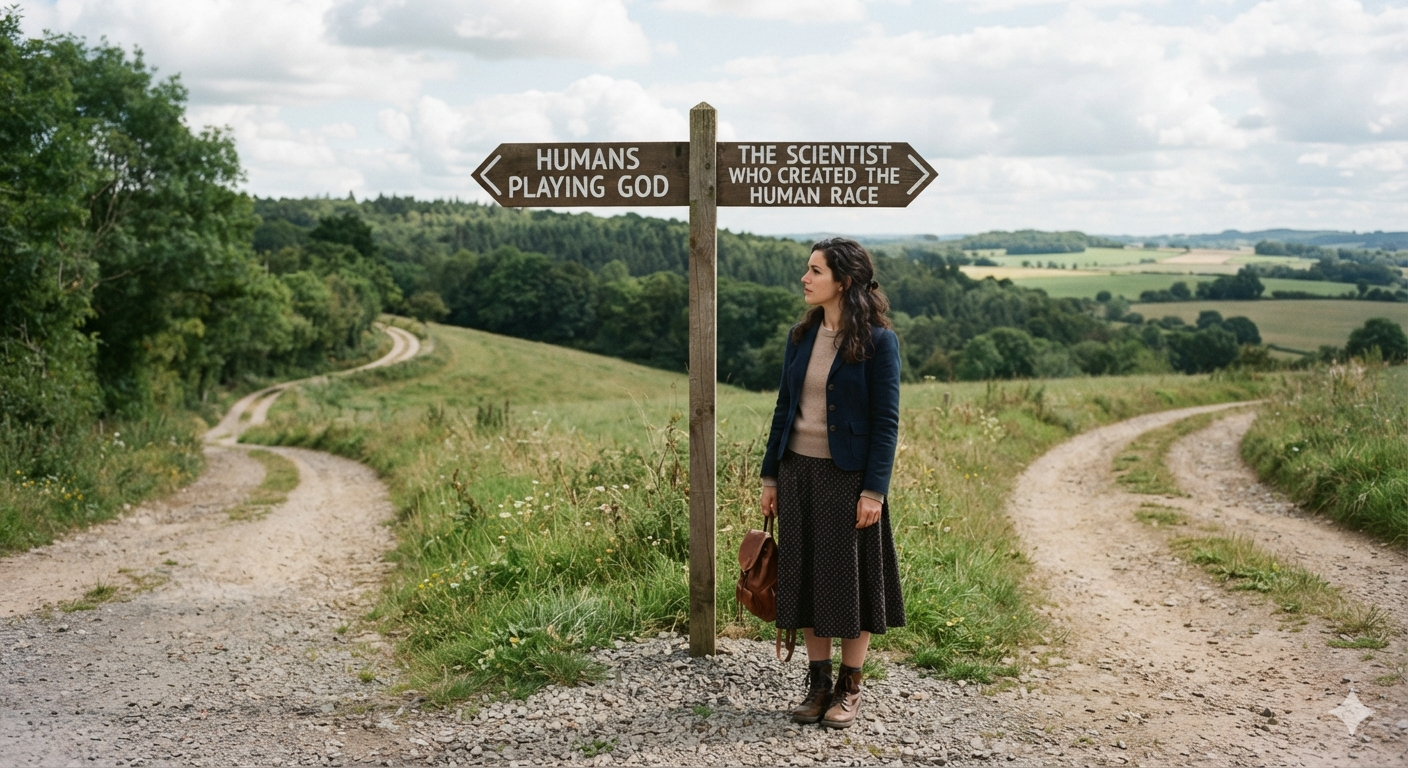
-
FROM THE AUTHOR
I would like to discuss what happened in Nuclear physics. What I discovered was that the entire science field is designed to turn people into atheists, so if you have no biblical background you will MOST CERTAINLY become an atheist, or at the very least - an agnostic.
This is: “god’s creation being described by people who say that there IS no god” therefore it is being described with quite a bit of bias, it’s like a devout atheist describing a church night where the Holy Spirit touched everyone and there was falling on the knees, and speaking in tongues which is a different language that doesn’t sound like any language on earth, and people physically reacting to being touched by the Holy Spirit.
This is a parent who’s child beat up two innocent first graders - describing to the police the very limited involvement their son had in the crime. You wouldn’t go to satan for information about Jesus, so why would you go to his agents for information about God’s creation? satan makes our scientists fools because he’s able to convince them that there’s no God, and then we trust these fools to find cures for diseases that are caused by our sinning.
When you read about Sir. Isaac Newton and everything he did for modern science, he’s after all KNOWN as the father of all science. But when you read about science in his time you realize where it all went wrong. Fellow scientists kept trying to describe the universe, even in his time scientists were already doing everything they could to take God completely out of science. It is TRULLY troubling when you consider that all science is - is just “observation” of someone else’s creation, and yet today’s scientists believe that there’s no higher power, after all science exists BECAUSE there’s a higher power and we want to learn as much as we can about our own creation.
While I was studying N. Physics I remember every now and again I would be given information that made me question the existence of God and I KNEW THAT GOD CREATED EVERYTHING, but the way they choose to describe it makes you feel that there’s no God. Satan is POWERFUL EVERYWHERE not just in our daily lives, but he also butts his ugly head into science too, and there’s not enough oversight in science to ensure that such things do not happen. But we just don’t have enough Isaac Newtons to go around, certainly not enough to police the science field, because you have to know God the bible and modern science to understand what went wrong. Because satan turns them all atheist early on so they don’t have the opportunity to figure out that something is wrong. But then I had to remember that the people who are feeding me this information are the same people who have not been able to find the cure to any disease, especially the one that is now effecting one out of every 2 people.
And then I remembered my mission. The entire reason I started to study science is because I wanted to find God. I knew that there was something wrong in science and I was determined to find it. I KNEW that there was something about science, something inside of the science education that needs to be fixed, but I never thought THIS is what I would discover. “MODERN SCIENCE HAS REMOVED GOD FROM ALL SCIENCE EDUCATION!” and THIS is the whole problem.
Please allow me to describe to you exactly what I felt. I can only imagine that an atheist feels the exact opposite of this when they finally accepts that there IS a God. The kind of loneliness I felt in that moment while also hearing God calling me to Himself, waiting to see what I’m going to do, for just (if I remember correctly)about a half a minute, I felt what it’s like to be an atheist. This wasn’t like I got really hurt by something and I prayed and God didn’t answer me and I had to deal with the situation by myself and I raise my fists at the heaven and say “there’s no god” out of anger, while still truly in my heart knowing that there indeed is a god. This was incredibly chilling, I felt the kind of loneliness that is so dead, loneliness makes you feel lonely and sad, but this felt like my lonely didn’t just come for me, but it’s also a corps, it’s the living dead. There was no sadness in this loneliness, nope, this loneliness was reserved for something else. There was something soo dead in that loneliness. Atheists like to believe that people only believe in God because they need to feel that there’s a deity somewhere in the clouds watching over them just to make themselves feel better, but I tell you that you have to be truly dead inside to believe something like that. At that incredibly horrifying moment I found myself in the memories of my grandfathers house, my grandfather who loved God more than anyone I know and raised ME to love God too, he was my greatest source for anything to do with God when I was young. It was the only place where I felt no fear and no loneliness, it was the only place that made sense to me.
I felt so bad when my battle was over, though I felt like a new creature after that, and I felt tired, like I had just wrestled with something that was stronger than me and I almost lost but God pulled me out and saved me from becoming lost. There’s this feeling of guilt that came over me, that I questioned the very existence of my beloved creator and friend. It was at THAT point where I realized that this wasn’t just gonna be a straight line anymore. But god showed me that what I went through is just a typical battle that many go through - but not many win.
I realized at that point what was wrong in science. All these little moments where their designed education made me feel like there may not even be a God. Somehow none of that made me connect the dots, somehow I needed to be brought to the point in my education where they made me choose “God or modern science” - for me to figure it out.
That was the scariest moment of my life, and I’m not young anymore trust me the kinds of scares in life I have had would make your hair go grey. But this was the kind of scare that made me want to come out of my skin. To accept that everything I had believed in my entire life wasn’t true was incredibly terrifying, most people will never have to accept that everything they believed about life wasn’t true ..... I wanted to come out of my skin - is the only way I can describe it. There are so many things that go through your mind at that moment, things that have never gone through my mind before. It tried to make me accept deadness. It wanted me to be dead with it. It wanted me to believe that even though we know that we are an intelligent design - that there’s no designer, so intelligent in fact, that we have to build science labs just to try to figure out such a tiny bit of it and still don’t get very far. But yet modern science has the audacity to teach our young minds who have never received Christ - that there’s no God, and this is SOO powerful that even I - who was raised in the church, had two incredibly christian grandfathers who prayed many many times per day and read the Bible much of the day, was raised in a very christian community, live my life by the code of the Bible. EVEN I was nearly taken down, EVEN I was nearly deceived into believing that there is no God - was nearly turned int an atheist than what chance does our youth have in eventually finding God after going through modern education in the sciences? they walk around for the rest of their lives spewing nonsense thinking themselves to be wise but sounding like fools when they try to describe God’s creation. It honestly felt like brainwashing, as I set in the office chair leaning to one side, it felt like there was a war inside me, it was a battle for my soul. If you want to call it a cult you may, if you want to call it a religion you may, because both of those are true, they have to brainwash you to keep you in the religion. And unfortunately those who did not receive Christ as a child in the same concentration that I was exposed to it - stand NO CHANCE when they face that same battle. They aren’t even aware that there is a battle for their soul, I WAS because it was everything I was raised to be and believe which was my knowledge of God and hearing God’s voice at that very moment for that whole half a minute - fighting for my soul. He was saying something to me over and over, I think he was saying “it’s not real, it’s not real, it’s not real” I’m not quite sure why He was saying that but just hearing His voice was the rope I needed to hang on to - to get pulled out of this battle I’m in before I perish in it. It was really weird how when God was speaking - He was speaking through an open door, like it was about to close ... there are a lot of things I still don’t understand about that day, I just prefer to completely forget that day even happened. But not the lesson I got out of it, THAT I prefer to remember till the day I die.
When you realize that there’s a brainwashing process, and you realize that science is intentionally structured to turn people atheist, you get a better Idea of why they do some of the things that they do. For example: studying the atom so we can manipulate the atom. I can see how believing in God might put a damper on that, but taking god out of science would allow us to do what we want, manipulating the atom is the human race playing God. When we figure out how to manipulate an atom we make atomic bombs. This is the human race playing God.
At it’s core, the study of science is the study of God’s creation. I find that God’s creation is better explained by the creator Himself, not a bunch of lab equipment and God denying scientists. I know that the reason they need all that lab equipment is BECAUSE God won’t talk to them, so they are blindfolded humans who are trying to put a 1,000,000 piece puzzle together in the dark. Because modern science sees all the puzzle pieces of the human body,but they don’t know what to do with them. I remember many years ago, wanting to learn everything about sewing machines because they keep braking down, they last only a month before you have to find your receipt to go return it. So I - having several broken sewing machines - decided that I was going to take one of the sewing machines apart, part by part, and see what’s inside so that maybe I’ll know how to fix sewing machines. Well let me tell you something, I learned nothing about fixing sewing machines by taking one apart. I need the maker of that sewing machine to be there with me to put it back together, to show me how He put it together, because if I know how He put it together and which part goes where - than I will know how to fix a sewing machine the next time it breaks down. It wasn’t a big sewing machine so I thought: “well how many parts could it possibly have?” (this was before google). I had that detailed sewing machine and it’s one million body parts littering an entire table that seats 8-10 people. As I was looking at all the parts I realized that I will never be able to put it back together, taking it apart was one thing, but I don’t know how to put it back together, they don’t make instruction manuals for vandalized sewing machines.
We will never succeed in finding a cure for anything if we continue excluding the creator who created us and wrote the destruction into our design, therefore He is the only one who can heal us and fix us when our disobedience has caused us to be a part of the sick bunch. But it’s terrifying scientists when they realize that in order for us to welcome God into our science activities - the human race will have to become obedient to the laws of God, and it’s THEM who will have to deliver the news since this would be something that they would find. It is true science that when you obey the Bible your body cells obey THEIR instruction.
I find EXODUS 20:4-5 extremely terrifying because here it says: “Thou shalt not make unto thee any graven image, or any likeness of any thing that is in heaven above, or that is in the earth beneath, or that is in the water under the earth. 5: Thou shalt not bow thyself to them, nor serve them: for I the Lord thy God am a jealous God, visiting the iniquity of the fathers upon the children unto the third and fourth generation of them that hate me;” (and the bible says “if you love me you will obey my commandments” and if you don’t love God than you hate Him and to that the bible says: “those who hate me love death”)
What this says plain and simple is that if you bow down to idols not only will you be sick, but He will also visit your sin on your children’s children's children. And this is seen in the genetics, a lot of people walk around with a genetic disorder, this is what the bible is talking about when it says: visiting the iniquity of the fathers upon the children.
Obviously not reading the bible will cause you to build futile labs all over the world, proving that there’s no scientist anywhere in the world who wants to take those two verses to the lab and analyze them.
I remember when I was in college God said to me: “ I want you to learn what they know so I can teach you what they DON’T know. The reason God chose me for this task is because what I have noticed is that no one on earth wants to accept the truth of God, they all just want to live their lives any kind of way they want no matter how un-biblical it may be, so when told the truth about idolatry, marriage, and every other issue living in the human race, I believed him right away. But I noticed that I can’t get anyone to believe what He taught me. You have to be willing to be broken down so you can be molded into the shape He needs you to be to accomplish the task. And this goes for EVERY human on earth, not just the vessels, but every human.
It amazes me how I can show someone the history of christmas and as vile and violent as it is, but even the history of a thing is not enough to get people to stop worshipping idols. I not only point out that they are worshipping idols, but I also make sure to point out the violent and sick history of christmas, and the knowledge that early christians instead of converting people OUT of their idolatress lives and into the pure faith the bible commands, they instead transformed the entire christian faith to suit the idolaters. This is where “don’t be like the world” completely flew out the window. So not only does christmas have a horrible past, not only is it pure idol worship, But it’s also evidence of the failure of christianity. And don’t tell me “well our religion wasn’t effected by any of that” because I will very quickly point out to you how your religion is the very descendent of it. And because you were born into the religion you do not know any different. You have to get out of the religion, stand back for a while, and observe everything at the same time: politics, religion, social climate, the sciences, and every other aspect of human life - for you to notice what’s actually going on, and how the great schism and the history of every holiday every religion worships - effected everything we believe in today, and why none of it fits the bible. And how people won’t come near the bible because they don’t recognize the current human race when compared to the way people lived their lives according to the bible.
But I noticed that people keep searching, looking for that right religion where they are both comfortable in the world and obedient to the word of God. They tried, they took a few words out of the bible and completely changed their meaning allowing people to unknowingly commit sin. There will NEVER be a religion that God is ok with that allows the world into the church. The bible specifically condemns churches that allow the world in. So if your church is doing something the Bible doesn’t permit, you have allowed the world into your church, therefore God is not in that building. And I say this not in a hateful manor, I say this as a scientific fact: pride flags outside your church is ‘your church doing something the bible doesn’t permit’. Allowing women to preach is ‘your church doing something the bible doesn’t permit’. And these aren’t churches, they are just buildings, community centers. It isn’t God being tyrannical, but He’s just not going to accept what he forbade you to do, no matter how hard you try, no matter what you tell him, He is unmoved, if you are disobeying ANY part of the bible, GOD WILL NEVER ACCEPT YOUR SIN. So your second marriage while your first spouse is still living - is not a blessing from God, cause God never told you to take a second wife, you’re just hearing things at this point, God made it very clear in the bible that remarriage after a divorce with the first spouse still living is called “adultery” which is a sin. God didn’t change His mind just because you’re head over heels in love with them. Just because YOU feel a special feeling and it feels exciting, doesn’t mean that God will go against His own word and allow you to go against the Bible. If God is the bible than disobeying the biblical text is you disobeying God, they aren’t two different entities, nope, the bible is god and god is the bible.
The whole science education is predicated on the evolution of man. So if you’ve ever detested “the evolution of man” than you would be incensed at the fact that education doesn’t respect the biblical faith. One thing I found absolutely mind boggling is the only thing that constantly gives them away: “WE NOW HAVE MORE QUESTIONS THAN ANSWERS” And no one bothers to correct or address that. If you have more questions about something than answers than that should tell you right away that you are indeed doing something wrong, that you have indeed gone down the wrong way. If the whole education was based on the bible and not the evolution of man, than we would be a very highly advanced intelligent race. We would have advancements that we can’t even fathom right now, devices we never knew could exist, but because we would be obedient - God would incourage us of what to ask of Him. He will put an idea in your head of a device that you have never thought of before, and it is so surreal how dumb we are it’s not even funny.
When Jesus was preaching in the bible, he was preaching science, he was telling us the only kind of control God allows us over our bodies. The expensive labs we keep building mean nothing if we refuse to understand what science actually IS!! us finding what makes our cells function and how they function, isn’t going to teach us anything about the only control over our bodies that god allows. Because CLEARLY us dedicating billions and billions of dollars to “modern science” ISN’T how we gain control over our bodies, because we have gained ZERO control over our bodies through the labs and research we keep building. We have completely refused the only means of control we are allowed by saying that “it’s not real” and that “there is no god” and we say those things so that we don’t have to do the only thing that the entire human race has agreed is the most difficult thing to do: OBEDIENCE TO THE BIBLE!!
IF YOU AGREE WITH ME THAT THE CELL OBEYING THE DNA INSTRUCTION IS THE MOST IMPORTANT THING TO OUR EXISTENCE, THAN YOU CAN NOT DISAGREE WITH ME THAT US FOLLOWING OUR HUMAN INSTRUCTION IS THE MOST IMPORTANT THING WE DO IN OUR EXISNTENCE AND IS THE VERY MEANING OF LIFE. If you disagree with me than answer this: “what would happen to you if your body cells all of a sudden begun to obey their DNA instruction as well as we obey our Biblical instruction? because that is not a question you want god to ask YOU!!
WHAT SCIENCE ACTUALLY IS!!
It is quite heartbreaking when I consider how far the human race has gone from the true meaning of science. Modern science is what you do when you have been soo disobedient that you are now dealing with consequences. But wouldn’t it have been better if we just obey the original science so that we can avoid the consequences? original science is: “us obeying the bible so that the executioner who is programed into our design does not become the last struggle we face in this life.”
SCIENCE is not what today’s scientists call it. SCIENCE is the clean up after an accident - one that could have been avoided if all the drivers were following the laws of the road, but because they weren’t the clean up crew now shows up to clean up after the accident has already occurred. That’s what today’s science labs ARE, they are the clean up crew that shows up after what not obeying the bible has done to the human body, in other words: “consequences” and that is most seen in the final disease we call cancer, if you observed cancer which is not a disease but it’s a SYMPTOM of a disease, you would realize what I’m talking about, because cancer is a response to the human race disobeying the bible. If you looked at cancer and you realize that it doesn’t behave the same way as other diseases, it can effect ANYONE!! no disease on earth is like this. We all know the phrase constantly used in the medical field “cancer can happen to anyone” you don’t hear them saying that about any other illness. ALS does not effect one out of every two people, AIDS does not effect one out of every two people, auto immune disease do not effect one out of every two people, and I have never heart anyone in the medical field say this phrase about any other illness or diaseas. Studying the psychology of cancer against other diseases will allow us to better understand what cancer actually IS! so as you can see, that cancer is not an disease - it’s a symptom of a disease, a disease which only the bible can diagnose, WHY you ask? well it’s because the bible is the book of human instruction the way the DNA strand is the bible to the cell, because humans and cells disobeying their instruction means the same fait for both: “physical illness - then death”
What science actually IS - is: “obedience to the biblical laws will keep our cells obeying THEIR instruction keeping US healthy” anything beyond that (like modern science labs) is the human race dealing with the consequences of not doing so.
MODERN SCIENCE LABS - IS THE HUMAN RACE DEALING WITH THE CONSEQUENCES OF BIBLICAL DISOBEDIENCE.
But why go there? why live in a maner which will produce diseases which we need labs for? why not just live the way we humans are instructed to live by our creator to begin with? so that we can avoid needing to build unsuccessful labs to try to mitigate the consequences of our disobedience, consequences so powerful we have no solutions for any of them. The major diseases which only exist due to our disobedience, those we have no solutions for.
THE MOST TERRIFYING DISEASE THE HUMAN RACE IS DEALING WITH IS: DISOBEDIENCE! why is it that we are fully aware that the most terrifying thing that can happen to our bodies is all or most of our cells being disobedient to their DNA instruction, but we can’t seem to connect the dots on our own existence
THE MOST TERRIFYING THING THE HUMAN RACE IS DEALING WITH IS NOT THE SYMPTOM OF A DISEASE, BUT THE DISEASE ITSELF! we are dialing with the symptom because that’s the only way we know that there is something wrong, the disease itself is painless, it’s the symptom of that disease that we are noticing and want relief from. So if we get the disease under control - the symptom will vanish
SYMPTOM - CANCER
DISEASE - BIBLICAL DISOBEDIENCEWhy is it so impossible for us to believe that the one who created hell for those who disobey the bible would program the executioner into our human design if we choose to disobey the bible?
Why are we ok with broken pieces of information that make no sense if you try to piece them together? we know that God created hell but we can’t eccept that this same god would program a symptom into our bodies which appears when we allow the disease into our lives? somehow people prefer broken pieces of information because as long as the information is broken they don’t have to take any responsibility for their disobedience, people just prefer to be oblivious when it comes to correct information like this. The human race prefers complete confusion when it comes to the bible, and it’s all because they do not want to be held responsible for biblical disobedience.
We would be sorely mistaken if we do not investigate EVERY part in bible where god strikes down, sends down diseases, causes mother nature to revolt - every time the human race disobeyed him. We would be very mistaken to ignore those parts of the bible, because I believe that it will allows us to create a blueprint of god’s mind as it pertains to the human race. It will allow us to see something we have never seen before - and I promise you, that everyone will see something different (because of the difference in the types of sins each commits), but we will all come to the same conclusion - that disobedience invokes god’s anger against our bodies which are usually the instruments of our sins.