

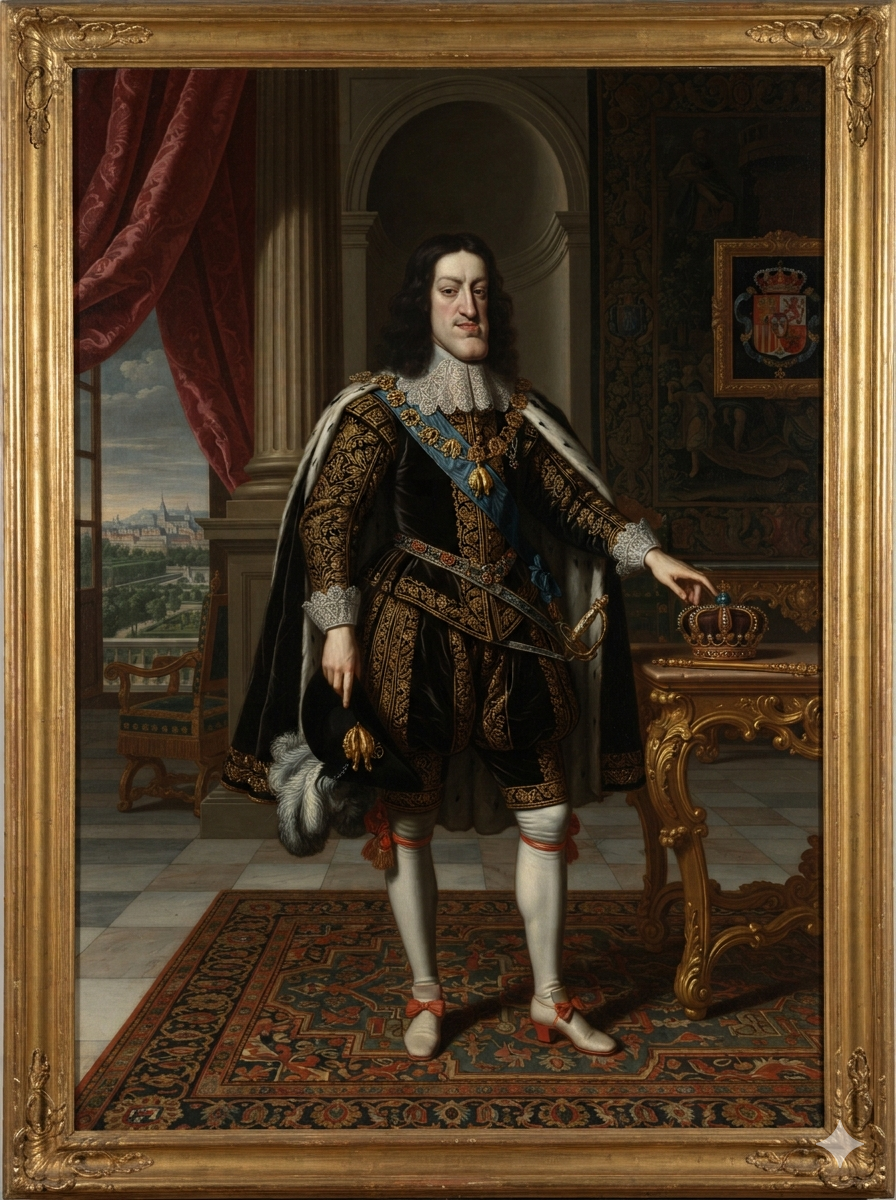
KING CHARLES ll
THE LAST HABSBURG KING
Disobedience in ANY part of the bible, ALWAYS means death, no matter which part of the bible you chose to disobey.

-
The Cautionary Mirror
A Meditation on the House of Habsburg, the Genetic Instruction of Mankind, and the Arrogance of a Creature That Forgot It Was Created
*
I. The Observer in the Gallery
Stand for a moment where I am standing. Imagine a long hall of a European museum, the kind with high ceilings and cold marble, where the light falls in gray columns through tall windows and the air smells faintly of varnish and centuries. On the walls hang the portraits of a single family, painted across two hundred years by the finest hands of their age — Titian, Velázquez, Juan de Miranda Carreño. They are the House of Habsburg, and if you walk slowly from the first canvas to the last, you will watch a human bloodline die in front of your eyes.
You will not watch it die the way a family usually dies, quietly and by attrition, one funeral at a time. You will watch it die in the flesh itself. In the first portraits the faces are strong, imperial, the faces of men and women who ruled an empire on which the sun did not set. And then, canvas by canvas, generation by generation, something begins to go wrong. The lower jaw lengthens and juts forward. The lip thickens and hangs open. The nose overhangs the mouth. The chin grows heavy and protruding until the teeth can no longer meet. By the time you reach the last portrait — a small, sickly man with an enormous drooping jaw, a tongue too large for his mouth, and the exhausted eyes of someone who has been unwell every day of his life — you are no longer looking at a king. You are looking at the visible, painted, documented consequence of a decision made two centuries before he was born. You are looking at what happens when a family decides it can rewrite the rules of its own biology and suffer no penalty for it.
This last man was Charles II of Spain, and when he died in 1700 without an heir, the Spanish Habsburg line simply stopped, the way a machine stops when the last gear finally strips its teeth. Contemporaries called him El Hechizado — "the Bewitched" — because they could not imagine that a king could be so afflicted by natural means. They believed he had been cursed, that a witch had done this to him, that a demon lived in his weakness. They were, in a spiritual sense, closer to the truth than they knew — but the curse was not sorcery. The curse was arithmetic. The curse was the slow, patient, mathematically inevitable consequence of a family that married itself again and again and again, uncle to niece, first cousin to first cousin, for the better part of two hundred years, convinced that the blood was too precious to be shared with anyone outside the circle.
I want you to understand why I call the Habsburgs the greatest genetic lesson ever given to the human race. It is not because they were unusually wicked. They were not monsters. Most of them were intelligent, devout, cultured people who genuinely believed they were preserving something sacred. It is precisely because they were not villains that their story is so terrifying. They demonstrate, in a single documented aristocratic bloodline, that a human being is not a soul that happens to wear a body. A human being is a body that carries an instruction, and if you corrupt the instruction, no amount of piety, wealth, power, or prayer will save the flesh from paying the price. The Habsburgs prayed constantly. They endowed cathedrals. They had the Pope himself sign off on their marriages. And their children still died in the cradle, and their last king still could not chew his food, because the instruction written into their cells does not read the paperwork of kings. It reads only itself.
This is the thing I want to sit with, because it is the thing modern people are most desperate not to see. We have persuaded ourselves that we are the owners of our existence — that our bodies belong to us the way a car belongs to its driver, and that we may do with them whatever we please, and that the only rules that bind us are the rules we choose to acknowledge. We look at the ancient prohibitions — do not marry your sister, do not lie with your close kin — and where we still obey them, we obey them for a very specific reason: because the consequences of disobedience are visible. We can see the child born wrong. We can see, in the Habsburg portraits, exactly what happens. And so we keep that one law, not out of reverence but out of fear, because the punishment prints itself on the face of the offspring for all the world to read.
But here is the question that will run under this entire essay like a river under a city: what about all the other instructions whose consequences are not visible? What about the prohibitions and the commands whose penalties do not show up in a single generation, on a single face, in a single obvious deformity — but instead diffuse themselves across an entire species, across centuries, until we can no longer trace the sickness back to the disobedience that caused it? The Habsburgs at least had the mercy of a warning. Their sin was written on their children's bodies within a lifetime. The rest of us have been given instructions whose violation shows up only in aggregate, only slowly, only in the great gray statistical fog of a whole civilization getting sicker — and because we cannot draw the straight clean line from the act to the consequence the way we can with inbreeding, we tell ourselves there is no line at all.
That is the observer's vantage point. I am not standing in that gallery as a scientist, though I will speak the language of science, because the science is real and it is precise and it must be respected. I am not standing there as a preacher, though I will speak of the spiritual, because the spiritual is the half of the picture that the microscope cannot photograph. I am standing there as a witness — as someone who has looked at the whole arc of a family's self-destruction laid out in oil paint, and who cannot un-see the lesson written in it. The Habsburgs are a mirror. When you look at them, you do not really see them. You see us. You see what a species looks like when it decides that it is smart enough, powerful enough, and sovereign enough to overrule the instruction it was given, and to pay no attention to the mounting evidence that it is destroying itself.
Let me be honest about what this essay is and is not. It is not a neutral encyclopedia entry, though I will give you the documented facts and I will not distort them. It is an argument — an argument that the human being is genetic material animated by a design it did not write and cannot fully read; that the design carries an instruction; that the instruction is for our good; that a great deal of what we call "religious rules" are in fact the human-readable summary of that instruction; and that the modern project of tearing open the design in order to seize control of it is not the triumph of intelligence we imagine it to be, but the oldest and stupidest ambition in the human record, repeated by a creature that has learned nothing from the wreckage of the families that tried it before.
And no family tried it more thoroughly, or paid for it more visibly, than the one whose portraits are hanging on the wall in front of us. So let us begin where the whole catastrophe began — not with a deformity, but with a strategy. Not with a curse, but with a plan that seemed, at the time, like the cleverest idea any dynasty had ever had.
The Habsburgs did not stumble into their ruin. They engineered it, deliberately, brilliantly, and with the full approval of the highest authorities of their world. That is the part that should frighten you most of all.
II. The House That Married Itself
There is a Latin sentence that hangs over the whole story of the Habsburgs like a family motto carved above a doorway, and in a sense that is exactly what it became. Bella gerant alii, tu felix Austria nube. "Let others wage war; you, happy Austria, marry." It is usually attributed to Matthias Corvinus, king of Hungary, spoken half in envy and half in mockery, but the Habsburgs took it up as though it were scripture. Where other dynasties expanded by the sword — spending their sons and their treasuries in the mud of battlefields to seize a province — the Habsburgs expanded by the wedding contract. They understood, earlier and more cynically than anyone, that a marriage is a bloodless conquest. Put your daughter on the right throne, and in a generation her son inherits it, and you have taken a kingdom without losing a single soldier.
For a long time it worked spectacularly. Consider the marriage of Maximilian I to Mary of Burgundy in 1477, which brought the immense wealth of the Burgundian Netherlands into the family. Consider the double wedding their heirs arranged with the royal house of Spain, so that Philip the Handsome married Joanna of Castile — and through that single union, when the other Spanish heirs died, the entire Spanish crown, and with it the newly conquered empire of the Americas, fell into Habsburg hands. Their grandson, Charles V, would rule an empire so vast — Spain, the Netherlands, Austria, parts of Italy, the Holy Roman Empire, and the silver-drenched colonies of the New World — that no European had held anything like it since the Caesars. And he had inherited nearly all of it not by winning it, but by being born the correct child of the correct marriages.
So the strategy was vindicated. The lesson the family drew from its own success was simple and, on its own terms, logical: the blood is the asset. The Habsburg blood is what sits on all these thrones. The Habsburg blood is what unites this improbable empire under a single crowned head. Therefore the blood must be protected, concentrated, kept from dilution, kept within the family, so that the claims never leak away to outsiders and the inheritance never fractures. Marry a foreign princess and you introduce a foreign claim, a foreign faction, a foreign loyalty into the succession. Marry your own cousin, and every child born is doubly, triply, quadruply Habsburg, with no competing bloodline to muddy the inheritance. The circle draws tighter, and the tighter it draws, the purer — they believed — the dynasty becomes.
You must appreciate the seductiveness of this reasoning, because it is the same reasoning that will run through the whole modern argument I am building toward. It is the reasoning of a creature that has identified a real good — here, the preservation of a dynasty — and has decided that it may pursue that good by any means it can devise, without reference to any instruction outside its own cleverness. The Habsburgs wanted to keep the crown in the family. That is not, in itself, a monstrous desire. But they pursued it by overriding one of the oldest and most universal instructions given to the human animal — the instruction against breeding with close kin — and they persuaded themselves that their special circumstances, their special blood, their special mission exempted them from the consequences that instruction was designed to prevent.
They did not think of it as inbreeding. That is crucial. They thought of it as purity. They thought of it as fidelity to the family, as prudence, as statesmanship, even as a kind of holiness — the preservation of a God-appointed dynasty against the chaos of the world. The very same act that a farmer would have recognized instantly as ruinous if he did it with his cattle, the Habsburgs dressed in ermine and called wisdom. And this is the first great mechanism of the tragedy that I want you to mark, because it repeats in every generation of the human story: we do not disobey the instruction while believing we are disobeying it. We disobey it while believing we are being especially wise, especially advanced, especially enlightened. The Habsburgs did not think they were violating nature. They thought they had outsmarted it. They thought the rules that applied to ordinary people did not apply to them, because they were not ordinary — they were the chosen dynasty, the pure blood, the special case.
And here the spiritual dimension enters the story for the first time, and it enters through the front door of the Church itself. Marriage between close relatives was not permitted freely even to kings. The Church forbade unions within certain degrees of kinship — a prohibition that is itself a fossilized remnant of the ancient biblical instruction against uniting with one's near kin. To marry an uncle to a niece, or a first cousin to a first cousin, required a formal dispensation: a document, signed by the Pope, declaring that in this particular case, for reasons of state, the ordinary prohibition would be set aside. The Habsburgs obtained these dispensations again and again. They went to the highest spiritual authority in their world, laid their dynastic ambitions on the table, and asked for permission to do the very thing the ancient instruction forbade — and, over and over, permission was granted.
Consider what this means. The instruction existed. It was known. It was written into the law of the Church, which had inherited it from scripture, which claimed to have received it from God. Everyone in the story — the kings, the queens, the cardinals, the Pope — knew that the prohibition was there and knew, in a general way, that it was there for a reason. And they set it aside anyway, because they had a plan, and the plan seemed more urgent and more real to them than the instruction. They treated the ancient law as an inconvenience to be waived rather than a warning to be heeded. They had the physical evidence of what inbreeding does — every peasant who bred cousin cattle could have told them — and they had the spiritual evidence, the standing prohibition itself, and they overrode both, because they could not see, in the moment of signing, the deformed jaw of the child who would be born a century later.
This is the exact posture I am accusing the whole modern human race of taking. We too have the instruction. We too know, in a general way, that it claims to be for our good. And we too have decided that our plans — our sovereignty, our autonomy, our desire to be the unquestioned authors of our own existence — are more real and more urgent than any instruction we did not write ourselves. We too go looking for the dispensation, the permission, the clever argument that lets us set the old law aside just this once, for this special case, because we are enlightened and the people who wrote the old law were not. The Habsburgs found their dispensation in the Pope's signature. We find ours in a philosophy that tells us the instruction never existed at all, that it is superstition, that there is no design and no designer and therefore nothing to disobey.
The Habsburgs at least had the honesty to admit that they were setting aside a rule they knew to be real. We have gone one step further into the darkness: we have abolished the rule in our minds so that we need not feel the guilt of breaking it. And the result, as we will see, is not freedom. The result is the same result the Habsburgs got. The instruction does not care whether you believe in it. The jaw grows anyway.
Before we can watch that jaw grow, though, we have to trace the actual shape of the circle they drew — the specific marriages, the specific unions, the pedigree that folded back on itself until it could fold no further. Because it is one thing to say "they inbred." It is another thing entirely to see, laid out generation by generation, exactly how tight the noose became, and to understand, through the eyes of science, precisely what that tightening did to the genetic instruction they were so busy trying to purify.
III. The Genealogy of a Closing Circle
To understand what the Habsburgs did to their own blood, you must first understand what a healthy pedigree looks like. Trace your own ancestry back a few generations and you find a widening fan: two parents, four grandparents, eight great-grandparents, sixteen great-great-grandparents, and so on, doubling at every step. Ten generations back, in the ordinary run of things, you should have somewhere over a thousand distinct ancestors, all of them separate people, each contributing a different fragment of the genetic library that becomes you. That widening fan is not decoration. It is the mechanism by which the instruction protects itself. Every new person married in brings a fresh copy of the genetic text, and where one copy has an error, the other copy is almost always intact, so the error stays hidden and harmless. Diversity is not a political slogan when it comes to the genome; it is the literal safety system that keeps a hidden flaw from ever expressing itself.
Now watch what happens when the fan refuses to widen. When first cousins marry, their children do not have eight distinct great-grandparents; they have six, because one couple is shared. When uncle marries niece, the collapse is even sharper. And when a family does this not once but repeatedly, generation after generation, the ancestors at the top of the tree stop being a thousand separate people and start being the same few individuals appearing over and over in different positions, like actors playing multiple roles in an under-cast play. The pedigree, instead of fanning out, folds back into itself and knots.
This is precisely, documentably, what the Spanish Habsburgs did. Let me walk you along the line so you can feel the circle closing.
The dynasty's Spanish branch effectively begins with the Emperor Charles V and his sister's descendants and continues through his son, Philip II. Philip II married four times over his life, and among those marriages the die was already being cast: one of his wives was Maria Manuela of Portugal, herself a double first cousin, the daughter of Philip's own aunt and uncle. Later Philip married Anna of Austria — who was his niece, the daughter of his sister Maria and his cousin Maximilian II. An uncle marrying his niece: that is not a distant, technical relation. That is one of the tightest consanguineous unions the human family recognizes, genetically almost as concentrated as a parent-child or sibling pairing. From this uncle-niece marriage came Philip III.
Philip III in turn married Margaret of Austria, another Habsburg cousin, and their son was Philip IV. And Philip IV, continuing the pattern with an almost ritual precision, married — as his second wife — Mariana of Austria, who was his own niece. Once again: uncle and niece. Mariana was the daughter of Philip IV's sister. So the King married his sister's daughter, and from that union came the last of the line, Charles II.
Read that pedigree slowly and you realize something staggering. In the span of just a few generations you have uncle-niece marriage stacked upon cousin marriage stacked upon cousin marriage. The same handful of names — the same Habsburg and Habsburg-Portuguese ancestors — recur again and again at the top of the family tree, occupying position after position that in a healthy pedigree would have been filled by unrelated strangers bringing fresh copies of the text. Charles II, when researchers reconstructed his ancestry, was found to have far fewer distinct ancestors in the relevant generations than he ought to have had. The fan had not merely narrowed; it had almost entirely closed.
Geneticists have a precise way to measure this closure. It is called the coefficient of inbreeding, usually written as F, and it expresses the probability that the two copies of a given gene in an individual — one inherited from the mother, one from the father — are identical because they descend from a single common ancestor. For a child of two unrelated parents, F is essentially zero. For the child of first cousins, F is about 0.0625, or one in sixteen. For the child of an uncle and niece, or of a brother and sister, F leaps to about 0.25 — one in four. When a team of Spanish geneticists led by Gonzalo Álvarez reconstructed the Habsburg pedigree across sixteen generations and thousands of individuals, and computed the coefficient for the last king, they found that Charles II had an inbreeding coefficient of roughly 0.25.
Sit with that number, because it is the whole tragedy compressed into a decimal. An F of 0.25 is the coefficient you would expect if his parents had been full siblings. Charles II was not, in fact, the child of a brother and sister — his parents were uncle and niece — but so many earlier generations had also intermarried that the accumulated, compounded inbreeding of all those ancestors added up, in his single body, to the same genetic concentration as incest of the closest degree. He carried, in effect, the genetic burden of a sibling union, produced not in one scandalous act but assembled patiently across two centuries of "prudent" dynastic marriages. The family had, without any single generation ever committing the ultimate taboo, arrived at the genetic destination of that taboo by the accumulated small steps of what they told themselves was only sensible statecraft.
And here is where the eyes of science and the eyes of the spirit begin to see the same thing from two directions. The Álvarez study did not only compute the inbreeding coefficient. It also examined the family's grim record of survival, and it found what the mathematics predicts. The Spanish Habsburgs suffered ferocious rates of infant and child mortality. Of the children born into that closing circle, a shocking proportion died in infancy or before reaching the age of ten — a death rate far exceeding even that of the Spanish peasantry of the same era, who lived in filth and famine and yet, breeding freely across the whole population, buried fewer of their babies than the wealthiest, best-fed, best-doctored family in Europe. Let that contradiction sink in. The Habsburgs had every physical advantage a human body could be given in that century — food, warmth, shelter, the finest physicians alive — and their children still died at rates that shamed the poor. The one advantage they lacked was the one that cannot be bought, because it is not a resource but an instruction obeyed: genetic diversity. And its absence killed their children faster than plague killed the beggars in the street.
The researchers proposed that the family's terrible fertility record and the specific catalogue of Charles II's afflictions were consistent with the expression of recessive genetic disorders — flaws in the instruction that in an outbred person would have stayed harmlessly hidden behind a healthy second copy, but which in these compounded pedigrees kept meeting their identical partner and expressing themselves in the open. We will come to the specifics of that expression, because Charles II's body was a case study in what the instruction does when its safeguards are dismantled. But first I want you to hold the shape of the thing in your mind: a family that looked at the widening fan of a healthy human pedigree — the very fan through which the instruction protects the species — and deliberately folded it shut, tighter and tighter, for two hundred years, in the sincere belief that they were refining something precious. They were not refining. They were concentrating. And what they concentrated was not the glory of the blood. It was the error hidden inside it.
This is the pattern I will ask you to remember when we turn from the seventeenth century to our own. A good thing pursued by overriding the instruction. A cost that does not appear at once, but compounds silently across generations. A family — or a civilization — that cannot see the accumulation because no single step in it looked catastrophic. And at the end of the line, a body that can no longer function, produced by no dramatic sin but by the patient, respectable, well-dispensed accumulation of a thousand small refusals to widen the fan.
Now let us look at the faces on the wall, because the instruction, when you break it, does not stay hidden in the mathematics. It comes up to the surface. It writes itself on the flesh. It grows a jaw.
IV. The Face on the Wall — The Habsburg Jaw as Seen Through the Eyes of Science
Walk back to the portraits now, because the mathematics we have just traced did not remain trapped in the abstractions of a family tree. It surfaced. It rose out of the pedigree and settled onto the bones of living human faces, and the court painters — who were paid to flatter — recorded it anyway, because it could not be flattered away. It was too gross, too structural, too rooted in the architecture of the skull.
The feature the world remembers is the jaw. "Mandibular prognathism," the anatomists call it: a lower jaw that projects forward far beyond the upper, so that the lower teeth sit ahead of the upper teeth and the two rows can never meet. Paired with it came a maxillary deficiency — an underdeveloped upper jaw — so that the two malformations reinforced each other and the whole lower face was pulled forward and down. The result, in its milder forms, was the famous "Habsburg lip": a heavy, everted lower lip and an elongated chin, visible in the portraits of Charles V, of Ferdinand I, of Maximilian I before them. In its severe forms it became a genuine disability. The mouth would not close. The tongue was affected. Speech was slurred. Eating was laborious.
A group of researchers took this beyond family lore. Led by Roman Vilas, a team examined dozens of Habsburg portraits — carefully authenticated works by reliable painters — and had maxillofacial surgeons rate the degree of two conditions in each royal face: mandibular prognathism (the protruding lower jaw) and maxillary deficiency (the recessed midface, which produces the overhanging nose and the sunken cheek). Then they correlated those clinical ratings against the inbreeding coefficient each individual carried, computed independently from the genealogy. The finding was as clean as science on a human population ever gets: the more inbred the individual, the more pronounced the facial deformity. The deformity tracked the mathematics. The jaw was a readout of the pedigree. You could, in effect, estimate how tightly a Habsburg's ancestors had folded the fan simply by measuring how far his jaw jutted past his teeth.
This is worth pausing on, because it is one of the rare moments where an ethical spiritual claim and a hard empirical claim shake hands in full view. The instruction against breeding with close kin is stated flatly in scripture, with no explanation attached — a bare prohibition, "you shall not." For most of human history no one could have told you the mechanism. They knew only that it was forbidden and that the offspring of such unions tended to be sickly and cursed. And then, thousands of years later, a team with statistical software and a wall of Renaissance portraits demonstrated, quantitatively, that the ancient bare prohibition was describing a real and measurable biological catastrophe with a real and measurable dose-response curve. The rule had no explanation attached because the people receiving it could not have understood the explanation. But the explanation was always there, waiting inside the cells, and when we finally grew clever enough to read it, it said exactly what the rule had always implied.
Hold that. It is the hinge of the entire argument. An instruction was given without its reasons. The reasons turned out, upon eventual investigation, to be true, precise, and protective. Which raises the question that should keep every honest person awake: how many other instructions were given without their reasons, whose reasons we are simply not yet clever enough to read? The Habsburgs are the one case where we have already run the experiment and already decoded the result. They are the answer key to a test we are still busy failing everywhere else.
But the jaw was only the visible surface. Turn now to the last man, Charles II, in whom the whole two hundred years of folding came due at once, and look through the eyes of science at what the instruction produced when it was allowed to break in full.
Charles II was born in 1661, and by the accounts of his court he was a catalogue of afflictions from his first breath. He did not walk until he was perhaps eight years old. He did not, by many accounts, speak clearly until nearly the same age; some report he could barely speak intelligibly for much of his life. His jaw was so pronounced — the family deformity in its most extreme documented form — that he could not chew properly and reportedly could not close his mouth fully, so that he drooled and his speech was thick. His tongue was described as too large for his mouth. He was chronically ill in almost every system: he suffered digestive disorders, could not properly digest his food, endured intestinal complaints his whole life. He was reported to be physically weak, prone to infection, intermittently unable to stand without support. Contemporaries described a man perpetually on the edge of collapse, whose survival to the age of thirty-eight astonished everyone who attended him.
Modern researchers, working from these records, have proposed that Charles II most likely suffered from a combination of recessive disorders acting together — the very outcome the inbreeding coefficient of 0.25 predicts. Two candidate conditions are frequently named. One is a pituitary hormone deficiency, which would explain his short stature, his weakness, his infertility, his delayed development, and his general frailty. The other is a renal or distal tubular disorder, which would account for his chronic digestive and urinary troubles, his bloody urine, his edema. Neither diagnosis can be confirmed across the centuries, but the point does not depend on the exact label. The point is the mechanism. Each of these disorders is recessive, meaning it expresses only when a person inherits a broken copy of the relevant gene from both parents. In an outbred population these broken copies are rare and almost never meet their match. But in a pedigree folded shut for two centuries — where the same few ancestors supply both the maternal and paternal line — the same broken copy is handed down through both branches and reunites in a single child. Charles II was the place where a dozen such reunions happened at once. He was not cursed by a witch. He was the statistically inevitable meeting point of every recessive flaw his ancestors had been quietly carrying and quietly passing along under the banner of pure blood.
And then there is the final, defining fact of his life, the fact that ended the dynasty: he could not produce an heir. He married twice. He fathered no living children. Whether through the infertility that accompanies pituitary deficiency, or through some other consequence of his genetic burden, the man in whom two hundred years of "protecting the bloodline" reached its concentrated summit was the man in whom the bloodline died. This is the exquisite, terrible irony that I want carved into the center of this essay. The entire project — every dispensation sought, every cousin married, every niece wed to her uncle, every foreign princess rejected to keep the blood pure — had a single purpose: to preserve the dynasty by preserving the concentration of its blood. And the concentration of the blood is the very thing that rendered its final vessel incapable of continuing it. They pursued survival by the exact means that guaranteed extinction. The strategy did not merely fail. The strategy was the failure. The method and the catastrophe were the same act, seen at two different distances in time.
When Charles II died on the first of November, 1700, the Spanish Habsburg line was finished. There was no son, no brother, no Habsburg heir of the Spanish house to take the crown. The succession fell into dispute, and Europe went to war over the wreckage — the War of the Spanish Succession — in which hundreds of thousands died to settle who would inherit the throne that inbreeding had emptied. Mark even that: the disobedience did not only destroy the family that committed it. Its consequences spilled outward, across a continent, into the lives of soldiers and peasants who had never heard of a coefficient of inbreeding and never chose any of it. The private sin of a closed circle became a public catastrophe for millions. Instructions, when broken, do not confine their penalties to the one who breaks them. That will matter enormously when we come to speak of a whole species breaking its instructions together.
So this is what science sees when it looks at the Habsburgs. It sees a controlled experiment that no ethical scientist could ever have designed, run accidentally by a family over two centuries, with a full pedigree, a full portrait record, a full mortality record, and a clean, unambiguous result. It sees the coefficient of inbreeding rising and the survival of children falling in lockstep. It sees the deformity of the face tracking the concentration of the blood. It sees, in the last king, the total collapse of a human body under the accumulated weight of expressed recessive error. And it sees the extinction of the line by the very mechanism the line believed was its salvation.
Science sees all of this and calls it genetics. And it is right to call it that. But I am standing in the gallery as an observer, and I am telling you that "genetics" is only the name we have given to the part of the instruction we have finally learned to read. The Habsburgs did not violate genetics. Genetics is not a law with a lawgiver's authority; genetics is a description of the machinery. What the Habsburgs violated was the instruction — the ancient command, given without its reasons, that turned out to be describing this exact machinery all along. And the machinery, being faithful, executed the consequence of the violation exactly as it was designed to, without mercy, without regard for rank, without accepting a single dispensation.
Which brings us to the harder question. If the instruction against inbreeding was real, and precise, and given long before we could understand it, and if it turned out upon investigation to be protecting us from a genuine catastrophe we could not otherwise have foreseen — then what are we to make of all the other instructions in the same book, the ones whose penalties are not written on a single face in a single lifetime, the ones we have decided we are free to ignore because we cannot see the deformity they were meant to prevent?
V. The Instruction We Can See and the Instructions We Cannot
Here is a strange fact about the human race that the Habsburgs throw into sharp relief. Of all the ancient instructions, there is essentially one that the modern secular world still obeys with something close to religious rigor, even though it has thrown out the religion that gave it. That instruction is the prohibition against breeding with close kin. An atheist who mocks every other line of scripture will still recoil in genuine horror at the idea of a brother and sister having children. He will not be able to give you a first-principles moral argument for his horror — he has, after all, discarded the framework that would supply one — but he will feel the horror all the same, and if you press him he will reach for exactly one justification: the offspring. The offspring will be damaged. He has seen, or heard of, or can imagine, the deformed child. He keeps this one commandment because its penalty is visible.
This tells us something profound about how the human animal actually decides which instructions to obey. We do not obey instructions because they are true. We obey instructions because we are afraid of their visible consequences. Where the consequence prints itself immediately on the flesh — a deformed child, a burned hand, a broken bone — we comply without needing to be persuaded, because the evidence argues for itself. But where the consequence is delayed, or diffuse, or spread across an entire population so that no single sufferer can trace his suffering back to a single cause, we lose our fear, and losing our fear we lose our obedience, and losing our obedience we lose the protection the instruction was giving us all along.
Consider the elegance of the inbreeding taboo as a teaching device. It is, of all the instructions, the one whose violation produces the fastest and most legible feedback. Break it, and within a single generation the penalty appears, embodied, unmistakable, in a child. You cannot argue with the child. You cannot philosophize the child away. The Habsburgs tried — they had the wealth and the power and the theological cover to explain away almost anything — and they still could not explain away Charles II, because Charles II was standing right there, drooling, unable to chew, dying by inches in front of the whole court. The instruction against inbreeding is, in a sense, the instruction God made easy to verify. It is the one He gave us with the evidence attached, precisely so that we would learn the pattern: that His instructions are not arbitrary, that they encode consequences, that obedience is protection and disobedience is damage.
And having taught us the pattern on the easy case, He asks us to extend it by faith to the cases where the feedback is not so fast. This is the reasoning I want to make explicit, because it is the reasoning the modern mind refuses. If you have seen, with your own eyes, that one ancient instruction whose reasons were hidden turned out to encode a real and precise protection you could not have discovered on your own — then intellectual honesty demands you take seriously the possibility that the other instructions, from the same source, also encode real protections whose reasons are simply hidden further from view. The inbreeding taboo is the proof of concept. It is the one where we got to check the answer. And the answer was: yes, the hidden reason was real, and it was protecting you, and you would have been a fool to ignore it.
So when the same source that gave us the inbreeding prohibition — which we now know, scientifically, to have been correct — also gives us a hundred other instructions about how to eat, how to rest, how to conduct ourselves sexually, how to treat our bodies and each other, the honest response is not "those are religious rules and religion is superstition." The honest response is: "the one rule from this source that I was able to independently verify turned out to be devastatingly accurate. What are the odds that it was accurate by accident, and that everything else from the same source is nonsense? And what is the cost to me if it is not nonsense, and I am ignoring protective instructions whose penalties simply take longer than one generation to arrive?"
This is where the disease enters the argument — where cancer enters the argument, where the whole gray fog of modern chronic sickness enters the argument. I am not going to claim, and I want to be careful here, that any single verse of scripture is a specific cure for a specific tumor, or that all illness is simple punishment for simple sin. That would be a crude and false claim, and it would insult the many faithful people who suffer terribly through no fault of their own. Illness is woven into a fallen world in ways no simple formula captures. But I am going to make a subtler and, I think, undeniable claim: that the human race, taken as a whole, has systematically abandoned a vast body of instruction about how to live inside these bodies, and that we are, as a whole, sicker in specific ways that correlate with specific abandonments, and that we refuse to draw the connection for exactly the same reason the Habsburgs refused to draw theirs — because the feedback is too slow and too diffuse to frighten us into obedience.
Think about how the inbreeding lesson would have looked if its feedback had been slow. Imagine that the damage from cousin marriage did not appear in the child, or the grandchild, but only faintly, statistically, across an entire population over three hundred years — a slight rise in this disease, a slight shortening of that lifespan, spread so thin that no single family could ever point to a single deformed child and say "there, that is what we did." Do you imagine for one second that the human race would have obeyed the taboo under those conditions? Of course not. We would have bred however we pleased and dismissed the prohibition as ancient superstition, and we would have gotten slowly, invisibly, collectively sicker, and we would have blamed everything except the cause, because the cause would have been un-seeable. The only reason we obey the inbreeding law is that God, in mercy, made its penalty fast and visible. For most of His other instructions, the penalty is slow and invisible — and so we treat them as optional, and we get slowly, invisibly, collectively sicker, and we blame everything except the cause.
That is the situation of the modern human race in a single sentence: we are the Habsburgs, but our feedback loop is slow. We are folding the fan shut in a hundred ways that do not produce a Charles II within one generation, and so we cannot see the jaw growing, and so we tell ourselves nothing is wrong. The Habsburgs had the mercy of fast feedback and squandered it anyway. We do not even have that mercy, and we squander what we have with an arrogance they never dreamed of — for they, at least, believed there was an instruction and merely sought to be exempted from it. We have gone further. We have decided the instruction was never written, that there is no author, that the book is a fossil of frightened primitive minds, and that we are free — gloriously, sovereignly free — to do whatever our cleverness permits.
And it is precisely at the summit of that freedom that we have arrived at the strangest spectacle of our age: a civilization that can read the genetic code letter by letter, that has proven the inbreeding taboo correct down to the coefficient, that possesses more biological knowledge than every prior century combined — and that has simultaneously decided to deny that biology tells us anything at all about what we most obviously are. We can measure the chromosome and then declare the chromosome irrelevant. We can sequence the instruction and then insist there is no instruction. This is not the ignorance of the primitive. This is a far darker thing: the willful blindness of the sophisticated, the deliberate un-seeing of a creature that has looked directly at the design and decided to pretend it did not see it, because seeing it would require obedience. And obedience is the one thing we will not give.
To understand why we will not give it, we have to understand what we are actually reaching for when we tear open the design. We have to understand the oldest ambition in the human record, the one the Habsburgs were a small local instance of, and the one that our laboratories are now the grand global instance of. We have to talk about the tower.
VI. The Tower Built of Genes
There is a very old story about a species that decided it could reach the heavens by its own construction. The people of the plain of Shinar gathered their bricks and their bitumen and said to one another, let us build a tower whose top reaches into the sky, and let us make a name for ourselves, so that we are not scattered and so that we need answer to no one. The story is short, and it is usually told to children as a fable about languages, but read it as an adult and it is not really about languages at all. It is about the deepest and most persistent ambition of the human creature: the ambition to ascend to the level of its Maker, to seize the controls, to make itself sovereign, to build so high that it need never again look up.
The Habsburgs built a tower of blood. It was a small one, confined to a single dynasty, but it was the same tower. They said, in effect: we will make a name for our house that cannot be scattered; we will concentrate the blood so that no outsider's claim can ever dilute us; we will secure our dynasty by our own cleverness, by overriding the instruction, and we will need answer to no one, because our blood is its own justification. And the tower rose, generation by generation, marriage by marriage, until it reached its full height in Charles II — and at its full height it did not touch the heavens. It collapsed. It collapsed because a tower built by overriding the instruction is built on the very flaw that the instruction was warning about, and the flaw does not disappear because you have declared yourself exempt. It compounds in the foundations until the whole structure comes down.
Now the human race is building a far greater tower, and it is building it out of the genetic code itself. This is the thing I want you to see with absolute clarity, because it is happening in plain sight and we have been trained to call it progress. We have learned to read the instruction. Letter by letter, gene by gene, we have sequenced the human design — the very blueprint the Habsburgs were blindly concentrating without any idea what was written in it. We can now hold the text in our hands. And the question the whole modern project turns on is: what do we intend to do with it? Do we intend to read it in humility, as one reads a manual left by a wiser engineer, seeking to understand the reasons behind the instructions so that we may obey them more intelligently? Or do we intend to read it in ambition, as a thief reads the blueprint of a stolen machine, seeking not to understand its purpose but to seize its controls — to rewrite it, to override the parts we find inconvenient, to make ourselves the authors of the design so that we need no longer obey the One who wrote it?
I say it is the second. I say the modern laboratory, in its deepest impulse — not in the honest work of the individual researcher trying to cure a sick child, but in the grand civilizational drive behind it — is a tower of Babel built out of DNA. It is the instrument by which the human race intends to break into the design and rewrite it, so that we may have complete control over our own creation without having to obey the instructions that came with it. And the genius of the enterprise, the thing that makes it darker than anything the Habsburgs attempted, is that it does not merely seek exemption from the instruction, as they did. It seeks to abolish the Author. It builds its whole edifice on the declaration that there is no design, no designer, no instruction — that the code is an accident, that it wrote itself over billions of years of chance, and that therefore we may do with it whatever we please, because it belongs to no one and answers to nothing.
Consider the strangeness of this posture. We stand before the most sophisticated information system in the known universe — a molecular text of billions of characters, error-correcting, self-replicating, capable of building an entire conscious human being from a single cell according to instructions written in a chemical alphabet — and we declare that it had no author. We would never say such a thing about anything else. Find a single sentence of comprehensible text scratched on a rock on Mars and every scientist alive would proclaim the discovery of intelligent life, because information implies an author; that is the most basic inference the human mind makes. But confront the human genome, a library dwarfing every text ever written by human hands, and we perform an astonishing act of intellectual contortion and declare that this, uniquely, this greatest information system of all, is the one text in the universe that wrote itself by accident. Why? Not because the evidence compels it. Because the alternative is intolerable. Because if there is an author, there is an instruction, and if there is an instruction, there is obedience, and obedience is the one thing the tower-builders will not give.
This is what I mean when I say we created science to do a particular job. I do not mean that science, as a method, is evil — the method is only a way of asking careful questions, and asking careful questions is a good and God-honoring thing, because it is reading the manual. The inbreeding studies I described earlier are science at its most honest: humble investigation that ended up confirming the ancient instruction. But there is a second science, wearing the same lab coat, that has a different purpose entirely. Its purpose is not to read the manual in order to obey it. Its purpose is to crack the manual open in order to overrule it. Its purpose is to find the switches so that it can flip them — to edit the genes we do not like, to abolish the limits we resent, to redesign the human being according to our own preferences, and above all to establish, once and for all, that we and not God are the authors of what we are.
The laboratories are built, in this reading, as the workshops of that ambition. They are the places where the tower is under construction. And the marketing of the enterprise is always the same, and it is always seductive, and it is precisely the Habsburg marketing translated into modern language. The Habsburgs said: we are improving the blood, we are purifying the line, we are being prudent and wise and preserving something precious. The modern tower says: we are curing disease, we are eliminating suffering, we are perfecting the human, we are liberating people from the tyranny of their biology. And just as with the Habsburgs, there is enough genuine good braided into it to make the whole enterprise nearly impossible to criticize. Curing a child's cancer is a genuine good. Ending an inherited disease is a genuine good. No honest person opposes the relief of suffering. But the good is the bait, exactly as the preservation of the dynasty was the bait, and hidden inside the bait is the hook — the assumption that because we can read the code, we may rewrite the code; that because we can identify a switch, we understand what the switch was for; that because we dislike a feature of the design, that feature was a flaw rather than a load-bearing beam whose removal will bring the ceiling down on our heads three generations from now, when no one can trace the collapse back to the edit.
Here is the fatal flaw in the whole rewriting project, the thing that makes it not merely arrogant but genuinely stupid, and I choose that word deliberately because the human race has never been more in need of hearing it. To rewrite a design safely, you must know what the design was for. You must know the purpose of every part, so that when you change one part you can predict what happens to the whole. The engineer who designed the machine knows this, because he had the purpose in mind when he drew the blueprint. But we did not draw this blueprint. We are reading it after the fact, from the outside, with no access to the intentions of the one who wrote it. We can see that a gene does something, but we are perpetually, catastrophically ignorant of why it was set the way it was — what disease it quietly prevents, what balance it silently maintains, what catastrophe three systems downstream it is holding shut like a finger in a dyke. We look at a stretch of the code we do not understand, decide it is useless because we cannot see its purpose, and cut it out — and we have done this, literally, calling vast regions of the genome "junk DNA" before discovering, to our embarrassment, that the "junk" was doing essential regulatory work we were simply too ignorant to recognize.
This is the Habsburg error raised to a cosmic power. The Habsburgs at least were only concentrating an existing design; they were not rewriting it. They were folding the fan, not re-drawing the blueprint. And even that limited meddling, that mere concentration, produced Charles II. Now imagine the confidence required to believe that we, who could not even correctly identify which parts of the code were functional, are qualified to rewrite it — to improve upon a design so far beyond our comprehension that our most advanced creations do not approach it. And this is where I must say the hard thing plainly, the thing the age does not want to hear.
VII. The Thief and the Broken Machine
Let me tell you what we are, in the plainest image I can find, because the image cuts through every layer of sophistication we have wrapped around our situation.
Imagine a man who steals something magnificent from his neighbor — a machine of such intricacy that he cannot even count its parts, let alone understand them. He steals it because he wants it, because he is tired of asking the neighbor for its use, because he wants to be its master and answer to no one about it. For a while the machine runs, because it is a good machine, built to run, and he congratulates himself on his cleverness and begins to tell the story that he built it himself, that it was always his, that there never was a neighbor at all. And then, inevitably, the machine begins to break down. A part wears. A function fails. Something inside it that he never understood stops working, and the whole thing begins to falter.
Now, what does an honest man do at this point? He carries the machine back to the neighbor and says: "I was wrong. I took this thinking I could master it, and I cannot. It is breaking, and I do not know how to fix it, because I did not make it and I do not understand it. Please — take it back, or teach me, or repair it, because you are the one who knows what it is for." That is what honesty and humility would do. That is repentance, in the exact and original sense of the word: turning around, admitting the theft, and returning to the one who understands.
But that is not what the thief does. The thief, having already told everyone that he built the machine himself and that there is no neighbor, cannot now carry it back without exposing his whole lie. His pride has trapped him. So instead of returning the broken machine to its maker, he does something desperate and absurd: he decides to break into the blueprint itself. He decides that since the machine is breaking and he cannot fix it by ordinary means, he will tear open its inner design, find the plans on which it was built, and rewrite those plans so that he can repair it — and more than repair it, redesign it, so that it will finally be truly his, running on rules he wrote, owing nothing to any neighbor. And he sets to work on the blueprint with enormous energy and confidence, and this frantic hacking at the design is the thing he calls progress.
That is us. That is the human race and the genetic code. We were given these bodies — this machine of unfathomable intricacy — and we decided we were their owners rather than their stewards. We told ourselves there was no Maker, that the machine assembled itself by accident, that it belongs to us and answers to nothing. And the machine has begun, in a thousand ways, to break down — we are chronically ill, we are anxious, we are infertile in rising numbers, we are afflicted by diseases of the very civilization we built to master our existence — and instead of returning in humility to the One who understands the design, we have decided to break into the blueprint and rewrite it, because returning would mean admitting that we are not the authors, and admitting that we are not the authors would mean submitting to the instruction, and we would rather hack the design of a machine we do not understand than kneel.
And here is why the hacking cannot succeed, no matter how clever we become, and it is the deepest point in this entire essay. To rewrite the blueprint, you would need to understand what the design was based on. And the design of the human being is based on something we have deliberately blinded ourselves to. It is based on a distinction that runs through the entire structure, a distinction between two functions that the whole thing is oriented around: right and wrong. Good and evil. The design is not morally neutral; it is a moral architecture. It was built by an Author who is Himself the reference point for right and wrong, and every instruction encoded in it — physical and moral alike — points back to that reference like iron filings to a magnet. The prohibition on inbreeding is a physical instruction that is also a moral one; obedience to it is health and virtue at once, and the two cannot finally be separated, because in this design they were never two things.
But we have thrown away the reference point. We have declared that there is no objective right and wrong, that good and evil are human constructs, that morality is preference and preference is sovereign. And having thrown away the reference point, we have made ourselves permanently incapable of reading the blueprint we are trying to rewrite — because the blueprint is written in terms of that reference point. It is like a thief trying to rewrite a text in a language whose entire grammar is built on a distinction he has declared does not exist. He can change the letters. He can flip the switches. But he has no way of knowing whether any change he makes is right or wrong, better or worse, healing or destroying — because he has abolished the very categories the design was written in. He is editing a moral document with the moral faculty deliberately removed. Everything he does is, to him, simultaneously right and wrong, because he has no reference by which to tell them apart. And a man rewriting a text he cannot read, in a grammar he has denied, on a machine he did not build, for reasons he cannot fathom, is not an engineer. He is a vandal who has confused the sound of breaking glass for the music of creation.
We should feel the full weight of the mismatch between our self-image and our reality. Look at the things we have actually built — the things we point to as proof of our genius. The computer. The smartphone. The most advanced machines the human race has ever produced. And they are marvels, genuinely; I do not sneer at them. But set the most sophisticated computer ever built beside a single living human cell — one cell, of the roughly thirty trillion in your body — and the computer is revealed as a child's toy. The cell manufactures thousands of different proteins on demand, repairs its own damage, reads and error-corrects a molecular database billions of characters long, generates its own power, communicates with its neighbors, and, given the right partner, builds an entire new human being from scratch. We cannot build a cell. We cannot build the humblest bacterium from raw chemicals. Our proudest creations do not come within a galaxy of the sophistication of the thing we are casually proposing to rewrite. And yet we look at the human design — a design so far beyond our engineering that we cannot reproduce its simplest component — and we say, with a straight face, that we are smart enough not only to understand it but to improve it.
This is a specific kind of stupidity, and it is worth naming precisely, because it is not the stupidity of the ignorant. The ignorant man knows he does not know. This is the stupidity of the clever man who has become so impressed with his cleverness that he can no longer perceive the boundary of it — the stupidity that grows in proportion to intelligence, because it is intelligence turned into pride. Up close, at the scale of a single laboratory or a single clever argument, the human being looks impressive, sophisticated, formidable. But step back — take the long view, the observer's view, the view from the gallery where the whole arc of a bloodline hangs on the wall — and the same creature looks like something else entirely. It looks like a thing that has been handed the most precious and intricate gift in the universe and has responded by trying to pick the lock on it. From close up, genius. From a distance, the most insultingly unintelligent behavior imaginable — a creature so unable to perceive its own limits that it has mistaken the theft of a design it cannot read for the achievement of authorship over its own existence.
And the terrible thing, the thing the Habsburg gallery whispers to anyone who will listen, is that this kind of stupidity does not feel like stupidity from the inside. It feels like progress. It felt like prudence to marry the cousin. It felt like wisdom to purify the blood. Every step down into Charles II felt, to the person taking it, like the sensible continuation of a successful strategy. No one in that dynasty ever woke up and said, "today I will destroy my house." They woke up and said, "today I will secure my house," and the securing was the destroying, and they could not tell the difference because the feedback was slow enough to hide the truth until the very last, drooling, heirless generation. That is what pride does to perception. It does not announce itself as pride. It announces itself as wisdom, right up until the tower comes down.
So the question presses on us with real urgency: if this is what we are doing — breaking into a design we cannot read, in a grammar we have denied, on a machine we did not build, in the sincere belief that we are progressing — then what is the nature of the instruction we are throwing away? What actually holds the human world together? And what happens, precisely, if we succeed in tearing it all down? To answer that, we have to look at the instructions not one at a time but all at once, as a single interlocking structure — and we have to imagine, as clearly as we can bear to, what the world looks like when the whole structure is removed.
VIII. The Chromosome and the Denial
Return once more to the gallery, and this time notice something about how you know what you are looking at. When you stand before the portrait of Charles II, you know instantly, without being told, a great deal about the body in the frame. You know it is a male body. You know it is diseased. You know its jaw is malformed, its frame is weak, its development is arrested. You do not need the placard. The body announces itself. The instruction it carries is written not only in the invisible chemistry of its cells but in the visible architecture of its bones, its proportions, its sexual dimorphism, its whole form. The body is legible. It tells you what it is.
Now here is the spectacle that would have been literally unthinkable to every prior human generation, including the Habsburgs themselves, who were not scientific but were at least sane on this point: our age has developed the technical power to read the chromosome directly — to look at the very XY that built the male body of Charles II, the very XX that would have built a female one — and has simultaneously developed the ideological insistence that this reading tells us nothing meaningful about what a person is. We have, in the same century, achieved both the most precise biological knowledge of sex ever possessed by humankind and the most aggressive cultural denial that sex is real. We can sequence it and deny it in the same breath. We can photograph the chromosome and then declare it a social construct.
I want to be careful and fair here, because this is a place where cruelty is easy and I have no interest in cruelty. There are human beings with rare biological conditions of sexual development exist, and none of that is what I am talking about. I am not talking about the suffering of individuals, which deserves compassion. I am talking about a civilizational claim — the claim, now taught and enforced, that sex is fundamentally a matter of identity or feeling rather than biology, that the categories of male and female are inventions of culture or religion rather than descriptions of a physical reality, and that to insist otherwise is bigotry rather than observation. That is the claim I am putting on the wall next to Charles II. And I am saying that it is the exact same error the Habsburgs made, wearing the opposite costume.
Watch how precisely the errors mirror each other. The Habsburgs looked at a biological reality — the danger of concentrated blood — and declared themselves exempt from it because of a special theory about their own specialness. The modern age looks at a biological reality — the sexed nature of the human body, written in every cell — and declares itself exempt from it because of a special theory about the sovereignty of individual identity. In both cases the move is identical: a real, physical, verifiable feature of the human design is subordinated to a human wish. In both cases the wish is dressed in noble language — purity of blood, freedom of identity. And in both cases the design is not actually changed by the denial. The Habsburgs could deny the danger of the blood all they liked; the jaw grew anyway. We can deny the reality of biological sex all we like; the chromosome remains what it is, the body develops as it develops, and the consequences of pretending otherwise — medical, social, generational — will arrive on their own schedule, slow and diffuse enough that we will refuse to trace them to their cause, exactly as we refuse to trace cancer and infertility and the rest of the modern sickness to their causes.
Notice the astonishing inversion in the language, because it is diagnostic. Those who insist that biological sex is real — the most elementary observation in all of biology, the thing every farmer and every child and every prior civilization simply knew — are now accused of importing religion into science. And those who insist that a person's sex is whatever they declare it to be are held up as the champions of science and reason. The accusation is precisely backwards, and the backwardness is the tell. It is the sophisticated blindness again: the clever creature that has decided, for reasons of desire, to un-see the obvious, and that then reclassifies anyone who still sees the obvious as the deluded one. The Habsburgs did something structurally similar when they called their inbreeding "purity" — they took the thing that was destroying them and relabeled it as the thing that was ennobling them, and anyone who suggested otherwise was insulting the sacred blood. Relabeling the disease as the virtue is the signature move of a bloodline, or a civilization, in the terminal phase of a proud self-deception.
And this is where the sexual denial connects to the whole genetic argument, because sex is not a peripheral feature of the human design that can be edited without consequence. Sex is close to the center of the entire instruction. The whole mechanism by which the genome protects itself — the widening fan, the diversity, the recombination of two distinct genetic libraries into a new and unique individual — depends utterly on the existence of two sexes and their union. Sexual reproduction is the design's own antidote to the very concentration that destroyed the Habsburgs. It is the built-in engine of diversity, the thing that keeps shuffling the deck so that hidden errors rarely meet their match. To attack the reality of the two sexes is therefore not a small cultural quarrel. It is an attack, whether we understand it or not, on the load-bearing mechanism of the human design's own self-repair — the very mechanism whose absence, in the Habsburgs, produced the drooling king who could not sire a child.
There is a dark symmetry here that the observer cannot miss. The Habsburgs destroyed their line by refusing the diversity that sexual reproduction across unrelated lineages provides — by folding the two libraries back into one. And a civilization that denies the reality and meaning of the two sexes is, at a deeper level, refusing the same principle from the other direction — declaring that the sexed structure of reproduction is optional, negotiable, a construct, a matter of choosing. Both are refusals of the same design feature. Both are the human wish overruling the biological reality. And both will produce, on their own timescales, the same category of result: a population that has attacked its own capacity to reproduce itself healthily, and that cannot understand why the children are fewer and the sickness is more, because it has forbidden itself from naming the cause.
The instruction, remember, does not care whether we believe in it. That is the whole lesson of the gallery. Charles II's jaw did not consult the Pope's dispensation before it grew. The chromosome does not consult our declared identity before it builds the body. The design executes itself. We may spend a generation, or a century, insisting that our wishes have overruled the physical reality, and the physical reality will absorb our insistence in perfect silence and then present the bill, and the bill will be paid by our children, who did not vote for any of it. This is not the anger of a preacher; it is the coldest observation of the scientist. The genome is indifferent to ideology. It only reads itself. And a species that has decided its ideology can overrule its genome is a species that has decided, in effect, that it can outvote arithmetic — and arithmetic has never once, in the entire history of the universe, conceded a single point to a majority.
So we have before us a creature that can read the instruction and denies the instruction; that can see the chromosome and denies the chromosome; that has proven the ancient inbreeding law correct to the third decimal and yet treats the rest of the ancient law as superstition; that is tearing open a design it cannot read in order to seize a control it cannot handle, in the sincere belief that it is progressing. To understand how catastrophic this is, we need to stop looking at the instructions one by one and see them as they actually are — not a scattered list of arbitrary rules, but a single, interlocking, load-bearing structure. Because you cannot understand the danger of removing a beam until you understand that it was holding up the roof.
IX. The Interlocking Structure — Why the Instructions Are One Thing
We tend to imagine the ancient instructions as a long list — a scattered inventory of dos and don'ts, some of which we keep, some of which we discard, as though we were shopping and could put back the items we did not care for. This is the fundamental error. The instructions are not a list. They are a structure. They interlock. Each one depends on the others and supports the others, and the whole thing stands or falls together, the way an arch stands only so long as every stone is in place and collapses the moment you remove the keystone, no matter how sound the other stones remain.
Begin with the one we have proven. The instruction against breeding with close kin. We keep it, and because we keep it, the genetic fan stays open, the diversity is preserved, the hidden errors rarely meet their match, and the population stays broadly healthy at the level of the genome. Now notice what that single instruction depends on. It depends on the existence of stable, recognizable kinship — on knowing who your relatives are — which depends in turn on the instructions surrounding marriage, faithfulness, and the family. In a world where sexual union is unbounded and unrecorded, where fatherhood is uncertain and lineage is a fog, the prohibition on incest becomes literally unenforceable, because no one can be sure whom they are related to. You cannot avoid marrying your sibling if you do not know who your siblings are. The instruction we all still obey rests, invisibly, on a whole scaffold of other instructions that we have been busily dismantling — and we imagine we can keep the one while discarding the scaffold that makes it possible.
This is the pattern everywhere in the structure. Consider the instruction to tell the truth. It seems like a simple moral nicety, a matter of personal virtue. But the entire edifice of human knowledge — including the science we are so proud of — rests on it absolutely. Science is nothing but a communal commitment to telling the truth about what one has observed. The moment truth-telling becomes optional, the moment data may be fabricated and results may be invented to serve a desired conclusion, science does not become more free; it ceases to exist, because it was never anything but disciplined honesty. The tower we are building out of genetic code depends, in its own foundations, on the very moral instruction — do not bear false witness — that the tower-builders' philosophy declares to be a mere human construct with no binding authority. They are sawing through the branch they are standing on and calling the motion progress.
Consider the reference point itself — the distinction between right and wrong. I said earlier that the human design is written in the grammar of that distinction, and now I can show you what happens to the whole structure when the reference point is removed. Right and wrong are not two independent things; they are a single distinction, and a distinction requires a fixed point from which it is measured, the way "up" and "down" require gravity to have any meaning at all. Remove the fixed reference — declare that there is no objective good, that morality is preference — and you do not get a world of pure freedom. You get a world in which right and wrong collapse into each other, in which every act is simultaneously justifiable and condemnable depending on who is speaking, in which there is no longer any ground on which to stand to say that anything is truly better or worse than anything else. You get a world where the same act is right and wrong at the same time, because there is no longer any reference by which to separate them. And a world in which everything is simultaneously right and wrong is not a liberated world. It is a world in which the very categories of moral thought have been destroyed, which means the very possibility of justice, of law, of trust, of meaning has been destroyed with them.
This is the chaos I want you to imagine, because it is the thing we are actually courting and do not understand that we are courting. We imagine that throwing off the instructions gives us freedom — that each instruction we discard is a chain removed, and that a person with all his chains removed is more free than a person still bound. But the instructions were not chains. They were the skeleton. They were the load-bearing structure inside which a free and healthy human life is possible, the way the banks of a river are not the enemy of the river but the very thing that lets it be a river rather than a swamp. Remove the banks in the name of freeing the water and you do not get a freer river. You get a stagnant marsh spread thin across a plain, going nowhere, that has lost the very thing that made it a river. That is what a human being becomes with all the instructions removed: not a liberated sovereign but a formless spreading thing with no direction, no reference, no shape, no health.
Now perform the thought experiment in full, because the request that animates this essay is exactly this: what if they were all disobeyed at once? Imagine the entire human race simultaneously discarding the whole interlocking structure of instruction — the sexual instructions, the instructions on truth, on kinship, on the taking of life, on property, on the treatment of the weak, on rest, on reverence, on the reality of the categories the design is written in. What would the world be?
It would first lose its bearings on kinship, and with kinship gone, the one instruction we still obey — against incest — would become unenforceable, and the Habsburg catastrophe would generalize from a single dynasty to the entire species: inbreeding not as an aristocratic peculiarity but as an ambient condition, because no one could any longer be sure whom they were breeding with. The very deformity hanging on the gallery wall would spread from the frame to the whole population. That alone should stop us cold — that the collapse of the surrounding instructions would reintroduce, at civilizational scale, the exact genetic ruin we are standing in the gallery to mourn.
It would lose the reference point of right and wrong, and with it the possibility of law, since law is only the codified distinction between the permitted and the forbidden, and a society in which that distinction has no fixed ground cannot make law, only impose the will of the strong and call it law. It would lose truth, and with truth the possibility of knowledge, of science, of any shared reality at all, dissolving into a war of competing fabrications in which power alone decides what is "true." It would lose the protection of the weak, because every instruction protecting the vulnerable — the child, the poor, the stranger, the aged — is one of the discarded rules, and a species with no reference point for right and wrong has no argument left against the strong doing exactly as they please with the weak. It would lose, finally, its very capacity to reproduce and continue itself, as the instructions surrounding sex, family, and fidelity — the ones that channel the reproductive engine of the species into stable, health-preserving, diversity-maintaining forms — are torn out one by one.
This is not a poetic exaggeration. It is a structural analysis. Remove the whole structure and you do not get freedom; you get the Habsburg gallery expanded to fill the entire human world — a species growing visibly, generationally sicker, unable to tell why, having lost even the categories in which the "why" could be asked, ruled by the strong, blind to its own decay, and proud of the freedom that is killing it. We do not know what we are asking for when we ask to be rid of the instruction. We are asking, without understanding it, for the chaos that the instruction was built to hold back. We are the Habsburgs pulling the dispensation from the Pope's hand, except that we are asking for a dispensation from the entire structure at once, and there is no Charles II yet visible to frighten us into stopping, because the feedback from this disobedience is spread so thin across so many generations that we cannot yet see the jaw beginning to grow on the face of the whole species.
But it is growing. That is the observer's grim conviction, standing in the gallery. The jaw is growing on all of us, slowly, invisibly, in the rising tide of chronic sickness and infertility and despair and the collapse of the shared reference points that once held the human world together. We simply cannot see it yet, because unlike the Habsburgs we have not been granted the mercy of fast feedback. And a creature that has decided there is no Author, no instruction, and no reference point for right and wrong has also, by the same decision, forfeited the only framework in which it could ever have recognized the sickness for what it is. We have blinded ourselves, and then congratulated ourselves on how much more we can see.
Which raises the last and most uncomfortable question. If all of this is so — if the instruction is real, if it is protective, if it is being broken at civilizational scale, if the penalty is accumulating unseen — then what is the actual relationship between the creature and its Author in this moment? What does it mean, spiritually, that a species should look directly at the design and choose to un-see it? That is the question the Habsburgs, in their strange way, can help us answer one final time.
X. A Closer Deep Dive — The People Inside the Pedigree
It is easy, when you speak of inbreeding coefficients and recessive disorders, to let the human beings dissolve into statistics. Let me put them back. Let me walk you through the family more slowly, because the tragedy is not really in the numbers; the numbers are only the shadow the tragedy casts. The tragedy is in the people — real people, who loved and feared and prayed and hoped for healthy children, and who were destroyed not by any wickedness of their own but by a strategy their ancestors chose and they inherited.
Begin with the towering figure of the whole story, Charles V, Holy Roman Emperor, the man at the height of Habsburg power in the sixteenth century. He was the grandson of that brilliant marriage of Maximilian and Mary of Burgundy on one side, and of Ferdinand and Isabella of Spain — the unifiers of Spain, the sponsors of Columbus — on the other. He inherited an empire spanning Europe and the Americas. He already bore the family jaw, the prognathism visible in every portrait, so pronounced that it was said he could not fully close his mouth and that he was self-conscious about it. But he was a vigorous, capable, formidable man, and at the height, the deformity was still only a curiosity, a family trait, the "Habsburg lip," almost a badge of belonging. The blood had not yet been folded tightly enough for the trait to become a catastrophe. The warning was already visible on his face, but it was mild enough to be ignored, even celebrated as a mark of the dynasty. That is how catastrophes begin: as a trait you are proud of.
His son, Philip II of Spain, ruled the empire at its zenith — the Philip of the Armada, of the Escorial, of an empire so vast it genuinely never saw the sun set. And it was in Philip's marriages, as I traced earlier, that the folding tightened. His marriage to his niece Anna of Austria was the decisive turn: uncle and niece, an inbreeding coefficient in that single union approaching that of a parent and child. Philip was himself already the product of consanguineous unions reaching back through the Portuguese royal house, with which the Spanish Habsburgs had also been intermarrying repeatedly — so the Spanish and Portuguese royal lines were being braided together and folded back at the same time, a double concentration. Anna bore Philip several children, and here the mercy of fast feedback began to be withdrawn from the family: most of those children died young. Only one son survived to inherit — Philip III.
Philip III was a weak and ineffectual ruler, and though the histories usually frame this in political terms — a lazy king who handed governance to favorites — the observer in the gallery cannot help but wonder how much of the political weakness was the surface of a physical and constitutional weakness rising through the generations as the coefficient climbed. He married Margaret of Austria, once again a Habsburg cousin, and their son was Philip IV.
Philip IV is the king of the Velázquez portraits, and it is worth dwelling on him because his life is a concentrated parable of the whole family's fate. He fathered many children, and he buried most of them. Child after child born into that court died in infancy or early childhood — a procession of small coffins that would have broken any parent, and that no amount of royal medicine could prevent, because the enemy was not in the air or the water but in the blood the children carried from both their parents at once. His first marriage produced an heir, Balthasar Charles, a promising boy painted by Velázquez in gleaming armor on a pony, the hope of the dynasty — and Balthasar Charles died at sixteen. The hope died with him. And so Philip IV, desperate for a male heir, married again — and married his own niece, Mariana of Austria, his sister's daughter. Uncle and niece once more, the tightest fold, chosen precisely because the previous strategy of concentration had failed to produce a surviving heir, so the family doubled down on the very concentration that was destroying its children. This is the pure logic of the trap: the strategy fails, and the response to the failure is more of the strategy, because the family cannot conceive that the strategy itself is the problem. From this uncle-niece marriage, at last, came the awaited male heir who survived to adulthood: Charles II, in whom, as we have seen, two hundred years of folding came fully and finally due.
I want you to feel the human weight of that sequence, because it is unbearable when you slow down and inhabit it. Here is a father, Philip IV, who has watched most of his children die. He wants nothing in the world so much as a healthy son to carry his house. And in his grief and desperation he reaches for the one strategy his family has always trusted — concentrate the blood, marry within, keep it pure — and he marries his niece, and the son who results is the sickest of them all, the drooling, half-formed, infertile king who will end the line entirely. Every choice was made out of love for the dynasty. Every choice made the catastrophe worse. The love and the destruction were the same act. There is no villain anywhere in this story. There is only a family faithfully executing a disobedience it had inherited and sanctified, and reaping, in the bodies of the children it desperately loved, the exact penalty the instruction had always promised.
And it was not only the Spanish branch. The Austrian Habsburgs, though somewhat less catastrophically folded, carried the same trait and the same troubles, and the two branches kept intermarrying with each other, which is precisely what kept the Spanish coefficient climbing — the "foreign" princesses brought in to refresh the Spanish line were themselves Habsburgs from Austria, so they refreshed nothing; they only reinforced the fold. This is a detail worth marking, because it is the perfect image of a false remedy. The family believed it was outbreeding when it married an Austrian archduchess to a Spanish king — bringing in a bride from another country, another court. But she was a cousin. The apparent diversity was an illusion. They were performing the ritual of outbreeding — the foreign wedding, the distant bride — while receiving none of its benefit, because the distance was geographic, not genetic. How often we do exactly this: we perform the appearance of the remedy while carefully ensuring we never actually take the medicine, because the real medicine would require giving up the thing we are unwilling to give up. The Habsburgs were unwilling to let the blood out of the family, so they staged foreign weddings that kept it in, and told themselves they were being prudent.
There is a further, quieter horror in the record: the sheer scale of the infant death. When the geneticists tallied the survival of Habsburg children across the generations of the closing circle, the numbers were staggering — a large fraction of children dead before their first birthday, a large fraction of those who survived infancy dead before the age of ten. Set that against the peasantry of the same Spain, malnourished and disease-ridden and utterly without royal medicine, and the peasants buried a smaller share of their babies. The richest, most protected, most physician-attended family in Europe was less able to keep its children alive than the beggars outside its gates. Every physical advantage on one side; one genetic disadvantage on the other; and the genetic disadvantage won, decisively, generation after generation. If you want a single fact to carve into the mind of a civilization that believes wealth and technology can overcome the consequences of violating the instruction, carve that one: the Habsburgs had everything money could buy and it did not save their children, because the thing that was killing them was not something money can buy. It was obedience to an instruction, and that is the one thing that cannot be purchased, only given.
This, then, is the deep dive: not a list of deformities but a family, across two centuries, loving its way into extinction, each generation faithfully repeating the disobedience of the last, unable to see — because the feedback, though faster than ours, was still slow enough to hide the truth across a lifetime — that the very thing they trusted to save them was the thing dissolving them from within. And the observer, standing in the gallery, having walked from the strong jaw of Charles V to the ruined face of Charles II, is left with the one question that the whole spectacle exists to provoke: why? Not the genetic why — we have answered that — but the deeper why. Why does a creature do this? Why does a family, or a species, look at mounting evidence of its own self-destruction and refuse, again and again, to change course? What is it in us that would rather die pure than live corrected? That is a spiritual question, not a scientific one, and it is where we must finally go.
XI. Why We Would Rather Die Pure Than Live Corrected
There is a phrase I used a moment ago that I want to hold up to the light, because I think it names the deepest thing in the whole story: the Habsburgs would rather die pure than live corrected. To take a bride from outside the blood — a healthy commoner, a vigorous foreign stranger with no Habsburg ancestry at all — would have saved the line in a single generation. The remedy was that simple, that available, that obvious. It required no science they did not have. It required only one thing: the admission that the strategy of purity had been wrong, and the humility to correct it by letting in the outside blood they had spent two centuries keeping out. And they could not do it. Generation after generation they could not do it, because to do it would have been to confess that the whole sacred project — the pure blood, the special dynasty, the thing that made them them — had been a mistake. And that confession was more terrifying to them than the death of their own children. They would rather bury their babies than admit their doctrine was wrong.
This is the spiritual disease at the root of the whole thing, and it is not confined to the Habsburgs. It is the universal human refusal, the thing the old book calls pride, and it is precisely the refusal to be corrected. The Habsburgs demonstrate it in the register of blood; the modern human race demonstrates it in the register of the whole design. In both cases the pattern is identical: the evidence of self-destruction accumulates; the remedy is available; the remedy requires admitting that the governing doctrine was wrong; and the creature would rather perish, and let its children perish, than make that admission.
Why is the admission so unbearable? Because it is not really an admission about a strategy. It is an admission about authority. To say "the strategy of purity was wrong" is, for the Habsburgs, to say "we were not wise enough to override the instruction; the instruction was wiser than we were." And to say that is to submit — to place oneself under an authority higher than one's own judgment. That is the thing pride cannot do. Pride would rather be destroyed as the sovereign author of its own catastrophe than be saved as the humble subject of a wisdom greater than itself. Pride would rather reign in ruin than serve in health. This is not an exaggeration; it is the literal shape of the Habsburg choice, and it is the literal shape of the modern one.
For what is the modern denial of the Author, at its root, but this same refusal to be corrected, raised to its ultimate power? The Habsburgs at least admitted there was an instruction and merely sought exemption from it. The modern human race has found the deeper, more total move: to deny the Author entirely, so that there is no instruction to be exempted from, no authority to submit to, no wisdom higher than our own to which we might have to bow. To say "there is no God" is, functionally, to say "there is no one who can correct me." It is the ultimate declaration of sovereignty. It is the creature looking at the design it did not make, the instruction it did not write, the body it does not understand, and declaring that all of it is authorless, ownerless, meaningless material that belongs to whoever is clever enough to seize it — and that the clever one is, of course, us.
And here we arrive at the thing the observer sees most clearly and the participant sees least: that this declaration is not an intellectual conclusion but an act of the will. We do not disbelieve in the Author because the evidence forced us to; I argued earlier that the evidence — a molecular text of billions of characters, a design that our proudest machines cannot approach — points overwhelmingly the other way. We disbelieve because belief would require obedience, and we have decided in advance that we will not obey. The denial of God is not the humble confession of the mind that has looked and found nothing. It is the proud verdict of the will that has looked, found Someone, and refused Him — and then constructed an elaborate intellectual architecture to justify the refusal, so that we can call our disobedience "reason" and our pride "enlightenment." This is what I meant when I said we are telling God, with every act of this refusal, not "we cannot find you" but "we will not have you" — that we are better than He is, that we would rather rewrite His design than receive it, that we would rather be the authors of a ruin we command than the children of a health we did not invent.
Consider what an extraordinary insult this is, and how the Habsburg gallery makes it visible. The design is a gift of staggering generosity — a body of thirty trillion cells, each one a factory of unfathomable sophistication, given freely, working ceaselessly, most of it beneath our notice, keeping us alive every second without our knowledge or effort. And the instruction that comes with the gift is not a burden imposed by a tyrant; it is the manual written by the One who made the gift, telling us how to keep it running, how to avoid the catastrophes it is vulnerable to, how to live long and reproduce healthily and flourish. And the response of the creature to this generosity is to say: I did not ask for this, it is mine now, there was no giver, and I will do with it whatever I please, and if it breaks I will not return it to the giver I have denied but will instead tear open its blueprint and try to seize its controls. If a child treated a human father this way we would call it monstrous ingratitude. We do it to the Author of our very cells and call it the triumph of the modern mind.
The body itself, though, does not participate in the denial. This is the exquisite irony the observer cannot stop returning to. Our minds may declare that there is no Author and no instruction, but our bodies go on obeying the instruction with perfect, unconscious fidelity every second of every day. Every cell reads its genetic text and follows it exactly. Every strand of DNA replicates according to rules it did not choose and cannot break. Every process of repair, of immunity, of metabolism, of development executes the instruction flawlessly, honoring the design with a faithfulness our conscious minds refuse to give. The body knows. The body knows that the instruction is the most important thing in its existence, that its whole life depends on reading and obeying the code correctly, that a single serious error in the instruction — a mutation, a corruption — can compromise the entire organism. The body treats the genetic instruction with the reverence due to something sacred, because at the level of the cell there is no such thing as the luxury of disbelief; there is only the instruction, obeyed, and life, or the instruction violated, and death.
So we have the strange spectacle of a creature whose body is a continuous act of obedient worship of the design, and whose mind is a continuous act of proud rebellion against the Designer. The hand that writes the atheist's book is composed of cells that are, at that very moment, obeying the instruction with total fidelity in order to keep the hand alive to write. The brain that formulates the denial of God is running on the very code whose Author it denies, executing His instructions billions of times per second in order to have the capacity to deny Him. There is no more perfect image of the human predicament than this: a being kept alive, moment by moment, by its faithful obedience to an instruction, using the life so granted to deny that the instruction exists or has an author. The body is the loyal subject; the mind is the rebel. And the rebel imagines itself sovereign while riding on the back of the subject's ceaseless obedience.
If the body knows that genetics are the most important thing in its existence — if the cell treats the instruction as sacred and inviolable — then why does the mind pretend to be ignorant of the very thing the body it commands treats as its highest law? Why do we, the conscious inhabitants of these obedient bodies, choose to act stupid about the instruction that every one of our cells is at this moment treating as the difference between life and death? The answer is the one we have circled all along: because acknowledging the instruction at the level of the mind would require obeying it at the level of the life, and obeying it would require submitting, and submitting would require giving up the sovereignty we prize more than health, more than truth, more even than the lives of the children who will inherit the consequences of our refusal. The body cannot afford the luxury of pride, so it obeys and lives. The mind can afford it, for a while, so it rebels — and spends the borrowed time of a life it did not grant itself denying the One who grants it.
That borrowed time is the last thing to reckon with. Because it is running out — not for any individual, who was always mortal, but for the project. The tower is rising. The design is being torn open. The denial is hardening into a civilization. And the observer, standing in the gallery before the last, ruined face of a family that would rather die pure than live corrected, is left to ask what happens when a whole species makes the Habsburg choice — and whether there is still time, before the last portrait is painted, to do the one thing the Habsburgs never could.
XII. The Second Babylon — What a Whole Species' Refusal Looks Like
We must now widen the lens all the way, from the single family to the entire race, and hold in view the thing this essay has been building toward: that the modern project of cracking and rewriting the human design is Babylon rebuilt, and that its darkness is precisely proportional to its invisibility.
The first Babylon was crude and honest by comparison. Its builders said openly what they wanted: to reach the heavens, to make a name, to escape the scattering, to answer to no one. They built a physical tower of brick and bitumen, and its ambition was legible to anyone who looked. The second Babylon is subtler, and its subtlety is its danger. It does not build upward with brick; it builds inward, into the code, into the cell, into the design itself. It does not say "let us reach the heavens." It says "let us cure disease, let us relieve suffering, let us perfect the human." It has learned to wear the mask of compassion over the face of ambition, and the mask is so convincing that to criticize the ambition is to appear to oppose the compassion. This is why the second Babylon is harder to see and harder to resist than the first: the first announced its pride; the second disguises its pride as love.
But strip away the mask and the ambition is identical. The goal of the tower, first and second alike, is autonomy from the Author — the establishment of the human creature as the sovereign master of its own existence, answerable to no instruction it did not write. In the first Babylon this meant physical ascent. In the second it means genetic authorship: the seizure of the pen with which the human is written, so that we may rewrite ourselves according to our own preferences, edit out the features we resent, override the limits we find intolerable, and thereby become — in the only sense that matters to us — our own creators. The whole enterprise is a bid to demote the Author to a superstition and install ourselves as the author in His place. And the reason we deny that the Author exists is not that we have disproven Him but that the tower cannot be built while He is acknowledged, because His acknowledged presence would carry with it the instruction, and the instruction would forbid the tower. So the denial of God is not a premise of the project; it is a requirement of the project. We must first evict the Owner before we can rewrite the deed.
Now, the observer must say something about the anger of the Author, because the request that animates this essay speaks of an angry God, and I do not want to flinch from it, but I also want to render it truly. The anger of God, rightly understood, is not the petulant rage of a threatened tyrant afraid of a rival. That is a caricature, and it is beneath the reality. The anger of God, as the old book presents it, is the anger of a maker watching his beloved creation destroy itself with the very gift he gave it in love — the anger that is the necessary shadow-side of love, the wrath that a good father feels not when his child disobeys a arbitrary rule but when his child runs toward a cliff he has been warned about a hundred times, laughing, calling the warning superstition. It is fury and grief fused together. It is the anger of the neighbor watching the thief smash the stolen machine to pieces trying to "improve" it, when the neighbor knows exactly how the machine works and could have fixed it in a moment, and the thief will not even ask. The horror of the second Babylon is not that it might provoke a jealous deity into vengeance. The horror is that it is the willful, elaborate, technologically empowered rejection of a love that made us, warned us, and waits still to correct us — and that we cannot even see the grief we are causing, because we have blinded ourselves to the Griever.
That blindness is the darkest feature of the whole enterprise, and it is the feature the Habsburgs make visible. The Habsburgs could not see, until it was far too late, that their strategy was their destruction — the feedback was slow enough to hide it across each individual lifetime, even though it was fast enough to become undeniable across the whole two centuries when finally viewed as a whole. We are in the same position, but our feedback is slower still, spread across more generations, more diffuse, more deniable. And so the fury and grief of the Author are, to us, entirely invisible. We do not feel watched. We do not feel warned. We feel free, clever, progressive, unopposed. The laboratory hums; the papers are published; the breakthroughs are announced; the applause rises. And the observer, standing outside the frame, sees what the participants cannot: a species cheerfully constructing the instrument of its own correction, unable to perceive either the danger it is in or the love that is trying to reach it through the very instruction it is tearing up.
Here I must connect the whole argument back to the specific denials of our moment, because the tower is not an abstraction; it is built out of concrete refusals, and I named two of them earlier: the refusal of the reality of biological sex, and the denial of the Author. See now how they are the same brick. To deny that the sexed body is real and meaningful is a small local instance of the great denial that the design is real and authoritative. It is the tower-logic applied to one particular feature of the human blueprint: I do not wish this feature of the design to bind me, therefore I declare it a construct, therefore I am free to override it. It is the Habsburg move — I do not wish the danger of the concentrated blood to bind me, therefore I declare my dynasty exempt — transposed into a new key. And it will produce, on its own timescale, the same result: a collision with a reality that does not care whether we believe in it, a bill presented to a later generation, a sickness we will refuse to trace to its cause because tracing it would require admitting that the instruction we overrode was real.
And this is the general danger, the one that the thought experiment of total disobedience laid bare: that the human race is pulling bricks out of the structure faster than it can perceive the consequences, and calling each extraction a liberation. The reality point of biological sex — a brick. The instruction on the family — a brick. The reference point of objective right and wrong — the keystone. Truth-telling — a foundation stone. Each one we pull declaring that the arch will stand just fine without it, that it was only an oppressive constraint anyway, that we are freer with it gone. And the arch does stand, for a while, because arches are robust and the collapse of an arch is not linear — it holds and holds and holds as the stones come out, right up until the moment it does not hold at all, and then it comes down all at once, and the people standing under it never saw it coming because it had held for so long. The Habsburg line held for two centuries of folding. And then, in Charles II, it came down all at once.
We do not know how many bricks are left. That is the terror of the slow feedback loop: it hides from us how close we are to the collapse. We know only that we are pulling them at an accelerating rate, that we have now reached the keystone itself — the distinction between right and wrong, without which no other brick can bear any load — and that we are congratulating ourselves on our progress with each extraction. We are the Habsburgs in the middle generations, when the jaw was growing but the line still held, when each cousin-marriage still felt like prudence and no Charles II had yet been born to make the catastrophe undeniable. We are in the part of the story where correction is still possible and no one thinks it is necessary. That is the most dangerous part of any such story — not the end, when the ruin is visible and it is too late, but the middle, when the ruin is invisible and it is not yet too late, and the creature uses the invisibility as proof that there is no ruin.
Which is why the observer, having walked the whole length of the gallery, turns back to the beginning with a single desperate wish: that someone in one of those middle generations — one Habsburg king, at the height, before Charles II — had walked this same gallery of his own ancestors, watched the jaw growing canvas by canvas, understood what he was seeing, and had the humility to break the pattern, marry outside the blood, and save the line by admitting the strategy was wrong. It would have cost him only his pride. It would have saved his house. He did not do it, because no one did it, because pride does not do it. And the whole human race is now standing in a far larger gallery, watching a far larger jaw grow across the generations, and the question of whether we will do the thing the Habsburgs never could is the only question that finally matters.
XIII. What the Observer Would Say to the King
Let me indulge one last exercise of the imagination, because I think it collects the whole argument into a single scene. Suppose the observer could step into the frame — could stand before one of those middle Habsburg kings at the height of the dynasty, before the ruin was visible, and be given five minutes to say what he had seen from the vantage of the future. What would he say? And notice, as he says it, that every word is spoken to us as much as to the king, for we are the ones now standing where that king stood.
He would say: Your Majesty, I have walked the gallery of your descendants, the portraits not yet painted, and I have seen how this ends. I know it does not feel like it is ending. It feels like you are at the summit — the empire vast, the blood pure, the strategy vindicated by two hundred years of success. But I have seen the last face, and I must describe it to you, because you still have the power to prevent it.
The last of your house will be a small, sick man who cannot chew his food, who cannot close his mouth, who cannot walk until he is nearly grown, who is ill every day of his life, and who cannot father a child. He will be called the Bewitched, because your people will not be able to imagine that a king could be so ruined by natural means. But there will be no witch. There will only be this: the thing you call the purity of the blood is the concentration of the blood, and concentration is not refinement, it is the reunion of every hidden flaw your ancestors have quietly carried, brought together at last in one child who cannot bear their combined weight. The strategy you trust to preserve your house is the precise mechanism that will end it. The method and the catastrophe are the same act. You are not securing your dynasty. You are, slowly and with great care, killing it, and calling the killing prudence.
And here is the thing you will find hardest to hear: the remedy is simple, available, and requires no wisdom you do not already possess. Let in the outside blood. Marry your son to a healthy stranger with no drop of your lineage. Open the fan you have spent two centuries folding shut. Do this and the line is saved in a single generation. It costs you nothing but the admission that the doctrine of purity was wrong — that the instruction against uniting close kin, which you have been buying dispensations to evade, was wiser than your whole dynasty's strategy. That admission is the entire price. And I already know you will not pay it, because your descendants did not pay it, because pride does not pay it. You would rather bury your children as the sovereign author of a pure ruin than raise them as the humble subject of a corrected health. I have seen that you will choose the ruin. I have come to beg you to choose otherwise.
That is what the observer would say to the king. And now hear it turned toward us, for the speech is identical, only the scale has changed:
Human race, I have walked the gallery of your descendants, and I have seen how this ends. It does not feel like it is ending. It feels like the summit — the knowledge vast, the power unprecedented, the tower rising, the applause loud. But the strategy you trust to perfect yourselves is the mechanism that is dissolving you. You have declared there is no Author so that you need obey no instruction; you have declared the design authorless so that you may rewrite it; you have declared the reference point of right and wrong a superstition so that nothing may correct you. And the fan is folding shut. The sickness is rising, generation over generation, too slow for you to trace, and you use its slowness as proof that it is not there. You are tearing bricks from an arch that has held so long you cannot believe it will ever fall, and you have reached the keystone.
And the remedy is simple, available, and requires no knowledge you do not already have. Return the machine to its Maker. Admit that you did not write the design and cannot rewrite it; that the instruction you have been evading was wiser than your whole civilization's strategy; that the body which obeys the instruction faithfully in every cell knows something your proud mind refuses to know. It costs you nothing but the one thing you will not give: the admission that you are not the author, that you are the creature, that there is Someone above you whose instruction is love and whose correction is mercy. That admission is the entire price. And I fear you will not pay it, because the Habsburgs did not pay it, because pride does not pay it. But I have not come to predict your ruin. I have come, while there is still time, while the arch still holds, while the last portrait is not yet painted, to beg you to choose otherwise.
This is the whole of it. The Habsburgs are not a curiosity of history; they are a prophecy in oil paint, hung on a wall for us to read. They took a real good — the survival of their house — and pursued it by overriding the instruction, in the sincere belief that they were being wise, with the full approval of the highest authorities of their world, and they concentrated not glory but hidden error, and the error came due in a body that could not function, and the line they were preserving died of the preservation. And we are doing the same thing with the whole design of the human being, on the scale of the entire species, with slower feedback and greater arrogance and a deeper denial — no longer merely seeking exemption from the instruction, as they did, but denying the Author entirely so that we may seize the pen.
The genome does not care whether we believe in it; it only reads itself. The chromosome does not consult our ideology before it builds the body. The instruction executes its consequences in perfect silence and then presents the bill, and the bill is paid by the children. The body knows this; every cell of it treats the instruction as sacred, obeys it as the difference between life and death, and it is only the proud mind riding on the back of that obedient body that pretends the instruction is not there. We are kept alive, moment by moment, by our faithful obedience to a design we use the resulting life to deny. There is no more perfect image of what we are, and no more perfect warning of where it leads, than the gallery of a family that would rather die pure than live corrected — a family whose last king could not close his mouth, and whose whole magnificent, doomed, self-devouring strategy can be read, if we are willing to read it, as the greatest genetic lesson ever given to a creature that will not learn.
Stand in the gallery long enough and the portraits stop being about them. Charles II's exhausted eyes are looking straight out of the frame, across three centuries, into ours. He is not asking for pity. He is asking a question, the only question the whole spectacle exists to ask, and he is asking it of the entire human race: You can see, on my face, exactly what happens when a family decides it is wiser than the instruction. You have my portrait. You have the answer key. Now — knowing all of it, seeing all of it, holding the pen over your own design and reaching for the keystone of the whole structure — what, in the name of everything you claim to know, do you imagine you are doing?
The gallery is silent. The light falls in gray columns. And the answer to his question is not written on any wall. It is being written, right now, by us — in the laboratories, in the courts, in the culture, in the ten thousand small refusals to be corrected that are folding our own fan shut one brick at a time. The last portrait in the human gallery has not been painted yet. That is the whole of the mercy we have been given, and the whole of the responsibility. The Habsburgs did not get to see their gallery before they lived it. We do. We are standing in ours. The only question left is whether a creature that can see the lesson is any wiser than a family that could not — or whether we, too, would rather die pure than live corrected, and will walk out of the gallery having seen everything, and learned nothing.